




Abstract

T
Thus, it is an opportune moment to remind the readers of Thyroid of a seminal publication by Herman Zondek. A century ago, in 1918, he published the first detailed description of the clinical, radiological, and electrocardiogram alterations in four patients with severe hypothyroidism (4). In this work, he also demonstrated the impact of therapy with Thyreoidin, a thyroid extract (Fig. 1).
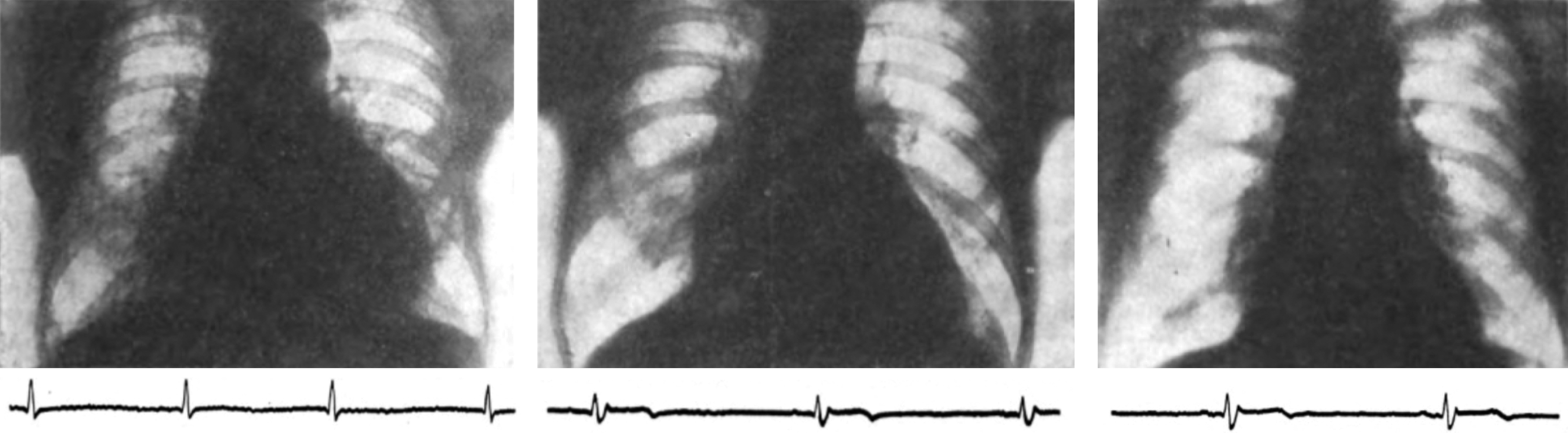
The impact of therapy with Thyreoidin, a thyroid extract, on the myxedema heart. The left panel shows a biventricular enlargement of the heart of a hypothyroid patient prior to therapy and the bradycardia with largely absent P and T waves; the middle panel illustrates the findings 4 weeks after initiating therapy with Thyreoidin, and the right panel after 8 weeks of therapy (composite figure created from 6 panels in the original publication. Reprinted with permission from Springer Nature [4]).
The observation that the cardiac alterations associated with hypothyroidism were reversible through treatment with thyroid extract were entirely novel. Herman Zondek also made many other important contributions to the field of endocrinology and thyroid pathophysiology (5). In 1921, Zondek and Loewy reported that the administration of iodine can attenuate the manifestations of hyperthyroidism (6), extending and corroborating several earlier reports. These publications preceded the widely-known observation by Plummer (7). Among other contributions, Herman Zondek demonstrated that oxygen consumption was increased in hyperthyroidism and decreased in hypothyroidism; speculated that thyroid hormone circulates in the serum as an inactive precursor which only gets activated in target organs; recognized the close connection between thyroid function and sympathetic tonus; and described patients with central hypo- and hyperthyroidism, recognizing the role of the pituitary in controlling the thyroid gland (5).
Herman Zondek (1887–1979) was born in Wronke, province of Posen, Prussia (8). He studied in Berlin and obtained his medical degree in 1912 and his habilitation for internal medicine in 1918. In 1922 he was promoted to the rank of professor at the Charité in Berlin, and in 1926 he was nominated medical director of the hospital “Am Urban” in Berlin. On March 12, 1933, he was one of the first to lose his position because of his Jewish origins under the Nazi regime. He fled Germany for Zürich, Switzerland, the same day, never to return. He then emigrated via England to Palestine in 1934 and continued his medical career as head of the Bikur Cholim Hospital in Jerusalem.
Herman Zondek was the older brother of Bernard Zondek (1891–1966), a pioneer in gynecology and endocrinology (9). Bernard Zondek was a proponent of the role of the pituitary as a master gland controlling, among other endocrine organs, the ovary. He discovered that the chorionic tissue of the placenta has endocrine activity. Together with Selmar Aschheim, Bernard Zondek developed the Aschheim-Zondek test as a bioassay for human chorionic gonadotropin—the first reliable pregnancy test (10). Aschheim and Zondek also described the endocrine overactivity originating from hydatidiform moles and choriocarcinomas.