




Abstract
Background:
Thyroid cancer is the most common endocrine tumor with an increasing incidence. Limited treatment options are available for patients with advanced or recurrent metastatic disease, resulting in a poor prognosis. Surufatinib targets multiple kinases (vascular endothelial growth factor receptors, fibroblast growth factor receptor-1, and colony-stimulating factor-1 receptor) involved in tumor angiogenesis and tumor immune evasion. Surufatinib has demonstrated promising antitumor activity in various advanced solid tumors. This study aimed to determine the objective response rate (ORR) of surufatinib in patients with locally advanced or distant metastatic differentiated thyroid cancer (DTC) or medullary thyroid cancer (MTC).
Methods:
This Phase II open-label study by Simon's two-stage design was conducted at 10 sites across China. Patients with radioiodine (RAI)-refractory DTC with locally advanced disease or distant metastasis (DTC1 group); patients who received limited initial surgery and then developed locally advanced unresectable recurrences and were not considered candidates for RAI therapy due to residual normal thyroid tissue (DTC2 group); or patients with MTC with locally advanced disease or distant metastasis (MTC group) were enrolled. A total of 59 patients were enrolled (26 in DTC1, 6 in DTC2, and 27 in MTC) and received 300 mg surufatinib daily in 28-day cycles. The primary endpoint was ORR as determined by the investigators.
Results:
Overall ORR was 23.2% [95% confidence interval, CI 12.98–36.42]: 21.7% in the DTC1 cohort, 33.3% in the DTC2 cohort, and 22.2% in the MTC cohort. Forty-nine patients achieved disease control (87.5% [CI 75.93–94.82]): 87.0% in the DTC1 cohort, 83.3% in the DTC2 cohort, and 88.9% in the MTC cohort. Median time to response was 59.0 days, and 59.0, 85.5, and 59.0 days in the DTC1, DTC2, and MTC cohorts. Overall median progression-free survival was 11.1 months [CI 5.98–16.69]; 11.1 months in DTC1 and MTC cohorts, while the DTC2 cohort had not reached the median at the data cutoff. The most common treatment-emergent adverse events grade ≥3 were hypertension (20.3%), proteinuria (11.9%), and then elevated blood pressure, hypertriglyceridemia, and pulmonary inflammation (5.1% each).
Conclusions:
Surufatinib demonstrated promising efficacy with a tolerable and manageable safety profile for patients with locally advanced or metastatic MTC, RAI-refractory DTC, or locally advanced unresectable recurrences unable to receive RAI.
Introduction
Worldwide, thyroid cancer is the most common malignancy among malignant endocrine tumors, occurring at a rate of 6.7 per 100,000 person-years in 2018 (1,2). The prognosis of thyroid cancer is generally good, with a mortality rate of 0.42 per 100,000 persons, which also shows a decreasing trend (2). In China, thyroid cancer is the eighth most prevalent cancer, with 90,000 new cases estimated to have been diagnosed in 2015 (3).
Differentiated thyroid cancer (DTC) is the most common endocrine cancer and accounts for 85–95% of thyroid cancers, while medullary thyroid cancer (MTC) accounts for ∼4% (4,5). When diagnosed at an early stage, many treatment options are available and patients have a promising prognosis, with 99.9% of patients diagnosed with localized thyroid cancer in the United States surviving beyond 5 years (5,6). Traditionally, treatment for thyroid cancer includes surgery, radioiodine (RAI) therapy, thyroid-stimulating hormone suppression, external beam radiotherapy, chemotherapy, or other multimodal treatments (7,8). However, for advanced or recurrent metastatic thyroid cancer, treatment options are limited and the prognosis for these patients is poor, dropping to a 5-year survival rate of 56.2% (6). To date, there are no effective treatments for patients who received limited surgery early, who then developed locally advanced unresectable recurrences and were not considered candidates for RAI therapy due to residual normal thyroid tissue (9).
Angiogenesis, one of the hallmarks of cancer, is a major target for anticancer therapy, including for the treatment of thyroid cancers (10,11). Currently, four compounds targeting vascular endothelial growth factor receptors (VEGFR) have been approved by the U.S. Food and Drug Administration (FDA): vandetanib, cabozantinib, sorafenib, and lenvatinib. However, some tumors are able to increase secretion of fibroblast growth factor (FGF) to bypass the VEGFR pathway and continue to promote cellular proliferation and angiogenesis (12). The fibroblast growth factor receptors (FGFR) are also often overexpressed in many tumor types, including thyroid cancers, and are believed to play a role in promoting cell proliferation. Tumor-associated macrophages (TAMs) are dependent on activation of colony-stimulating factor 1 receptor (CSF-1R). By blocking this receptor, tumorigenesis-promoting TAMs are reduced and the ratio of M1 macrophages is increased, which can target tumor cells, resulting in increased tumor cell death (13,14).
Surufatinib (HMPL-012, previously named sulfatinib) is a potent, small-molecule tyrosine kinase inhibitor that selectively targets VEGFR1, 2, and 3, FGFR 1, and CSF-1R (15). By targeting this combination of receptors, surufatinib may induce tumor cell death in a multifaceted manner and reduce the potential of tumor resistance. Recently, a Phase III study in China of surufatinib in advanced nonpancreatic neuroendocrine tumors met its primary endpoint (
This Phase II multicenter study aimed to determine the ORR of surufatinib in patients with advanced MTC, RAI-refractory DTC, or patients who received limited surgery early, who then developed locally advanced unresectable recurrences and were not considered candidates for RAI therapy due to residual normal thyroid tissue.
Patients and Methods
All patients provided written informed consent, and the study was conducted in accordance with the International Conference on Harmonization Good Clinical Practice guidelines, the Declaration of Helsinki, and applicable local laws and regulations. This study was registered at
This Phase II, multicenter, open-label study by Simon's two-stage design was conducted at 10 sites across China (17). Three groups of patients with thyroid cancer were enrolled. Patients with RAI-refractory DTC with locally advanced disease or distant metastasis, who had lost the indication for surgery or were unable to receive external beam radiotherapy with disease progression by Response Evaluation Criteria In Solid Tumors (RECIST) v1.1 within at least 6 months since last RAI therapy and 12 months before starting surufatinib therapy: the DTC1 group; patients who received limited initial surgery and then developed locally advanced unresectable recurrences and were not considered candidates for RAI therapy due to residual normal thyroid tissue: the DTC2 group; and patients with MTC with locally advanced disease or distant metastasis, who had lost the indication for surgery, or were unable to receive external beam radiotherapy with disease progression 12 months before starting surufatinib therapy: the MTC group. RAI-refractory disease was defined by meeting one or more of the following criteria: disease progression by RECIST v1.1 within 12 months after last RAI therapy; one or more lesions that did not concentrate RAI; and disease progression by RECIST v1.1 within 12 months of starting test drug therapy after a cumulative RAI dose ≥600 mCi or equivalent concentrations.
Eligible patients were aged ≥18 years, with histologically or cytologically confirmed MTC or DTC (including papillary carcinoma, follicular carcinoma, Hürthle cell carcinoma and variants). Additional key eligibility criteria included measurable disease at baseline according to RECIST v1.1 and an Eastern Cooperative Oncology Group performance status (ECOG-PS) of 0 or 1. Adequate bone marrow, liver, renal, and coagulation functions were also required.
Key exclusion criteria included any diagnosed thrombosis 12 months before the study, significant bleeding 3 months prior, significant cardiovascular disease (e.g., myocardial infarction or unstable angina), gastrointestinal disease affecting medication absorption, untreated or unstable central nervous system metastases, or other malignancy, excluding basal cell or squamous cell carcinoma of the skin, or cervical carcinoma in situ after radical surgery. Patients receiving prior antitumor treatments, including systemic medication, surgery, or radical radiotherapy within four weeks before surufatinib initiation, or prior palliative radiotherapy for bone metastases within two weeks before the first dose of surufatinib, were also excluded.
Patients received surufatinib 300 mg as an initial dose, once daily, and continuously for every 28-day cycle until disease progression, intolerable toxicity, or withdrawal of consent. Tumor response was assessed by investigators, per RECIST v1.1, and every 8 (±1) weeks for the first year, then every 12 (±1) weeks thereafter. Patients without disease progression upon surufatinib discontinuation were followed for tumor staging until initiation of new antitumor treatment, loss to follow-up, withdrawal of consent, or death.
Surufatinib treatment could be temporarily interrupted for up to 28 days if there were intolerable toxicities. The surufatinib dose could be reduced to 250 mg and then to 200 mg if intolerable AEs occurred. AEs were continually assessed using the Common Terminology Criteria for Adverse Events (CTCAE) v4.03.
The primary endpoint of this study was ORR, defined as the proportion of patients achieving a complete response (CR) or partial response (PR). A confirmatory assessment of response was required from four weeks after initial assessment. If a patient's initial CR or PR was not confirmed at the subsequent assessment, stable disease (SD) was assigned as his/her best overall response, provided SD had been demonstrated after six weeks since the first dosage.
Secondary study endpoints included disease control rate (DCR), duration of response (DoR), progression-free survival (PFS), time to response (TTR), safety, and tolerability. DCR was defined as the proportion of patients who had a CR, PR, or SD as best response. DoR was defined as the time from first documented evidence of CR or PR until the time of first documented disease progression or death (any cause), whichever occurred first. PFS was defined as the interval between the first surufatinib dose and the earliest date of disease progression or death (any cause). TTR was defined as the time interval from the first dose of study treatment to the initial CR or PR in the patients with objective response. Changes in tumor biomarkers were also assessed. This study planned to recruit 36–56 patients. A two-stage enrollment process was performed: initially, 15 patients were enrolled in the DTC1 and MTC cohorts for the first stage, and continuing to the second stage when at least two patients achieved objective response. Data from all centers were pooled for analysis. Kaplan–Meier analyses were performed for time-to-event endpoints, and median and two-sided 95% confidence intervals [CI] are reported.
Results
Patients
Between February 24, 2016, and September 30, 2018, 77 patients were screened, of whom 59 were enrolled for this study: 27 in the MTC cohort, 26 in the DTC1 cohort, and 6 in the DTC2 cohort (Fig. 1). Three patients from the DTC1 cohort were excluded from the efficacy evaluation set, as they had no postbaseline tumor evaluation. Patients were aged 19–78 years, and 28/59 (47.5%) were male. Most patients (50/59; 84.7%) had stage IV disease at baseline and an ECOG-PS of 1 at the time of enrollment. Baseline characteristics are detailed in Table 1.
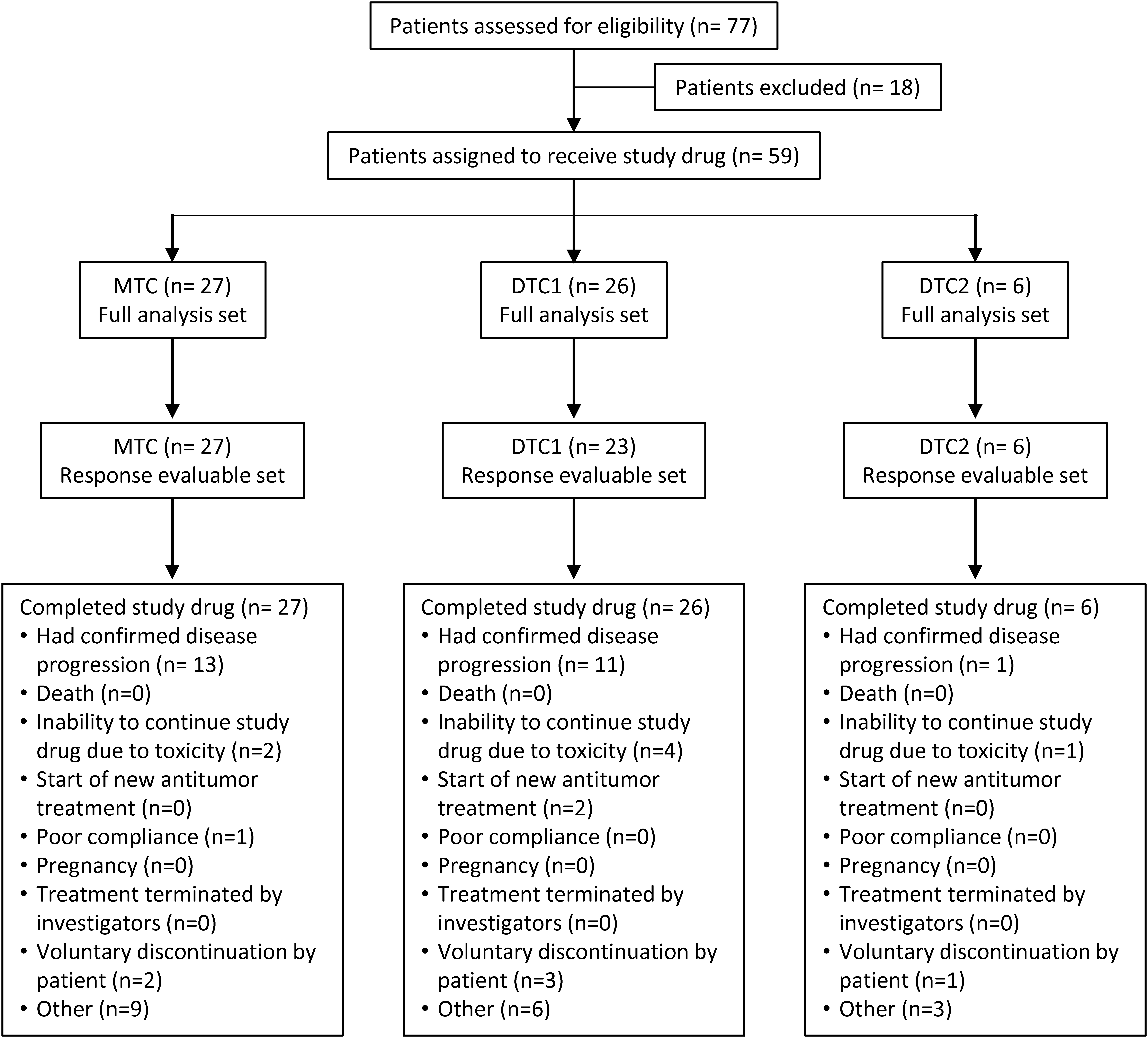
Patients enrolled in the study. Fifty-nine patients were enrolled in this study, and 56 patients were included in the response evaluable set. Three patients were excluded from the DTC1 cohort due to missing post-baseline tumor evaluations. DTC1 cohort: patients with RAI-refractory DTC with locally advanced disease or distant metastasis. DTC2 cohort: patients who received limited surgery early, who then developed locally advanced unresectable recurrences and were not considered candidates for RAI therapy due to residual normal thyroid tissue. MTC cohort: MTC patients with locally advanced disease or distant metastasis. DTC, differentiated thyroid cancer; MTC, medullary thyroid cancer; RAI, radioiodine.
Demographic and Baseline Characteristics of the Full Analysis Population
DTC1 cohort: patients with RAI-refractory DTC with locally advanced disease or distant metastasis. DTC2 cohort: patients who received limited surgery early, who then developed locally advanced unresectable recurrences and were not considered candidates for RAI therapy due to residual normal thyroid tissue. MTC cohort: MTC patients with locally advanced disease or distant metastasis.
DTC, differentiated thyroid cancer; ECOG, Eastern Cooperative Oncology Group; MTC, medullary thyroid cancer; RAI, radioiodine.
Treatment and dose modification
The median relative dose intensity received by each patient was 95.9% (range, 45.0–100.0%) for a median treatment duration of 164.0 days. More than half of the patients (33/59; 55.9%) received six or more cycles of treatment.
Efficacy
A summary of efficacy results is detailed in Table 2. Overall, 13 of the 56 patients had confirmed PR, producing ORR of 23.2% [CI 13.0–36.4]: six in the MTC cohort (22.2% [CI 8.6–42.3]), five in the DTC1 cohort (21.7% [CI 7.5–43.7]), and two in the DTC2 cohort (33.3% [CI 4.3–77.7]).
Summary of Efficacy Results
DTC1 cohort: patients with RAI-refractory DTC with locally advanced disease or distant metastasis. DTC2 cohort: patients with locally advanced unresectable DTC, no previous RAI, and unable to receive RAI therapy. MTC cohort: MTC patients with locally advanced disease or distant metastasis.
CI, 95% confidence interval; CR, complete response; DCR, disease control rate; DoR, duration of response; DTC, differentiated thyroid cancer; MTC, medullary thyroid cancer; NR, not reached; ORR, objective response rate; PD, progressive disease; PFS, progression-free survival; PR, partial response; SD, stable disease; TTR, time to response.
Overall, 49 patients had SD with a DCR of 87.5% [CI 75.9–94.8]: 24 patients in the MTC cohort (DCR 88.9% [CI 70.8–97.7]), 20 in the DTC1 cohort (DCR 87.0% [CI 66.4–97.2]), and 5 in the DTC2 cohort (DCR 83.3% [CI 35.88–99.58]).
Most patients experienced tumor shrinkage from baseline (Fig. 2), with a decrease of target lesions >10% in 20 of 27 (74.1%) patients in MTC, 15 of 22 (68.2%) in DTC1, and 4 of 6 (66.7%) patients in DTC2. The mean best percentage change in the sum of the target lesion diameter was −23.42% (standard deviation 18.01), −22.86% (standard deviation 22.64), and −23.48% (standard deviation 13.63) for the MTC, DTC1, and DTC2 cohorts, respectively (Fig. 2).

Waterfall plot of best percentage change from baseline in tumor size in the response evaluable analysis sets. The best percentage change from baseline in tumor size for 55 evaluable patients. One patient in the DTC1 cohort was excluded due to having no measurable target lesions at baseline. DTC1 cohort: patients with RAI-refractory DTC with locally advanced disease or distant metastasis. DTC2 cohort: patients who received limited surgery early, followed by locally advanced unresectable recurrences who were not considered candidates for RAI therapy due to residual normal thyroid tissue. MTC cohort: MTC patients with locally advanced disease or distant metastasis.
The median PFS was 11.1 months [CI 5.55–not reached (NR)] in MTC patients and 11.1 months [CI 5.62–16.69] in DTC1 patients; the median PFS was not reached in DTC2 patients (Fig. 3). The median DoR of the MTC and DTC1 cohorts were 9.17 months [CI 3.75–NR] and 9.20 months [CI 3.94–NR], respectively (Table 2).
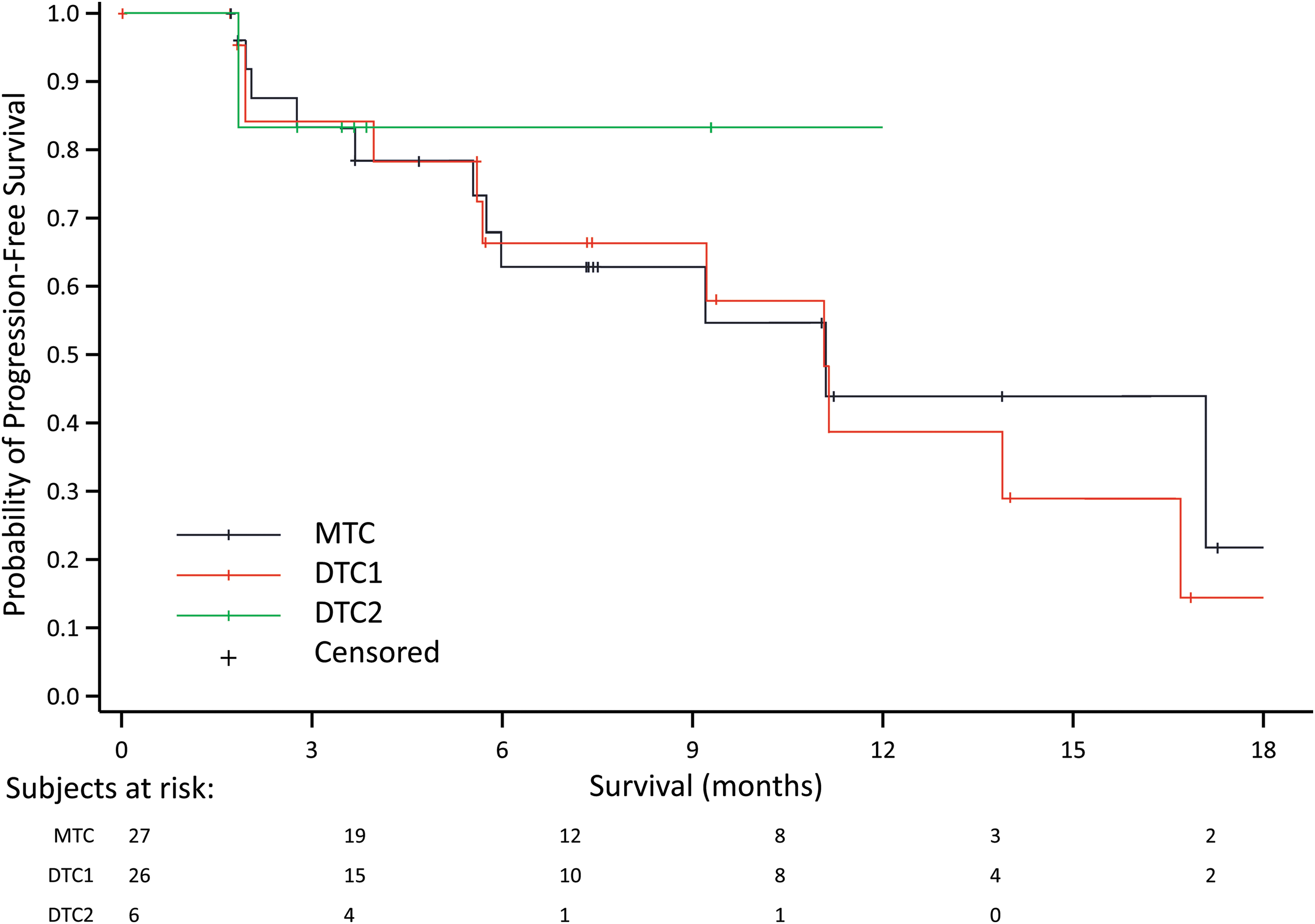
PFS in the full analysis sets. Kaplan–Meier estimates of PFS of MTC, DTC1, and DTC2 cohorts. Vertical lines indicate time points at which patients were censored. DTC1 cohort: patients with RAI-refractory DTC with locally advanced disease or distant metastasis. DTC2 cohort: patients who received limited surgery early, followed by locally advanced unresectable recurrences who were not considered candidates for RAI therapy due to residual normal thyroid tissue. MTC cohort: MTC patients with locally advanced disease or distant metastasis. PFS, progression-free survival.
All patients who achieved an objective response achieved PR within four months. The median TTR was 59.0 days for the MTC and DTC1 groups [CI 51.0–113.0 and 54.0–115.0, respectively] and 85.5 days for the DTC2 group [CI 57.0–114.0].
Biomarker analysis
Most patients with DTC (25/28 [89.3%] and 17/18 [94.4%]) demonstrated a reduction or no change in serum thyroglobulin at 8 and 16 weeks, respectively, after commencing treatment with surufatinib. A decrease in serum thyroglobulin ≥75% from baseline was detected in four (14.3%) and three (16.7%) patients at week 8 and 16, respectively (Table 3).
Decrease in Serum Thyroglobulin in Patients with DTC 8 and 16 Weeks After Commencing Treatment with Surufatinib
Circulating calcitonin levels were measured in the MTC cohort. A greater change in serum calcitonin was associated with a greater best observed response in patients with MTC (Fig. 4 and Supplementary Fig. S1).
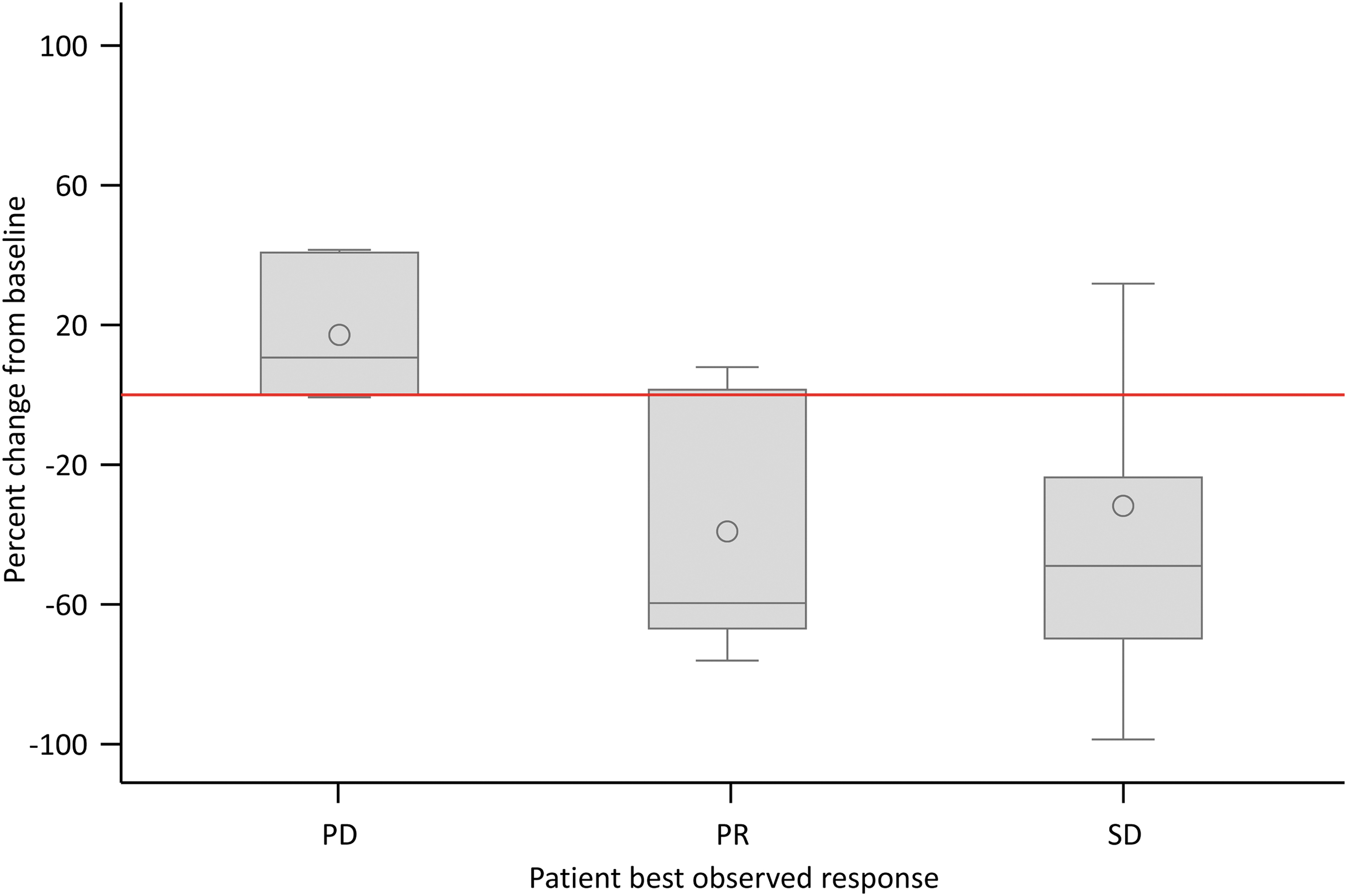
Change in serum calcitonin levels at best observed response from baseline. Percent change of serum calcitonin levels at patient's best observed response. Three horizontal lines from top to bottom in each box plot indicate 25%, median, and 75% values, and circles indicate mean values. PD, progressive disease; PR, partial response; SD, stable disease.
Safety
All patients had at least one AE of any grade. Treatment-emergent AEs occurring in ≥10% of patients are reported in Supplementary Table S1.
In all 59 patients, the most common ≥grade 3 treatment-related AEs were hypertension (20.3%), proteinuria (11.9%), and elevated blood pressure, hypertriglyceridemia, and pulmonary inflammation (each of 5.1%).
Dose interruption and reductions due to AEs occurred in 30 (50.8%) of the patients. AEs that resulted in treatment discontinuation were reported in eight (13.6%) patients, including proteinuria (3/59; 5.1%), heart failure, cardiotoxicity, hyperbilirubinemia, coma, and diarrhea (each 1 case; 1.7%). Serious adverse events (SAEs) were reported in 16 (27.1%) patients; SAEs experienced by more than one patient were lung inflammation (3/59; 5.1%) and acute kidney injury (3/59; 5.1%). Only one patient experienced a fatal AE. The study drug was discontinued after the patient experienced grade 1 diarrhea, and death occurred ∼2.5 months later. This AE was deemed by investigators as possibly related to the study drug.
Discussion
This study investigated the use of surufatinib for the treatment of locally advanced or metastatic MTC and RAI-refractory DTC and is the first report to investigate treatment of who received limited initial surgery and then developed locally advanced unresectable recurrences and were not considered candidates for RAI therapy due to residual normal thyroid tissue. The results of this study suggest that surufatinib is comparable to current treatments available in China for patients with RAI-refractory DTC. ORR for the DTC1 cohort was 21.7% and is comparable to that for sorafenib (ORR 22%), the only currently approved treatment for DTC in China (16). Furthermore, the proportion of patients achieving DCR was also greater in patients with RAI-refractory DTC who received surufatinib in this study (87.0% in the DTC1 cohort) compared with that found with sorafenib (74%) as reported in the meta-analysis by Shen et al. (16). The median PFS in the DTC1 cohort was 11.1 months, which is further comparable to the sorafenib findings (12.4 months) (16). The tumor shrinkage observed with surufatinib in this cohort (mean: −22.86%) may allow for these previously unresectable tumors to become resectable.
This study is the first to investigate treatment of patients who received limited initial surgery and then developed locally advanced unresectable recurrences and were not considered candidates for RAI therapy due to residual normal thyroid tissue (the DTC2 cohort). Patients who had high-risk tumors but only received limited surgery and later develop unresectable local recurrence or metastatic disease are not suitable for RAI therapy due to the presence of residual normal thyroid tissue. The 2015 American Thyroid Association guidelines recommend systemic therapy for RAI-resistant DTC patients with significant locoregional disease and/or progressive distant metastases (18). However, there is no clear guidance on the treatment of patients in our DTC2 cohort, who have tumor recurrence and cannot undergo surgery or RAI therapy. These patients have a high mortality rate, largely due to significant locoregional issues, such as airway compression, or cervical vessel bleeding due to tumor invasion. Our study demonstrated promising results for these patients who currently have limited effective treatment options. The DTC2 cohort in this study achieved an ORR of 33.3%. Two patients who achieved PR eventually had surgery in thyroid and neck recurrent sites, followed by treatment with RAI. Although this cohort only consisted of six patients, these results suggest that surufatinib treatment may be able to reduce the tumor burden in these patients to a level where resection is possible, improving their prognosis. Thus, investigation of surufatinib in a larger cohort in a neoadjuvant setting seems of interest.
Surufatinib also demonstrated efficacy in the treatment of MTC. Effective treatment of MTC is an unmet need in China, as there are currently no drugs approved for its treatment. The results of this study indicate that surufatinib may fill this gap. Objective response was observed in 22.2% of patients with MTC, and the majority of patients achieved disease control (88.9%). The median PFS for this cohort was 11.1 months, which is comparable to results of a Phase III trial of cabozantinib in advanced MTC (median PFS, 11.2 months) (19). Furthermore, tumor shrinkage was observed in all three patient groups. The mean shrinkage of −23.4%, −22.9%, and −23.5% for the MTC, DTC1, and DTC2 groups, respectively, may be adequate to reduce the unresectable lesions for resection.
Due to the small sample size and the nonrandomized design of this study, the efficacy of surufatinib will require further investigation. Recent preclinical investigations suggest that alternating sorafenib and lenvatinib was more effective in inducing cell cycle arrest than either drug alone (20). A similar protocol with sorafenib and surufatinib may also lead to an improved result and should be investigated.
The safety profile of surufatinib in this study corresponds to previous reports, and no unexpected important safety signals were reported (21). Most of the AEs reported could be managed by dose adjustment, with eight patients (8/59; 13.6%) discontinuing the study drug. The most commonly reported AE was proteinuria (43/59; 72.9%), and ≥grade 3 treatment-emergent AEs occurred in 35/59 (59.3%) patients, with the most prevalent being hypertension (12/59; 20.3%) and proteinuria (7/59; 11.9%). Although hand–foot syndrome has been commonly associated with VEGFR tyrosine kinase inhibitors (risk ratio 7.70 [CI 1.83–32.39]; p = 0.005), it was not reported in this study (22). Overall, surufatinib was well tolerated.
There are a number of limitations to this study. First, the sample size is small, particularly in the DTC2 cohort, where only six patients fulfilled the criteria for enrollment, and thus, the study is unable to draw conclusions concerning this group. However, the patients in this small group showed promising responses, indicating that surufatinib warrants further investigation in larger populations. Second, there was no placebo arm. As such, no direct comparison between surufatinib and the current standard of care can be made. Third, no genetic profiling was performed in this study. Biomarkers are increasingly being used to stratify patient treatments, and the identification of appropriate prognostic factors that would make patients more responsive to surufatinib may allow for more targeted treatment, furthering the benefits of the treatment.
Overall, surufatinib demonstrated promising efficacy with a tolerable and manageable safety profile for patients with locally advanced or metastatic MTC, RAI-refractory DTC, or locally advanced unresectable DTC who have not received RAI.
Footnotes
Author Disclosure Statement
No competing financial interests exist for authors except S.F., J.Z., and W.S. who are employees of Hutchison MediPharma, Ltd.
Funding Information
Editorial assistance in article preparation was provided by Joyce Lee, PhD, of Nucleus Global, Shanghai, China, funded by Hutchison MediPharma.
Supplementary Material
Supplementary Figure S1
Supplementary Table S1