




Abstract

While attending the first joint American Thyroid Association and Latin American Thyroid Society symposium, two of the authors had the opportunity to visit Salta. This is the capital city of Salta Province located in northwest Argentina at an elevation of 1152 meters above sea level. The surroundings of Salta are extremely mountainous and encompass three regions: the Lerma Valley cutting across from north to south, the western mountainous region, and the plains and meadows to the east (1). The mountainous section includes the Quebrada del Toro (Toro Gorge), part of the eastern section of the Andes range. The town of San Antonio de los Cobres, one of the highest villages in Argentina, lies at an elevation of 3775 meters. The highest point in this part of the Andes is approximately 4267 meters above sea level. Salta is known for its Spanish colonial architecture, Andean heritage, and many fine museums.
These museums include the Salta Fine Arts Museum (Museo de Bellas Artes de Salta). One of the paintings displayed in its collection is the work “Los Muqueadores” shown in Figure 1. This masterpiece, painted by the artist Alejandro Ache in 1962, shows the production of “Chicha,” a traditional drink of the northern region of Argentina originally made by chewing corn (Muquear) to produce a fermented beverage, thus giving the painting its name. The painting depicts the original mode of preparation (Chicha Muqueada) that was carried out in front of the stove or kitchen, a meeting point of the community. Community members received handfuls of corn kernels to chew and spit into a vessel, thus producing the alcoholic beverage “Chicha” with the aid of salivary amylase. Corn cobs can be seen lying on the ground in the right of the picture. Alejandro Ache was born in Lebanon in 1898, but moved with his family to Argentina at age 12 years. He originally worked as an illustrator in the Faculty of Medicine in Buenos Aires, but later moved to Salta where he executed primarily religious artwork. He also illustrated poems and stories, some of which were of his own authorship. He died in Salta in 1983, leaving a legacy of approximately 5000 paintings (2).
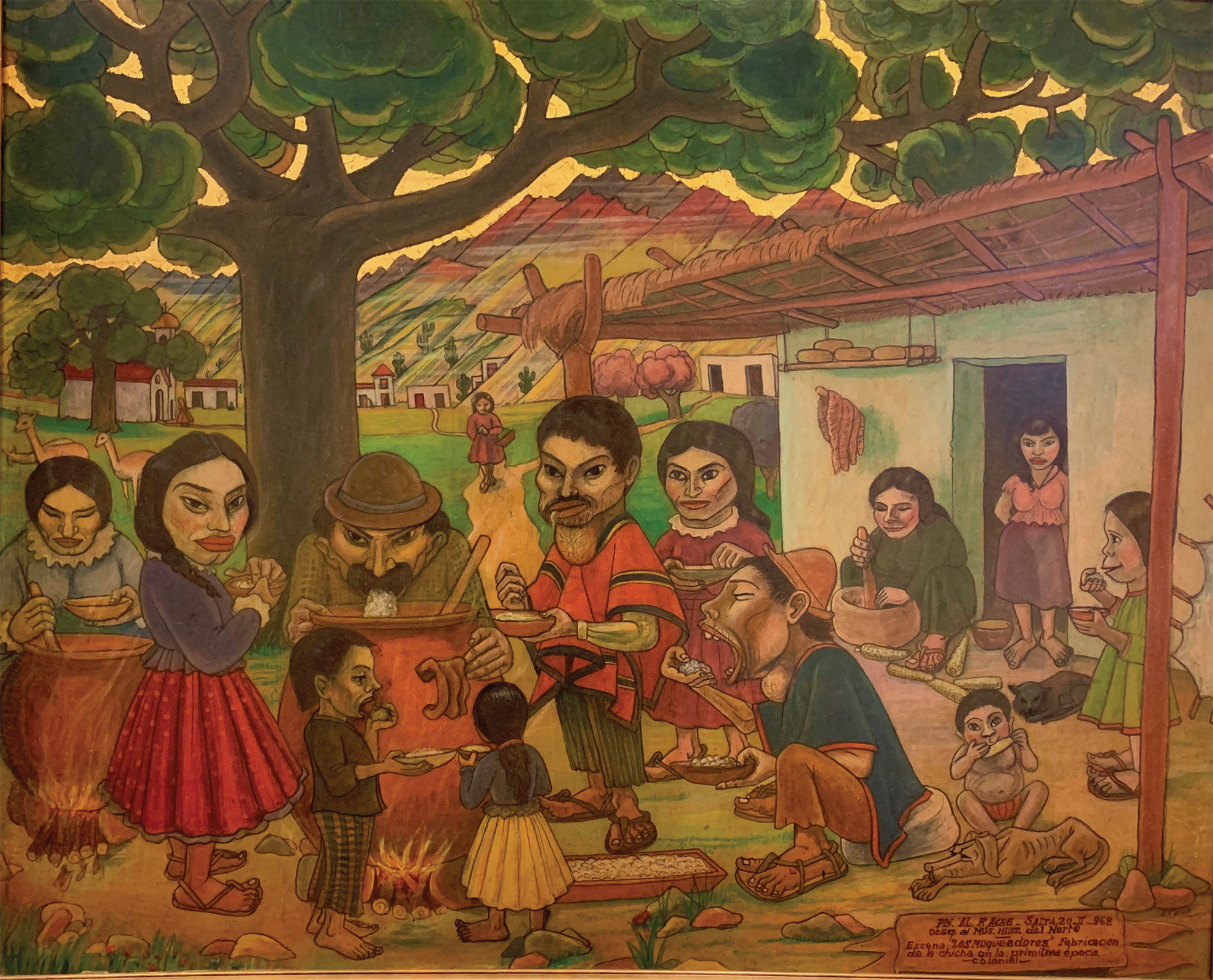
The painting entitled “Los Muqueadores” by the artist Alejandro Ache painted in 1962, housed in the Fine Arts Museum of Salta (Museo de Bellas Artes de Salta). Reproduced with permission.
Closer examination of the painting, however, shows not only the traditional ritual in progress in the village square, but also evidence of a goiter in two of the villagers (Fig. 2). This begets a question regarding the causation of the goiters: is there a goitrogen in the diet of these residents or is there iodine deficiency in the region, or could a genetic defect be causing a familial goiter? At first consideration, it might seem reasonable to assume that the goiters portrayed in the painting were due to a goitrogen present in the grain or the brew being produced. Examples of goitrogenic foods, based on their production of thiocyanate that is a competitive inhibitor of the sodium iodide symporter, are the “brassicacae” that include cassava, cabbage, turnip, radish, and cauliflower (3). These agents inhibit thyroid hormone synthesis due to their glucosinolate (a cyanogenic thioglucoside) and the biosynthesis of thiocyanate by thioglucosidase, such as linamarase in the case of cassava. However, as already described, the drink is corn based, and, therefore, does not contain a goitrogen. Thus, although the Chicha Muqueadais is an integral part of this painting, it appears to be unrelated to the goiters present in the villagers. The Andean setting of the village is illustrated by the llamas in the left of the painting and the spectacular vivid multicolored mountains in the background, for which this region in renowned. This mountainous region, remote from the coastline, is a “perfect storm” for iodine deficiency and gives us the key to the likely cause of the goiters (4).
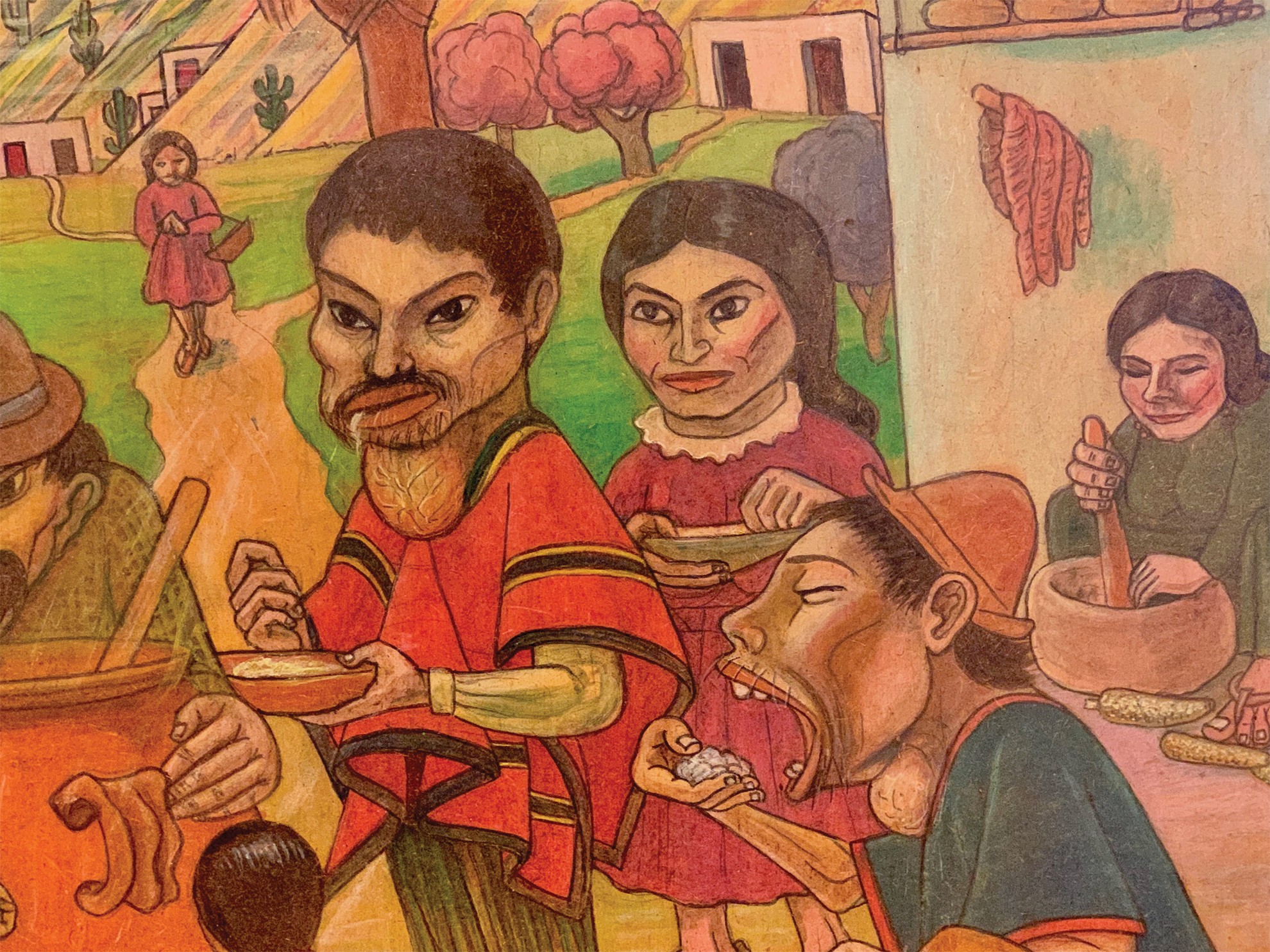
A closer view of “Los Muqueadores” showing the goiter depicted in two of the villagers. Reproduced with permission.
From a historical perspective, many travelers and naturalists who toured this part of Argentina, in addition to detailing the geographical characteristics, flora and fauna, and society of that time, also made observations of the existence of people with goiter (Bocio), both in the mountain ranges and the plateau areas. It is believed that the first observations of goiter by such travelers were recorded by the Spanish doctor, mathematician, and cosmographer Cosme Bueno and the Andalusian publicist, Nicolás de la Cruz Bahamonde in 1759. Also in 1773, the Peruvian writer Alonso de la Vandera in the account of his trip from Montevideo to Lima mentions having observed goiters. Both D'Orbigny in 1826 and McCann in 1842 noticed individuals with goiters. Martín de Moussy in his description of the Argentine Confederation, published in 1860, mentions having observed a large prevalence of goiter in the northeast and northwest of the country and also stated that “cretinism” was very developed in the latter region. “Deaf mutism” was apparently also reported (5), as was endemic neurological cretinism without evidence of myxedema (6). It is possible that the balance of the duration of fetal hypothyroidism and the magnitude and duration of the postnatal hypothyroidism together determine the final manifestations with respect to presentation with neurological defects, myxedematous features, or both (7). “Endemic cretinism” is memorably depicted in the 1933 film documentary of Luis Bunuel, Tierra sin Pan (Las Hurdes), which includes a sequence with endemic cretins (8). With regard to the depiction of the physical features of myxedema in the painting by Alejandro Ache, it is hard to be certain of their presence due to the stylized nature of the painting and without reference to the nutritional conditions and typical heights achieved at that time period. However, it would appear that coarse facial features, short stature, and pedal edema are possibly being illustrated (see woman in red skirt and woman in doorway). Endemic neurological cretinism without evidence of myxedema may possibly be depicted in the goitrous individuals in this painting. Another theory to consider, when viewing this painting, is the possibility of a familial goiter due to a genetic defect. This is an attractive consideration, given that only 2 individuals out of the 13 depicted clearly have a goiter. Although this cannot be categorically ruled out, given the well-documented iodine deficiency in this geographic region, this remains the most plausible etiology of the goiters.
Gaspard Adolphe Chatin is generally credited as being the first to formally link iodine deficiency and endemic goiter in 1852 (9,10), although the underlying mechanisms were elucidated by John Stanbury in the 1950s using radiotracer studies (11). Iodine deficiency is currently prevented with iodized salt. One of the earliest treatments for iodine deficiency was seaweed. Boussingault demonstrated in 1835 that salt procured from goiter-free regions of South America could be used to reduce goiter in areas where goiter was endemic (12). Successful salt iodization was introduced in Switzerland in 1922 and in the United States in 1923 (12). In addition to use of iodized salt, iodized oil can also be used, and as its effect is long lasting, it is particularly helpful in remote or inaccessible areas (13,14). Historically in the 1950s, challenges to successfully reducing iodine deficiency and endemic goiter extended beyond issues of delivery of iodized salt to remote areas, but also involved the cost of iodized salt exceeding that of noniodized salt (15).
With respect to the situation in Salta Province, in 1958 the National Commission for the Control of Endemic Goiter was created, composed of doctors Bernardo A. Houssay, Enrique B. del Castillo, Héctor Perinetti, Juan M. Allende, Carlos Bravo, Arturo Oñativia, Mauricio Rapoport, Eduardo Trucco, and Alberto B. Houssay. In 1963, the mandatory sale of iodized salt was implemented in the province of Salta. A seminar on the technical aspects of salt iodization was held in Salta in 1965 under the auspices of the Pan American Health and World Health Organization and the government of Argentina to help prevent administrative and technical barriers to salt iodization (16). At the current time, salt iodization costs pennies per person per year. Although there remain many barriers to successful salt iodization programs, typically cost is not the key issue. For example, it should be noted that while Argentina as a whole is currently considered to be iodine sufficient, the Salta region remains iodine deficient, largely due to ongoing issues with small producers of noniodized salt in this region (17). Although the magnitude of the problem, as described in the past (18), has been substantially remedied, iodine deficiency has not yet been completely eliminated.
Studies conducted in 1985 showed that the prevalence of goiter and iodine deficiency had been substantially reduced in school children of Salta Province after salt iodization (19). Other studies have also shown the dramatic reduction in goiter prevalence and the higher urinary iodine excretion (1,20). As has also been shown in other countries, there has also been a change in the pattern of various thyroid disorders after salt iodination, with more papillary thyroid cancer and less follicular and anaplastic thyroid cancer. For example, a study comparing thyroid disorders before and after 1963 showed an increased ratio of papillary to follicular thyroid cancers, and an increase in lymphoid infiltration of the background thyroid tissue from 8% to 25% (21). The trend to detect more papillary thyroid cancer may be due to a combination of the reduction in iodine deficiency and also greater access to health care with earlier thyroid cancer detection in differentiated rather than undifferentiated states (22,23).
At the present time, Chicha is still widely consumed in the northern provinces of the country such as Jujuy, Salta, and Tucumán. It is consumed for religious holidays, birthdays, or during the Pachamama celebration. The current production process, however, usually employs yeast, rather than salivary amylase.