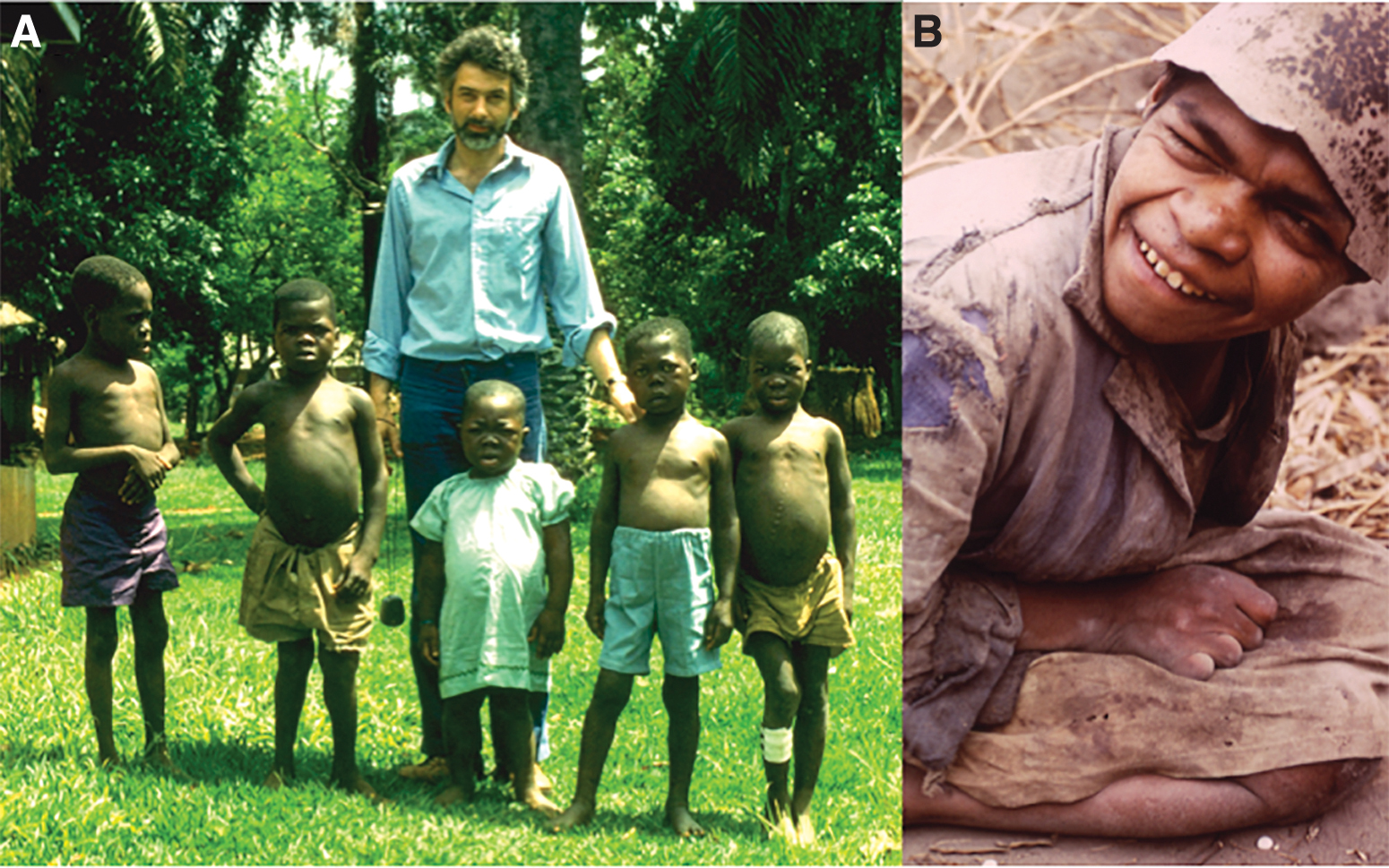
I enjoyed reading and learning about Alejandro Ache who depicted the goitrous Muqueadores of Salta, located in the Andean mountain range of Argentina (1). The etiology of neurological as compared with myxedematous cretinism typically encountered in the South American Andes and Central Africa, respectively (Fig. 1), has been debated for many years. As the authors indicate by referring to a publication by Boyages and Halpern (2), the timing of hypothyroidism, prenatal and postnatal, respectively, has been advanced as the putative cause of the two forms of cretinism (3). This has been based on observation of goiter and presumed hypothyroidism in the mothers, yet near normal thyroid hormone levels in many of the neurological cretins. The more recent identification of severe neurological deficit with spasticity and contractures observed in individuals with MCT8 deficiency confirms this interpretation (4,5). MCT8 is a thyroid hormone-specific cell membrane transporter, particularly important in supplying thyroid hormone to the brain. Thus, irrespective of maternal supply of thyroid hormone the embryos are thyroid hormone deprived. Yet, postnatally, as in neurological cretinism, MCT8-deficient individuals are not thyroid hormone deficient in peripheral tissues but do not speak or walk and often develop limb contractures.
Myxedematous compared with neurological cretins from two endemic areas of iodine deficiency. (A) Myxedematous cretins in Central Africa during a 1975 visit with Professor François Delange, to Karawa, currently the Democratic Republic of the Congo, formerly Zaire. The author is depicted with 5 myxedematous cretins ranging in age from 17 (far right) to 40 (center) years old. Note short stature. They are slow but coordinated. (B) Neurological cretin from the Ecuadorian Andes during 1967 visit to La Esperanza, Ecuador, under the sponsorship of John B. Stanbury. Note the facial expression suggesting retardation and the limbs contractures, unable to stand or walk.
Funding Information
The study is supported by grant DK 15070 from National Institutes of Health, USA.
References
1.
JonklaasJ, MitchellC, DanielsenM. 2020. Goiter in residents of Salta, Argentina: an artistic rendition. Thyroid, 30:34–36.
Stanbury JB 1968 Endemic Goiter. Report of the Meeting of the PAHO Scientific Group on Research in Endemic Goiter Held in Puebla, Mexico, June 27–29, 1968. Pan American Health Organization, Washington, DC, pp 447.
4.
DumitrescuAM, LiaoXH, BestTB, BrockmannK, RefetoffS. 2004. A novel syndrome combining thyroid and neurological abnormalities is associated with mutations in a monocarboxylate transporter gene. Am J Hum Genet, 74:168–175.
5.
FriesemaEC, GruetersA, BiebermannH, KrudeH, von MoersA, ReeserM, BarrettTG, MancillaEE, SvenssonJ, KesterMH, KuiperGG, BalkassmiS, UitterlindenAG, KoehrleJ, RodienP, HalestrapAP, VisserTJ. 2004. Association between mutations in a thyroid hormone transporter and severe X-linked psychomotor retardation. Lancet, 364:1435–1437.