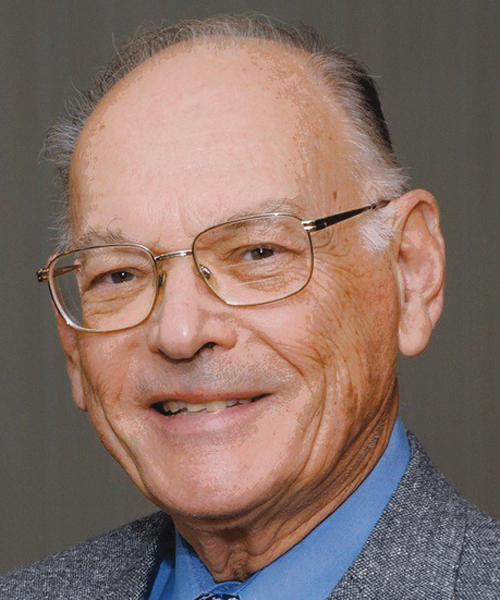
The Conversation
Dr. Terry F. Davies: Thank you Jerry for submitting to this interrogation. I am sure many people will enjoy what you have to say. So to begin, I know that you graduated from the University of Illinois College of Medicine in 1957, but where did you come from?
Dr. Jerome Hershman: Thanks for inviting me. I am looking forward to our talk. Both my parents came from Poland. My father came to Chicago after the first World War at the age of 18 years wishing to escape his poor “shtetl” while my mother arrived at 2 years of age and was one of seven children. Father was in the shoe business and I had a happy middle-class upbringing—comfortable but not wealthy. I actually grew up in Chicago when it was safe and I commuted to Northwestern for college and became interested in chemistry and medicine without any family influence. I then chose to do a master's on the characterization of DNA structure at the California Institute of Technology in 1952 under the direction of Alexander Rich and Linus Pauling. I completed it in a record 9 months, but my thesis was never published because Rich lost interest in the project!
Dr. Davies: So then you entered medical school after college and the master's degree?
Dr. Hershman: Yes—After that I did medicine at Illinois starting in 1953. During medical school, I did research with Howard Armstrong and studied plasma protein turnovers and published a couple of articles (1,2) and enjoyed this introduction to medical science. I also first became interested in endocrinology during medical school, thanks to my interaction with a charismatic teacher Ted Schwartz who was a thyroid physician.
Dr. Davies: So where did you do your residency training?
Dr. Hershman: I had rotating internship at Cook County Hospital for a busy year during which I became married to my wife Fleurette Kram in December 1957 during a surgery rotation. She is the daughter of a surgeon who very much encouraged me to pursue my career. We have had three wonderful children—all sons—no physicians and so far only three grandchildren.
Dr. Davies: So now you were ready for a career!
Dr. Hershman: Fortunately, Howard Armstrong directed me to a residency at Beth Israel Hospital in Boston although I had already volunteered for the Air Force under the Berry Plan. The Berry Plan allowed physicians to defer obligatory military service until they had completed residency training so after only a year in Boston I was sent to a 10-bed dispensary at a yet to be built Strategic Air Command Hospital in Southern California, which was most unexciting; but I had time to attend some courses in endocrinology and was still most interested in the thyroid. In fact, I tried a couple of thyroid biopsies quite unsuccessfully.
Dr. Davies: So a charismatic teacher, Ted Schwartz, attracted you into the thyroid business?
Dr. Hershman: Yes—so much so that I looked around for an Endocrinology Fellowship in Boston and applied to Dr. E.B. Astwood at the New England Center Hospital and Sydney Ingbar at the Thornedike (Boston City Hospital). Since Astwood offered me the job first I accepted his offer and spent two very enjoyable and productive years there. I first worked in the laboratory with Lester Van Middlesworth researching thyroxine deiodination in rats and the influence of propylthiouracil, which soon resulted in a publication in Endocrinology in 1962 (3). This was some time after the visits of Adams and of McKenzie to the Astwood laboratory, which I know you have written about before (4). I knew about their work and did follow-up of hyperthyroid patients treated with antithyroid drugs (5), but their bioassays were not in use. Astwood himself was mainly interested in pituitary hormones rather than Graves’ disease at that time.
Dr. Davies: So now begins a life time of service to the VA Medical Service?
Dr. Hershman: Yes—After endocrine fellowship, I moved to the Boston VA Medical Center for a year to get more clinical experience, but I wanted to pursue academic medicine as well. I did not get much research done there, but then I applied for a 3-year VA Clinical Investigatorship, which I won and chose to take it at the Northwestern VA Research Hospital since my wife and I very much wanted to return to Chicago. There I was able to establish my own research laboratory for the first time in 1964. Looking for a more permanent position in 1967, I was recruited by Jim Pittman and I became Assistant Chief of Nuclear Medicine at the Birmingham VA hospital and Assistant Professor of Medicine in the Endocrine Division. During this very productive 5-year stay in Alabama I achieved promotion to full professor before moving in 1972 to Los Angeles as Chief of Endocrinology at the Wadsworth VA hospital in West Los Angeles and Professor of Medicine at UCLA where I still am but in an Emeritus position!
Dr. Davies: So has the VA changed since you began?
Dr. Hershman: The VA has since become less friendly to research, but it depends on the academic partner and the close dependency on the partner can be a good or not so good influence. Of course the VA system is now mainly an outpatient health care system and it is an excellent health care system. But there is less time for research and any time on research has to be paid for with grants, which was much less emphasized in my early career.
Dr. Davies: Has not this change caused there to be much fewer research-oriented clinicians? There are so few young thyroid academics these days.
Dr. Hershman: Yes it certainly has. In addition, what research is getting done tends not to be laboratory based at all.
Dr. Davies: I would like now to review some of your major contributions only a few of which I am familiar with. I know very well your long interest in human chorionic gonadotropin (hCG) but less well your studies on TSH releasing hormone (TRH) and thyrotropin (TSH) itself. You have published >500 articles, chapters, and books, and so my preparation for our talk could never be complete!
Dr. Hershman: Well, I think you are surprisingly well prepared and a good analyst! Over the years I have had a diverse interest in aspects of thyroid physiology and disease, but the work I am best known for is establishing that hCG has a thyrotrophic activity. I had an early interest in the idea that the placenta contained a thyroid stimulator and wanted to work out the details. There was a general interest in the placenta as a “pituitary imitator” by making hormones similar to the pituitary gland—placental somatotropin was characterized, and I thought it may also make a thyroid stimulator. I tried to find this early on while I was in Chicago where I first set up an immunoassay for bovine TSH as a forerunner to a human TSH immunoassay and worked on both issues when I moved to Birmingham. I visited Bill Odell at NIH and Bob Utiger in St. Louis who had each developed TSH assays. My version of the Odell assay proved to be a good assay, and Pittman and I worked on TSH secretion (6). When Schally discovered the structure of TRH, Pittman and I went to New Orleans to meet with him before it was presented and so we got the structure very early, which we then synthesized in Birmingham and showed that it worked in rodents and then we used it in humans (7).
Dr. Davies: You should know that at the same time as you were doing this Schally sent some of his early TRH to my own mentor, Reginald Hall in Newcastle, England, and as I always tell our fellows, he then injected it into his fellows, including me, which gave me acute urethral pain as well as releasing my TSH and prolactin. IRBs were not active in the United States or United Kingdom at that time!
Dr. Hershman: Wow! Then you should know that with Jim and Connie Pittman we characterized the first patient with hypothalamic hypothyroidism (8). Howard Armstrong and Jim Pittman were my major mentors and Jim especially was an active investigator—we did a lot of TRH studies together.
Dr. Davies: How exactly did you characterize the thyroid activity of hCG?
Dr. Hershman: There was a group working on the purification of bovine TSH in Birmingham under the direction of Ray Lindsay and we were measuring TSH activity using the McKenzie Assay (9), which I had first used in Chicago. I extracted placentas and found thyroid activity and wrote an article on chorionic thyrotropin activity and showed that it cross-reacted with an antibody to bovine TSH (10). At the same time Hennen, working with John Pearce in Los Angeles, California, published an article showing a similar finding (11). When I moved to Los Angeles from Birmingham, I decided to repeat the work and with a postdoc Akira Harada we extracted placentas again and could not repeat the work! The McKenzie assay was not stimulated nor could we find activity that reacted with antibody to bovine TSH. It was a negative report in which we expressed concern about bovine TSH contamination in the earlier studies that invalidated our previous work (12). About the same time, Pat Higgins sent me samples from a patient's hydatidiform mole and serum and we showed this to be positive in the McKenzie assay while the TSH immunoassay was negative (13). We then showed that the hCG content of the preparations from molar pregnancies correlated with their thyroid stimulating activity (14) and then found that highly purified hCG also had thyrotropic activity (14). There were still a lot of doubters around until Bruce Nisula from the NIH published similar findings (15).
Dr. Davies: I was at the NIH at that same time, as a research fellow, and did a few projects with Bruce Nisula on the same subject (16) while I was in Kevin Catt's laboratory. Even today, however, many people still do not know much about gestational thyrotoxicosis.
Changing subject, in more recent years you have worked on thyroid cell biology, thyroid cancer, and written a great deal about the care of patients with thyroid disease.
Dr. Hershman: I had become interested in the sodium-iodide transporter and gained some molecular biology experience and wanted to look at redifferentiation of thyroid cancer cells while working with Greg Brent. I was even recently (17) involved in this concept of active surveillance.
Dr. Davies: Thyroid cancer now dominates thyroid research, does it not?
Dr. Hershman: Yes. Too much. But there have been great strides and drug therapy with the kinase inhibitors opens new frontiers.
Dr. Davies: You have also had a large role in thyroid publications.
Dr. Hershman: I was delighted to become the first editor of THYROID in 1991 after being invited by Leonard Wartofsky and served in that role for 8 years. I solicited articles and the acceptance rate was 75% to begin with, but it has progressed a great deal under subsequent editors such as yourself and is now a high-quality journal.
Dr. Davies: But that was not enough for you was it?
Dr. Hershman: Well I was happy to become editor of Clinical Thyroidology when Ernest Mazzaferri wanted to give up the role. Ernie was superb and spent a lot of time replotting published data and I made it much easier by inviting review contributions and did that for 8 years.
Dr. Davies: Where are we going with thyroid publications?
Dr. Hershman: Young people do not want paper journals so everything will be online. I grew up at a time when you bound your journals and stored them on the bookshelves! However, open access is also a problem because it puts the publication costs onto the researchers and the libraries and they do not want to pay. Of course online has no page limitations, which is an advantage so more can be published—if you consider that an advantage.
Dr. Davies: The problem for me is the lack of new ideas in many publications with too many articles simply repeating in a different pattern what has already been published by others.
Dr. Hershman: Repetition has always been a problem, but there are some very innovative ideas from groups around the world. Unfortunately, the United States no longer dominates thyroid research since the funding has continued to be very limited in our area.
Dr. Davies: Well I think we have covered a lot of interesting points from a busy life and together we have totally avoided politics so this has been really enjoyable!
Dr. Hershman: Right. But before we finish I do want to say that something must be done about educating young people as physician scientists.
Dr. Davies: I think the medical schools and the teaching hospitals have all but abandoned this aim as an important part of their portfolio. They do not provide jobs with research time and even the research residencies are limited in number. This has resulted in the NIH Endocrine Study Sections having no thyroidologists on them except those specializing in thyroid cancer.
Dr. Hershman: It is a great shame and they will regret it in the long term.
Dr. Davies: Thank you Jerry this has been really enjoyable.
Dr. Hershman: Great fun for us but I am not sure how entertaining we are to others!