




Abstract

The computation of π was first determined by Archimedes with an accuracy of 3 digits, and then again by Isaac Newton to 15 digits, and today, with the use of modern supercomputers, more than 100 trillion digits. Similarly, we as thyroidologists have made strides with the aim of perfecting patient care. As the prevalence of thyroid nodules continue to grow and the incidence of thyroid cancer continues to climb, the American Thyroid Association (ATA) has continually adapted alongside. Considering such improvement, the strive for perfection plateaus and becomes asymptotic, requiring more attention to detail. One factor that has improved but could still be optimized is our calculation of nodular volume.
Accurate thyroid nodular volume determination is essential when considering volume reduction rate calculation, repeat fine-needle aspiration, and active surveillance patient monitoring (one indication to terminate active surveillance is an increase in tumor volume >50%). 1 While the current three-dimensional model approximates the thyroid nodule volume with impressive accuracy, it is well known that thyroid nodules best resemble an ellipsoidal shape and would, therefore, be better estimated as such. 1 –5
In fact, the safety and popularity of the thyroid nodular ablative moving-shot technique stems from this notion, allowing the ablation of smaller conceptual spherical units within the ellipsoid-shaped nodule, rather than a single ablative effort as is commonly seen for hepatic masses. Accordingly, the thyroid nodule volume would be optimized by considering the following equation: V = (4/3) × π × (W/2) × (L/2) × (D/2), where V is the nodular volume, π is the ratio of a circle's circumference to its diameter and is equal to 3.14159, W is tumor width, L is tumor length, and D is tumor depth (Fig. 1).
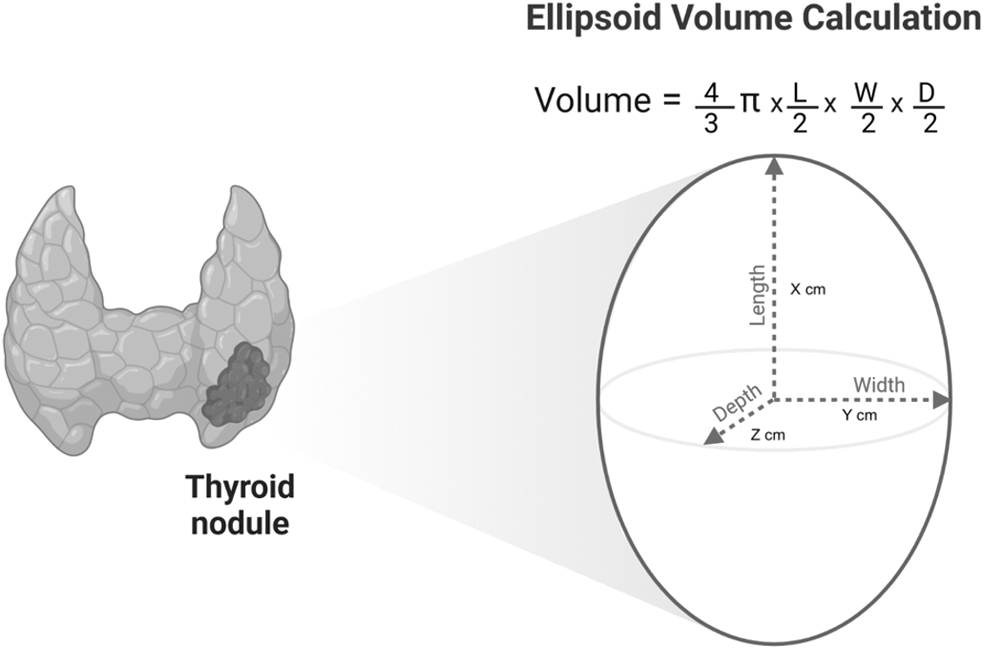
Formula for thyroid nodule volume in a typical ellipsoid-shaped nodule. When using the half-cube model (X*Y*Z/2) to the ellipsoid model (X*Y*Z*π/6), we find a consistent 4.51% underestimation of nodular volume. Image created by Biorender (License: Tulane University).
As part of the larger multidisciplinary community caring for patients with thyroid nodules, we recognize the convenience of the current calculator available on the ATA website, which obviates the need for a calculator. 6 Yet, the current half-cuboid calculator, or the quotient of a 3D nodule (X*Y*Z) with a customary adjustment (divide by 2), consistently erroneously underestimates a tumor's volume by 4.51% (Fig. 1).
Since this underestimation is almost equivalent to the alpha value generally accepted for statistical significance, many works, both internationally and locally, have reported thyroid nodule volume using the ellipsoid formula. 1 –5 The vitality of sound clinical judgment based on the most accurate information is required in the aforementioned examples that rely on tumor volume. Considering this, we humbly suggest the ATA website update or add an additional calculator to allow physicians and surgeons alike the opportunity to better optimize thyroid nodular volume determination. Together with the ATA community at large, we believe this will be one more step in better monitoring patient outcomes.
Footnotes
Authors' Contributions
Conceptualization by M.H.; methodology by E.T., M.H., and T.L.; validation by E.T., M.H., and E.K.; formal analyses by E.T.; writing—original draft by P.P.I. and E.T.; writing—review and editing by all authors; and funding acquisition by E.T. and E.K.
Author Disclosure Statement
No competing financial interests exist.
Funding Information
This study was supported by a research grant (THYROIDGRANT2021-0000000232) from the Bite Me Cancer and facilitated by the American Thyroid Association (to E.T) and Tulane University Bridge Fund (to E.K).