




Abstract

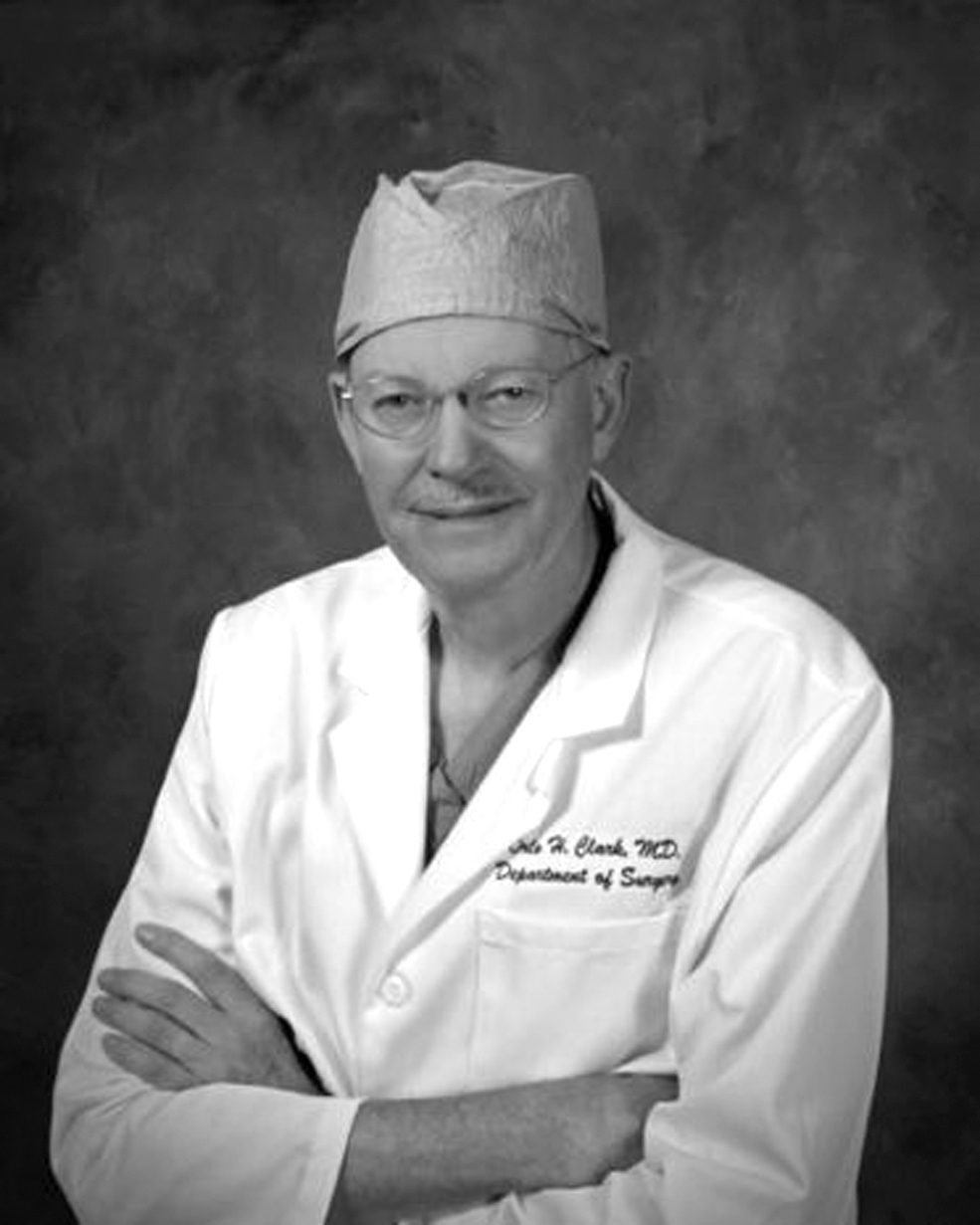
Dr. Orlo H. Clark
Dr. Orlo H. Clark passed away peacefully on the evening of October 11, 2022. He was an internationally renowned endocrine surgeon and made innumerable contributions to the understanding and treatment of thyroid disease. In this collection of remembrances, we highlight and celebrate the life and career of Dr. Clark, with tributes to his scientific and clinical achievements, love of the arts, and mentorship.
Orlo H. Clark was born on August 7, 1941, in Brooklyn, New York. The son of a surgeon and nurse, Orlo had a strong interest in the medical profession, but his childhood was spent exploring a number of interests and passions outside of science and medicine. Orlo was a talented athlete and had a distinguished career as a prep basketball player at Nutley High School in Nutley, New Jersey, and as a collegiate star at Cornell University. He was also a gifted musician and played the trumpet and sang in his church choir. Orlo had a lifelong interest in art and much of his professional career was spent exploring the intersection of art, science, and medicine.
Orlo spent his undergraduate years at Cornell University, where he studied zoology, and went on to medical school at Cornell, where he was an honors student and served as class president for 4 years. He considered specializing in a variety of areas, including internal medicine, but ultimately chose to pursue a career in general surgery. In 1967, he began his general surgery residency training at the University of California, San Francisco (UCSF).
While a resident at UCSF, Orlo became interested in the nascent field of endocrine surgery. He was especially fascinated by the biology and anatomy of the thyroid gland, especially thyroid cancer. He was able to immerse himself in the surgical treatment of endocrine disease during a 1-year fellowship at the Royal Hammersmith Hospital in London. At the Hammersmith Hospital, Orlo trained with Selwyn Taylor and Richard Welbourn, two of the founding figures of endocrine surgery, and planted the seeds for his career in this field.
Orlo completed his surgical training at UCSF in 1973 and was invited to stay on as a faculty member in the UCSF Department of Surgery. He would remain at UCSF for the entirety of his career. Orlo's first faculty position was based at the San Francisco VA Medical Center. He would later move his practice to the UCSF Parnassus campus, and in 1991, he was named the first Chief of Surgery at the newly formed UCSF/Mount Zion Medical Center.
Orlo Clark received countless awards and honors throughout his career and held major leadership roles in a variety of professional organizations. Among the highlights was an honorary doctorate from the Université de Poitiers in France in 1998 as well as the Oliver Cope Meritorious Achievement Award from the American Association of Endocrine Surgeons. He served as President of the American Association of Endocrine Surgeons (1994) and the International Association of Endocrine Surgeons (1996). In 1999, he was chosen as President of the American Thyroid Association, one of few surgeons to serve in that distinguished position.
Despite his numerous awards and accolades, Orlo was proudest of his professional family of more than 100 endocrine surgeons around the world whom he mentored and trained. He also had deep affection for the many others outside of surgery whom he collaborated with and learned from over the years; his enormous circle of friends included endocrinologists, radiologists, pathologists, basic and translational scientists, and so many others who benefited from his guidance and support. Former fellows and friends of Orlo's currently hold leadership positions in US and international academic departments. His was truly a worldwide legacy.
Wen T. Shen, MD, MA
Department of Surgery
UCSF
San Francisco, California
USA
E-mail:
Orlo's Scientific and Clinical Contributions
I had the great fortune of meeting Dr. Orlo H. Clark when I rotated on the surgical service as a fourth-year medical student in 1994 at the UCSF. Orlo's love for surgery and patients was infectious! Orlo became my beloved work father for 28 years and I know many who worked with him feel the same way. He led a remarkable personal and professional life. Orlo was a man of integrity and a gifted teacher and surgeon. I was fortunate enough to work with him throughout my general surgery residency, my research years in his laboratory, and as a junior faculty—all at the UCSF, where Orlo spent his entire career.
Reflecting on these years with him, I remember Orlo's many wonderful characteristics and wisdom. He created an inclusive culture, welcoming and mentoring many premedical and medical students and residents as well as international surgical and medical colleagues. He always saw the best in everyone and their full potential. He was a phenomenal mentor and a quiet and humble supporter who did not claim or broadcast any credit even though he was responsible for many professional opportunities that came our way. Most importantly, Orlo taught by example. He was a master collaborator as he believed everybody had something to contribute.
Orlo's accomplishments and contributions to our field are numerous; however, I believe what he was most proud of was the culture of curiosity that he inculcated among hundreds of his colleagues and mentees, the many patient-centered consequential investigations, and his cultivation of the next generation of surgeon–scientists.
Orlo's contribution to thyroidology spanned from basic science to clinical research. He demonstrated in a classic surgical study that patients undergoing partial thyroidectomy remain euthyroid by compensatory hypertrophy. 1 He showed us how one can achieve a true total thyroidectomy for differentiated thyroid cancer and taught us the important steps to follow to achieve this result while minimizing the complications that can be associated with such a procedure. 2 He characterized the thyrotropin receptor-adenylate cyclase system in neoplastic human thyroid tissue. 3,4
Orlo also emphasized the need for understanding thyroid anatomy, embryology, localization procedures, and surgical technique to avoid the failure to identify the thyroid (the missing thyroid). 5 He brought the concept of redifferentiation therapy for thyroid cancer of follicular cell origin to the forefront. 6,7 Orlo and colleagues showed that the latency period of thyroid neoplasia after radiation exposure was shorter for malignant thyroid tumors, including follicular carcinomas, than for benign thyroid tumors. 8
Orlo also introduced innovative approaches to vexing clinical issues such as reoperation for low-volume, persistent/recurrent thyroid cancer, which can be facilitated by adjunct technology, and approaches using hook needle localization and methylene blue injection to ensure surgical success for reoperative surgery and the utility of nerve monitoring in thyroid and parathyroid surgery. 9 –12
Beyond thyroidology, I think many of our colleagues would agree that Orlo's work defined the causes and risk factors for many types of endocrine tumors and improved our management of inherited syndromes. He also taught many endocrine surgeons when and how to look for endocrine tumors, which operation to do, and to ask which technology is useful. Orlo developed new approaches and treatments for endocrine cancers. Ultimately, all of this work led to improved patient outcome.
Orlo's contribution to our field beyond his individual work is best exemplified when looking at the last edition of the Textbook of Endocrine Surgery, which he edited. The size of the book grew to more than 900 pages, with over 200 contributing authors from all over the world. In essence, this textbook demonstrated that Orlo formalized our field, brought in many bright minds into endocrine surgery, and nurtured the seeds for the future. We are fortunate to be able to watch the ripple effects of Orlo. Let us honor his legacy by sharing his work and life lessons and by striving for excellence in all that we do like the inquisitive Dr. Orlo H. Clark.
Electron Kebebew, MD
Department of Surgery
Stanford University
Stanford, California
USA
Remembrances from Orlo's Endocrinology Colleagues
“The legacy of excellence in endocrine surgery at UCSF can be attributed to him.”
Morris Schambelan, MD
Professor Emeritus of Medicine
University of California, San Francisco
San Francisco, California
USA
The loss of the late Orlo Herrick Clark, the pre-eminent endocrine surgeon at UCSF, continues to be felt deeply by the UCSF Divisions of Diabetes, Endocrinology, and Metabolism, as well as the wider group of San Francisco Bay Area endocrinologists, who referred many of their most challenging cases to him for nearly 40 years. Orlo's remarkable characteristics, not only as a surgeon, researcher, and teacher but also as a mentor and colleague, stand out for their depth, constancy, and appearance at times when most needed.
In this remembrance, our endocrine colleagues offer their thoughts on this unique man who touched their lives. He inspired UCSF medical students, solidifying their nascent interests in endocrinology as a career choice. He was a role model for students and fellows who wanted to pursue academic careers, he supported junior faculty in their career development, and he engaged with each of us as collaborative colleagues and as friends. He knew the names of our children and our partners. He would ask about both. In this tribute, we share some of those reflections with our colleagues across the scientific world where his impact has been felt in similar ways.
Medical student solidified her interest in endocrinology as her career choice
As a third-year medical student, Anne Schafer, MD, now UCSF Professor of Medicine and Epidemiology and Biostatistics and Chief of Endocrinology and Metabolism at the San Francisco VA Health Care System, loved her experiences as a third-year UCSF medical student during her rotation through Endocrine Surgery with Orlo, which was part of her surgery core clerkship, and was inspired to study endocrinology.
In the operating room, standing on several lifts like everyone else because the table was set so high, Anne remembers being asked intricate questions about the endocrine pathophysiology of the case at hand. Trying her best to answer, she would get back a remarkably erudite and clear explanation of the patient's problem.
After these cases, Orlo took the medical student team across the street from Mount Zion Hospital for burrito lunches and more discussion and teaching about the endocrine and surgical aspects of the cases they saw on his service. Which attending in medicine, surgery, or any other field would share that time with medical students? Later as an attending herself, Anne realized much of her current teaching and practice were inspired by Orlo.
Endocrine fellows were inspired to pursue academic careers
As an endocrine fellow and later a junior faculty member, Dr. Edward Hsiao, now UCSF Professor of Medicine and Director of the UCSF Fellowship Training Program in Diabetes, Endocrinology and Metabolism, would travel to the Mount Zion campus to meet with Orlo in his laboratory to discuss challenging patient management cases. One of the impressive aspects about Orlo was his deep insight and knowledge of endocrine disorders.
Orlo would happily discuss the cases, providing detailed insight into the challenges and approaches of the surgical procedures and subsequent medical management. In addition, Orlo's vast experience in thyroid and parathyroid disorders spanned both basic and clinical research—serving as an inspiration for Dr. Hsiao and others pursuing a physician–scientist career.
Young faculty endocrinologists were supported and mentored
As a junior faculty member working in the combined Endocrinology/Endocrine Surgery Clinic at UCSF/Mount Zion Medical Center and attending the UCSF Thyroid Cancer Tumor Board, Dr. Chienying Liu, now UCSF Professor of Medicine and Director of the Thyroid Clinic, had the good fortune of not only soaking up the wisdom and vast experience that Orlo continuously shared but also benefiting from his support of her career development.
As a new faculty member, Chienying remembers his inclusive, genuinely kind, and welcoming persona in spite of his awe-inspiring accomplishments. Orlo supported her interest in thyroid cancer and provided pointers on navigating an academic career. There were big shoes to fill when she began taking care of patients Orlo had expertly cared for. These patients maintained not only great respect for him but also deep affection, which was inspiring to her as a clinician.
Senior colleagues remember his unique contributions and partnership
Dr. Morris Schambelan, UCSF Professor Emeritus of Medicine and former Chief of Endocrinology at the Zuckerberg San Francisco General Hospital, had a decades-long professional and collegial relationship with Orlo. He recalls that he first met Orlo in the early 1970s. The circumstances were quite memorable when Morrie, a junior attending on the endocrine service of the then San Francisco General Hospital, got a call asking him to come immediately to the operating room. The call was from Orlo, who as a chief resident on the trauma service was operating on a 71-year-old man who had presented a few days earlier with severe right upper quadrant abdominal pain.
This was before computed tomography (CT) scans were available, so a patient with persistent and unexplained acute abdominal pain often ended up with an exploratory laparotomy. The reason Orlo called was his discovery that the patient had bilateral adrenal hemorrhages. He immediately received hydrocortisone, recovered nicely, and Morrie followed him for many years to manage his adrenal insufficiency. Orlo, being the scholar he was, decided to look into this topic further and he and Morrie ended up publishing a case series of seven patients at the UCSF training sites, which reviewed the clinical manifestations of adrenal hemorrhage in the American Journal of Surgery in 1974.
Orlo and Morrie remained friends and colleagues thereafter, particularly as he put endocrine surgery on the map at UCSF. Morrie will miss him dearly, as will the rest of the endocrine and surgical communities.
Dr. Carl Grunfeld, UCSF Professor of Medicine, notes the impact of scientific publications by Orlo and the countless patients Orlo and his team managed so successfully at the San Francisco Department of VA Medical Center. Carl comments that when he first went to the Metabolism/Endocrine clinic at the VA, he was surprised and delighted to see Orlo taking care of general endocrinology patients, not just surgical patients.
When Orlo's surgery day changed and he could no longer see patients in the clinic, Carl inherited many of them. They included patients with type 1 diabetes mellitus, for whom Orlo gave the level of care you would expect from a sophisticated professor of endocrinology (and of course they all loved Orlo). Carl specifically notes another unique contribution of Orlo—his joint partnership and authorship with his wife Carol of their book, The Remarkables: Endocrine Abnormalities in Art.
Carl wrote him: “I keep your book face up in a prominent place in my office, and I am always interested in which fellows and students comment on it. More importantly, I just got back from Madrid where I spent 4 days entirely in museums. I thought a lot about both of you. I saw The Bearded Woman and a large number of paintings of dwarfs, including the incomparable Las Meninas. Inspired by you, I updated my lectures on acromegaly and gigantism and on obesity as well. I remain grateful for inspiring me in so many different ways.”
Orlo's humanity was a standout for many of us in the competitive academic arena. Dr. David Gardner, former UCSF Chief of Diabetes, Endocrinology and Metabolism, remembers Orlo's kindness, his generosity with his time, and his wit, noting that he was the perfect colleague, always brought something important to the conversation, and was never demeaning or dismissive, even with the most novice trainees.
He always solicited input from others, even when he was clearly the most knowledgeable person in the room. He always took time for the little things. If they had not seen each other for a while, Orlo would want to know how he was doing and how other faculty they both knew were faring. David notes “Orlo was a unique human being and I am grateful to have had the experience of knowing him during my time at UCSF.”
Dr. Robert Rushakoff, UCSF Professor of Medicine comments, “Orlo was a true mensch.” After Rob began his practice at Mount Zion Hospital, Orlo's research group moved to that campus. They began a close collaboration with weekly meetings on patient management and care. The only time the meeting was canceled was when Orlo attended Rob's son's bris. Years later, when Orlo and that same son crossed paths again at a restaurant where Rob's family was celebrating his son's white coat ceremony as a UCSF medical student, Orlo came to the table and gave him a “pep talk” on his future in medicine.
Dr. Dolores Shoback, UCSF Professor of Medicine, recalls that Orlo set the bar for collegiality, intellectual engagement, and leading by example. When she was starting her academic career at UCSF, she remembers Orlo telling a group of faculty that on certain weekdays, he drove the school carpool for his children and their friends. His wife Carol had an important career and needed to be at work early too.
Besides, Orlo loved talking to the other children in the car with whom he formed warm friendships over the years. Here was a major player in the UCSF Department of Surgery not only driving carpools but also telling us how much he enjoyed doing it! Starting out a career in academic medicine as a mother and physician, Dolores was reassured that family and children were key priorities for this academic surgeon and that both parents shared the responsibilities.
Over the years, Dolores and Orlo shared many patients with complicated parathyroid and thyroid disorders. She recalls that as the referring physician, Orlo kept her in the loop, as no other surgeon ever did. At the end of a surgery, even if it was evening, she would receive a phone call from Orlo, sometimes coming right from the operating room as they were closing the case. Orlo told her what he found, what he had done, and what his follow-up plan was and he thanked her for the referral. Then, he went and spoke to the family.
His professional life with colleagues and patients was centered on this respect for building and sustaining relationships. Families appreciated his way of doing things, as did his colleagues. Orlo had a superb mind. As Dolores recounts, when she would meet Orlo on campus, he always wanted to stop and talk science—how were their experiments in the laboratory going, what were they finding out, and how did those parathyroid cells signal in response to external concentrations of calcium?
Orlo carried the latest issues of Science in his briefcase in those early days when journals were in print—here was a surgeon reading the journal Science and thinking hard about what he read.
These reflections convey just a small part of what it was like to be his colleague. In this man was the rare combination of intelligence, curiosity, warmth, and humanity—gifts that all of us lucky enough to know him have so benefited from. His legacy will continue to inspire us all.
Dolores Shoback, MD
Chienying Liu, MD
Division of Endocrinology
UCSF
San Francisco, California
USA
Orlo's Lifelong Love of the Arts
In some ways, it is difficult to think of Dr. Clark's amazing contributions to the field of endocrine surgery, his international stature, his friendships and mentorship, and even his technical prowess in the operating room in the absence of his and his family's love of the arts. The culture of beauty and of esthetics was woven into his personhood, which then enriched us all. With Dr. Clark, beauty and discovery and GOITERS were all around, if only you took the time to notice.
Dr. Clark spent his entire professional career at UCSF on the West Coast, but his love of the arts started in the Northeast. He was born in Brooklyn, then spent much of his childhood in Nutley, New Jersey. There, he played the trumpet and the piano and was, by report, a very talented soprano in the boys choir. A growth spurt in the 9th grade put an end to his soprano voice, but heralded the beginning of a fantastic basketball career in high school and college.
Dr. Clark attended undergraduate studies at Cornell, a university that encouraged “unpredicted lines of thinking.” He then moved south to medical school and NYC, where he and his high school sweetheart and then wife, Carol, when able, were able to enjoy all the theater, museums, and music that Manhattan had to offer. Dr. Clark traveled west to San Francisco for surgical residency at UCSF and then spent a transformative year at the Hammersmith Hospital in London, another fantastic city in which he developed his love of endocrine surgery and continued his artistic and cultural education. He and Carol were able to enjoy all the cultural riches of European cities and beyond, as well as make lifelong international friendships that would last decades.
In 2011, Dr. Orlo and Carol Clark published The Remarkables after years of research and a European sabbatical. It had been a lifelong dream of theirs to do this project together. Remarkables refers to a term used to describe those with unusual physical differences, and in the art of the Renaissance and beyond, these Remarkables were many times people with endocrine disease.
In this beautiful book, Orlo and Carol detail, with text and wonderfully rich artwork, the intersection of scientific sensibilities that began to link representation of endocrine disease in art well before many of the underlying diseases were formally described or understood. There are gorgeous paintings, many depicting the full rounded necks signifying diffuse goiter, often used to represent beauty and fertility, rather than infirmity. Through these and other examples of endocrine disease in art, Dr. Orlo and Carol Clark show the power of observation, so important in art and medicine.
Dr. Clark was surrounded by a family centered in discovery, the humanities, and art. They are all such talented people. It was wonderful to know that the things Orlo wanted with him toward the end of his life—family, classical music, artwork, and a nice glass of an Italian red—were all there in abundance. Rest in peace Dr. Clark. Thank you for showing us all that medicine, surgery, art, and beauty can coexist and are indeed beautiful companions.
Jessica E. Gosnell, MD
Department of Surgery
UCSF
San Francisco, California
USA
Orlo the Mentor
Aaniin, hello, bonjour.
I suppose I could say this in dozens and dozens of languages and it still would not have the impact with respect to the worlds that Dr. Orlo Clark has touched. I have had the absolute honor of being one of Orlo's thousands of mentees and colleagues. I heard stories about the history of endocrine surgery, the role of endocrine in art, and tales of his family and university years … while learning the knowledge and skills of endocrine surgery he embodied so completely. I started in the formal role as an Endocrine Surgery Fellow at the UCSF in 2004, but continued as an informal mentee since then.
Make no mistake about it, I know that anyone who ever met Orlo could have been given this honor to write about his role and impact as a family man and as a friend. Orlo was first and foremost a kind giving human being who changed my world and my family's world for the better. I looked at Orlo like a second dad just like my husband, Patrick, looked at him as a second father-in-law and my daughter looked at him as a second grandpa. Ripples of sadness and loss spread quickly with news of Orlo's passing, along with memories jogged and stories being told.
I met Orlo in 2003 when I went down to San Francisco for the American College of Surgeons' Annual Clinical Congress. I came for an interview for the upcoming fellowship in endocrine surgery at UCSF and entered the room where the university was hosting a gathering for its current and past residents and faculty. I was looking for a surgeon and gentleman by the name of Dr. Orlo Clark. I had heard his name, of course, but I had never met him. I went in and asked where I could find Dr. Clark as my time of the interview was approaching and I wanted to make sure that I could locate him in this large room packed with people who were obviously enjoying themselves in camaraderie and stories.
I asked the first person I saw: “Do you know if Dr. Orlo Clark is here?” They looked at me, smiled, and said, “You obviously haven't met him before.” I affirmed that no, I had never met him, and he smiled, pointed over to the far side of the room, and said, “Just look for the biggest crowd because they will be surrounding Dr. Clark, waiting to talk to him, and he'll be the tall guy in the middle.”
Sure enough, there was Orlo—taller than anyone else in the room with a large crowd of people around him. He always was the easiest person to spot. I used to think it was because of his tall stature until I realized very shortly afterward that it was the energy that emanated from him, the kindness in his eyes, his infectious smile, and his sincere compassion, empathy, and love for those in his profession, those in his circle of friends, and those in his family.
Later that evening, I sat and interviewed with Orlo, but it was more of a conversation than it was an interview. He wanted to know more about me as a person than my accomplishments. He wanted to know more about why I wanted to do endocrine surgery rather than prove that I could. He wanted to know what I loved to do outside of the operating room rather than my favorite operations. We quickly found out that we both loved basketball, I had played at Simon Fraser University and he had played at Cornell University. He told me about his two daughters, Katie and Emilie; where they lived and what they were doing. I talked about my brothers, and he talked about his son, Andrew. He asked about my parents and introduced me to his wife, Carol.
In the end, I left that evening knowing that I had been fortunate enough to receive this fellowship and he knew more about me in that one interview than most of the UBC faculty had learned about me in my entire 6-year surgery residency.
My fellowship year in San Francisco was amazing. Orlo obviously surrounded himself with incredible people, colleagues, and friends who connected the working relationship and the informal parts of the fellowship. Every day I felt so fortunate—and I want to extend my gratitude to Quan Duh, Electron Kebebew, Jenny Ogilvie, Cord Sturgeon, and Wen Shen who were with me at that time.
I went through a great, sudden personal loss when I was at UCSF in the operating room at Mount Zion. I remember at the time of this loss having tunnel vision, where the only thing that I could do was somehow hold it together, stay upright, and keep my feet moving until I got to Orlo's office where Kate, his long-time secretary, was in the reception area. I simply said I needed to talk to Orlo.
She opened up the door; he was on the phone and to this day, I do not know who he was talking to or what he was talking about, but I know that just like a father, he looked at my eyes and realized that there was something that I needed from him and he seemed to reorientate his universe to try to help. He gave me his fatherly hug and when I told him what it was about, to this day, it was the only time I ever saw Orlo even remotely flustered—because it was something that he could not fix, he could not suture together, and he could not cure, but he did what he was best at—he loved me unconditionally.
In the short year that I was there, Orlo came to know me so well. He had met my parents, my brothers, and my husband. He helped me with career decisions based on the stories that I had told. I remember calling him from the obstetrics ward in the hospital up in northern Canada after our daughter Aliah was born, and shortly thereafter, of course, a gift arrived in the mail with a set of onesies fit for a newborn.
Something tells me Carol had a role in selecting those, but either way, we put Aliah in the onesie that night and it was the first time she slept through the night, so we are convinced that once again it was Orlo's magic and since he sent us two, we just made sure we had one washed ready to go each evening for the next couple of months until we were sure she could handle sleeping through the night without Orlo and Carol's help.
Moving back up to Canada meant moving away from USCF friends and colleagues. We had promised Orlo that we would come down to San Francisco once a year and to stay in touch. Sometimes we would connect in San Francisco and sometimes we would end up meeting at the places where the American Association of Endocrine Surgeons met. I also kept in touch with Orlo through friends and colleagues such as Wen, Cord, Jenny, Quan, Electron, Janice, James, and others, and there is always an amazing story or memory to be shared.
It was a large leap for me, leaving the supportive environment at UCSF, with Orlo and his network, for a community hospital in northern Canada and introducing the clinical and academic colleagues to the concept of endocrine surgery. As we all realize with time, residency and fellowship training do not prepare us for all the unexpected challenges that our careers and life throw our way. I found this note that I had written for Dr. Clark's Festschrift early on in my career, which is remarkably close to how Orlo remains for me.
DEAR Dr. Clark—I have the honour of learning from my patients in each clinic, having them trust me as we proceed to the operating room for a procedure that will aim to increase the quality and quantity of their life based on what you have taught me … but in my career, to date, I have had challenges that few in the room know … yet you were one of the first I called … who I went to … when I seemed to have no strength to stand you held me up. In the world and culture of Indigenous Peoples, you are my Elder … a title not based on age, not based on years of experience … but based on one's foundation of who they are and how they can make a world that rotates stay still for a moment so that those that follow can hang on … and feel comfortable spinning with it.
For all that you have taught me and for all that you continue to teach me, thank you, merci, miigwetch.
It really was fascinating to see how Orlo's love of history and art could be merged with his career as a surgeon. I loved how Carol's love of books seemed to merge with Orlo's love for writing. Orlo's obvious pride in his family would make me feel like he had pride in those who liked to call him their second dad. Over the years, Orlo, in one way, made my world expand in terms of possibilities and, in another way, made my world contract in terms of feeling connected and feeling part of something.
If I were to list people who had an influence on my life as a person, as a parent, as a colleague, or as a surgeon, I would put Orlo Clark at the top of my list. Therefore, while I benefited from that over all these years, in typical Orlo style, now I realize that it is my responsibility to not only show gratitude for what he gave but also strive to be that same type of person to my family, my friends, and my colleagues that he was for others.
Orlo knew that I am a fan of quotes, those from famous orators and those that make their rounds from anonymous sources. I remember sharing one with him and then highlighting it at the Orlo Clark Lecture in 2017. One of my favorite quotes is by Thomas King, an indigenous author, which states “The truth about stories is that … that is all we are.” Orlo's stories could make us laugh, think, reflect, question, and feel loved. His life story is a best seller.
I don't believe that Orlo is gone, he is just not someone I can pick up the phone and talk to right now; I can't “zoom” with him and Carol or e-mail him…but he has always been bigger than life. Therefore, while the world now seems like a slightly emptier place, at the same time, I can hear his voice in my head and feel him in my heart, if possible, more than I ever did before.
Thank you, Orlo. Thank you for everything you have given and for being with us today as we all remember you and think of you and celebrate who you have been in our lives. You will always be deeply and completely loved.
Nadine R. Caron, MD, MPH
Department of Surgery
University of British Columbia
Vancouver
Canada
Footnotes
Acknowledgments
The authors would like to acknowledge and thank the members of the Clark family, especially Orlo's wife Carol, for their support, and offer their deepest sympathies and condolences for their loss.
Authors' Contributions
Each of the listed authors (W.T.S., E.K., D.S., C.L., J.E.G., and N.R.C.) wrote and contributed their individual sections.
Author Disclosure Statement
None of the listed authors has any relevant conflicts of interest to disclose.
Funding Information
There are no sources of funding to report.