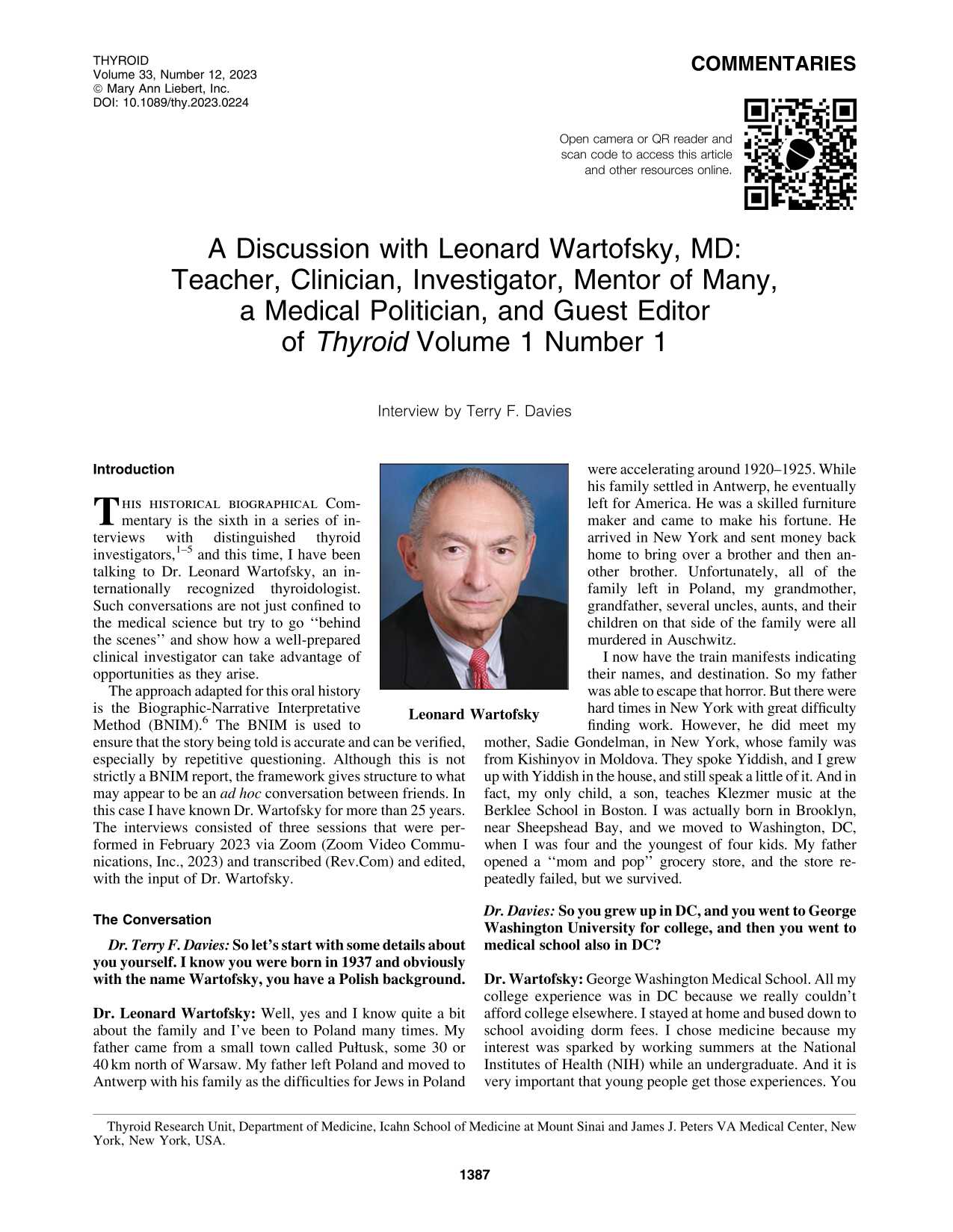
The Conversation
Dr. Terry F. Davies: So let's start with some details about you yourself. I know you were born in 1937 and obviously with the name Wartofsky, you have a Polish background.
Dr. Leonard Wartofsky: Well, yes and I know quite a bit about the family and I've been to Poland many times. My father came from a small town called Pułtusk, some 30 or 40 km north of Warsaw. My father left Poland and moved to Antwerp with his family as the difficulties for Jews in Poland were accelerating around 1920–1925. While his family settled in Antwerp, he eventually left for America. He was a skilled furniture maker and came to make his fortune. He arrived in New York and sent money back home to bring over a brother and then another brother. Unfortunately, all of the family left in Poland, my grandmother, grandfather, several uncles, aunts, and their children on that side of the family were all murdered in Auschwitz.
I now have the train manifests indicating their names, and destination. So my father was able to escape that horror. But there were hard times in New York with great difficulty finding work. However, he did meet my mother, Sadie Gondelman, in New York, whose family was from Kishinyov in Moldova. They spoke Yiddish, and I grew up with Yiddish in the house, and still speak a little of it. And in fact, my only child, a son, teaches Klezmer music at the Berklee School in Boston. I was actually born in Brooklyn, near Sheepshead Bay, and we moved to Washington, DC, when I was four and the youngest of four kids. My father opened a “mom and pop” grocery store, and the store repeatedly failed, but we survived.
Dr. Davies: So you grew up in DC, and you went to George Washington University for college, and then you went to medical school also in DC?
Dr. Wartofsky: George Washington Medical School. All my college experience was in DC because we really couldn't afford college elsewhere. I stayed at home and bused down to school avoiding dorm fees. I chose medicine because my interest was sparked by working summers at the National Institutes of Health (NIH) while an undergraduate. And it is very important that young people get those experiences. You should know that I was initially overwhelmed by the college fraternity life and at first didn't do that well academically. And then my future wife Donna came along as a 17-year-old, and said, “Hey boy, you've got to buckle down and study if you're going to get anywhere, or you can forget about me.” So I did indeed buckle down! I then went to medical school and ultimately did well, graduating at the top of the class, and was president of Alpha Omega Alpha and all that.
Dr. Davies: Now at what point did you start to get interested in endocrinology?
Dr. Wartofsky: Well, I left medical school for internship at Barnes Hospital in St. Louis. And Barnes, as you know, has been a strong academic center for many decades. And that orientation was instilled into the house staff. We went to meetings of the American Federation for Clinical Research, and we were encouraged to take on research projects, and our role models were academicians. So I became impressed by Bill Daughaday,
*
who was then Chief of Endocrinology, and he urged me to take on a project, and since he was interested in acromegaly I wrote up a huge protocol on the effects of steroids on growth hormone release.
Then I went to a residency at Einstein in New York, to the Bronx Municipal Hospital, because I had also become interested in liver disease, and Irwin Arias
†
was there, who was one of the great lights in liver research. Unfortunately, when I got there, he went on sabbatical and somehow my interest came back to endocrine. On looking for a strong endocrine fellowship program, I came up with the name of Sidney Ingbar in Boston.
‡
And I wrote Dr. Ingbar a letter and that's where I went for my Fellowship and met Sid Ingbar.
Dr. Davies: And so you spent a few years with Ingbar doing mostly basic research, right?
Dr. Wartofsky: Pretty basic, but also I would still call it clinical investigation in that it had direct relevance to patients and patient care. For example, my first article on iodine inhibition of hormone release in Graves' disease, we still use today for the treatment of severe thyrotoxicosis.
7
Dr. Davies: Yes. Important work. But you must also have received clinical endocrine training of some sort?
Dr. Wartofsky: Of some sort, but not diabetes. There was a separate diabetes fellowship at the Thorndike laboratory where I was, and Ron Arky
§
was the director of that.
Dr. Davies: But tell me, looking back now, do you think it's best for endocrine and diabetes to be separate? Or do you think they really should be merged?
Dr. Wartofsky: Well, it is complex, needless to say. I think it would depend on what the endgame is going to be. If it's going to be someone in pure clinical practice in the community, then it's incumbent upon them, of course, to be highly skilled in both. But for someone with an academic bent, time is short, and there is so much to know, and learn, and investigate, that a focus on one area, I think, is more reasonable.
Dr. Davies: You then moved from Boston to Walter Reed. So you were with Sid Ingbar from 1967 to 1969. Did you keep in touch after you moved on?
Dr. Wartofsky: Yes, after I went to Walter Reed, we still kept in close contact both professionally and socially. Sidney Ingbar died in 1988—much too young as you know.
Dr. Davies: And just after discovering that thyrotropin (TSH) and insulin-like growth factor 1 actually work together and synergize.
8
He would have taken that observation much further had he still been there, and it is so relevant for thyroid eye disease today.
Dr. Wartofsky: Indeed. Much too soon. It was the cigarettes that killed him. But Sid's philosophy lived on. That one should do both basic and clinical research at the same time. You should have projects going with mice or rats or cells and also clinical studies, because when you want the patients to study, they may not be around, but the mice and cells are. And you can then go back and forth.
Dr. Davies: That is good advice, but it is increasingly hard to do these days. Because of the clinical paperwork, and because of the need to use very advanced techniques in the laboratory to make progress. I recall you saying even before today that one of the great advantages of spending a long time at Walter Reed was that there was money for research. Is that still true?
Dr. Wartofsky: Oh, that's exactly right back then. I went in as what was called the Berry Plan,
**
where you had an obligation to serve for 2 years. So after the 2 years, I was ready to leave, and I looked around at jobs and funding, and thought, “Why would I leave this? I have great patient material, people with thyroid disease referred from all over the world to Walter Reed, and I have money for research.” There were some catches. Some of the research had to be what they called “mission-related” to what the army was interested in. Hence, you may have seen the early work on malaria
9,10
so I could show that I was really “up” with the mission.
Dr. Davies: So after New York and Boston, you spent more than 25 years at Walter Reed and for that you received a Legion of Merit award.
††
I thought that was for fighting the enemy?
Dr. Wartofsky: Well, you've never heard of combat endocrinology?
Dr. Davies: I have now. It says “For exceptionally meritorious conduct in the performance of outstanding services and achievements.”
Dr. Wartofsky: Well, sounds impressive.
Dr. Davies: Right, so obviously they loved you at Walter Reed.
Dr. Wartofsky: I believe they did, and it was mutual.
Dr. Davies: And you were there as Chair of Medicine eventually after being Chief of Endocrinology?
Dr. Wartofsky: Yes indeed. We first built a fantastic Division, and of course, we had a fellowship, two new fellows every year. Residents came mostly from Georgetown as well as Walter Reed. So it was a very exciting academic place. I also later enjoyed running the Internal Medicine residency with the best and the brightest of young people.
Dr. Davies: And you had some famous Fellows! Too many to mention them all but including Daniel Duick, Hunter Heath, Ken Burman, Robert Smallridge, James Hennessey, Henry Burch, Victor Bernet, and Michael Tuttle—it is an incredible listing that you must be very proud of.
Dr. Wartofsky: Indeed. It does speak for itself.
Dr. Davies: So you eventually decided to leave Walter Reed and moved to Washington Hospital Center.
Dr. Wartofsky: I could have retired earlier and gotten a pension after 20 years at Walter Reed, but I was there for 25 years because I was content. Then, in 1993, a former Walter Reed colleague, Jim Howard,
‡‡
who was in downtown DC at the Washington Hospital Center, recruited me to be Chair of Medicine with promises of building a great department.
Dr. Davies: And you built another Department of Medicine there?
Dr. Wartofsky: It was a very small department when I got there. Mainly teaching done by part-time private practitioners. But the rules of the Accreditation Council for Graduate Medical Education changed so that you needed to have so many hours of full-time faculty per program. So while I was there, we went from, I'd say, 9 or 10 full-time faculty and a lot of part-timers, to more than 150 full-time faculty in the Department of Medicine, with strengths in all of the subdivisions.
Dr. Davies: And you stayed on as Chair of Medicine until just a few years ago? When did you retire from that?
Dr. Wartofsky: Four years ago, after 25 years.
Dr. Davies: Indeed, let me ask you, how long should a Chair of Medicine stay on?
Dr. Wartofsky: I think the average tenure is somewhere around 6 or 7 years, which should be long enough.
Dr. Davies: So you were an exception to the rule?
Dr. Wartofsky: Yes, I was.
Dr. Davies: Why was that?
Dr. Wartofsky: Well, I think in both places, it was enjoyment with the productivity and excellence of the programs. I had everything I needed in that regard. I was also able to recruit strong people for the various Divisions of the Departments. In Endocrinology, we had, as I'm sure you know, my first fellow, Ken Burman,
§§
who I recruited from Walter Reed to Washington Hospital. And strong strengths in endocrine surgery and nuclear medicine as well as endocrine pathology. So it just made for wonderful multidisciplinary care on the clinical side, but also productive research on the investigational side throughout my tenures.
Dr. Davies: So I think what you're saying is that the job satisfaction was why you stayed so long in these positions, but clearly the institutions must have appreciated what you were doing.
Dr. Wartofsky: Well, that's a very important point. The institution has to be supportive of the academic mission. Washington Hospital Center is now part of what's called the MedStar Network, a not-for-profit system, which also owns Georgetown University Hospital, and there is not the same support for the academic mission as when I first arrived.
Dr. Davies: I'd like to talk a little bit more now about a few of your many thyroid contributions. You have more than 500 publications, some of which we have touched on earlier, but there are certain things that people listening, or reading, will want to know. For example, your interest in Thyroid Storm. Every fellow knows about the famous Burch–Wartofsky score.
11
Dr. Wartofsky: Well, let's see. I guess it started, as many projects do, because of interesting patients. I saw more thyroid disease at Walter Reed in 1 month than in the 2 years at Boston City Hospital. We were seeing lots of “thyroid storm” patients, and one of the first ideas we looked at was removing thyroid hormone from the circulation. And this was Ken Burman's project since he was interested in the assay of thyroid hormones.
12
We set up a dog study, making dogs thyrotoxic. Have you ever tried to do that?
Dr. Davies: I do know in thyroid failure in dogs that you have to give very large doses of thyroid replacement.
Dr. Wartofsky: Yes and it's well nigh impossible to make them hyperthyroid. They have very low levels of thyroxine (T4). And to crank them up is very difficult. So we had to give very, very, large doses, and then, we did different types of dialysis. We filtered the blood through AmberLite resin to extract T4 by peripheral perfusion.
13
And then after demonstrating that it would work, we then started doing it on hyperthyroid patients. And the interest in thyroid storm grew. We looked at iodine-induced thyroid storm
14
and looked at effects of lithium treatment,
15
which were areas of great clinical interest at that time. Hank Burch was a Fellow with me, and he put together a series of these thyroid storm patients who we were seeing and tried to classify them as to what really constituted “storm.”
The issue being that it's often difficult to tell the difference between storm, which could be fatal in 50–60% of patients, at that time, versus garden variety Graves' disease patients with thyrotoxicosis, who might develop an infectious disease but not really be in “storm.” So we were trying to distinguish between the two, and he developed the criteria for the score.
11
We had no idea that it would become so well known. And Terry, I have to tell you. I was recently visiting Walter Reed Hospital to see Donna, my wife, who was the patient, and the residents came around to see her. And as she introduced them to me, they said, “Wow, are you the Wartofsky of the Burch–Wartofsky score?”
Dr. Davies: And that's the way the world works! No doubt because it is in UpToDate (Wolters Kluwer) that everyone in the world sees it! Turning from Thyroid Storm, you much more recently made a decision that studying thyroid cancer is where you should concentrate your remaining years. Is that correct?
Dr. Wartofsky: Basically, yes. It is more challenging, more interesting, and apparently, more common than we previously believed. I do want to mention that our interest in thyroid cancer could not have been possible without isotope and nuclear medicine studies driven by Douglas Van Nostrand
***
who has been a superstar for us. We did things with dosimetric therapy that no one else was doing,
16
and with Iodine-124
17
and many other studies.
18
Lots of innovation at that time and since and thyroid cancer was an area I became very much interested in.
Dr. Davies: Our problem these days is that many of the patients with the worst thyroid cancer don't respond very well to radioiodine.
Dr. Wartofsky: Happily, most patients can be successfully treated with radioiodine, but there are cancers that don't take up radioiodine at all, and so they are radioiodine refractory.
19,20
Then, there are those who do take it up, but don't really respond very well, and the tumors continue to grow. So we need to apply alternative therapies for these different types. Current initiatives are often based on mutational analysis, trying to identify the various molecular signatures of these different tumors, and we have just published our thoughts on this.
21
In some cases, as you just alluded to, perhaps re-differentiating a radioiodine refractory, poorly differentiated, or undifferentiated tumor, to again take up radioiodine. Because even with all of these kinase inhibitory drug therapies, radioactive iodine is still the original and best targeted therapy. It is the only one that really gets to the specific target.
Dr. Davies: So this is going to require sequencing every tumor, and looking to see what drugs in the armamentarium there is to either kill the cell, or re-differentiate it?
Dr. Wartofsky: Or at least slow down the growth, and in some cases it's more than one drug, a combination therapy as has been shown for other tumors.
Dr. Davies: You obviously made a distinct and important decision and chose to pursue thyroid cancer.
Dr. Wartofsky: Well cancer was linked to my early interest in TSH/thyrotropin-releasing hormone (TRH), and trying to understand not just cancer physiology, but how the knowledge could be applied to clinical disease. So for example, we had tried to use bovine TSH to stimulate radioiodine uptake in thyroid cancers. Do you remember injecting bovine TSH? I think Jerry Hershman was early into that.
22
But then, we had TRH available. At the time, Bruce Weintraub
†††
was just across town at the NIH, and he gave us early access to TRH and we could show stimulation of TSH and then stimulation of radioiodine uptake in cancers.
23
And then of course, recombinant human TSH (Thyrogen) came along.
24
And I think that was the key to really learning about management of thyroid cancer.
Dr. Davies: You are 100% right. I think those early clinical trials of recombinant TSH, and the thought we and colleagues at Genzyme all put into the protocols really did bring people to focus on what was going on and revealed the ignorance that there was at the time.
25,26
Now we know you have been very involved with the Endocrine Society including having been Editor of the Journal of Clinical Endocrinology and Metabolism as well as Endocrine Reviews. And you were also President of the Endocrine Society in 2006. I would refer all our listeners, watchers, or readers to the YouTube video, recorded 10 years ago, which deals with more about the Endocrine Society than I think is necessary here (https://www.youtube.com/watch?v=ssa114FPz4Y). But we cannot close our discussion without talking about the American Thyroid Association (ATA). Being President, which you were in 1995, is minor but being Secretary means really being the workhorse of the ATA and you brought the association into the modern era.
Dr. Wartofsky: I first joined the ATA in 1971. That is more than 50 years ago, and so it has changed and is certainly a very different organization now. Then, it was small and rather elite. You could not gain entrance automatically. You really had to demonstrate an interest in the thyroid by publications or presentations and be recommended. An official ATA office was actually first established at Walter Reed. My years as Secretary were, I think about 1988 to 1992 or so, or maybe right up to 1993 the time I left to go to Washington Hospital. And I recall Colum Gorman,
‡‡‡
who was my predecessor as Secretary, calling me to say that the nominating committee wanted me to be Secretary.
And I said, “Colum, I'm much too young to have that distinguished office, that's for you older guys.” And he said, “And how old are you, Len?” And I told him, and he told me he was younger than I at the time. So that was no excuse and I became Secretary. But one major achievement was hiring Bobbi Smith as the secretary and chief executive of the ATA, which occurred at the urging of my wife. And Bobbi served the ATA for some 20 years, recently retiring just a year or two ago, and was widely acknowledged to have done an excellent job.
Dr. Davies: Absolutely, she was terrific. And I want particularly to get you to talk about the establishment of the journal Thyroid while you were Secretary. As I understand it, this was somewhat difficult. Am I right?
Dr. Wartofsky: Yes, it was a little difficult to say the least.
It was Jack Wilber, then in Baltimore at the University of Maryland,
§§§
who came over to visit 1 day to discuss our concept of a thyroid journal. He took on the task of trying to convince a potential publisher that a thyroid journal would be a good venture. He and I eventually negotiated with Mary Ann Liebert and her associate, Vicki Cohn, on the business aspects of the journal. But when we presented the idea of a journal to the ATA executive board, the Council, there were several members who were against it from the start and who said, “We don't need another journal” “There are too many journals, we're buried in publications, and nobody reads them” “blah, blah, blah.” We put it to a vote at our business meeting held at the delayed International Thyroid Congress that year in The Hague, which as I recall was about February 1990.
We had a quickly-put-together business meeting, and I presented the motion for the new journal. My suggestion for the name of the journal was not Thyroid, but JATA, like JAMA, only with a T, Journal of the American Thyroid Association. I recall both Jack Wilber and I doing a lot of behind the scenes campaigning and lobbying before we presented it. There was a lot of discussion and a lot of nay voices and nay arguments. I remember Bruce Weintraub standing up and speaking in support of the journal, that we should try, it will grow, and we will be proud of it. All of the right words. And it passed by a slim hair. So we then started a search for the first editor. And as you mentioned, Jerry Hershman, who was highly distinguished, took up the position. And I served as Guest Editor of the first issue of Thyroid, which was a special issue commemorating Sidney Ingbar (Vol. 1, No. 1, 1991), who, as we said earlier, had died in 1988 just a couple of years beforehand.
Dr. Davies: Well, thank you for that. I think we probably need to come to a quiet ending now. You are a wonderful example of a clinical investigator who has had, and is still having, a highly productive career despite starting with limited resources, and a family that had a lot of trauma. I think you do deserve a medal, and your wife deserves a medal of valor for putting up with you.
Dr. Wartofsky: Yes, she deserves more than that. Well, Terry, when you talk about what I've accomplished or achieved, I have to mention, as I'm sure you're well aware, in your own situation, how much we owe to our colleagues, to our fellows. And my publications all carry the names of the fellows who did the grunt work on the studies. My partner of 50 years, Ken Burman, after his fellowship, became a full partner in the research endeavors, and was a driving force behind many of the projects. And we not only have to give credit to colleagues and trainees, but also to all those who came before us. I'm standing on Sidney Ingbar's shoulders and Lew Braverman's shoulders,
3
and John Nicoloff's shoulders
****
and Jerry Hershman's shoulders.
5
One study leads to another.
And we wouldn't be where we are without those earlier studies. And I have to end by saying I wouldn't be where I am if not for one person. I'm reminded of the comments of the Nobel Prize winners, Goldstein and Brown, who worked on cholesterol metabolism. Someone asked, “What's the most important thing in being a productive investigator?” And Joe Goldstein said, “You have to pick the right problem.” And Mike Brown said, “Well, that's important, but you also have to pick the right spouse.” And I picked the right spouse. And I would not be where I am today without her.
Dr. Davies: That's a beautiful ending Len. And so that also relates to mission. Mission-related activity starts at home, starts with love and with the family.
Dr. Wartofsky: And that's good advice for the young people of today.