




Abstract

The year 2023
Thyroid disease, predominantly manifested as goiter, was a very common problem throughout the United States. This was not limited to the “goiter belt” (Upper Midwest, Great Lakes regions, Appalachians, and Pacific Northwest) with endemic iodine deficiency, where the rates of goiter in some communities were >60%. 2 In addition, World War I had created a demand for surgeons, who were then trained in large medical centers, often in areas of the country where goiter was prevalent. However, on their return from the war, there were often operative complications due to the surgeons' inexperience with thyroid surgery.
It was in this environment that Dr. Sloan proposed an organization of “medical men” from across the country that would include not only surgeons, but also experts from all medical disciplines, to stimulate research into the cause of goiter (it was not clear that much of it was due to iodine deficiency at that time), and to advocate for improved treatments and possible prevention. This was to be accomplished through meetings and subsequent publication of information about goiter that would be available to all physicians interested in caring for patients with goiter.
On December 6, 1923, in Bloomington, IL, Dr. Sloan's vision was realized in the formation of the AASG (Fig. 1). 3 Dr. Sloan was inaugurated as the first president for the years 1923–1924 (Fig. 2). † According to a recollection of the early history of the society, there were 26 “Charter Members,” including a Denver surgeon, Seymour D. Van Meter (who initiated the Van Meter award in 1930 during his presidency), as well as his daughter, Dr. Virginia Van Meter, who was also a surgeon. Of note, Dr. Henry S. Plummer, an internist, was also one of the founding members of the society.

Selected milestones illustrating the history of the ATA, the International Thyroid Meetings, and thyroidology. For more details see references.
3,5,6
AASG, American Association for the Study of Goiter; AGA, American Goiter Association; ATA, American Thyroid Association; BRAF, proto-oncogene B-RAF; CH, congenital hypothyroidism; ESCs, embryonic stem cells; ICCIDD, International Council for the Control of Iodine Deficiency Disorders Global Network; IGC, International Goiter Conference; IGN, Iodine Global Network; irAEs, immune-related adverse events; ITC, International Thyroid Congress; LATS, long-acting thyroid stimulator; MCT8, monocarboxylate transporter 8; MTC, medullary thyroid cancer; NIS, sodium iodide symporter; PTC, papillary thyroid cancer; RET, rearranged during transfection; RTH, resistance to thyroid hormone; T3, triiodothyronine; T4, thyroxine; TIRADS, Thyroid Imaging Reporting and Data System; , ITCs.

Edwin Plummer Sloan, first president of the American Society for the Study of Goiter. Dr. Sloan was born in Missouri and graduated from medical school in 1898. After a surgical residency, he received additional training at clinics in Berlin, Germany, and with Theodor Kocher in Berne, Switzerland. Further information can be found in the Clark T. Sawin History Resource Center of the ATA that includes biographical notes and pictures of all past presidents. 9
The first regular meeting occurred at the Unitarian Church during January 23–25, 1924, in Bloomington, IL, with >200 physicians in attendance (Fig. 3). 4 Lectures included “An Analysis of the Types of Goiter with Indications for Treatment,” “Radium Treatment of Goiter,” and “A Review of Another Years Work with Thyroid Disease” by Dr. Frank Lahey (who could not attend the meeting), and, interestingly, “Use of Seaweed in the Prevention and Treatment of Goiter,” by Dr. J.W. Turrentine from the U.S. Department of Agriculture. There were also debates on the causes and classification of goiter, with emphasis on the benefit of appropriate classification, ‡ which might, importantly, lead to nonoperative treatment.
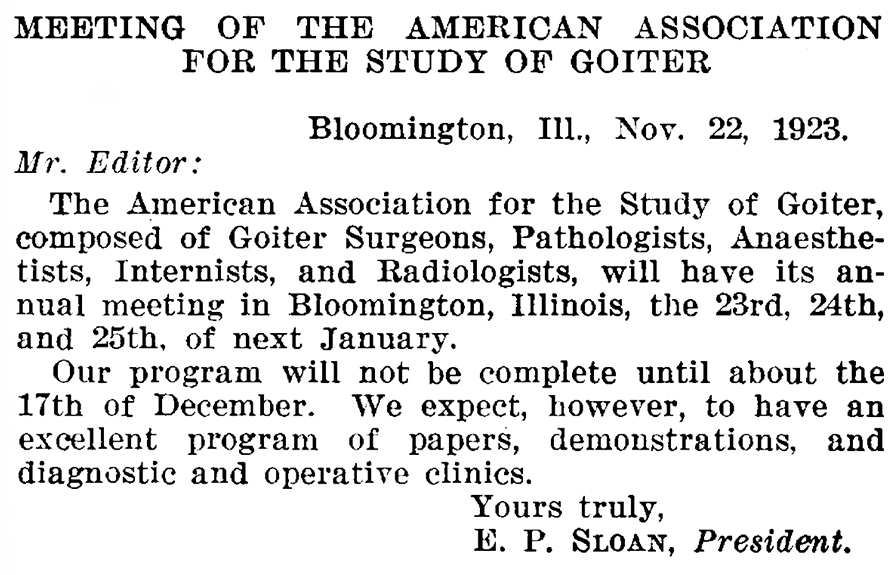
Call for the first meeting of the American Association for the Study of Goiter. From N Engl J Med 189: 961, 1923.
In addition to >50 lectures during the 3-day meeting, operative clinics were held each day at 2 local hospitals where surgeons demonstrated the latest surgical and anesthetic techniques (Fig. 4). Interestingly, the names of the patients who were to have surgery were published in the local newspaper (The Daily Pantagraph, Bloomington, IL) each morning.
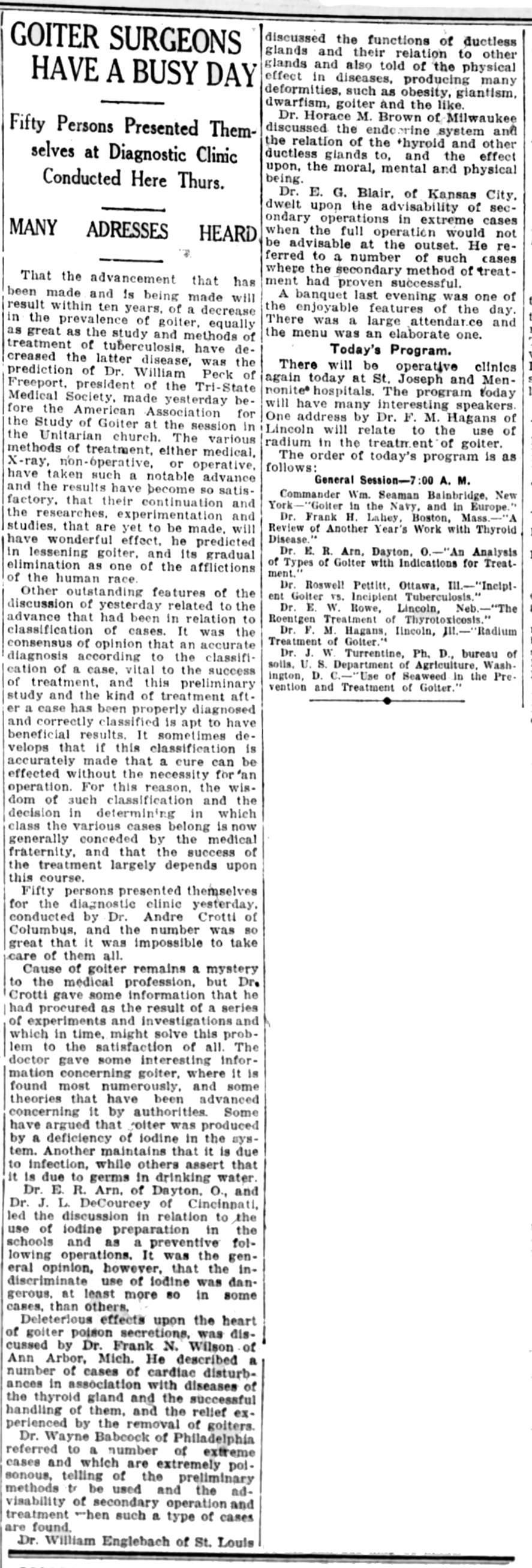
Goiter surgeons have a busy day. Excerpt of the The Daily Pantagraph, Bloomington, IL, January 25, 1924 (page 3), describing educational events presented at the first meeting of the American Association for the Study of Goiter.
The first meeting of the AASG concluded with the announcement that the officers would continue their role in the following year, and that the site of the following years' meeting was yet to be decided (the meeting, in fact, took place in Bloomington, IL, in conjunction with the annual meeting of the American Medical Association in Chicago). In 1959, the AASG was incorporated in the New York State as the American Goiter Association, and in 1961 the name was changed to the American Thyroid Association (Fig. 1).
Programmatic Themes 1923–2023
The founding members of the AASG were focused on the improvement of thyroid surgery and outcomes, still a significant challenge in the 1920s. Gordon S. Fahrni, a founding member of the AASG, wrote in his recollections in 1973: “Its birth was a response to a need across the country to increase our knowledge of the whole subject and improve the care of people so afflicted.” 4
The subsequent developments are reflected in the topics of the meeting programs and abstracts, in publications, and the membership composition (see Composition of the ATA by Medical Specialty and Sex). Accompanied by numerous scientific, medical, technological, and societal developments, there has been a constant and dynamic development, which has impacted the focus and the composition of the ATA. A detailed summary of these milestones is not possible due to space constraints, but the timelines in the Clark T. Sawin History Resource Center illustrate the landmarks in the history of the ATA, 3 the International Goiter and Thyroid Meetings, 5 and the history of thyroidology (Fig. 1). 6
Composition of the ATA by Medical Specialty and Sex
In the beginning, the AASG was composed almost exclusively of male surgeons. 4 Despite a focus on surgical aspects, § the group had an interest in nonsurgical topics related to the thyroid already at the inaugural meeting in January 2024. For example, Dr. Henry Plummer spoke, although the topic of his address is not known. Presumably, it related to the use of potassium iodide to prepare patients with Graves' disease for thyroidectomy, an approach that significantly improved the outcomes of hyperthyroid patients undergoing surgery. 4,7
Dr. Plummer would go on to become the first nonsurgeon to be elected president of the society in 1933. At the January 1927 meeting in Philadelphia, James Howard Means spoke on “The Development of Our Knowledge of the Thyroid Gland.” Dr. Means would later become the second nonsurgeon to become president of the society in 1948. From the early days, the AASG was committed to integrate other disciplines interested in thyroid pathophysiology. ** However, unfortunately, there did not appear to be a formal breakdown of medical specialty within the organization until 1961 (Fig. 5).

Demographic development by specialty groups within the ATA.
At that time, ∼50% of active members were surgeons and the other half were composed mostly of endocrinologists and internists in equal proportion. Over the subsequent three decades, the number of surgeons in the organization decreased dramatically to only 3% in 1990. The reasons for this decline are uncertain, but possibly relate to a decrease in nontoxic goiter prevalence due to iodine sufficiency in the population, as well as a decrease in surgical therapy for many thyroid conditions, especially Graves' disease and toxic nodular goiter. Beginning in 2000, there has been a welcomed increase in the proportion of surgeons, both endocrine surgeons and head and neck surgeons. This is likely reflective of the increase in the prevalence of thyroid nodules and thyroid cancer, as well as important advances in thyroid cancer care. Over the years, there have always been society members who were pathologists, basic scientists, radiologists, and pediatricians, and these proportions have remained relatively stable over time. Paralleled by the development of systemic therapies for advanced thyroid cancer, the ATA membership now also includes a group of dedicated oncologists.
Initially, the AASG was composed entirely of men (with the exception of Dr. Virginia Van Meter), reflecting the paucity of women physicians in the United States. Dr. Virginia Van Meter did address the group at the January 1925 meeting in Bloomington, IL, on the topic of “Goiter Survey in the Public Schools of Denver.” In reviewing minutes of society meetings and member participation lists at annual meetings is difficult to extract information about the makeup of the organization by sex, since the listings utilize first name initials, so the sex of individual participants cannot be identified.
Dr. Virginia Frantz, an esteemed thyroid pathologist at Columbia University became the first woman president of the ATA in 1962 (Fig. 6). The number of women members in the society has continued to increase progressively over the past several decades, reflecting increasing number of women in medicine in general, and in endocrinology and surgical specialties in particular. By the year 2020, 44% of ATA members were women (Fig. 7). There are currently no reliable longitudinal or cross-sectional data on ethnic/racial background, minorities, and diversity.

Virginia Kneeland Frantz, first female president of the ATA in 1962. Dr. Frantz pursued medical studies at Columbia College of Physicians and Surgeons, graduating in 1922, and she became the first woman surgery intern at New York Presbyterian Hospital. In 1935, she described insulin-secreting tumors of the pancreas in collaboration with Dr. Allen Whipple. In 1942, she was involved in the pioneering study demonstrating radioiodine uptake in a metastatic focus of well-differentiated thyroid cancer but not in coexisting poorly differentiated metastases. 9,10
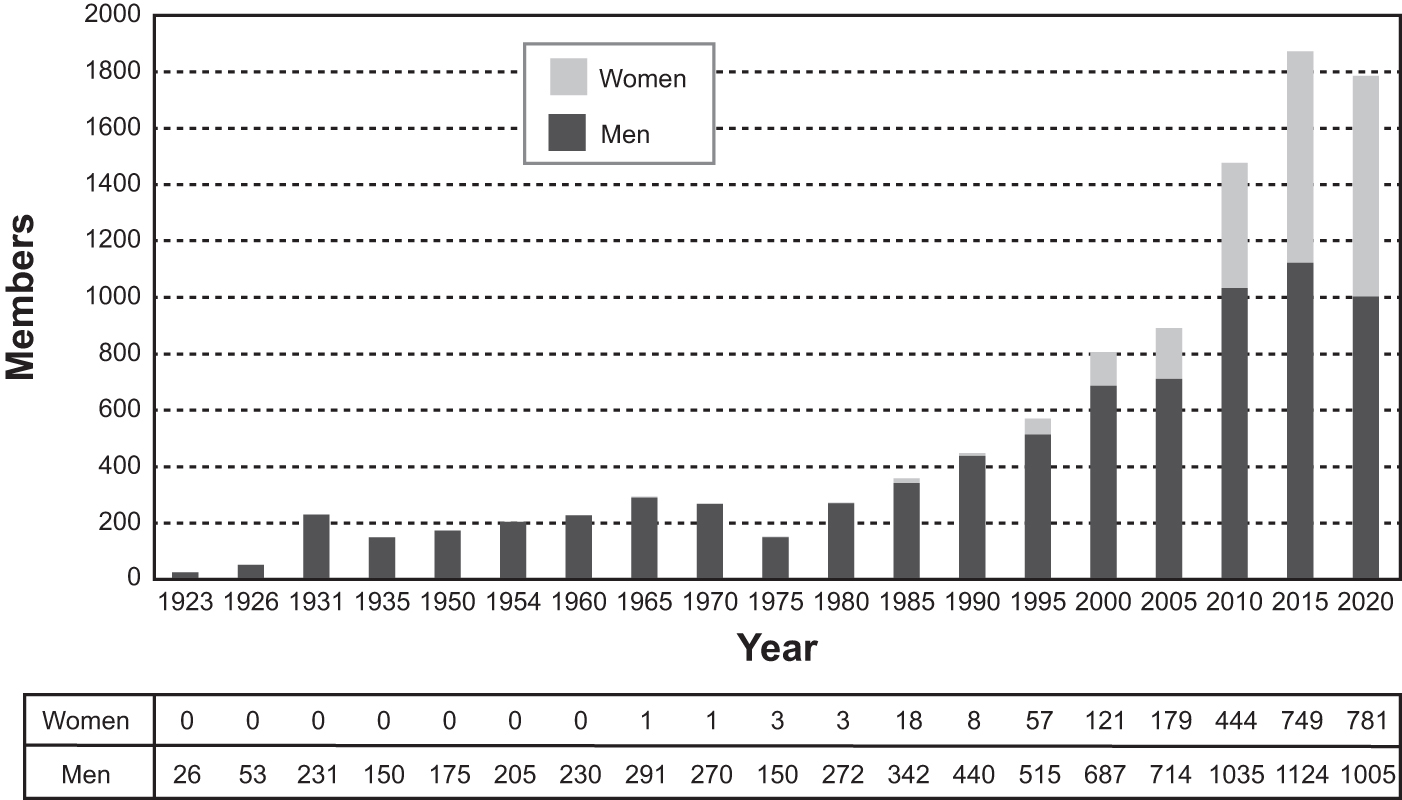
Membership by Sex in the ATA. (For the period until the early 1960s, it is difficult to extract information about the makeup of the organization by sex. The listings utilize first name initials and the sex of individual participants can usually not be identified).
Mission and Perspectives
The ATA's vision is committed to achieving the goal of Optimal Thyroid Health for All, and its mission statement is Transforming thyroid care through clinical excellence, education, scientific discovery and advocacy in a collaborative community.
Efforts toward clinical excellence and education are strongly supported by the ATA's dedication to developing high-quality guidelines, the educational meetings, and its publication portfolio. Thyroid, the official journal of the ATA, was launched in 1990 with Dr. Jerome Hershman as founding editor. 8 It is complemented by Clinical Thyroidology (year of inception 1988), Clinical Thyroidology for the Public (2008), and VideoEndocrinology (2014).
Scientific discovery is, in part, dependent on appropriate funding, sources that must be defended. Much work needs to be done toward the elimination of national and global disparities and inequities in terms of access to health care and education. The ATA is committed to valuing diversity and integration, and the organization is embedded in a global context. Worldwide collaborative efforts and connections are key to respond to the challenges of the future with constructive and sustainable solutions.
All these goals can only be achieved by ongoing engagement and citizenship of the ATA membership and, as illustrated by our history, openness to dynamic change and reorientation. To quote Gordon Fahrni: “… our Thyroid Association, … kept pace with and helped to stimulate and develop the sequence of changes over the years of which we are all so proud.” 4
Let us enter into the ATA's new century with a renewed commitment to the prevention and innovative treatment of thyroid disorders, with dedication to excellence in clinical care and research, and with a collaborative approach and an inclusive membership.
Footnotes
Acknowledgments
We thank Sharleene Cano, Director, Membership and Publications, American Thyroid Association, for the information on membership statistics, and Bill Kemp, McLean County Museum of History, Bloomington, IL, for providing materials from The Pantagraph.
Authors' Contribution
The article was conceived and written by David S. Cooper and Peter A. Kopp.
Author Disclosure Statement
No competing financial interests exist.
Funding Information
No funding was received for this article.