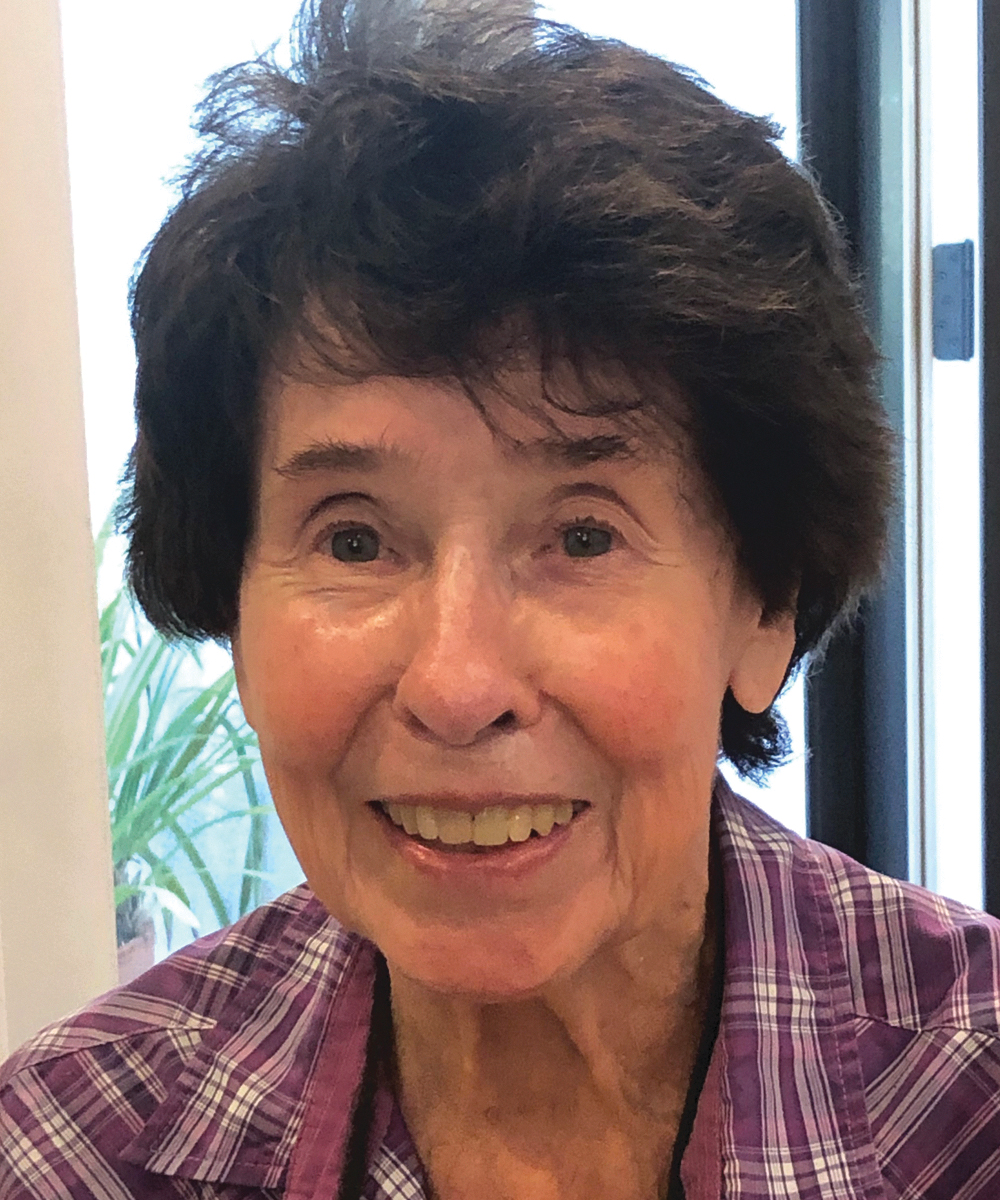
The Interview
Dr. Terry F. Davies: Thank you, Sandra, for agreeing to be interrogated. We are not going to be able to cover all of your 260 or more publications, but we will get a flavor of your work as we go along.
Dr. Sandra McLachlan: Thank you, Terry, for inviting me. I am humbled but usually never short of words although it is getting harder and harder to remember the details of my work.
Dr. Davies: So, we should first tell the audience that we were Research Fellows together in Newcastle upon Tyne in the North East of England in the 1970s. That means we've known each other for over 50 years.
Dr. McLachlan: Good gracious. That many years. But that's quite true, Terry.
Dr. Davies: So, let's start at the beginning. I know you came from South Africa, from Johannesburg originally, but I don't know who your parents were or what they were doing in South Africa.
Dr. McLachlan: My mother's family, originally from Britain, lived in the Cape. My father had an Italian background. His father came to South Africa in 1898 from what was then a peasant farming area (Campiglia Cervo, Piedmont) in northern Italy on the border with Switzerland. His parents died of the plague in Sardinia where they had gone to work, and my grandfather was brought up by an uncle.
My understanding is that the Uncle told him, “Go to South Africa. There's gold there. You'll make money.” So, he went and became a steel and wood merchant. My father, one of his three sons, became a geologist searching for water on a scientific basis. He had a small laboratory at home in Johannesburg and obtained his DSc for “The Petrology and Petrography of Clays.” My mother was a botanist but gave up working when her three children were born (two daughters and a son). And I went to an all-girls' school in Johannesburg and then to the University of Witwatersrand just like both of my parents before me.
Dr. Davies: So, when did science take your interest?
Dr. McLachlan: I was going to be a ballet dancer from the time I was about 10 years old. As I got older, I realized that I wasn't really very good! My Father then asked me, “What do you want to do?” and I replied, “I want to go to university.” He said, “What subject do you want to do?” I replied, “I want to do math.” And I found that I had to do chemistry also. So that was that.
Dr. Davies: So, were there many females in the university in 1958?
Dr. McLachlan: Yes and No. Most classes were mixed. But chemistry had one row at the front where the women (only about six of us) sat, while other classes, especially zoology, had many more women.
Dr. Davies: As I understand it you were soon married, and you and your husband went to work in what is now known as Zimbabwe?
Dr. McLachlan: Yes. When I was married, my husband and I went in 1963 to live on the shores of Lake Kariba when the lake was just filling behind the Kariba Dam.
*
Dr. Davies: Does this relate to your article published in 1971 with a wonderful title. It's called “The Rate of Nutrient Release from Grass and Dung.”
7,8
Dr. McLachlan: Oh yes! When the waters were rising behind the Kariba Dam, we didn't know the levels were going to fluctuate. Each time it fluctuated, it swamped the bordering grass, trees, and dung from the game … the grass died, and you got a huge nutrient release. I measured oxygen content of the water as the water levels were rising and found that the water actually become anoxic. So, I was interested in the changes that occurred after the huge nutrient release. I went on to do an MSc on that field work and then my husband went to work in the North East of England in the city of Newcastle-upon-Tyne and of course I followed.
Dr. Davies: So now you were a scientist?
Dr. McLachlan: Well yes! When I was in Newcastle, I eventually found a first job working for a botanist called Ronald McCloud. As you'll see, in my CV, some of my publications are about root meristems.
9,10
But after his grant ended, a position was advertised to work with Professor Reginald Hall
†
and Dr. Bernard Rees Smith
‡
in the medical school. I met a visiting fellow, Antonio Gomez Pan from Spain who asked if I was going to work with the Thyroid King? Although I didn't know anything about the thyroid or their work, I went for an interview, which must have gone well. And that was the beginning of my life's career in thyroid research.
Dr. Davies: And so, you became an accidental thyroidologist?
Dr. McLachlan: Completely accidentally. I wanted a position that was going to allow me to work as a scientist, as an individual, and this allowed me to pursue my PhD.
Dr. Davies: So up till this point would you say that being a woman was a disadvantage to you? Or you never felt that?
Dr. McLachlan: I never felt being a woman was a disadvantage. I suppose the attitude of some men could be slightly adverse. On the whole, I had no trouble and as I got into working with Reginald Hall and Bernard Rees Smith, I felt very comfortable. I also had no trouble with the work. The University of Newcastle was quite a small place at that time as you know. It was very easy to get help from people. It was easy to find out if somebody had equipment they could lend you or advise you about some technique.
Dr. Davies: Right. And how was it adjusting to life in the UK compared with Kariba?
Dr. McLachlan: I found that exceptionally difficult at first.
I always thought I had enough in me to keep going without my relatives, without my family. The UK had a lot of strikes, and I hadn't been there for more than a few months when there was a postal strike, which lasted at least 6 or 8 weeks. We had no telephone and no mail. So, I then found it exceptionally difficult being so out of touch with home. I always thought I was self-sufficient. But let me tell you, I learned very quickly then. You know it's very easy to be self-sufficient in your own country. But adapt I did.
Dr. Davies: So that would include adapting at work.
Dr. McLachlan: Once I had work, I was fine. That's what I found the most difficult thing—initially not having somewhere to go every single day. Because when I was at Lake Kariba, I was in the laboratory every day, I was doing something every day. But when I was first in Britain, the women I met when I first arrived stayed at home. They looked after the house, they cleaned the house, and the men went to work. So, I found that difficult. As soon as I had a job, a full-time job, I felt much happier.
Dr. Davies: And so, of my seven interviews, you are the first senior female thyroidologist because you are one of a very small group.
Dr. McLachlan: Yes, I know.
Dr. Davies: So, there was certainly something in society that held women back at that time and you didn't feel it.
Dr. McLachlan: I didn't feel it at all at university. And I didn't feel any difficulty other than what we all experience finding a job. When I came to the UK, it was not easy to find a position. I had to do a lot of walking around and asking questions and finding out from people. It is fair to say that nobody in science was looking for a woman applicant!
Dr. Davies: When you joined Reginald Hall and Bernard Rees Smith, you obviously found a home and entered a very productive scientific period.
Dr. McLachlan: Oh, yes, because it was busy, you were very involved, we were always doing something. I am sure you remember what it was like then. A special time.
Dr. Davies: So right. A very productive time in a group that also included Alan McGregor
§
and Tony Weetman.
**
And there was a flood of productivity for a number of years. And one of your highlights, I would say, in your career was developing assays for in vitro assessments of thyroid stimulating antibody secretion and measurement by human lymphocytes; beginning with your Nature article in 1977
11
and later adapted for anti-Tg and antithyroid peroxidase (TPO).
12
Dr. McLachlan: I had help with using a very complicated system called the Marbrook culture system
††
to measure IgG production by lymphocytes in culture,
13
which was wonderful for a number of years. Later, researchers developed different systems using disposable tubes and lower concentrations of lymphocytes.
When I first started in thyroid autoimmunity, I said to Bernard Rees Smith, “What we've got to learn to do is to find out how to make B cells produce antibodies.” And then I found an article by Milstein
‡‡
on making monoclonal antibodies.
14
Bernard jumped on that right then and there. We learned how to get B cells to secrete without making monoclonals. But that really was the start of his and my interest in monoclonal antibodies. He realized right away the significance of how important they were.
Dr. Davies: And you must have had good hands to do this excellent work.
Dr. McLachlan: One thing I was lucky about was that I soon had a technician assigned to me. Setting up the lymphocyte cultures and preparing the Marbrook system was very time-consuming. Basically, you had to culture the cells at high density in an inner tube separated by a dialysis membrane from an outer, bigger volume of culture medium. And of course, the whole thing had to be kept at a constant CO2 concentration. So, the cells had access to nutrients, but the IgG made was retained in a pocket.
Later it was possible to buy Marbrook equipment, with a dialysis membrane in place, and you pop the tube into a Petri dish and put the medium in it. Easy! We had to use glass tubes that all had a notch around them so that we could tie a dialysis membrane and then sterilize it in water to prevent it from drying out. It took a lot of washing up and sterilization.
Thyroid tissue was not difficult to obtain, but nearly all the patients were treated with antithyroid drugs, which decreased the extent of lymphocytic infiltration. Then I met a thyroid surgeon, Christopher Pegg,
§§
who treated some of his milder Graves' patients with just a beta-blocker (propranolol) and no antithyroid drug. These thyroids came all the way from Nottingham to Newcastle, UK, by train overnight. We received them the next day and then chopped them up and released the lymphocytes for our studies.
15,16
Dr. Davies: Well, it was very productive! And you did it on not just thyroid antibodies.
Dr. McLachlan: Right. We also looked at acetylcholine antibodies from myasthenia gravis patients.
17,18
We had a very good group in Newcastle working on the clinical aspects of myasthenia gravis. And of course, they sometimes obtained thymic tissue from such patients.
Dr. Davies: And you used your culture system to actually make it clear that it is the lymphocytes inside the thyroid gland in Graves' disease that secrete the thyroid antibodies, including the thyrotropin (TSH) receptor antibodies.
15
So, you not only set up the cultures to be able to detect thyroid antibodies in vitro for the first time, but you actually proved that the primary site of secretion was within the thyroid itself—a concept that we should all remember.
Dr. McLachlan: Yes, and we were also lucky enough to obtain some thyroid tissue from Hashimoto's patients. And those are the most “beautiful” cultures because the lymphocytes didn't need any “triggers” to secrete IgG—they produced the antibodies spontaneously,
19,20
whereas with lymphocytes from the peripheral blood, you needed something to actually kick the lymphocytes into action; we usually used pokeweed mitogen, which triggers T and B lymphocytes and not just T cells, which is what almost all immunologists were studying at that time. Unfortunately for us we hardly ever got thyroid from a patient with Hashimoto's thyroiditis.
Dr. Davies: And you worked with Alan McGregor on first showing that carbimazole,
***
the antithyroid drug, actually inhibited the intrathyroidal lymphocytes directly.
21
Dr. McLachlan: Yes. It is not just the antithyroid action of carbimazole, but it also reduces lymphocytic infiltration and we showed that with intrathyroidal lymphocytes.
16
Dr. Davies: So already, we've hit on three very significant contributions—developing a thyroid antibody culture model and measuring thyroid antibody secretion in vitro, showing that intrathyroidal lymphocytes are the prime source of thyroid antibodies, and proving the direct action of carbimazole on such lymphocytes. I was also thinking that you really worked the other way round from most people. You started with human samples and by now we are going to come to your drift into mouse studies. Most people start with mice and then drift into human studies!
Dr. McLachlan: Most of the immunologists I knew had indeed started with mice. The interesting thing is that at the time, people studying mice didn't seem to study antibody production. They studied T cell responses. That's what I found so terribly, terribly frustrating because there were so few people who were interested in antibodies. The only people who studied antibodies at that time were interested in allergy. And something that I also learned from those studies was that lymphocytes could be used for molecular biology studies.
Dr. Davies: Yes indeed. And more to come on that. So you spent a good few years in the Smith and Hall laboratory, obtained a PhD (1980), and fame from your articles, and then, your mentors both moved from Newcastle to the University of Cardiff in Wales in 1988. And you moved with them to Wales as a Senior Lecturer.
Dr. McLachlan: Yes, I did.
Dr. Davies: But at some point, you must have had enough since you departed in 1990.
Dr. McLachlan: I had a new relationship in my life.
Dr. Davies: Now we have to introduce the audience to the fact that your other half is Basil Rapoport, and Rapoport and McLachlan become a well-known pair in the thyroid world. And you ended up in California of all places!
Dr. McLachlan: Well, that's where Basil was.
Dr. Davies: Well, what was he doing in California? Another South African.
Dr. McLachlan: I'm not sure that you know, and I didn't know at the time, that Basil and I actually grew up in the same street in Johannesburg. We didn't know each other. But when I was writing my PhD dissertation in Newcastle, I came across articles by somebody called Basil Rapoport. And I thought it's an unusual name. I wonder if he's related to the family who used to be up the road. I cited these articles in my thesis and then, later, went to a thyroid meeting in Italy. And at the meeting in Italy, I saw his badge and I said, “Oh, where do you come from?” As soon as he opened his mouth, I realized he was a South African. And where did you live? We lived about three blocks apart.
Anyway, at that stage, he was already in California. And how he found me is I think an accident.
Dr. Davies: I would say that's all preordained. But you're going to still say it's an accident. Right?
Dr. McLachlan: A very fortunate accident.
Dr. Davies: So, we should remind the readers that Basil Rapoport is world renown, with principal interests in the TSH receptor, having been among the first to clone the human TSH receptor gene,
22,23
and TPO, as well as autoantibodies to these autoantigens.
24,25
So, he obviously thought that you could be a big help to him in many ways …
Dr. McLachlan: Well, we soon realized we could work together—initially in San Francisco from 1990, and in 1998, we moved to the Cedars Sinai Medical Center in Los Angeles.
Dr. Davies: So, did thyroid research start to go home or did it stop at the laboratory door?
Dr. McLachlan: Oh, no. It went home, of course! I think there are two important things when you work with your partner. It's wonderful when things are going well. But when things are going badly, it hits both of you. So that's the negative side. And things do sometimes go badly. I mean research is research …
Dr. Davies: Of course. Life is up and down. Elie Wiesel
†††
would always say that life is made up mainly of moments you remember, and you forget everything in between. So, you remember the highs and the very lows.
Dr. McLachlan: But the time in between the highs is often very long!
Dr. Davies: Yes. We want long highs and short lows. But you and Basil had a very productive partnership.
Dr. McLachlan: All our studies were done together, including some focusing on mice.
Dr. Davies: Yes. What do you think were the major contributions during that time?
Dr. McLachlan: Using molecular biology approaches, we cloned and expressed essentially the entire repertoire of human TPO autoantibodies.
26
And I think this would have been very difficult to do by conventional techniques of cell fusion. It was facilitated by the development of the immunoglobulin gene combinatorial approach.
Dr. Davies: So, you learned cutting edge techniques that you were able to apply to thyroid autoimmunity.
Dr. McLachlan: It was exactly that. I'd heard about this approach before I joined Basil, and I didn't know he was doing it. But I thought that if anybody in the world was going to be doing this kind of work it's going to be Basil. I was quite right.
27
Dr. Davies: But what do you think we gained from all that research?
Dr. McLachlan: Well, apart from cloning and expressing a huge number of antibodies, what we found was we could examine the detailed immune response to TPO. And we were able to show that although it is quite a large molecule, very large compared with the haptens that many biologists study, autoantibodies focus on a much smaller area than the whole molecule (the epitope). It's as though they've got a blind over their eyes. They can't see the rest of the TPO molecule, they can only see this one portion (the immunodominant region). We have a better idea of its location on TPO now that the three-dimensional structure is known—not from crystallography but from cryo-electron microscopy.
28
Incidentally, immunodominant “regions” occur for many other antibodies such as those in myasthenia gravis. The antibody repertoire only sees a portion of the acetylcholine receptor, not the whole receptor.
Dr. Davies: So this is back to breaking tolerance to only a small region of an antigen.
Dr. McLachlan: I still don't know why the immune system is blinded, why it can't see the rest of the molecule because it's not as though there's anything that's very special about the epitope. We had observations about one or two spots in the dominant region where the antibodies bind but we never knew the exact position of the dominant epitope.
Dr. Davies: And then of course, you and Basil with Yuji Nagayama pushed forward the model of Graves' disease in mice, which has become the standard hyperthyroid mouse model.
29,30
Dr. McLachlan: It was a great development that Yuji made. When he worked as a postdoc with Basil, he made a critical contribution to cloning the TSH receptor.
22
And when he returned to Japan, he made a TSHR-adenovirus construct. Instead of using plasmid vaccination, which didn't really work well since it was very difficult to get a good TSH receptor antibody response, he tried an adenovirus.
For the first studies, Yuji brought us the adenovirus construct from Japan. I think the big step forward that we made then was that we realized it wasn't the whole TSH receptor that was the autoantigen. It was actually just what we called the A subunit (the leucine-rich ectodomain region). And as soon as we made constructs of the adenovirus expressing the A subunit as opposed to an adenovirus expressing the full-length receptor, we found it was indeed the critical antigen.
31
This model induced hyperthyroidism more easily and is now used by many people all over the world.
Dr. Davies: Indeed, and Yuji Nagayama also went on to be a highly productive scientist in Japan.
Dr. McLachlan: He was very productive, yes.
I do want to tell you about our other mouse studies. There is so much you can study in mice that you just can't do in human beings. To study tolerance, we made transgenic mice expressing the TSH receptor A subunit either at a high level or a low level. We found as you would expect that the mice that expressed a very high level were tolerant to the whole molecule. But what about the low expressers? Working on another strain of mice gave us a fantastic clue on how to proceed. NOD.H-2h4 mice on a high iodide diet spontaneously develop antibodies to thyroglobulin and TPO. When we crossed the TSHR A subunit low expressor transgenics with the NOD.H-2h4 mice, the offspring on sodium iodide spontaneously, yes spontaneously, developed TSH receptor antibodies.
32
This is a model that should allow studies to find a way of blocking the production of TSHR antibodies.
Dr. Davies: There's a lot more to do with those mice. Did you ever look to see if they developed eye disease?
Dr. McLachlan: We did look, but we didn't see any signs. The NOD.H-2h4 mice do not make high levels of TSHR antibody. They're not high producers and that is likely what would be needed for eye disease to develop.
Dr. Davies: So now you have retired.
Dr. McLachlan: Very reluctantly. With regret at not being able to finish what we still wanted to do.
Dr. Davies: I think that's a pretty common finding in scientists, that the ending of a research path is always inconvenient. It's true in politicians as well. Right?
Dr. McLachlan: Yes—they can't finish what they want to do.
Dr. Davies: Right. But in science, there is really no ending.
Dr. McLachlan: Correct, there's no ending because there's always something better or something new to pursue.
Dr. Davies: Exactly. So regret is inevitable. There's no ending. There's also no perfection. To be a perfectionist, you don't get anything finished. Right?
Dr. McLachlan: So right.
Dr. Davies: I want to come back again to the fact that I can't find so many senior women doing thyroid research. What we can do is to help women, in particular, stay the course. We do have some excellent female investigators in our field, so I think that the problem is the dropout rate. That there's a large dropout in men and women, obviously. But there seems to be a very large dropout in women who do not sustain their career.
Dr. McLachlan: It's a real problem if you have to take care of children. You cannot do everything. Women can be helped in many, many ways, but if they need their time at home, they're going to be displaced. They're going to lose out in the race. They may never be able to get back. And I mean, this is just a terrible disadvantage for women.
Dr. Davies: Now, one of the main complaints from our Fellows in training is the availability and the cost of childcare. And there doesn't seem to be an understanding in the male side of the administration how important this is.
Dr. McLachlan: Terrible, because otherwise, you're losing half the population. Terry, the real problem is not only that, but it's what happens when a child is sick. When a child is sick, you can't expect the mother to take the child to the care center and expect the mother to work. Or even at the later stage when they're young kids at school, when they're sick, they're sick and they need mommy at home.
Dr. Davies: Right. Well, men have to take part in that.
Dr. McLachlan: And the administrators have to realize that there has got to be male childcare!
Dr. Davies: Correct. So, Sandy, this has been a really enjoyable conversation, but one thing I do want to ask before we finish is whether the American Thyroid Association helped your career or could have done more?
Dr. McLachlan: Well, I don't think you can lean on anybody and you do have to depend on yourself. The American Thyroid Association obviously was a great help with its annual meetings, allowing us to interact with many people. But the difficulty for us with the American Thyroid Association now is that there are fewer and fewer research oriented thyroidologists interested in thyroid autoimmunity. There's very little NIH funding. You can cure Hashimoto's disease with a thyroid tablet that costs eight cents. But Graves' disease is different and there are lots of problems with Graves' disease and very important questions to be answered. But there's not much grant money under the current peer review system.
Dr. Davies: And there are few thyroidologists on the review groups.
Dr. McLachlan: The ATA must apply pressure on the NIH.
Dr. Davies: Sandy, I want to thank you so much for talking. It seems to me that there was no real accident in your thyroid career—in fact you brilliantly strategized your career. Unlike so many people, you knew what you wanted, you recognized positive opportunities, and you had the courage to pursue new research directions. This required you applying your phenomenal talents and working hard for success. You are a great role model. There should be no unconscious bias here that for women, career successes are an accident!
Dr. McLachlan: Thank you, Terry.