The Conversation
Dr. Terry F. Davies:
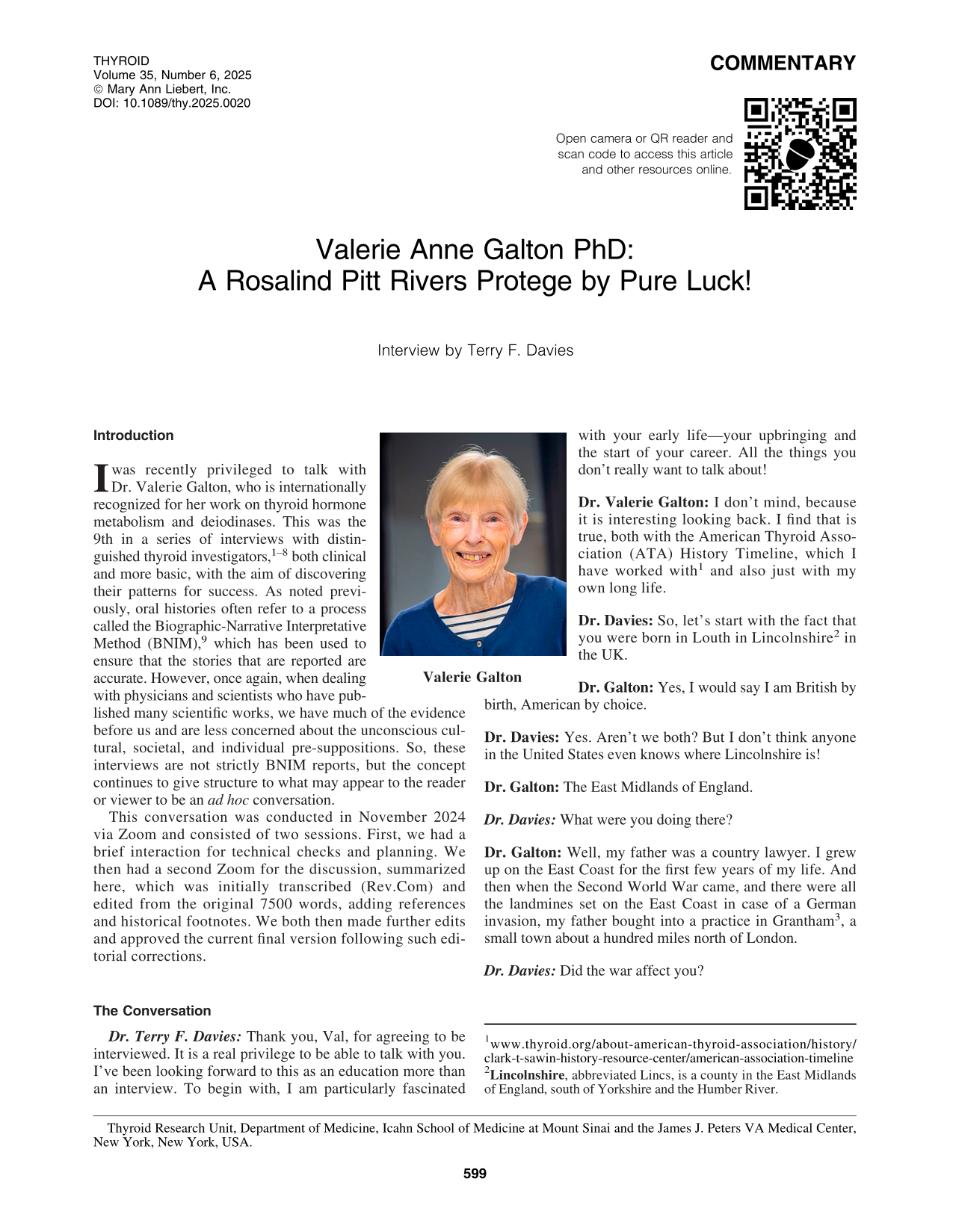
Thank you, Val, for agreeing to be interviewed. It is a real privilege to be able to talk with you. I’ve been looking forward to this as an education more than an interview. To begin with, I am particularly fascinated with your early life—your upbringing and the start of your career. All the things you don’t really want to talk about!
Dr. Valerie Galton: I don’t mind, because it is interesting looking back. I find that is true, both with the American Thyroid Association (ATA) History Timeline, which I have worked with
1
and also just with my own long life.
Dr. Davies: So, let’s start with the fact that you were born in Louth in Lincolnshire
2
in the UK.
Dr. Galton: Yes, I would say I am British by birth, American by choice.
Dr. Davies: Yes. Aren’t we both? But I don’t think anyone in the United States even knows where Lincolnshire is!
Dr. Galton: The East Midlands of England.
Dr. Davies:
What were you doing there?
Dr. Galton: Well, my father was a country lawyer. I grew up on the East Coast for the first few years of my life. And then when the Second World War came, and there were all the landmines set on the East Coast in case of a German invasion, my father bought into a practice in Grantham
3
, a small town about a hundred miles north of London.
Dr. Davies:
Did the war affect you?
Dr. Galton: It was amazing how little, at the time, it affected us, because although we would hear the German planes going over, we were not in an area that was bombed. So, when the air raid siren went off, it was just exciting for us because we got to go down into our basement in the middle of the night and food and water were there for us. So, as a 5 year old, not having known anything else, it didn’t seem unreasonable.
Dr. Davies: Did you go to high school in Grantham?
Dr. Galton: No, I ended up at boarding school for much of my young life. This was originally because of the lack of gasoline. We couldn’t be driven each day to my school on the East Coast, so from the age of four, I boarded there. And that was fun. We all slept in the school basement. I did go to the local school for three years after moving to Grantham. At the time, Margaret Thatcher
4
, the first female UK Prime minister, was head girl. Her father was my mother’s grocer. Then I ended up going to Harrogate College, a boarding school in Yorkshire when I was 11.
Dr. Davies:
And then you went from boarding school to college?
Dr. Galton: Well, this was interesting. Because as I grew up, my parents didn’t really view careers for women as being the norm. I don’t think they even thought about it. But eventually, my father felt very strongly I should have the same education as my brother and that I should have a career in case I needed it. I was lucky enough, when I was at boarding school, to have a really superb chemistry teacher who encouraged me to go to university. I sat the entrance exam for Bedford College
5
, an all-women’s college of London University, and was admitted for a special honors degree in physiology even though I could not, at the time, have defined physiology. And it was a great time, it was just a great education.
Dr. Davies:
So how did you end up with thyroid studies?
Dr. Galton: I had said all along to Professor Margaret Murray
6
, Chair of Physiology at Bedford College, that endocrinology was by far and away my favorite area of physiology. In fact, I was lucky enough, when I had my oral exam for my finals in 1955, to have Henry Barcroft
7
as the examiner. He asked me, “What area of physiology do you like?” And I said, “Endocrinology.” He said, “Oh, I know nothing about that. Tell me about it.” That was a real opening for me. But anyhow, when I started learning about the thyroid, I just found it fascinating. It seemed further along than other areas. The hormones had been discovered and synthesized, and I have never wanted to leave it! But actually, I hadn’t even started to think of what I was going to do next, after graduation, and that was when Rosalind Pitt-Rivers
8
stepped in.
Dr. Davies: So that was your entrance to thyroidology?
Dr. Galton: Yes. It turned out that Rosalind Pitt-Rivers knew my professor (Margaret Murray) very well, and she came down to see if there were any graduating students who would like to do a PhD. My professor asked me, “Would you be interested?” and I said, “yes,” again not really knowing what doing a PhD entailed. However, I knew I enjoyed thyroid physiology, and we had learned about her identification of T3 in 1952.
Dr. Davies:
Well, in fact, in front of me right now is the Gross and Pitt-Rivers Lancet paper on the identification of T3 (1952),
10
which I admit I hadn’t read before, but that’s where I was led to from your biography. So, you joined the lab in 1955, which was 3 years after the identification of T3. She was becoming well known by then, I suppose?
Dr. Galton: Yes, it was at the point that she became very well known. I don’t know whether you’ve read much about her, but I have a copy of an article that Jamshed Tata wrote about her after her death,
11
and it is very informative. It is now available on the ATA Thyroid History TimeLine.
Dr. Davies: Yes, I also read David Evered’s piece written for the European Thyroid Association Milestones in European Thyroidology series after her passing.
12
I do not want to dwell on Pitt-Rivers too much here, but clearly when you joined her lab there must have been a lot of activity.
Dr. Galton: Yes, and a lot of people from the USA, well-known people at the time, such as Nick Halmi
9
, Jacob Robbins
10
, and many others were all coming to visit her, so I got to meet them. But when I joined her group in 1955, she was becoming disillusioned about T3. Having suggested it might be the active hormone, there were a whole lot of reasons why, given the state of the art at the time, she began to feel it was not the active hormone. One was because it, like T4, seemed to have a long latent period of action. That was why she suggested to me that I should see if some of the other analogs, such as Triac (triiodothyroacetic acid) and Tetrac (tetraiodothyroacetic acid), were involved, and that was my PhD thesis, to see if animals made Triac and Tetrac, which they did. My thesis was eventually titled “Identification of some thyroxine analogues in mammalian tissues” and led to a publication
13
Dr. Davies: I see that you published at least 5 papers with Pitt-Rivers around that time including the first confirmation of the Wolff and Chaikoff
11
effect
14
so this was a very successful few years.
Dr. Galton: It was a wonderful time. I also married my late husband, Michael, while there!
Dr. Davies: Yes!. So, you finished your PhD in 1958 with Rosalind Pitt-Rivers and then you end up in Boston of all places!
Dr. Galton: Yes, I didn’t stay in London, and this was a sore point with Ros, who wanted me to remain with her.
Dr. Davies:
She wanted you to stay, and you wanted to see the world?
Dr. Galton: Yes exactly. What happened was that Sidney Ingbar
12
came to do a sabbatical year in London at the National Institute for Medical Research (NIMR) in 1957. He was there when I got back from my honeymoon after the first year of my PhD. And of course, as he was interested in thyroids, I got to know him and indeed his family quite well. He had bought a terrible car that spent most of the year in the shop, so I would often give him a ride to the NIMR on the back of my Vespa, to the great delight of his three-year-old son. I also took Gabriella Escobar
13
around London on my Vespa when she spent a few weeks in the Pitt-River’s lab!
Dr. Davies: Sounds great. I had a Vespa in medical school and they still make good Vespas today!
Dr. Galton: So they do. Anyhow, as the year went on, Sidney and I got very deep into thyroid physiology discussions. You have to put your mind back to the time when we knew very little about deiodination and then ask how important it was for the iodine to come off thyroxine. Was the process connected with its physiological action? We used to sit out on the cricket field and think and talk. I had played cricket at boarding school, so they let me play on the NIMR team. We came up with the idea of testing this idea in amphibians. At the time, it was known that tadpoles responded to thyroid hormone both metabolically and by metamorphosis, whereas frogs were seemingly unresponsive. We hypothesized that the ability of tadpoles to respond to thyroid hormone was dependent on its ability to deiodinate thyroxine. Thus, we needed to study deiodination in this species.
Sid then offered to wait for up to 18 months for me to come to his lab a. work on the project in Boston. As a result, my husband and I decided to go to the USA in 1959 for one year, which turned into two and a half! We sailed over in the Queen Mary
14
, and we arrived in Boston the day Castro took over Cuba. Second of January 1959.
Dr. Davies:
But you must have worked well with the Ingbar lab, and I see that you eventually published the subsequent frog studies in Endocrinology in 1962.
15
showing the unresponsiveness of the frog to thyroxine but the ability of tadpoles to deiodinate explaining their metamorphosis response. In fact, you actually carried on, intermittently, working with Sidney Ingbar all the way through to 1978 did you not?
Dr. Galton: We did indeed go on collaborating long after I moved from Boston to Dartmouth Medical School (DMS) in Hanover, New Hampshire, in 1961.
Dr. Davies:
Why Dartmouth?
Dr. Galton: It really was due to my husband, who had been training to be an obstetrician. He got his MBBS at University College Hospital (UCH), London, and was happy to come to the US with me, basically to get the BTA “degree” (Been To America). He had arranged to do obstetrics at the Boston Lying-In (BLI) hospital
15
, but the methods there were just totally different to what he was used to at UCH and Queen Charlotte’s Hospital in London, and he was not happy. The UK was very much into the natural, or minimal drug use, etc., which was totally the opposite at BLI! Fortunately, he was becoming interested in related research and soon found a home in Kurt Benirschke’s
16
lab at the BLI. However, in 1960, Kurt left to become Chair of Pathology at DMS. He told Michael, “If you really want to do clinical research, you really need to get medically qualified in the US, and if you come to New Hampshire, I’ll give you space in my lab to go on doing work there.” At the time, New Hampshire had medical reciprocity with England. I think it was the only state that did. So, he went up and interviewed and decided that it would be ideal for him, but of course they had to have something for me. The way things were done in those days may shock your readers, but Kurt Benirschke said, “OK, we’ll go up and see Dr. Marsh Tenney
17
, Chair of Physiology, and who as Dean of DMS is leading the refounding of the Medical School, so I’m sure he’ll have space for an endocrinologist.” So, we went up and talked to him, and he told me they could give me some salary, but I would eventually need to get my own research funds from the National Institutes of Health (NIH), which were now giving out grants. And this I think, is probably one of the strangest things of my entire career. He said, “if you’ll just write out your project, we’ll have the face page of the application all ready for you. And you sign it, we’ll fill it in.” I wrote that thing in one afternoon. I mean, it was that simple, and it was funded! I think with the last NIH proposal I submitted, I took more than six months to put it together.
Dr. Davies:
A great story. So how did it go early on in Dartmouth?
Dr. Galton: It was really nice. At that time, as I mentioned, the medical school had just been re-founded. It’s the fourth-oldest medical school in continuous operation in the USA, although prior to its re-founding in 1956, it was run by, I think, three or four physicians at the local hospital. It was re-founded as a two-year medical school. We focused on the basic sciences, initially with 24 students. So, one did have plenty of time for research. We were all very focused both on the quality of teaching for the medical students and on our research. Really, I could not have been at a better place for being able to just move forward and develop, although my chairman felt my collaboration with Sidney Ingbar showed I was not exhibiting enough independence. But Dartmouth, at that time, was isolated, and Sid was not only a mentor and collaborator, but I was friends with the entire family. In fact, his mother-in-law had a summer place in Thetford, VT
18
, near Hanover, and she had horses! So that’s where I was able to continue riding. And of course he was superb to work with. I had a sounding board, and as you know, two people discussing a problem is more productive than either of them doing it singly.
Dr. Davies: Quite right. I did meet Sidney Ingbar before his illness. He also liked things I liked, such as the TSH receptor and its antibodies. Of course, he was interested in everything in thyroid, right? There wasn’t much that he wasn’t interested in or hadn’t published on.
Now, you have done a lot of work on iodine with Pitt-Rivers and Ingbar and continued your studies with a lot of work on thyroxine metabolites. But I have the feeling you’re not really proud of that period of work investigating deiodination.
Dr. Galton: I was at the time.
Dr. Davies:
Yes. We all celebrate when a paper is published. Right? Looking back, you think that it didn’t make too much progress? Is that the right impression?
Dr. Galton: I think everybody working on thyroid hormone metabolism at that time had a rude awakening when we discovered that a lot of the deiodination that occurred when you studied it in vitro was chemical deiodination
19
. With our first tadpole studies, we had planned to use tissues incubated at 0°C as controls. However, it proved to be a hassle to get ice in a timely fashion at that time, so we switched to using boiled tissue as a control. Then we found that some deiodination of thyroxine could occur in the boiled homogenates! Ultimately, we showed that it was due to the generation of peroxidase-like compounds. Peroxide deiodinates thyroxine very rapidly. So eventually, we gave up studies in vitro, and I then worked primarily on deiodination in vivo.
Dr. Davies:
Right. So that obviously came to be a great success, in the sense that the deiodinases were eventually found,
16
to prove that the earlier observations in 1962.
15
were correct. Is that fair enough?
Dr. Galton: Well, not exactly. I have to be honest and say that we came to the right conclusions but for the wrong reasons because most of the studies were done in liver, and Rana catesbeiana tadpoles do not have 5′ deiodinase activity in the liver. But we didn’t know that at the time. It was only once the deiodinases were identified and characterized that we saw the light. That was after Visser
20
published his 1976 paper
17
about the need for reducing agents in the system, such as DTT. Once that was discovered, then we could return to doing in vitro studies, and I spent a lot of the 80s studying the ontogenic profiles of the D2 and D3 in amphibia
18,19
and later in rodents.
Dr. Davies: Yes. And you were working very happily in Dartmouth with your own lab.
Dr. Galton: Yes, but by this time I was on my own with two young boys since my husband had died in a car accident.
Dr. Davies:
Oh, how terrible. What happened?
Dr. Galton: From 1967 to ‘68, we spent a sabbatical year in Mexico. My husband wanted to go to Mexico for a specific research reason, so we went over there with the boys. They were five and three, and we put them in a local school, and they had a really good year. I don’t know whether you noticed on my CV that there are papers on hydatidiform moles.
20
It was known that molar pregnancies were associated with very high levels of protein-bound iodine (PBI). Sid Ingbar knew that Mexico had a lot of molar pregnancies, whereas the US sees only a few cases per year; I studied 50 cases in Mexico while I was there. At the time, I could only determine blood PBI
21
levels of the patients; the measurement used at the time indicated relative plasma thyroxine levels, but after I returned, Jerry Hershman
22
determined the actual thyroxine levels for us using his recently developed assay.
Dr. Davies: I have one of these conversations with the late Jerry Hershman,
5
and I knew him very well for a long time. He was one of my favorite colleagues. A very wise man.
Dr. Galton: Yes, I knew him well too, and he was really good. All went well until coming home from Mexico, just after we crossed into the US, my husband was hit by a car as he was crossing the road and later died.
Dr. Davies:
How terrible. Were you all out of the car, or just Michael?
Dr. Galton: We were still in the car. Ironically, we had been breathing our collective sighs of relief at having driven all over Mexico for a year and survived. But anyhow, things like that happen, and you have to pick yourself up and move on. Now it is a long time ago.
Dr. Davies: You do what you do. My wife has a mug. On the front of the mug, it says, “Stand up and carry on.”
Dr. Galton: Yes. I have a more colorful way of saying that, but I will not voice it here. Now a lot of my friends are losing their wives or husbands after many years together. In retrospect, I think it is much harder for them than ever it was for me after only 12 years of marriage because I had my two kids to focus on.
Dr. Davies: All right, so we’ve got you busy in Dartmouth now, with maybe more freedom to do your work, as the boys grow. And you have 150 papers for me to review, which I obviously can’t do justice to. There are one or two that I know you’re particularly pleased with and also your recent focus on thyroxine being an active hormone.
Dr. Galton: Yes, but first let me say that all my work from 1980 onwards would not have been possible without the collaboration with Donald St. Germain
23
and Mark Schneider
24
. I’m well aware I could not have done it on my own. The cDNAs for the type 2 and 3 deiodinase cDNAs were first identified in tadpoles in our labs,
21,22
and Mark made the targeting vectors for our D1 knockout (KO)
21
and D2 KO
22,23
mice. These mice gave us great models to really study what happens when you don’t have one or more deiodinase enzymes. For example, knock out the five prime deiodinating enzymes from a mouse (D1/D2-KO), and thyroxine should have no action, at least according to conventional wisdom. Right? Well, wrong. The gross phenotype of these mice is very mild,
24
and this reawakened in me the likelihood that T4 must have some intrinsic activity.
There is a paper early on
25
where we provided evidence that tadpoles didn’t have to convert T4 to T3, for it to be active. And that was certainly Rosalind Pitt-Rivers’ view. I am not disagreeing with the view that T3 is responsible for the vast majority of thyroid hormone action, I think it is, but we have obtained indisputable evidence that thyroxine per se has intrinsic activity, using a mouse we created that could neither deiodinate thyroxine nor synthesize T3, the D1/D2/Pax8-KO mouse.
24
I think the results may have opened Pandora’s box.
Dr. Davies:
So that’s the 2021 paper on the intrinsic activity of T4
26
?
Dr. Galton: Yes. And the thing that I find fascinating the most is that, in the liver, T4 is more effective than T3 on the genes that are down-regulated by thyroid hormone,
26
and it’s much more striking in the brain, which we are working on now.
Dr. Davies:
So, the T3 reaction becomes a secondary action?
Dr. Galton: Well, I wouldn’t go that far, but there is a lot more going on than the hormones simply being secreted by the thyroid gland. They are differentially taken into different tissues, and different tissues can produce different amounts of active T3, which we know is true, but there’s still more to it than that.
Dr. Davies: Particularly in the brain. Because different areas are going to metabolize thyroid hormone in different ways and use it in different ways.
Dr. Galton: We have the data in brain. I’ve managed to sort out which genes are affected by which hormone from this large RNA-seq, I think there are about 25,000 genes, and many seem to be affected.
Dr. Davies: The hard part is deciding what percentage change is significant.
Dr. Galton: Yes. I am collaborating with Arturo Hernandez
25
on this, so this winter we are going to get together and do more analyses. We need to act soon because we can’t count on me having many more years!
Dr. Davies: Well, judging by this conversation, you’ve got quite a long way to go. You better be prepared for a goodly number of cold winters. Which you must like.
Dr. Galton: I’m liking it less than I used to. I’m definitely more sensitive to it. But yes, I like to get out in the snow, and I like to cross-country ski.
Dr. Davies: Well, be careful.
Dr. Galton: Well, the one thing that’s become apparent in the last few years is that your mind is aware of your age, probably more than you are, as you become more fearful. I stopped horse riding when I was 84 because I became bothered by the idea that I might fall and incapacitate myself.
Dr. Davies: Quite right. Now, you’ve been, obviously, associated with the ATA for a long time, and I don’t know when you first became a member.
Dr. Galton: 1963. Bobbi Smith
26
told me it was then.
Dr. Davies: So that’s a long time. 60 years. Obviously, you’ve enjoyed being a member, and the ATA established the Valerie Anne Galton Distinguished Lectureship Award to recognize your contributions. The award recognizes an ATA member who demonstrates collaborative research as you have done for many years and supports an honorarium and travel stipend to attend the ATA Annual meeting.
Dr. Galton: Yes; that was wonderful, and I do enjoy the ATA meetings better than the Endocrine Society meetings because, using a very female word, it’s very “cozy.” It’s of the right size. The Endocrine Society, to me, although it’s very useful, and I am a member, it’s just too big and has less thyroid. But it was nice when I first started. Again, looking back on it, although I never thought about it at the time, there weren’t many women in it, in fact, hardly any women at all at either meeting. Then investigators started to take their students and postdocs along, so it wasn’t totally devoid of women. It was the same when I first got on an NIH study section, I was the only woman for a while. Looking back, it was not something that I really thought about at the time.
Dr. Davies:
Why do you think it was so difficult for women to progress?
Dr. Galton: It is awfully hard for me to say because I think I did it by pure luck. My female chemistry teacher, my female college professors, and then Ros Pitt-Rivers. And then through Pitt-Rivers, I met open-minded people primarily from the US as they came through Ros’ lab. When I came to the USA, many invited me to visit. So, it was easy for me. And I have to say, both with the ATA and also at Dartmouth, I’ve never felt discrimination. Quite the contrary, I think everything was done to help me along. And part of that was our Physiology chairman. In 1962, a year after I got there, out of a faculty of 10 in our department, 3 were women. When I first started at DMS, there was only one woman medical student. And then shortly thereafter, they began to admit a few more women. With 20/20 hindsight, compared with now, they were looked at rather disdainfully by the men. That gradually improved as the numbers grew. Now the gender ratio is on either side of 50%, and it is quite clear that the men respect them. In fact, there used to be a prize, voted on by the medical students, for the graduating student who they feel will make the best physician. And four times out of five, it was given to a woman! So, I think they’ve made a lot of headway. I think it’s like anything else, it takes time. I look at my kids, particularly with race and gender, and they don’t bat an eyelid about either.
Dr. Davies:
That’s correct. I think we’re coming towards the end of time, so tell me a little bit about your “boys,” what are they up to?
Dr. Galton: Well, my older son is at UCSD and is a professor of electrical engineering, and he has a daughter who now has a PhD in Developmental Biology and is doing a postdoc in Kansas City. He also has a son who is an expert in specific lighting needs for growing plants and is also finishing a degree, part-time, while continuing on this career path. My younger son, who fortunately for me lives on the East Coast, obtained a law degree and then built a successful career in urban real estate development. He has two daughters, one who is now in her first year at Dartmouth and who wants a career like mine and plans on going for her PhD. And then a younger daughter, who has also applied to Dartmouth, among other schools. She is more into the humanities, creative writing, and film, etc.
Dr. Davies: Plenty of young people to keep you busy.
Dr. Galton: Yes. And the Kansas City granddaughter now has two sons, so I have two great-grandsons!
Dr. Davies: Really? Well, I hope you manage to see them now and then. It’s a long way to Kansas City.
Dr. Galton: Well, they all came over in May for my 90th birthday.
Dr. Davies:
Oh, congratulations. Now I think our last discussion should be the future of thyroidology. Where do you think the important progress is going to be?
Dr. Galton: I think we need to know more about which genes are really important in thyroid action and which of the hormones are acting at the early stages of development and of course we have so much to learn about the brain.
Dr. Davies: The role of thyroid hormones in mammalian development is indeed very important and not well clarified at all.
Dr. Galton: That’s right. Particularly very early on, which is something my granddaughter is looking into. She is working on killifish
27
. I happened to mention to her that thyroid hormones are effective in fish. She said, “Well, what about in their development?” I said, “I don’t know if anyone has actually looked at fertilized fish eggs.” Now she already has a very preliminary suggestion that their development is indeed sped up with thyroid hormones.
Dr. Davies: Fascinating. But we need to close now. This has been a real education for me, and you need time for a lot of RNA-seq to work through.
Dr. Galton: Well, thank you.
Dr. Davies: And thank you for your time.
Dr. Galton: I’m honored that you would choose me.
Dr. Davies: You are having a wonderful life, and your story is dramatic and interesting.
Bye-bye, Val.