




Abstract
A new system for nasal sound analysis via Internet to cellular phone was investigated. Spectral analysis of the nasal sound with frequency domain and dB is an important factor in the investigation of nasal airflow pattern. This study included 10 patients and 10 healthy subjects. Patients underwent nasal septoplasty surgery for treatment of nasal septal deviation. This nasal sound analysis was performed on subjects at 1 month postsurgery. This study was performed using an investigator-developed software that sends real-time frequency and spectral analysis video of a patient's nasal sound to an otolaryngologist's cellular phone. Sound intensity was observed at over 25 dB with high range of frequency (2–4 kHz) and less than 10 dB with low (500–1,000 Hz) and medium (1–2 kHz) frequency from 10 patients with nasal obstruction symptoms (group A). In 10 healthy subjects without nasal obstruction symptoms (group B), sound intensity was observed at high frequencies below 5 dB; however, low and medium frequencies were above 15 dB. A statistically significant difference in sound intensity was observed between group A and group B. It was ascertained that use of the new technique will help patients to avoid an unnecessary return to the hospital and will also save money and time.
Introduction
In recent years, live telemedicine as a way of obtaining advice from healthcare professionals has been suggested as an alternative to the traditional referral system and has been adapted in the telemedicine field because of development of wireless communication and enhancement of data transmission. Recently, the iPhone (Apple, Inc.) has fundamentally changed the capabilities of handheld phones and can receive data correctly and quickly through a 3G network and high-speed wireless transmission. The function of the iPhone is strengthened by installation of various applications and iCam (SKJM, LCC). One of its applications is useful by connecting to live audio and video through the iPhone. The technical proof of concept in this study was established using iCam software that sends real-time frequency and spectral analysis video from a patient's nasal sounds to an otolaryngologist's iPhone through a remote setting. That is, patients can easily check on the condition of their nasal passages in real time without hospital visits after nasal surgery, and iCam software can be applied to the practice of real-time otolaryngology consultation.
Materials and Methods
A basic schematic diagram and photograph of the hardware setup are shown in Figure 1.

A schematic diagram of the hardware setup: solid lines represent hard-wired connections; dotted lines represent wireless connections.
Subjects
Ten patients including 6 men and 4 women (average age: 25; age range: 17–38) were enrolled in the study. Their primary complaint was nasal obstruction, and they did not have any additional pathology. All of the patients in this group underwent nasal septoplasty. The control group consisted of 10 normal subjects (no nasal complaints or significant nasal septal deformities), including 5 men and 5 women (average age: 24; age range: 19–36).
Equipment
Subjects' nasal sounds were recorded using a computer via microphone (AT831b; Audio-Technica Co.), and a low-pass filter, including amplifier and variable cutoff frequencies, was built into the microphone (frequency range: 40–18,000 Hz). The microphone was connected to an amplifier and a data acquisition board (NI USB 9162; National Instruments Co.), and the nasal sounds were recorded and sampled.
Software
Spectral analysis and frequency analysis programs for nasal sounds were developed by the Medical Device Clinical Trial Center, Korea University, using the fast Fourier transform technique from Labview (National Instruments Co.). We characterized the following frequency spectra by using a series of variables: low frequency (500–1,000 kHz), medium frequency (1–2 kHz), and high frequency (2–4 kHz).
Methods of Nasal Sound Recording
From a location, patients performed transmission of expiration sound from each side of their nasal cavity, as directed by an otolaryngologist in a hospital. In a testing room under quiet conditions with a temperature of 23°C–25°C and a humidity ratio of 50%, patients performed the test after taking a deep breath. Patients were instructed to relax before starting the test. The microphone was placed 1 cm from the nose. Patients covered their right nostril with their right thumb while measuring nasal sounds of the left nostril and covered their left nostril with their left thumb while measuring nasal sounds of the right nose. Measured frequency and spectral analysis data were transmitted to the otolaryngologist through the iCam application in real time and diagnosed. Peak level was calculated in the program and was the maximum value of noise level.
Statistical Analysis
Value data for the patient group and the control group were tabulated and interpreted using the Student's t-test. All the statistical outcomes based on the two-sided test were completed using SPSS software (version 12; SPSS, Inc.). We regarded a p-value of <0.05 as statistically significant. All data were expressed as mean±standard deviation.
Wireless Data Transmission
The microphone was connected to a MacBook Pro laptop (with a 2.4 GHz Intel Core 2 Duo processor, 4 GB memory, and 1,066 MHz SDRAM; Apple, Inc.) with the operating system of a Mac OS X 10.6.1. iCam and iCamSource (SKJM, LLC) were used to send videos from the program by working on the laptop. iCamSource sends video and audio in a designed monitor to iCam software installed in the iPhone, transmission signals were protected as codes, and an iCamSource was installed in the MacBook Pro. The monitor of Labview program was selected for input of iCamSource. Input of audio was off, and the MacBook Pro was connected with the home asymmetric digital subscriber line Internet to a wireless 802.11g router through an internal 802.11g wireless network card (Airport; Apple, Inc.). The testing location for patients was 31 km away from the otolaryngologist who received signals. The iPhone with iCam software received signals through a cellular 3G connection or local network with a WiFi signal. Patients and otolaryngologist communicated using Skype (Skype Ltd.), a free Internet phone call service.
Results
Sound intensity was interpreted as an increase of frequency within the sound spectrum. Sound intensity was observed under 5 dB with high frequency and over 15 dB with low and medium frequency from 10 subjects without nasal obstruction (group B) (Fig. 2a). Table 1 shows nasal cavity results from patients with nasal obstruction.
Results of Nasal Cavity Examination

Nasal sound frequency samples:
Sound intensity was observed at over 25 dB with a high range of frequency (2–4 kHz) and less than 10 dB with low (500–1,000 Hz) and medium (1–2 kHz) frequency from 10 patients with nasal obstruction symptoms (group A) (Fig. 2b).
Table 2 shows the mean sound intensity of the patients group and the control group. Sound intensity between group A and group B showed a statistically significant difference.
Mean Sound Intensity (dB) at Low Frequency (500–1,000 Hz), Medium Frequency (1–2 kHz), and High Frequency (2–4 kHz) in the Patient Group and the Control Group
Values are mean ± standard deviation.
Statistically significant difference (p < 0.05) in comparison with group B.
The otolaryngologist was able to diagnose patients' nasal sounds by spectral and frequency analyses in real time. Figure 3 shows a video of patients' nasal sound analysis on the iPhone. The otolaryngologist was able to communicate results to patients using Skype. The average bandwidth of transmitted video was 1.7 Mb/s (range: 1.5–2.3 Mb/s). The frame rate was calculated to be 0.4 frames per second (fps) when connecting through the 3G network and 1.1 fps through WiFi. The average frame rate of the transmitted original signal was 11.9 fps.
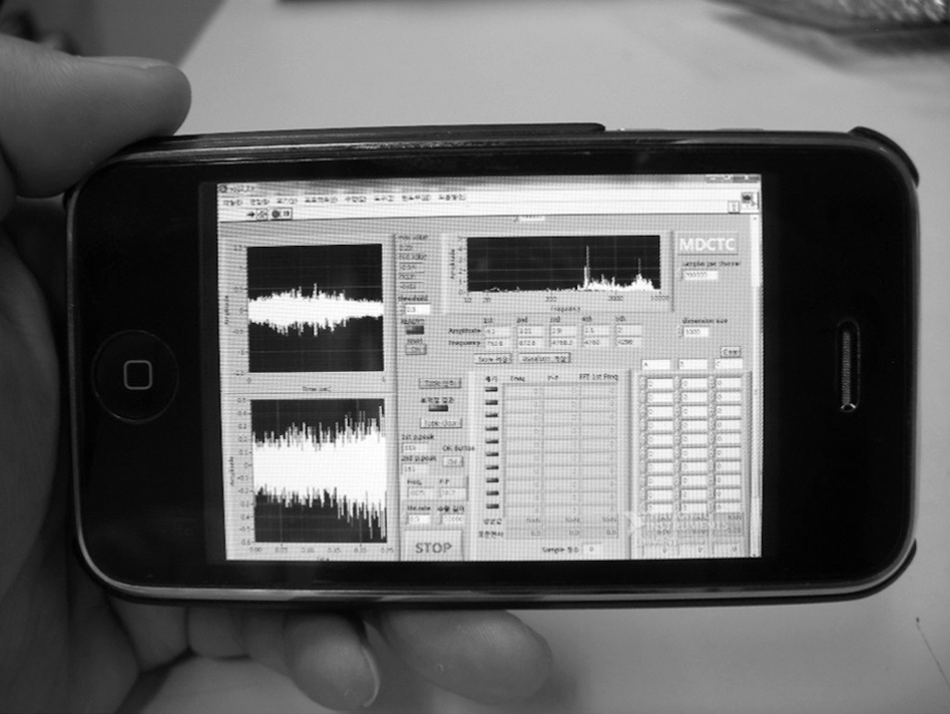
An image example of a video transmitted to an iPhone.
Discussion
Telemedicine can be defined as the provision of healthcare consultation and education using telecommunication networks to convey information or simply as the use of telecommunications for medical diagnosis and patient care. 1 Telemedicine technologies can help to provide reasonable efficiencies for the healthcare system. 2 Today, the most common information captured in one place at one time to another place for review and analysis at another time. This is known as store-and-forward (asynchronous) consultation. 3 However, this study was performed as a technological proof of concept, adapted to the interactive (real time; synchronous) consultation, and to prove its diagnostic potential and low cost compared with existing otolaryngology telemedicine consultation.
The unique thing is that spectral and frequency analyses video of the patient's nasal sounds was transmitted to the iPhone 3G, a cellular phone, in real-time. Cellular phones are easy to carry and otolaryngologists could use them anytime. In this study, iCam application has been proven to have good connection with video quality and nasal sound analysis video.
Transmitted video was protected with a security code, and user name and password were required for anyone to log-in. Several otolaryngologists can check from their cellular phone at the same time. Also, audio feed was transmitted with real-time video and real-time audio commentary from the iCam application, which increased the education effect. WiFi connection was observed to have a faster frame than 3G during transmission of video for nasal sound analysis, and use of WiFi would be preferable if a wireless environment is offered in the hospital.
In this study, no video image quality problems associated with wireless transmission were observed in nasal sound analysis; however, the quality of the general video was limited to problems associated with wireless Internet connection. Transmitted video with limited bandwidth should have the same quality and frame rate. Transmitting pixel per second is limited when there is a limitation in bandwidth and a complicated result is obtained because of video image quality degradation, decrease of frame per second, transmission delay, and others. Although these problems were issued in existing telesonography within telemedicine, recent real-time ultrasound scanning video is continuing by variable compression and technical development. 4 –8
Until now, the specific methods used for evaluation of nasal obstruction have been performed. The relationship between rhinomanometry and peak nasal inspiratory flow was studied by a group in Germany. 9
Dastidar et al. 10 correlated the volumes and cross-sectional areas of the nasal cavity with those obtained by clinical acoustic rhinometry in patients with chronic sinusitis. Stefan et al. suggested a new method for functional rhinologic diagnostics, named long-term rhinoflowmetry. 11,12 Nasal sound frequency analysis has been widely investigated by a Turkish group. 13 In addition, other methods were applied to evaluate the patients with nasal obstruction, such as impulse oscillometry, optical rhinometry, and nasal spirometry. 13 –17
Using sound frequency by nasal airflow such as Odiosoft-Rhino, one of these evaluation methods was a noninvasive technique for real-time remote treatment and was suitable for evaluation of nasal obstruction. This is because spectral and frequency analyses are facilitated by use of fast Fourier transform of a nasal signal from a microphone. Nasal sound analysis video of two test groups is sent to the otolaryngologist in real time and evaluated. After nasal surgery, patients' nasal airflow is affected, and the laminar flow and consistent flow patterns are changed. In nasal sound spectral analysis of laminar flow, sound intensity was observed under 10 dB with high frequency and almost 20 dB in turbulent flow with low frequency. A turbulent flow pattern of nasal flow is a sign from patients with nasal polyp, nasal synechia, crust formation, and turbinate hypertrophia, which lead to narrow nasal cavity. This is the reason for classification of nasal cavity evaluation.
In this study, while interpreting sound frequency, the nasal cavity obstruction situation was observed for all patients. After surgery, patients had no symptoms of nasal obstruction. This technique has been proven effective in nasal airflow analysis (septoplasty, concha reduction procedure, polypectomy, etc.) after surgery.
After undergoing nasal septoplasty, and because of early stage crustal development, a follow-up check must be performed directly with an otolaryngologist at a hospital. Also, the time for wound healing may take about 1–2 weeks. Within this period, patients must make medical visits to check the condition of their nostrils for presence of possible infection or hematoma. After this stage, patients still have to regularly visit the hospital for checkups to see whether the result of their operation is appropriate or not. If this investor-developed device is used in their home, they do not need to visit a hospital during this period. Therefore, traffic expenses and checkup fees should be saved. Even the traveling time, reservation time, and waiting time to see doctors would all be saved. In particular, it would be of great help for the elderly people or patients living in remote villages.
In conclusion, transmission of real-time nasal sound analysis video to a remote iPhone using inexpensive technology is feasible, with preservation of the video image quality and minimal delay.
Transmission speed using a WiFi connection was superior to that with a 3G connection. At this stage, the system is composed of a laptop computer with a software program, and a microphone, amplifier, and data acquisition (DAQ) board are used for measuring nasal sounds. Therefore, for further studies, we would like to make use of a more compact apparatus, such as an iPhone with a microphone, or an all-in-one unit. It would be more portable, simpler, and easier to use in any quiet place.
Footnotes
Acknowledgments
This study was supported by a grant from the Korea Healthcare Technology R&D Project, Ministry for Health, Welfare, and Family Affairs, Republic of Korea (A090084).
Disclosure Statement
No competing financial interests exist.