




Abstract
Healthcare personnel shortage is a growing concern in many countries, especially in remote areas, where it has major consequences on the accessibility of health services. Information and communication technologies (ICTs) have often been proposed as having positive effects on certain dimensions of the recruitment and retention of professionals working in the healthcare sector.
Introduction
Information and communication technologies (ICTs) have often been proposed as an effective way to counter workforce shortages in the healthcare field. 1,2 The objective of this knowledge synthesis is to better understand the influence of ICTs on factors related to the recruitment and retention of healthcare professionals, particularly job satisfaction, continuity in service delivery, continuing education opportunities, and knowledge transfer.
Context
Workforce shortages in the health sector are a growing concern in Canada, as in many other countries of the world, 3 and workforce-related problems are a major preoccupation for decision makers. 4 This problem is particularly important in peripheral, rural, or remote areas, because of significant inequalities in workforce distribution between regions. Canada is the second largest country in the world in terms of geographic area and the population is of low density according to international standards. Although some areas are very urbanized, 20% of the Canadian population lives in communities of less than 10,000 inhabitants. 5 In such context, equitable and continuous access to health services represents a constant challenge.
Workforce shortages in the health sector are well documented among physicians 6 ; however, little is known about how this problem also affects other groups of healthcare professionals, contributing to the importance of this study. Moreover, problems related to human resources are expected to increase in the coming years. For example, in the province of Quebec, the Ministry of Health and Social Services estimates a current deficit of 10,000 nurses, which could rise to 17,000 in 2014. 7
Workforce shortages are a relevant issue because of the repercussions they have on access to healthcare. Moreover, these problems add direct pressure to existing healthcare professionals and create difficult working conditions because of increased workloads. 8 It is therefore urgent to find innovative solutions and to develop strategies that optimize the use of available resources.
ICTs: A Support for Healthcare Professionals
Among these solutions, several studies propose that ICTs could have a positive effect on workforce recruitment and retention. 1,9 As in all sectors of human activity, the healthcare sector increasingly uses new technologies to improve the health system and to make it more productive and effective. 10
These technologies facilitate the acquisition, transfer, and exchange of knowledge, which can have a direct impact on healthcare professionals' job satisfaction and quality of life. Research by members of our team and by other investigators has demonstrated the impact of telehealth on various aspects of work environment and delivery of medical services. For instance, a study has demonstrated that telehealth could have a positive effect on several factors influencing physicians' recruitment and retention, thus supporting the delivery of health services through better distribution and improvement of medical services in remote regions. 9,11
Telehealth is also a means to facilitate better organization of care and a more equity among geographic regions, by eliminating travel constraints of both patients and health professionals. 2 Consequently, telehealth could facilitate a better equity between regions and between countries, increase professionals' knowledge and skills through distance continuing education and direct contact with experts in large centers, and decrease the feeling of isolation. 12 As well, telehealth introduces an important change in medical practices, as it encourages individualistic and isolated practices to become more networked and collective, based upon the sharing of medical information and knowledge. 1
Although there are several well-documented positive effects of telehealth, such as access to better healthcare, continued education, professional development, and knowledge sharing, 1,2,13 we know little about its impact on health sector staff recruitment and retention in less-served regions. Studies demonstrate that possibilities of promotion, continued education, and professional development were factors that could influence medical staff retention. 14,15 Although according to certain studies 1,9 , telehealth has a positive effect on many organizational, professional, and educational factors influencing recruitment and retention, there is a lack of current knowledge about its real impact on various aspects of recruitment and retention and on the work of healthcare professionals. 12,16
Also, little data are available about the impact of other ICT applications on the health sector workforce. For example, in medical education, evidence points about positive effects of educational training activities increased for teaching doctors working in areas of practice. 17,18 However, the impacts of ICTs on job satisfaction and retention of health sector staff have yet to be demonstrated. 16 This knowledge synthesis, therefore, responds to the need for better understanding the impact of ICTs on various aspects of recruitment and retention of health sector workforce.
Objectives
The main objective of this systematic review was to synthesize current knowledge on the influence of ICTs on recruitment and retention factors of health sector staff and, more specifically, on job satisfaction, continuity of services, and opportunities for continuing education and knowledge transfer.
Materials and Methods
A systematic literature search was conducted on the following databases: PubMED, Embase, CINAHL (EBSCO), Web of Science (SCI and SSCI), Cochrane Library, Business Source Premier (EBSCO), and Proquest ABI/Inform Global. Empirical studies in the gray literature were also searched. The Journal of Telemedicine and Telecare (1996–2009) and Telemedicine and E-Health Journal (1995–2009), as well as journals related to rural health: Australian Journal of Rural Health (1992–2009), the Canadian Journal of Rural Medicine (1996–2009), the Online Journal of Rural Nursing (2000–2009), and the Rural and Remote Health Journal (2001 and 2009), were also reviewed. Additionally, Web sites such as Delta Health Education Partnership, Canadian Society of Telehealth, Center for Health Workforce Planning and Analysis, Telehealth.net, American Telemedicine Association, and Telemedicine Information Exchange, as well as Google and Google Scholar search engines, were included.
The included studies met the following inclusion criteria: (1) were empirical study, (2) involved healthcare professionals, (3) described one or several ICT applications, (4) investigated ICT impact on recruitment or retention (or both), and (5) were published in French, English, or Spanish.
A data extraction grid was created to collect relevant information for this review. The following information was extracted: descriptive characteristics of study (origin, type of study, methodology), type of healthcare professionals, type of ICT and its application, sample size, area where the study took place, and results related to recruitment and retention dimensions. Extraction was done by two independent members of the research team who compared their results and reached consensus about the final codification. Finally, study quality was appraised using a mixed-methods research scoring system developed by Pluye et al., 19 which proposes evaluation criteria for quantitative, qualitative, and mixed-methods studies. This grid proposes six criteria for qualitative studies and three for quantitative studies. For mixed-methods studies, the criteria for both the qualitative and quantitative studies as well as three extra criteria specific to this category were completed. This evaluation of study quality did not aim to decide upon inclusion or exclusion, but rather to help take into consideration the studies' results according to their scores.
Results
A total of 2,225 publications were retrieved using the online search strategy, and an initial selection was made using titles and abstracts (Fig. 1). Fifty-nine publications were retained for full-text review, of which 13 were included in the systematic review. We consulted the references of these publications and examined the ISI Science Citation Index database, which led to the inclusion of a new publication. A search of documents and reports from other sources such as government Web sites (gray literature) also identified two other publications. Of the 16 included publications, some were related to the same study and were thus considered collectively. Thirteen studies (represented by 16 publications) were finally included.
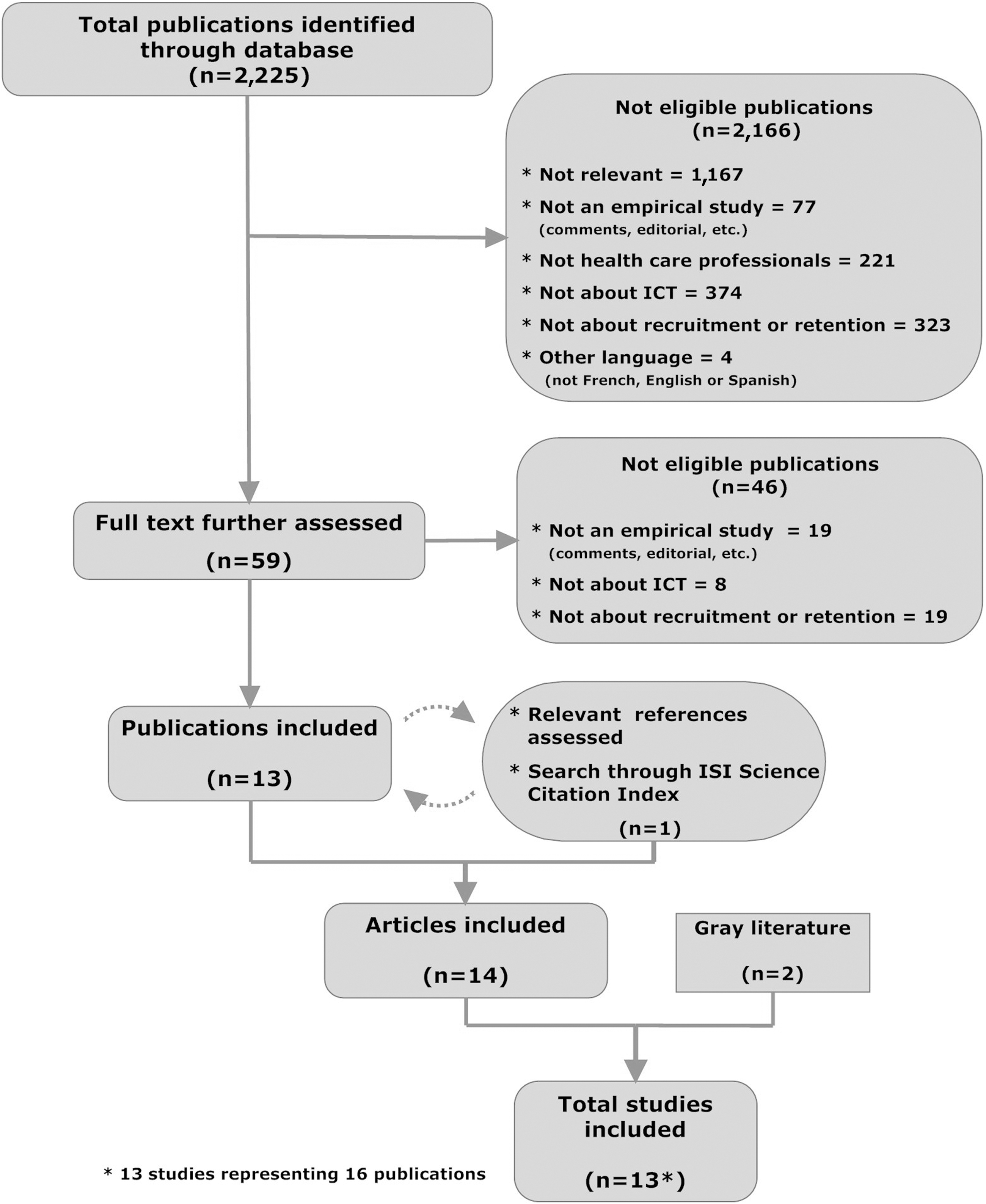
Flow diagram of study selection.
Characteristics of Included Studies
Of the 13 included studies, 11 are from scientific literature 2,9,11,12,20 –28 and 2 are from gray literature (Table 1). 29,30 One study comprises publications from both gray and scientific literature. 31 All but one of the included studies are from Anglo-Saxon countries: Canada (6), 2,11,12,20,22,23,27 United States (4), 25,28 –31 Scotland (1), 26 and Australia (1). 21 The remaining study is from Japan. 24
Influence of Information and Communication Technologies on Factors of Healthcare Professional's Recruitment and Retention in the Included Studies
ICT, information and communication technologies; PACS, Picture Archival and Communication System; RIS, Radiology Information System.
All of these studies were published between 1993 and 2007. Among the 13 included studies, 4 have a quantitative study design, 21,25,28,30 5 are qualitative, 2,9,11,20,22 –24 and 4 are mixed methods. 12,26,27,29,31 The included studies mainly concern nurses and physicians. Three studies are exclusively related to nurses 20,22,29 –31 and three others are dedicated to physicians and medical residents. 9,12,27 One study concerns both nurses and physicians 26 and another study is about nurses and mental health practitioners. 12 Other studies involve radiology technologists, 25 occupational therapists, 21 and physiotherapists. 24
The last two studies deal with all types of healthcare professionals, without distinguishing between them. 2,11,23 Although healthcare professionals are the general focus of these studies, other participants are also present in certain studies: project coordinators, 23 researchers in the healthcare field, 11 case managers, 28 administrators, 28 and medical directors. 11
Five studies are related to both recruitment and retention. 2,9,11,12,21,23 Five studies exclusively examine retention, 24,26,28 –31 whereas the three others pertain only to recruitment. 20,22,25,27
The oldest study 20 focuses on information technologies as system, allowing management of patients, care, finances, and patients support as well as the computerization of hospital environments. All other studies target the domain of telehealth. Of these, five focus on general telehealth, 11,20,23 27 five on videoconferencing and teleconsultation, 12,21,24,26,28 two on home telecare, 29,30 and one on digital radiology through the picture archival and communication system. 25
The tasks covered through these technologies are very diversified: admission, transfers, and update of patient records, 20,22 teleconsultations and home care, 2,23,26,29,30 meetings and information exchange, 24,25 teleradiology diagnosis, 25 and distance education and networking. 12,21,28 For two studies, a specific task was not specified. 9,11,27
Among the included studies, six involve only remote and/or rural areas, 9,11,12,21,24,27 four focus on all areas (remote and/or rural, semiurban, and urban), 25,28 –31 two concern two of these areas, 2,23,26 and one study does not specify the area in which the research was conducted. 20,22
Influence of Icts on Recruitment and Retention
Among the 13 studies included in this review, 3 conclude that ICTs do not influence recruitment and retention. 20,25,28 According to the study by Rapko and Adaskin 20 and Hughes et al. 22 involving 202 nurses at a Canadian hospital using an integrated information system, hospital computerization has no influence on nurses' intention to engage in a hospital with such technologies. A study by Reiner et al. 25 involving radiology technologists came to the same conclusion, indicating that staff shortages are not affected by the presence or absence of digital radiography/picture archival and communication system. Finally, Meyer 28 examined the link between use of technology and job satisfaction among various healthcare professionals in rural southeast regions of Ohio in the United States, and he found no significant relation between continuing education for rural practitioners via ICTs and their intention to continue practicing in rural areas.
A single study by Sargeant et al. 12 concludes that ICTs have limited influence on recruitment and retention. The results of this 2-year evaluation of a telemedicine program in small rural communities of Nova Scotia do not lead the authors to conclude that telemedicine is a factor that influences recruitment and retention of physicians in rural areas.
As for the nine other included studies, their results indicate a possible positive influence of ICTs on recruitment and retention. Watanabe et al. 2 and Jennett et al. 23 led a study involving telehealth project coordinators in 12 Canadian provinces and territories and concluded that ICTs have an effect on recruitment and retention of healthcare professionals by contributing to reducing professional isolation and by allowing more clinical support by the peers. A study by Brebner et al. 26 with nurses using an emergency teleconsultation service in Scotland came to the same conclusion, stating that teleconsultation can affect recruitment by reducing professional isolation.
A case study by Jin et al. 24 offers a concrete illustration of improved retention due to the use of an ICT. The presented case is one of a physiotherapist in a remote region of Japan, for whom access to videoconferencing positively influenced this health professional's quality of life and choice to continue to practice in a remote region. Other authors came to similar conclusions, affirming that telehomecare influences nursing retention by improving job satisfaction. 29 –31
The results of a study by Gagnon et al. 27 among medical residents reveal that ICTs have positive effect on residents' intention to practice in remote regions. This intention is correlated in part with residents' perceptions of the positive effects that telehealth may have on quality of practice and, in part, with their intention to use telehealth. Further, it seems that one of the factors influencing residents' intention to practice in remote regions is the possibility of access to continuing medical education, which telehealth can facilitate. 27
Taylor and Lee assert that access, availability, and use of ICTs play an important role in influencing occupational therapists to continue to practice in rural or remote areas. 21 Their study of 413 occupational therapists found that access to ICTs influences their job satisfaction and thus their decision to continue their practice in rural or remote regions. Further, according to a Delphi study involving 12 Canadian telehealth experts, led by Duplantie et al., 11 ICTs have an indirect effect on recruitment and retention by influencing related factors such as providing a second opinion in case of doubt, diminishing the feeling of isolation, supporting decision-making, and maintaining natural professional networks between physicians. 11 The results of a case study in eastern Quebec, Canada, by Gagnon et al. 9 obtained similar results and affirms that telehealth can have an impact on various professional, organizational, educational, and individual factors related to the recruitment and retention of physicians.
Finally, five studies revealed certain fears and concerns about possible undesired effects of ICT implementation. In one study, project coordinators were concerned about additional staff required for ICT implementation, 4 whereas another study worried about a short-term repercussion of ICT implementation, that is, the creation of new groups of subspecialists recruited from technologists' ranks. 7
A third study indicated that costs created by the implementation of ICTs would substantially reduce the financing of basic health services. 9
A fourth study was apprehensive about a direct impact on physicians' recruitment and retention: the risk of increasingly complex cases if patients are not transferred. 13
The last of the five studies presented the apprehensions of certain rural area physicians who believed that telehealth might deprive them of external continuing medical education, which they considered privileged opportunities to interact with their peers, to update and share their knowledge, and to socialize. 14
Discussion
The results of this systematic literature review demonstrate that ICTs may have positive effects on the recruitment and retention of healthcare professionals in rural and remote regions. However, it seems that the effects are more perceptible on the diverse constitutive recruitment and retention factors, such as reduction of professional isolation, networking, decision-making support, improvement of quality of life, and job satisfaction. This study allowed us to index these factors, which represents an important first step. However, more research is needed to better understand how these factors exert their influence by exploring the dynamics between retention and recruitment and the personal, professional, and educational factors related to healthcare professionals and the organizations in which they work.
Although ICTs could have positive effects on recruitment and retention of healthcare professionals, their implementation and their use may also arouse concern, which highlights the importance of the implementation and appropriation process by professionals.
This knowledge synthesis also reveals that there are few studies on this subject and that existing studies are relatively dated, considering that this is a new subject and the speed at which ICTs evolve. Consequently, it is essential to be careful in the generalization of our results, as there is little literature on the subject. However, this study also demonstrates that knowledge about the real impact of ICTs on recruitment and retention of the healthcare sector workforce in rural and remote regions is clearly lacking.
Conclusions
The results of this systematic review have proved to be extremely heterogeneous at many levels: diversity of healthcare professionals, many forms of ICT, a variety of regions, and different methods. Therefore, despite the conclusions of 9 of 13 studies reporting a possible positive influence of ICTs on the recruitment and retention of healthcare professionals, we believe that these results are only the beginning of a deeper reflection that is needed on this topic. Caution should be exercised when generalizing the results, and other studies are certainly needed to better understand the scale and subtleties of this complex relation. In this respect, a second phase of this project is underway, in which we aim to better understand how work practice reorganization, supported by ICTs, may influence professional, educational, and organizational factors relating to the recruitment and retention of Quebec nurses, notably those working in peripheral regions. This project will follow-up on the present study and aims, through a solid partnership between stakeholders and researchers, to find innovative solutions to healthcare workforce shortages.
Footnotes
Disclosure Statement
No competing financial interests exist.