




Abstract
Introduction
It is widely acknowledged that an increasing elderly population and diminishing caregiver support resource, as witnessed in most developed countries, renders many of the current care provision models for the elderly unsustainable. In 2005, the Council for Economic Planning and Development of Taiwan estimated that the percentage of people in Taiwan above the age of 65 had already exceeded 9%. This figure is expected to reach as high as 14% by 2020; the rate of aging in Taiwan would then be second only to that of Japan, making it the second highest in the world. An aging society implies gradual decrease in the productive labor force of a nation and increase in dependent population. Therefore, the government plays an important role in properly developing economic and effective long-term care services, whether these are institutional, home, or community-based service models. Telecare is believed to be an effective way to reduce the cost of care services and improve care performance. 1,2 However, given the potential of related technology, telecare applications are not as widely used as might be expected. That is, the adoption of telecare by care institutions remains uncommon at present. Therefore, understanding what factors influence the decision as to whether to adopt telecare in care institutions is a critical issue for governments and related stakeholders.
When exploring the key factors that influence organization to adopt an innovation, Rogers 3 concluded that the character of leaders, internal structure, and external factors can be significant. In addition to Rogers's viewpoints, Tornatzky and Fleischer 4 developed the Technology-Organization-Environment (TOE) framework to determine what factors influence an organization's decision to adopt an innovative technology. The TOE framework indicates that the three contexts of a firm–technological, organizational, and environmental—influence the process by which it adopts and implements technological innovations. 4 In the TOE framework, apart from technological, organizational, and environmental factors, “project planning” is another important element of the campaign for innovative technology. Particularly with regard to large-scale information technology projects, such as implementing telecare, project planning has a relatively high risk of failure. 5,6 Project planning is believed to be an essential factor that significantly influences the execution of large-scale technology projects in care institutions.
To date, relatively few empirical studies have researched the key factors associated with the intention to adopt telecare from an institutional perspective, although numerous studies have addressed the viewpoint of telecare users. 7,8 This study examines this issue from the viewpoint of nursing home managers and makes valuable contributions to the practical application and academic investigation of telecare adoption.
Materials and Methods
Research Framework and Hypotheses
We adapted the TOE framework and the project planning construct to form our research framework (Fig. 1). Technological context factors comprise compatibility, 9,10 relative advantage, 9 –11 and supplier support. 12 –14 Compatibility means the degree to which telecare is perceived as being consistent with the existing values, needs, and past experiences of potential users within a care institution. Relative advantage considers the degree to which telecare is perceived as being better than its precursor. Supplier support is defined in terms of the ability of the external telecare supplier to provide support.
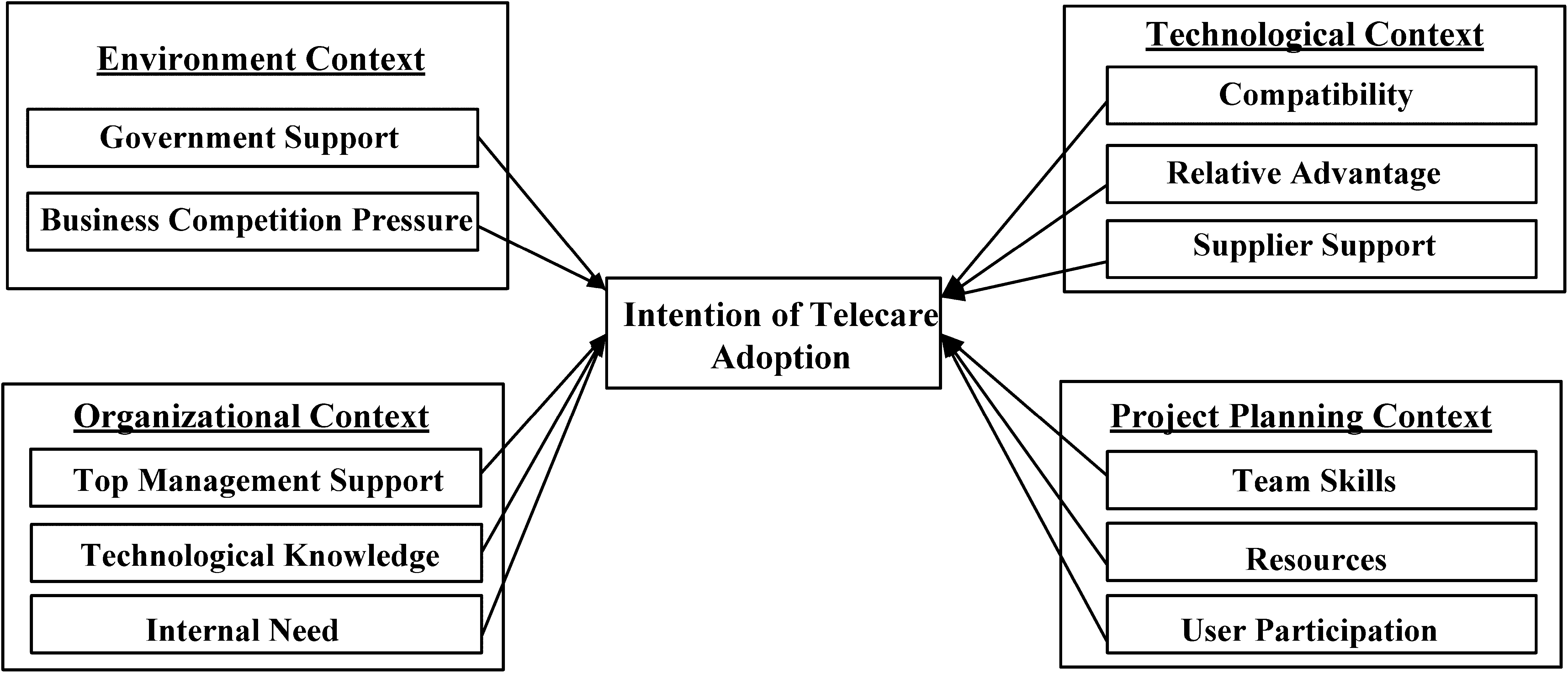
Research framework.
Organizational context factors comprise top management support, 15 internal need, 11,15,16 and technological knowledge. 17 –19 Top management support means the extent of support from top management for telecare adoption within a care institution. Internal need is the recognition of a genuine need within the care institution to use telecare to improve its operations; Technological knowledge represents the totality of institutional technological knowledge resident within a care institution.
Environmental context factors comprise government support 14,19,20 and business competition pressure. 14,21 Government support emphasizes that the government can encourage or lead telecare adoption by developing business, healthcare, and tax laws and regulations that are beneficial to the care institutions. Business competition pressure refers to influences from external environment, including business partners and competitors.
Lastly, factors of the project planning context comprise team skills, resources, and user participation. 22,23 Team skills is defined in terms of the technical and interpersonal abilities of members of the telecare project team. Resources include the finances, personnel, and time that are required to successfully complete the telecare project. User participation exists when users are assigned project roles and tasks during implementation of a project and is a relatively important factor for an unclear project, such as telecare. Following the research framework, we proposed 11 hypotheses as follows:
H1. Government support has a positive effect on the intention to adopt telecare
H2. Business competitive pressure has a positive effect on the intention to adopt telecare
H3. Top management support has a positive effect on the intention to adopt telecare
H4. Technological knowledge has a positive effect on the intention to adopt telecare
H5. Internal need has a positive effect on the intention to adopt telecare
H6. Compatibility has a positive effect on the intention to adopt telecare
H7. Relative advantage has a positive effect on the intention to adopt telecare
H8. Supplier support has a positive effect on the intention to adopt telecare
H9. Team skills have a positive effect on the intention to adopt telecare
H10. Resources have a positive effect on the intention to adopt telecare
H11. User participation has a positive effect on the intention to adopt telecare
Questionnaire Design and Survey Method
In conducting the national survey, this study incorporated all nursing homes in Taiwan as its population. Targeted respondents were at the management level. These question items used a 5-point Likert scale (1: strongly disagree–5: strongly agree), the content of which was based on questionnaire samples and pertinent theories proposed and verified by previous related studies. Further, a group of experts, including a professor in healthcare information management and an executive of a nursing home, were invited to review and modify the questionnaire. A pilot test was then conducted on two experienced care institution managers, whose opinions were compiled and used as reference when modifying the final draft of the questionnaire.
Results
Descriptive Statistics
A total of 339 copies of the questionnaire (there are 339 nursing homes in Taiwan) were mailed, and 70 valid questionnaires were collected, yielding a response rate of 20.65%. Among the 70 respondents, 46 were top-level managers and 24 were middle-level managers, indicating that the respondents were quite representative of the target group.
This questionnaire first investigated the five most common types of telecare services employed by nursing homes, as described below:
Resident Positioning Service: Provides the function of locating the resident's current position at anytime and recording the path of movements.
Remote Vital Signs Monitoring Service: Equipped with features for the collection, transfer, saving, and storage of residents' vital information (e.g., blood pressure and pulse).
Emergency Notification Service: In the event of an emergency at a care institution, residents can communicate with the health management center through the emergency notification system.
Remote Healthcare Consultation Service: Provided mainly by the hospital through Internet communications and in cooperation with the care institution; provides residents necessary medical advice, consultation, diagnostic recommendations, or pharmaceutical services.
Distance Learning Service (e-Learning Service): Used to conduct synchronous or asynchronous professional learning activities through Internet connection with external facilities (e.g., hospitals).
The survey showed that, of the five major types of telecare service currently active in Taiwan, the main type remains the basic “distance learning/e-Learning” (n=23, 32.86%) type. In further analysis, eight nursing homes (11.43%) expressed that they have already employed distance learning systems to connect with experts at a remote hospital, to implement synchronous care instructions learning. Nine nursing homes have adopted an emergency notification service (12.86%), whereas six nursing homes have developed a resident positioning service to monitor residents' movements (8.57%). These two types of telecare services both require being in partnership with the insurance industry and being connected to telecommunication networks and satellite positioning systems. This requirement entails a rapid connection with a remote health management center, thereby providing residents timely assistance. Six nursing homes reported that they have built interactive channels with external support to obtain remote healthcare consultation service (8.57%). Although the percentage of nursing homes using a remote vital signs monitoring service is relatively small (n=4, 5.71%), these results, however, indicate that the care industry in Taiwan is beginning to accept and adopt types of telecare service that have a relatively high technology level and cross-organizational applications.
Reliability and Validity Evaluation
This study utilized the Partial Least Squares approach to estimate the measurement and structural parameters. 24 All constructs in this study included reflective indicators, and principal component analysis provided by Partial Least Squares was employed to ensure the unidimensionality of the constructs. After principal component analysis, all indicators were found to be significantly associated with only one latent variable, which indicated the establishment of unidimensionality. 25 This study then evaluated reliability by means of composite reliability and average variance extraction (AVE). For all measures, the values of composite reliability well exceeded the cut-off value of 0.70, and the values of AVE exceeded the cut-off value of 0.50, 26 which also indicated fulfillment of the criteria of convergent validity. 26,27 Moreover, none of the construct inter-correlations exceeded the square root of the AVE of the constructs confirming discriminant validity. Consequently, we concluded that all constructs exhibited satisfactory convergent and discriminant validity.
Hypotheses Testing
The study tested the statistical significance of the parameters in the structural model by utilizing bootstrapping procedure. At a significance level of 0.05 or better, the results revealed five factors, government support (β=0.260), technological knowledge (β=0.234), compatibility (β=0.195), supplier support (β=0.108), and team skills (β=0.171) that positively and significantly influence intention to adopt telecare in nursing homes (Fig. 2). That is to say, hypothesis 1, hypothesis 4, hypothesis 6, hypothesis 8, and hypothesis 9 were significantly supported. The total explanation power of the model has reached 24.0% level (R 2 =0.240).

Path modeling analytical results.
Discussion and Conclusions
Factors of Influence in the Technological Context
With regard to telecare, compatibility includes both compatibility with the service delivery organization and the capacity to integrate with existing systems. 28 The results of this study echoed this finding. Further, since telecare is a complex project that integrates various technologies and services, an important consideration when an institution is deciding whether to adopt telecare is the ability of the suppliers to provide fully compatible solutions to any technological problems.
Conversely, this study pointed out that whether adopting telecare can increase the relative advantage of the institution is an insignificant consideration in the decision by institution managers. Since many care institutions are local and small-scale, competition with other care institutions is less intense than that between hospitals and clinics. The benefits of implementing telecare mainly involve increasing the quality of service within the institution itself or reducing operational cost, as well as increasing work efficiency, the collection and analysis of patient information, and communications between healthcare providers and family members of the patients.
Factors of Influence in the Organizational Context
Since telecare covers various technological applications, including the use of application systems, communication network, and physiological monitoring equipment, telecare is more easily accepted by senior managers if the staff in the institution has a certain level of technological literacy.
Nevertheless, in the field of heath care, the introduction of technology usually has no direct impact on increased profit or the volume of services, which would more effectively ensure the quality of medical service and the safety of patients. This study also failed to show a causal relationship between the internal needs of nursing homes and adoption of telecare. Moreover, the results did not prove that top management support is a critical factor in the intention to adopt telecare. A possible reason is that the introduction of telecare remains a mere idea or a preliminary exploration at best; the decision by top managers may remain a less relevant consideration at present.
Factors of Influence in the Environmental Context
In Taiwan, some government-led projects such as the “Seniors Ubiquitous Care (U-Care) Flagship Project (sponsored by the Ministry of Economic Affairs)” and the “Telecare Pilot Project (sponsored by the Department of Health)” show that promoting telecare as the new economic model and healthcare model is an important trend in national policy. However, the cost of adopting telecare without external/political support is too high. Therefore, the attitude and relevant subsidy policies of the government can influence the willingness of institutions to implement telecare. Likewise, the Long-term Care Insurance Act currently being proposed in Taiwan is bound to become one of the most critical factors influencing the decision of care institutions to invest in innovative services such as telecare.
On the other hand, the influence of business competition pressure on the willingness to adopt telecare was inconclusive in this study. The survey results showed that the care industry has relatively high expectations regarding government support for the adoption of telecare, including financial and technological support.
Factors of Influence in Project Planning
In previous telemedicine-related cases, large system integration suppliers or IT departments of medical institutions were usually responsible for the planning and execution of telecare implementation projects, which were supervised by the government (or by an institution commissioned by the government). By contrast, the degree of computerization in general care institutions (e.g., nursing homes) is relatively low, and many small-scale care institutions have small IT departments or none at all. Due to this fact, outsourcing to a professional supplier who has experience in implementing telecare is bound to become the main way of adopting telecare. Therefore, how to ensure the completeness of a telecare project plan in a care institution and meet the requirements of the institution while actually adopting it will significantly influence final decision making, as proved by this study. Institution staff often have relatively less experience and understanding with regard to telecare, and available resources (i.e., funding and IT equipment) for telecare are limited; thus, the influences of put-in resources and user participation on the willingness of managers to adopt telecare were not significant.
Other Influencing Factors
Apart from the influence of the constructs of TOE, the opinions expressed in the bottom blank space of each questionnaire reflected much valuable information as well. First, cost was considered by most respondents to be the most important factor. In particular, since insurance related to long-term care has not yet been legislated, requiring residents/patients pay additional fees entails difficulty. Moreover, some respondents questioned the effectiveness of telecare in assisting an institution's operation. If not effective, telecare would become a burden on care activities. Some respondents felt that, since care institution staff are generally not highly literate in innovative technology, an important consideration in the implementation of telecare is the capability of the staff to operate technological equipment. Additionally, whether follow-up suppliers are able to continue providing system maintenance is another concern. If the suppliers fail to do so, the care operation could come to a halt, placing the health of residents/patients in jeopardy.
The Actual Solutions to Perform Telecare in Nursing Homes
Based on the aforementioned discussion and related literature review, this study recommends solutions to the government, care institutions, and technology suppliers with regard to issues related to adopting telecare in Taiwanese nursing homes.
At the government level, enforcing clear and long-term policies for the promotion of telecare remains a critical point. Policies should cover regulatory amendments, subsidies, and other incentives. Only with the clear support of government policy will care institutions have greater intention to develop mid- and long-term plans to adopt telecare and effectively and successfully execute such plans. 29 In Taiwan, the passage of bills related to long-term care insurance is an exciting policy trend, because long-term care stakeholders (e.g., patients and institutions) can obtain insurance benefits to support some care costs, including telecare. Moreover, as compared with traditional face-to-face methods of care and visitation, legal issues regarding the future use of Internet-based/virtual-based telecare services should also be clarified by legislators. This study also suggests that governments take a stronger position in promoting telecare and engage in the cultivation of competent technology suppliers to assist nursing homes in adopting telecare.
At the care institution level, telecare is believed to be an innovative service trend but requires high investment cost. Considering that most nursing homes are relatively small-scale, nursing homes should pay close attention to the direction of government policy to determine how much financial or technological support will be provided by the government and then decide whether to adopt telecare. Concerning the compatibility of telecare with existing institutional processes, increasing the technological literacy of staff, and further encouraging them to accept telecare are all key elements influencing the successful adoption of telecare. In general terms, requiring staff to attend various relevant seminars or inviting experts from industrial and academic fields to speak about telecare-related technology are feasible ways of broadening staff knowledge about telecare. Practically, benchmarking visits and even actual joining a large or government-led telecare project are the most encouraged ways to experience telecare.
It should be noted that for an inter-organizational innovative technology such as telecare, the institutions should alter some of their existing processes to facilitate the adoption. Selecting appropriate suppliers and integrating the services and needs of various stakeholders 29 are all essential considerations. These suppliers should generally be large companies with a good reputation and broad experience. Developing a complete project plan and recruiting a skilled team to successfully execute the plan will undoubtedly be key factors at the final stage of telecare adoption. 28
At the technology supplier level, delivering reliable equipment (e.g., vital signs monitoring modalities and Internet/Intranet/Extranet infrastructure) and integrating the requirements of stakeholders are key determinants of a reliable telecare technology supplier. 29 A telecare technology supplier should consider a combination of technological and organizational innovation in a care institution that involves diverse stakeholders, including patients/residents, healthcare providers, insurance providers, social care providers, information and communication technologies (ICT) infrastructure providers, and the institution itself. In particular, an integrated Internet-based information platform should be developed to provide an easy, secure, and standardized method of communication and exchange of health information among the stakeholders. This platform can be designed based on the concepts of Service Oriented Architecture, Public Key Infrastructure, and Health Level 7 standard. 30,31 Anyway, this study suggests that forming a solid team with a variety of skilled and experienced professionals should be of high priority to telecare technology suppliers.
Conclusions
This study proposed an extended TOE framework comprising technological, organizational, environmental, and project planning constructs to explore the intention to adopt telecare from an institutional perspective. This study discussed the intention of nursing homes to adopt telecare, investigated factors influencing their decisions, and considered methods of overcoming or mitigating potential difficulties in adoption of telecare as indicated by these factors. This study found that government support, technological knowledge, compatibility, supplier support, and team skills are key factors influencing the intention of nursing homes to adopt telecare. The factors of business competitive pressure, internal need, relative advantage, resources, and user participation were not found to significantly influence the intention to adopt telecare. This study also proposed solutions to potential problems with regard to the adoption of telecare in nursing homes.
A research limitation in this study is the low survey response rate (20.65%), which may not have been sufficient to represent the target population. In addition, the questionnaire responses may have been influenced by each respondent's different perception of the questionnaire items (e.g., common method bias).
The explanatory power of the actual results was only 0.240. Further related studies may be conducted to investigate more in-depth the six insignificant factors. Likewise, researchers could explore other factors such as issues of trust and ethics. 32 Further, telecare remains a relatively new concept for most care institutions, and numerous unknown considerations potentially remain. More in-depth case studies are required for a complete understanding of this subject. Finally, in addition to the nursing homes investigated in this study, other care organizations (e.g., care centers for the aged and sanatoria, which are greater in number) may also be potential users of telecare services. These organizations may be incorporated in future studies, and the results obtained may be compared with those of nursing homes.
Overall, this study is an early attempt to use a systematical method to explore the intention of care institutions to adopt telecare. The results provide indication of how managers respond to telecare and what factors are significant in their intention to adopt telecare. Therefore, this study contributes both academically and practically to the notion of adopting telecare in care institutions. Further refinement and follow-up research is expected to be conducted on this basis.
Footnotes
Acknowledgments
Sincere thanks and recognition are due to the National Science Council of Taiwan for funding this study (NSC 97-2410-H-041–007).
Disclosure Statement
No competing financial interests exist.