




Abstract
On December 7, 1988, an earthquake destroyed a significant portion of the Spitak Region of Soviet Armenia. The destruction resulted in significant death toll, building and infrastructure destroyed, and the displacement of hundreds of thousands of people. The entire local medical infrastructure was significantly damaged. Before the disaster, the space medical leadership of the United States and the Union of Soviet Socialist Republics were collaborating on joint activities in medicine and biology. The leaders of this collaborative effort devised an approach to support a disaster recovery utilizing telecommunications assets. This effort was focused on healthcare in a postdisaster event and became known as the Spacebridge to Armenia. This spacebridge was put in place 5 months after the calamity and operated for several months in the spring–summer of 1989. The spacebridge was extended to Ufa, Russia, in response to a second disaster. The influence of the Spacebridge to Armenia in the 20 years since has been significant. This article summarizes how telemedicine has evolved from the response to the earthquake in 1988. It presents lessons learned and illustrates the many influences that have been made.
Introduction
The U.S. Geographic Survey (USGS) reports that on average there are 12,000–14,000 earthquakes per year worldwide. 1 These are common occurrences on a dynamic planet still in development. Although most earthquakes are inconsequential as illustrated in a USGS table (Table 1), there are a few that cause significant death and major damage to infrastructure. The images of the 2010 earthquake in Haiti continue to haunt us. The destruction of the infrastructure for basic services was immense. Hospitals and medical schools were destroyed in a matter of minutes. It may take a generation to fully recover to some level of normalcy. The death toll was staggering. A much more powerful quake in Chile in early 2010 did not have the same destructive outcome or the loss of life experienced in Haiti; however, it demonstrated the disruptive power of nature. There are a number of reasons why Chile and Haiti experienced different outcomes such as construction codes and preparation, but these are reported elsewhere. 2,3
Number of Earthquakes Worldwide for 2000–2010 Located by the U.S. Geological Survey National Earthquake Information Center
On December 7, 1988, an earthquake struck Spitak, a mountainous region in the northern part of the Soviet Republic of Armenia. This quake was significant enough to destroy vital services, including major portions of the healthcare infrastructure. The estimated death toll exceeded 50,000 casualties.
The disasters in Armenia and Haiti are separated by over 20 years. Although there are similarities in response, there are stark differences. In 1988, it took some time to get news out of the region and that was carefully filtered and obscured by politics as much as substandard telecommunications. 4 In Haiti, on the other hand, victims, trapped in the rubble, were texting their location to aid in the rescue effort. In Armenia there was no Internet and there were no programs to collect financial resources to support recovery as we have seen in Haiti.
Haiti, which faced numerous challenges before the quake, has seen a completely different response from that in Armenia. The response in Haiti was within hours, whereas the response of the larger community in Armenia was over weeks and months with most efforts not at rescue but at rebuilding after the temblor had already extracted its heavy toll.
At the time, the response to the Armenian earthquake was significant for the first full embrace of the concepts of international telemedicine although only in the recovery phase. The ability to project a medical presence in Armenia by means of a spacebridge was a significant step to providing recovery from the devastation. Similar efforts have been promulgated in disaster responses in these past 20 years, including earthquakes, tsunamis, and hurricanes. Those events that transpired in the Spacebridge to Armenia impacted the development and foundation from which telemedicine would grow in the decades that followed.
The very nature of store-and-forward telemedicine (asynchronous) and real-time (synchronous) interaction take their roots from the space program. Beginning in the late 1950s, the United States and the Union of Soviet Socialist Republics (USSR) used telecommunications between spacecraft and the ground to monitor the physiological status of animals initially and then humans. Figure 1 is a photograph of Laika, the first living system launched into space. Laika went into space aboard Sputnik 2 on November 3, 1957. 5 As humans began to fly in space, it was necessary to monitor their physiological status during all phases of flight. 6 The ability to telemeter data from a spacecraft to the ground was developed to support real-time monitoring and thus impacted the development of telemedicine. NASA's ground-based work on telemetry and monitoring increasingly demonstrated the utility and capability of telemedicine, and it led to those common practices we are accustomed to today. Without this pioneering work, telemedicine support in disasters such as Armenia may have developed differently.
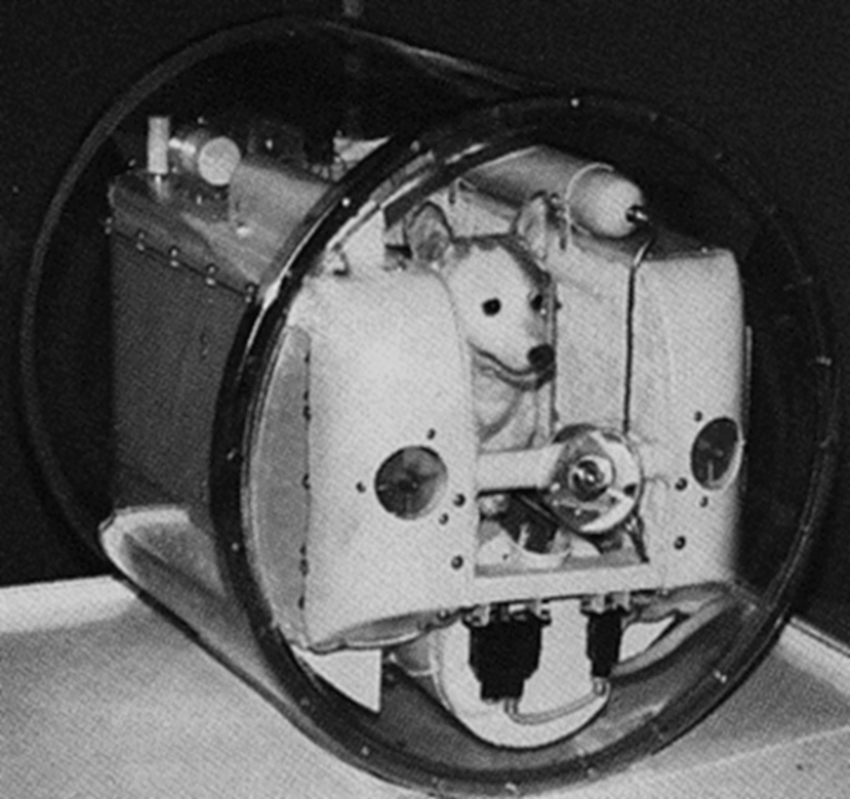
The dog Laika enclosed in the life support containment system on board the Sputnik 2 rocket.
This article evaluates the application of telemedicine in response to an enormous disaster. It reflects on the outcomes and the influence the Spacebridge to Armenia has had on our efforts worldwide today both in telemedicine and in operational spaceflight. 7 The article looks back at the influence this activity had on the development of telemedicine—from planning and implementing an effective response. This effort led to discussion within the U.S. Government and the United Nations on effective mechanisms for responding to disasters. 8
A Foundation for Collaboration
Mutually beneficial collaboration over scientific endeavors between Cold War adversaries, the United States and the USSR, were nonexistent or severely limited during 1947–1992. One area that was not as severely constrained as others was the ongoing efforts in space exploration. While there was a space race underway and competition to get to the moon first was fierce, there were a number of efforts where collaboration was active. One such area was the United States and USSR joint docking mission, the Apollo-Soyuz Test Project in 1975. Another area was the Joint Working Group (JWG) on Space Biology and Medicine. 9 The JWG provided a foundation for sharing knowledge to gain a greater understanding of the challenges of living and working in space. Medicine did not have a strong military connotation and it was mutually agreed that contact by telex and periodic meetings of the involved scientists was not a matter of national security. This group had a number of subgroups, which were discipline-focused. One of these was on telemedicine. 9
Telemedicine was a vitally important capability as early as Sputnik 2 in 1957. To better understand the impact of space travel on a mammalian species, initially dogs and primates, and then humans, vital signs were transmitted by telemetry from the spacecraft to the ground. 5,10 This integration of health information and telecommunications proved to be a highly valuable tool that over the ensuing decades became a necessary capability for monitoring astronauts and cosmonauts, and served as the foundation of what we recognize telemedicine to be today. The same technology defined capabilities for monitoring and telemetry in the intensive care units, which could not have existed without space medicine research. Biotelemetry developed to support human spaceflight was a key tool in the development of telemedicine. 5,10
The JWG provided a necessary and key element in the development of collaborative research in medicine and life sciences. It was the need for developing telemedicine capabilities and the desire to utilize these tools that drove applications for terrestrial medicine. The Spacebridge to Armenia was a direct result of the commonality of need that permitted the two adversaries the opportunity to utilize space-based technologies to support the medical relief in the earthquake region of Armenia in 1988.
Background of Spacebridge to Armenia
The earthquake struck on December 7, 1988, in the Spitak region of Soviet Armenia (Fig. 2). The 6.9-magnitude quake destroyed Spitak and severely damaged the towns of Gyumri (also known as Leninakan) and Vanadzov (also known as Kinrovakan). It was followed 4 min later by an aftershock 5.8 quake. 11 The earthquake has also been called the Spitak Earthquake. Initial estimates suggested the quake killed 25,000 people and destroyed the majority of the structures, which were mostly high-rise apartment buildings. The building codes in this region were not sufficient for an earthquake zone. When the earth shook, the buildings just collapsed one concrete slab upon another compressing the victims and property. In the days after the quake, the death toll estimate rose to nearly 50,000. The destruction injured over 100,000 and left 540,000 people throughout the region homeless and without basic necessities. Figure 3 illustrates the level of destruction in the region.
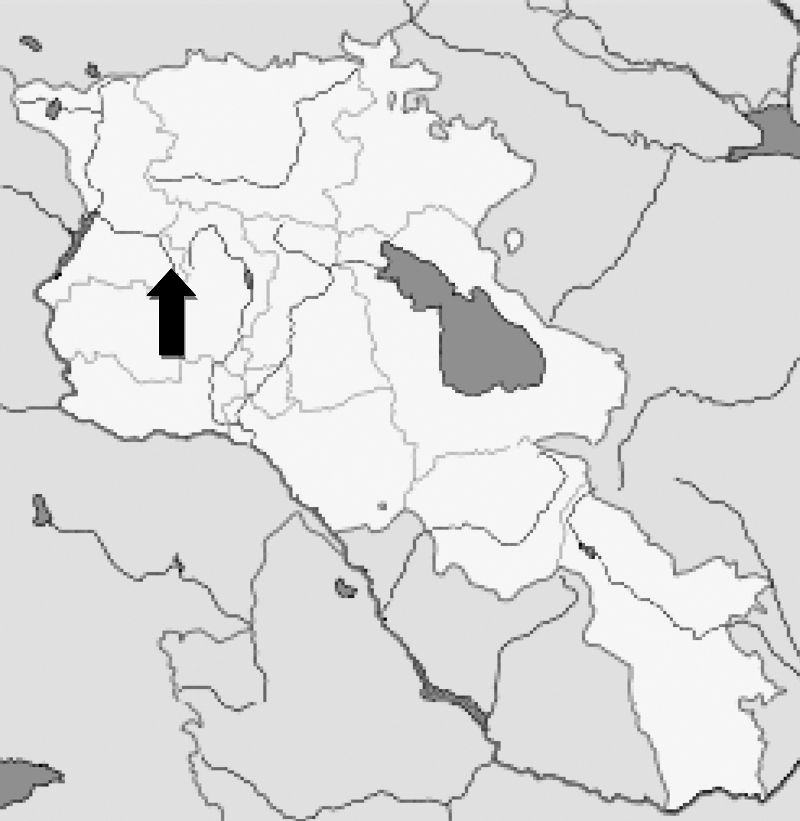
A map of Armenia. The Spitak region is in the center of the upper left quadrant.
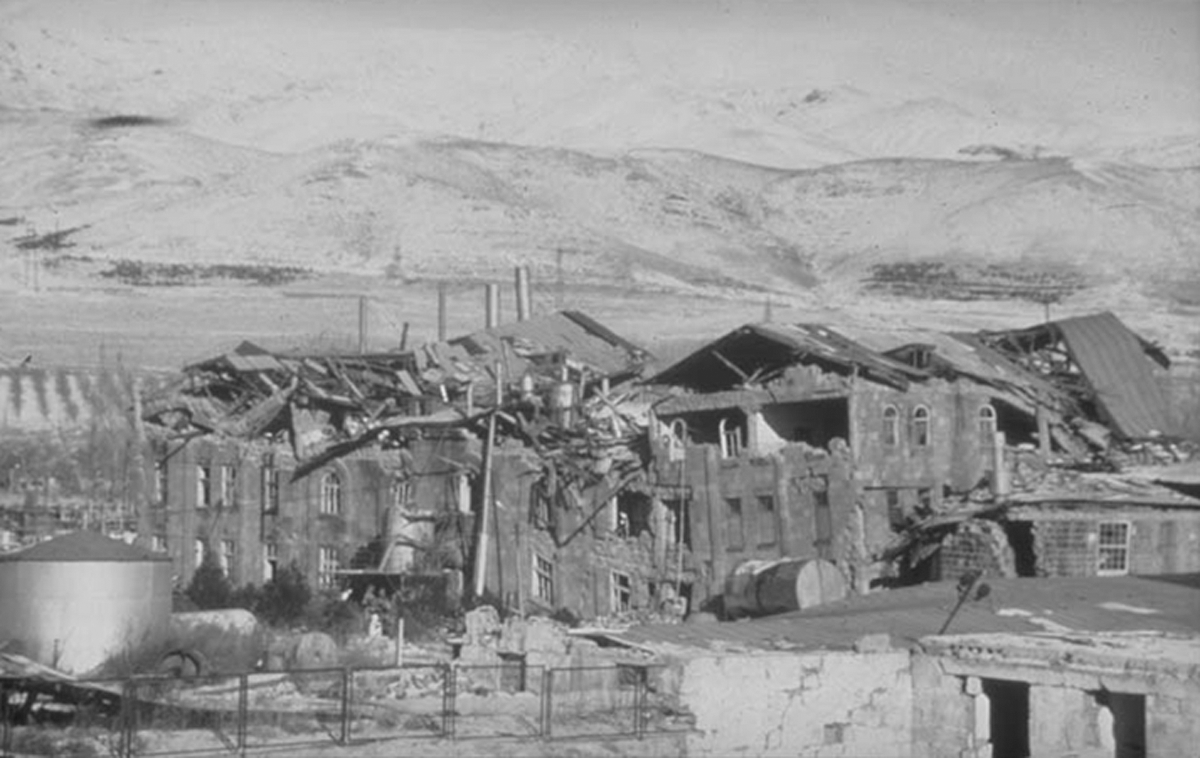
Extensive damage to infrastructure in Armenia after earthquake.
At the time of the earthquake, Soviet President Mikhail Gorbachov was visiting U.S. President Ronald Reagan and President-elect George H.W. Bush in New York City. He asked the United States for help. This was the first time the Soviet Union had asked for help since World War II. The Soviet Union was operating with unprecedented openness.
At the same time, Dr. Arnauld Nicogossian of NASA and Dr. Oleg Gazenko of the Soviet Union's Institute for Medical and Biological Problems (IMBP) were participating in an American Medical Association/USSR Academy of Sciences meeting at the Annenberg Center of the Health Sciences in Palm Springs, CA. NASA was a cosponsor of the event. Best-selling author Ray Bradbury kicked off the event. Participants included U.S. astronauts Alan Shepard and Buzz Aldrin, Russian cosmonaut Oleg Atkov, and U.S. Congressman Manuel Lujan. The event was organized by Dr. Thomas Zimmerman, director of the Annenberg Center.
Dr. Nicogossian, Director Life Sciences Division, and Academician Oleg Gazenko, Director IMBP, agreed to deploy telemedicine technology to aid Armenia. NASA contributed $300,000 toward a telecommunications spacebridge that was used from May 4, 1989, through June 28, 1989, with Nicogossian's office serving as the hub for agencies and hospitals in the United States, Russia, and Armenia. NASA management approached Comcast for transponder time at no cost. NASA rented a ground antenna and audio/video recording and telecommunications equipment, which the USSR transported to the disaster site using a Soviet Antonov AN 124 military aircraft.
Foundation For The Spacebridge
At the time of the earthquake, the United States and USSR were working together in a number of areas, including spaceflight. However, there was little that could be done to expedite the agreements, coordinate the shipment of equipment (e.g., satellite ground terminals), obtain travel visas for entry into Soviet Armenia, arrange clinical protocols, establish a telecommunications link, and the like. Every step took time. The earthquake occurred in December 1988 and the Spacebridge did not start until May 1989. 11 The application of telemedicine in this instance was used in a postdisaster recovery environment. It was not possible to implement a project of this scale in the days or weeks immediately after the event. It took a number of months to get all the necessary steps of logistics, bureaucracy, and protocol completed. There was no precedent in doing something on this scale involving the United States and the USSR since the Second World War.
The technical aspects of the spacebridge were focused on a telecommunications link using satellite-based assets to support two-way audio communication and one-way video. The technical aspects required extensive negotiations to ensure various systems and standards could be supported.
The spacebridge permitted the transfer of information from the disaster zone to select U.S. clinical sites via audio, facsimile, and one-way video. 12 The organization of the effort was conducted through NASA Headquarters in Washington, DC, and Dr. Alexander Kisilev of Soyuzmedinform (the Soviet Health Sciences Laboratory) in Moscow. On the U.S. side, there were several clinical sites involved in the project. They were linked to a medical facility in Yerevan. 11
The Spacebridge was operational for nearly 60 days (May–July 1989). It took nearly 5 months to get all the steps completed to conduct the first patient encounters. There were 209 patients seen by experts in the United States using the spacebridge. 11 These cases covered a variety of medical issues, including burn management, psychiatry, trauma management, urology, infectious disease, and post-traumatic stress disorder, which was predominately brought on by the devastation and recovery efforts. Clinical cases were prepared by the Soviet side with all pertinent information sent via fax to the clinical sites in the United States for review once weekly. The utilization of the spacebridge was extensive during the period of operation. The spacebridge provided a foundation for clinical interaction. This interaction resulted in a change in initial diagnosis of 25% of the 209 cases seen using the spacebridge. 11 While some attempt was made to follow-up with these patients in the months that followed, the distribution of patients and the lack of appropriate telecommunications tools prevented any follow-up.
During the 3 months of operation, a railway accident occurred in a mountainous region in Ufa, Russia. Two trains collided in a valley filled with a cloud of flammable gas from a leak causing a significant fire. This resulted in numerous burn injuries. The spacebridge was immediately mobilized to support real-time interaction between Ufa and U.S.-based clinical sites. 11
This prompt mobilization in an emergency demonstrated that an existing, operational telemedicine system could be easily adapted to fill a need. This would not be the first time such a system would be of great importance. It does, however, illustrate the importance of the capability ensconced and ready for implementation.
The Spacebridge to Armenia was a successful implementation of telecommunications across distance and culture in support of disaster recovery. 11 The benefit to Armenia and Russia was of great value to each country and can be measured by the introduction of a number of capabilities.
Many of the telemedicine activities and other international efforts today can be traced to this collaborative Spacebridge project. For example, this project led NASA to conduct telemedicine using the Internet and the Web in 1993–1994 (Spacebridge to Russia), much earlier than anyone else. This follow-on project focused on Internet-based videoconferencing and the use of the Web to support an early electronic medical record. 13
First International Conference on Telemedicine
As a result of the successful Spacebridge to Armenia, NASA in partnership with the Uniformed Services University for the Health Sciences (USUHS) sponsored in 1991 the world's first international conference on telemedicine and disaster medicine at USUHS in Bethesda, MD. 8 This conference led to the establishment of a follow-on Spacebridge to Moscow and the Spacebridge to Russia. Both of these projects were natural progressions from the Armenia experience. The Spacebridge to Russia was perhaps the world's first international telemedicine program to incorporate Internet Protocol (IP), the World Wide Web, and multimedia computers. 13 This permitted Voice Over IP, real-time multipoint video-teleconferencing, and an electronic health record interface with video and audio files all available through a graphical user interface (GUI) on the Web. Figure 4 illustrates the GUI in 1994. Today, much of the telemedicine done around the world is conducted with these basic functions—Internet and the Web.

NASA's Web-based telemedicine system in 1994.
A second conference was held in 1994 at USUHS. A number of the articles that were presented were published in a special issue of the Journal of Medical Systems. 12,14 This three-volume collection of articles covered a wide variety of subjects, including disaster response, policy, and global health.
These two follow-on Spacebridge efforts were easily implemented and once again demonstrated the utility of how an existing telemedicine system could easily be adapted in a disaster. During the civil strife in Moscow in 1993, the Spacebridge infrastructure was rapidly deployed and implemented to address trauma victims in the streets of Moscow. 5,13 NASA Administrator, Daniel Goldin and Dr. Nicogossian were in Moscow at this time and they proposed using the Spacebridge. The Spacebridge provided a unique opportunity and window into trauma support in Moscow, which had largely not seen the kind and level of trauma before. The interaction with the U.S. physicians using both the Spacebridge network and the Internet provided priceless experience.
Growth of Telemedicine in Armenia
The impact of the Spacebridge is still felt today in Armenia. 15 Shortly after the spacebridge concluded, the local medical institutions, including the Diagnostica Medical Center, Emergency Medical Center, and Yerevan State Medical University (YSMU) Center of Clinical Pathology began to utilize low bandwidth for store-and-forward teleradiology and telepathology. 16
In 2009, YSMU embarked on collaborative activities in distance learning and Internet-based continuing medical education (CME) activities with the Arabkir Medical Center, the Armenian Relief, American Austrian Foundation, and several other local and international organizations.
Armenia Fund USA has established with YSMU a program called HYEBridge for telemedicine in the country. The organization in Armenia is an Institutional Member of the American Telemedicine Association. HYEBridge also has regular lectures from United States for distant learning.
Armenia has also established the Armenian Association of Telemedicine (AATM;
While these are important steps in moving forward, Armenia itself still has significant challenges in information and computer technology penetration. According to the Armenia Ministry of Health, the distribution of sustainable access to high-speed Internet, as well as other modern telecommunication routes, is limited. While this is a challenge, it has not diminished the interest or desire to incorporate telemedicine into the broader healthcare delivery system. Armenia is partnering with a number of organizations worldwide to support changes in its healthcare system.
Growth of Telemedicine in Russia
The Spacebridge to Armenia was a stepping stone to new opportunities for Russia. The outcome of the project led to the conduct of two additional Spacebridge projects both of which established the foundation from which a majority of telemedicine is practiced in Russia today. Many of the lessons learned from this international interaction served as a strong foundation for the early stages of the Russian involvement in the International Space Station (ISS) Program. The ISS Program began with the docking missions of the U.S. Space Shuttle and the Mir Space Station in 1995.
Other initiatives that resulted from the Spacebridge to Armenia include the establishment of the Space Biomedical Center (SBC) for Training and Research at Moscow State University in 1994. The SBC concept, which involved Dr. Michael DeBakey and the medical faculty of Moscow State University, was to develop a new medical school curriculum. Drs. Nicogossian and Anatoly Grigoriev developed this concept and it was a direct result of the Albert Gore/Victor Chernomyrdin agreements between the United States and Russia. 18 NASA also developed the East-West Space Science Center (EWSSC) at the University of Maryland in the early 1990s to serve as an entryway for scientists of the former Soviet Union and Eastern Bloc countries to come to the United States to learn about peer-reviewed research methodologies, which they could in turn utilize these skills in developing research.
Telemedicine in Russia has also grown significantly since 1988. There are numerous large efforts within the Russian Railway Hospital System. This system is one of the largest employers in Russia and crosses 11 time zones. Dr. Oleg Orlov, deputy director of IMBP, is an officer of the Telemedicine Association of Russia and a board member of the International Society for Telemedicine and e-Health. His efforts related to the Spacebridge legacy have helped him champion telemedicine within Russia.
There has been a proliferation of telemedicine activities in commercial, academic, and educational sectors throughout Russia and beyond.
Impact on the Phase 1 Program and ISS
The foundation of the Spacebridge to Armenia project was affiliated with the US/USSR JWG, which had been the vehicle that permitted a collaborative environment in the 1970s and 1980s in space medicine and life sciences between the United States and the USSR. The lessons learned from the interactions between scientists, biologists, engineers, and medical doctors provided ample opportunity to successfully develop an international approach to medical care in the extreme environment of space.
The operational tempo of the ISS program can trace its roots to these early spacebridge efforts. The interactions of NASA with its partners were a fundamental scientific objective of the Clinton Administration in the 1990s. When the United States entered into bilateral discussions with Russia, Ukraine, and other nations, space exploration was discussed with specific mention of (1) access to space for cosmonauts on U.S. spacecraft; (2) life sciences research opportunities; and (3) telemedicine activities. The SBC and the EWSSC were two outcomes of these international negotiations. 18
Telemedicine was a cornerstone of each. Within the Russian sphere, the SBC helped develop the Russian telemedicine sector, which include the Telemedicine Foundation of the Russian Government. There have been other organizations that have developed telemedicine through the region, including the National Railway System.
The Spacebridge efforts also impacted the development of telemedicine in the Ukraine as well.
Summary
Over the past 20 years, NASA's experience with the Spacebridge to Armenia has helped develop a greater understanding of disaster preparedness and response. The use of space-based technologies for responding to terrestrial events was deemed important. 19 There are, of course, many more lessons to be learned and applied; nevertheless, the work done in 1989 led to many new telemedicine activities in Armenia and Russia. The Spacebridge help shepherd the use of the Internet and the Web as early as 1993, and incorporating the use of store-and-forward telemedicine.
The experience gave us a greater understanding of the language and cultural differences and imparted a greater understanding of how operational telemedicine systems can easily be adapted to respond to new events.
Telemedicine has been around a long time and it will continue to evolve based on experiences and on new technologies. A lot has changed in the past 20 years and the Spacebridge to Armenia experience has taught us all some lessons.
Conclusions
As the space age began, the integration of telemedicine was a necessary tool to monitor the health and well-being of astronauts in space. These tools had to be developed to meet a need. These same communications and monitoring tools became the foundation of telemedicine and its application in disaster response. Recently, the world was transfixed by the rescue of the Chilean miners. NASA played a significant role in this rescue due to its experience in providing medical care in remote and extreme environments.
The lessons, learned over 50 years of telemedicine experience, have had a tremendous and often unknown impact on telemedicine development and its application to disasters. 19 NASA was an early adopter of the Internet, multicasting video, and the Web during the Spacebridge projects. Many of the activities in the United States, Russia, Ukraine, and Eastern Europe have been significantly impacted by the NASA-led initiative.
Telemedicine today has been appreciably influenced by the efforts made during the Spacebridge to Armenia. While this effort did not single-handily change telemedicine, it was surely the catalyst for change.
Footnotes
Acknowledgments
The authors extend their appreciation to Dr. Arnauld Nicogossian for his leadership establishing the Spacebridge to Armenia and his visionary work in moving telemedicine forward.
Disclosure Statement
No competing financial interests exist.