




Abstract
Introduction
Falls are relatively common events in older people. One-third of community-dwelling people aged 65 years and older, and up to 50% of those aged 80 and older, experience a fall each year. 1,2 In everyday life, locomotion typically occurs under complicated circumstances with cognitive attention focused on other tasks. Lundin-Olsson et al. 3 reported a novel method for predicting falls based on the dual-task (DT) performance of subjects. In recent years, numerous studies have evaluated DT walking in elderly people. 4 In particular, among the nonfrail elderly population, DT walking is a useful predictor for falls. 5 For these reasons, we developed a seated DT stepping exercise, in which a person steps up and down as quickly as possible while seated, alternating between the left and right legs, while performing a verbal fluency task. 6 Our previous randomized controlled trial (RCT) indicated that a supervised seated DT stepping exercise is beneficial to the improvement of the DT walking ability in community-dwelling elderly adults.
However, the supervised exercise is difficult to control and monitor in many older adults. In recent years, several studies have demonstrated the effectiveness of various video- or Internet-based exercises in older adults or orthopedic patients. 7 –9
In the current pilot study, we investigated the feasibility and effectiveness of a digital video disc (DVD)-based seated DT stepping exercise for the improvement of DT walking capability in community-dwelling older adults.
Methods
Participants
Participating institutions were recruited by means of an advertisement in the local press. Eight day-service centers in Kyoto, Japan, totaling 146 community-dwelling older adults participated in a 24-week, RCT. From each living area, defined as a cluster, individuals were selected according to the following inclusion criteria: aged 65 and older, community-dwelling, had visited a primary care physician within the previous 3 years, no severe cognitive impairment Rapid Dementia Screening Test score of 4 points or less, 10 ability to walk independently (or with a cane), willingness to participate in group exercise classes for at least 6 months, access to transportation, no significant hearing and vision impairments, and no regular exercise in the previous 12 months. The interview was also used to exclude participants based on the following criteria: severe cardiac, pulmonary, or musculoskeletal disorders; co-morbidities associated with greater risk of falls, such as Parkinson's disease and strokes; and use of psychotropic drugs.
After collection of these baseline data, a researcher not involved in the study allocated clusters by using computer-generated randomization lists. Eight clusters (n=93) randomized into a DVD group (4 clusters, n=48) and a nonexercise control group (4 clusters, n=45) participated in a pilot cluster-RCT. We obtained written informed consent from each participant who was included in the trial in accordance with the guidelines approved by the Kyoto University Graduate School of Medicine and the Declaration of Human Rights, Helsinki, 2000.
Intervention
In the DVD group, participants received 20 min of group training sessions twice a week for 24 weeks. The exercise class used an exercise DVD that included a 15-min basic exercise section and a 5-min seated DT stepping exercise section (Fig. 1). An exercise DVD with 4 volumes was used. The basic training involved stretching, strength, and agility training while being seated. In the seated DT stepping exercise, participants were asked to perform a verbal fluency task while stepping up and down as quickly as possible alternating between the left and right legs, while remaining in a seated position. 6 The verbal fluency task consisted of listing words within a category (e.g., names of animals, vegetables, fruits, and fish) or by letter (e.g., a word that begins with “A”) at a self-selected speed. This task was self-generated; participants did not read from a list, but had to conceptualize and vocalize each word. Participants were not specifically instructed to prioritize either task but were asked to combine both tasks as best as they could. The instructions were as follows: “Please step up and down as quickly as possible, and avoid making mistakes to the best of your ability.” An example from the exercise program is shown next:
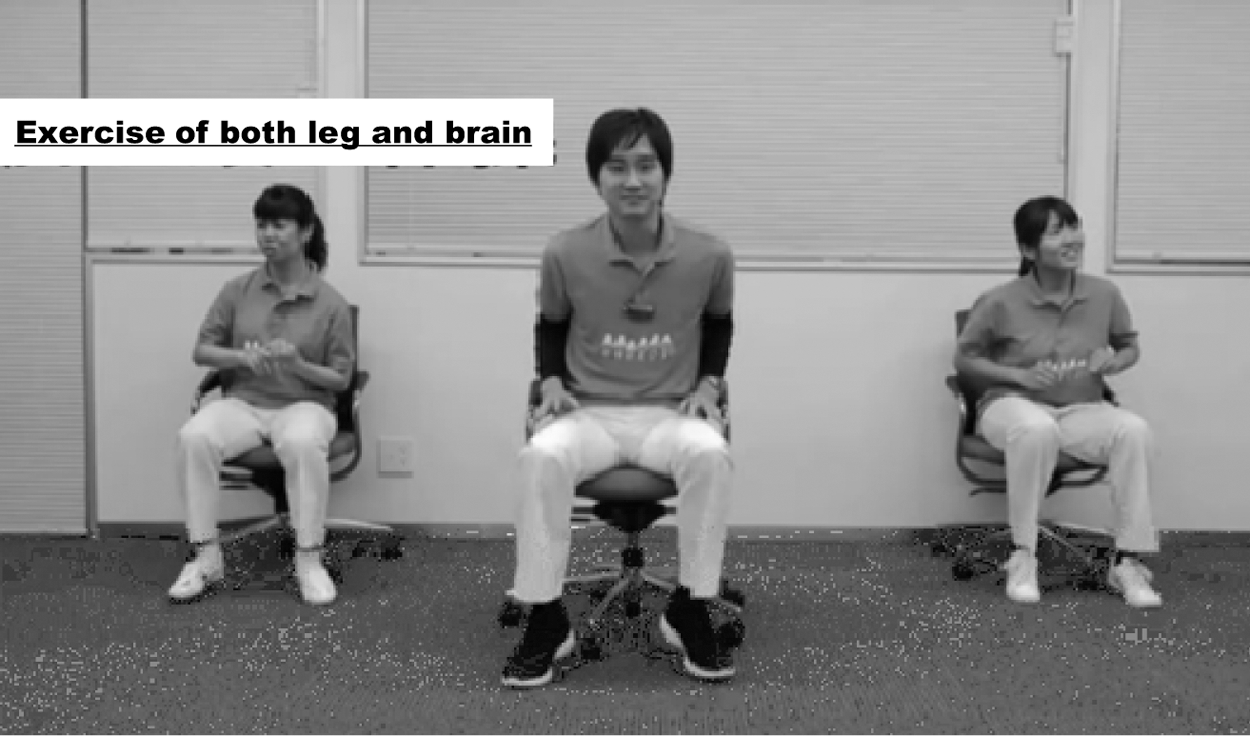
Schematic representation of the digital video disc (DVD) training.
No exercise program was prescribed for the control group.
Outcome Measurements
All participants underwent measurement of the following six quantities: 10-m walking under the single-task condition (ST walking), 11 10-m walking under the DT condition (DT walking), 6 the Timed Up and Go (TUG) test, 12 and the 5-chair stand test. 13 In the TUG test, participants were asked to stand up from a standard chair, walk a distance of 3 m at their maximum pace, turn, walk back to the chair, and sit down. In the 5-chair stand, participants were asked to stand up and sit down five times as quickly as possible and were timed from the initial sitting position to the final standing position at the end of the fifth stand. A physiotherapist, unaware of the group allocation, administered and recorded these baseline measurements on completion of the 24-week investigation. All baseline measures were completed before randomization. All pretest measures were also completed before randomization. Before the study started, all staff members had received training regarding the correct protocols for administering all assessment measurements included in the study from one of the authors (M.Y.). If a walking aid was normally used at home, then this aid was used during the 10-m walking and TUG test.
In ST walking, time was recorded by using a stopwatch while participants walked at a self-selected comfortable speed over the middle 10 m of a 15 m track, thus allowing for acceleration and deceleration. 11 The time recorded in the two trials was averaged as the ST walking score. In DT walking, participants walked 15 m at an individually comfortable speed while carrying a ball (7 cm in diameter, 150 g in weight) on a tray (17 cm in diameter, 50 g in weight). A stopwatch was used to record the time required to reach the 10-m point that was marked in the middle of this walk. The score for each walking episode was calculated as an average of the score obtained from the 2 trials. The DT lag was then calculated as follows 14 :
DT lag (%)=100* (DT condition–ST condition)/ST condition
Required Sample Size
A previous study showed that exercise under the DT condition produced a moderate improvement in DT lag (preintervention=21.14%±25.76%, postintervention=7.86%±3.37%). 6 With a significance value of 0.05, a power of 80%, and a medium effect size (0.7), 34 participants were needed in both the investigation and control groups. With an estimated dropout rate of 20%, a final sample size of 41 per group was required. The power calculations assumed an additive scale of measurements between the two groups.
Statistical Analysis
Baseline characteristics of DVD and control groups were compared to examine comparability of the two groups. Differences in the physical function variables between the two groups were analyzed by using a Student t-test or chi-square test. The effect of exercise on outcome measurements was analyzed by using mixed 2×2 (group [DVD/control])×time [pretraining/posttraining]) analysis of variance. Post hoc Tukey tests were used to assess which group or time periods showed significant differences. Data were entered and analyzed by using the SPSS program (Windows version 18.0, SPSS, Inc., Chicago, IL). A P value of <0.05 was considered statistically significant for all analyses.
Results
One hundred forty-six people were screened, and 93 (63.7%) who met the inclusion criteria for the trial and agreed to participate were enrolled (Fig. 2). Of individuals not meeting the inclusion criteria (n=53), most were excluded, because they had exercised regularly for 6 months before screening. Six people who were eligible for the study declined after the initial screening. Of the 93 selected subjects, 84 (90.3%) completed the study protocols and returned for their exit interviews and final testing sessions. All 48 scheduled investigation sessions were completed. The median relative adherence was 87.5% (25th–75th percentile, 83.3%–95.8%) in the DVD group. No fall incidents occurred during training sessions or testing. No health problems, including cardiovascular or musculoskeletal complications, were observed during training sessions or testing. Minor problems experienced in both groups were aching muscles after the first training sessions and fatigue. All problems were easily managed after adjustment of the intervention protocol and subsequently improved during the investigation.

A flow chart describing the distribution of participants taking part in the trial.
Participants in the DVD and control groups were comparable and well matched with regard to their baseline characteristics (Table 1). There were no significant differences in age (DVD=83.0±6.7, control=82.9±5.5; p=0.931), height (DVD=152.0±8.0 cm, control=153.2±7.5 cm; p=0.477), body weight (DVD=52.7±17.9 kg, control=49.9±13.4 kg; p=0.420), or gender (women: DVD=80.5%, control=74.4%; p=0.605).
Baseline Characteristics of the Study Participants in the DVD and Control Groups
DVD, digital video disc; RDST, rapid dementia screening test; ADL, activity of daily living.
The outcome measurements, including the DT walking time and DT time lag (p<0.05), among the participants in the DVD group were found to be significantly improved (Table 2). However, other outcome measurements were not significantly different between the two groups (p>0.05) (Table 2).
Functional Fitness Tests for Each Group at Pre- and Postinvestigation
Columns indicating pre- and postinvestigation values are expressed as mean±standard deviation.
$, As calculated by group comparison p<0.05.
DT, dual-task; ST, single-task.
DVD-based exercise is a more cost-effective and superior method than supervised instruction for improving the DT walking ability. Our study shows that a DVD-based seated DT stepping exercise showed a good adherence rate and improved DT walking ability.
This study resulted in significant improvements in walking time under DT conditions after a seated DT stepping exercise. In addition, it is important to note that walking time improved under manual-task conditions despite the use of a cognitive task during exercise, such as verbal fluency. Participants in the DVD group may have learned to efficiently coordinate their performances between the two tasks as they improved in each task. 15 These results indicate the importance of the instructions given while training under DT conditions. Participants may learn to allocate their limited attention between primary and secondary tasks during the seated DT stepping exercise. Improvements in division of attention may then influence DT walking ability. This motivates training across different DT modalities to improve proficiency in dividing attention. This study indicates that our seated stepping exercise program can improve the ability to divide attention under DT conditions. In particular, current DVD-based training and supervised training 6 were equally effective in improving DT walking capability. For these reasons, the current study demonstrates the effectiveness of a DVD-based seated DT stepping exercise for improving DT walking capability in community-dwelling elderly adults. This result is supported by a study by Silsupadol et al., who found that the elderly can improve their balance under DT conditions, but only after receiving DT balance training. 16 Collectively, these findings suggest that explicit instructions which serve to focus attention should be provided during balance training under complex-task conditions.
There are several limitations to this study. First, we conducted the study by using a small convenience sample. Second, no follow-up was conducted. Evidence regarding the long-term effect of exercise on fall prevention is poorly understood. However, the utility of DVD- or Web-based exercise regimes may contribute to the development of telemedicine. A larger study and Web-based exercise study are needed to confirm the present results and to evaluate the most effective exercises for the prevention of falls and fall-related fractures.
Footnotes
Acknowledgments
The authors wish to acknowledge Ms. Sachie Ikushima and Mr. Kunihiro Fujiwara for their major contribution to the data collection.
Disclosure Statement
No competing financial interests exist.