




Abstract
Introduction
The healthcare industry is an information-intensive industry with high information demands. Information technologies (ITs) provide timely and accurate information, fulfilling managerial needs while improving operational effectiveness and efficiency. With the rapid development of healthcare IT, many hospitals have aggressively increased their IT expenditures to assist daily operations and have developed hospital information systems (HIS) to support healthcare-related operation and decision-making tasks.
The primary goal of HIS development is to ensure that physicians can obtain the complex and extensive information they require to provide high-quality care. 1 Haux 2 indicated that HIS can facilitate a patient-centered approach in nursing care while providing a support tool for the administrative and management tasks needed to support such care. Therefore, HIS are integrated information systems (IS) that support hospital affairs through the use of appropriate healthcare IT. With the rapid development of electronic medical records and the growing needs of inter-organizational information exchange, HIS provide important support for internal hospital activities and functions as a key mechanism for conducting cross-institute information exchanges among healthcare institutions, insurance companies, public health units, government agencies, and other organizations.
A national survey on the development of electronic medical records indicates that 98.7% of Taiwanese hospitals have implemented medical service-related HIS, while approximately 89.2% of hospitals utilize computerized medical records to some extent. 3 Despite this high adoption rate, not all hospitals in Taiwan have achieved the full benefits of HIS as anticipated. Previous research indicates that a key factor affecting the successful adoption of technology lies in user acceptance of IS. 4 Therefore, an evaluation of successful HIS implementation should consider various users' perspectives, such as physicians, nurses, and other personnel. HIS can produce positive benefits only when users are willing to accept and adopt the system and apply it in their daily operations.
Many researchers have used the technology acceptance model (TAM) to predict and explain user acceptance related to the development and application of a new IT/IS. A previous TAM meta-analysis study indicates that the TAM is a flexible tool for measuring user acceptance and for examining and evaluating strategies to promote user acceptance. 5 The TAM posits that individual attitudes towards various behaviors and subjective criteria determine behavioral intentions towards technology applications, which in turn affect behavior. 4 –6 Perceived usefulness and perceived ease of use are two major factors affecting IT acceptance, and numerous exogenous variables may influence these factors. 4 –7 Exogenous variables may include personal characteristics, organizational factors, and IS characteristics.
Previous studies use the TAM to evaluate the acceptance of various healthcare applications. 8 –14 For example, Yi et al. 14 used an extended TAM to investigate physician acceptance of technology from the internalization and identification processes in adopting technology. They found (1) perceived behavioral control influences behavioral intention indirectly through perceived ease of use and perceived usefulness, (2) subjective norm influenced perceived usefulness directly and indirectly via image, and (3) result demonstrability was a significant determinant of both perceived usefulness and perceived ease of use. Previous researchers included various exogenous variables of TAM, depending on their research purposes and targets. However, previous findings are inconsistent because of the inherent differences between user groups or applications systems investigated. 5 Although physicians support the influences of perceived usefulness and perceived ease of use on a clinical decision support system, 15 perceived ease of use does not greatly influence physician acceptance of telemedicine. 10
Physicians are key providers of healthcare services and among the principal users of HIS. The implementation and appropriate usage of HIS can improve the quality of care that physicians provide and influence patient satisfaction. Thus, physician technology acceptance is important to understand. 16 However, the TAM explains only a portion of technology acceptance behavior among this population. 16 Because the quality antecedents were considered key factors affecting IS success, 17 this study uses three quality antecedents (system quality, information quality, and service quality) as the exogenous variables of the extended TAM to better understand factors affecting physician technology acceptance. These quality antecedents are seldom investigated in the healthcare domain and therefore require further validation.
Materials and Methods
Research Framework and Hypotheses
This study is theoretically based on the TAM and extends this model by considering quality aspects of HIS as perceived by physicians. The proposed extended TAM (Fig. 1) consists of six constructs, including system quality, information quality, service quality, perceived usefulness, perceived ease of use, and HIS acceptance. The high cost of developing HIS makes it necessary to measure and carefully evaluate the value and effectiveness of the system. Measuring IS effectiveness is a necessary process, and system quality, information quality, and service quality are critical factors affecting IS success. 17 This model is suitable for physicians, the principal users of HIS. The degree to which physicians perceive the quality of HIS has a significant effect on the evaluation of the system.
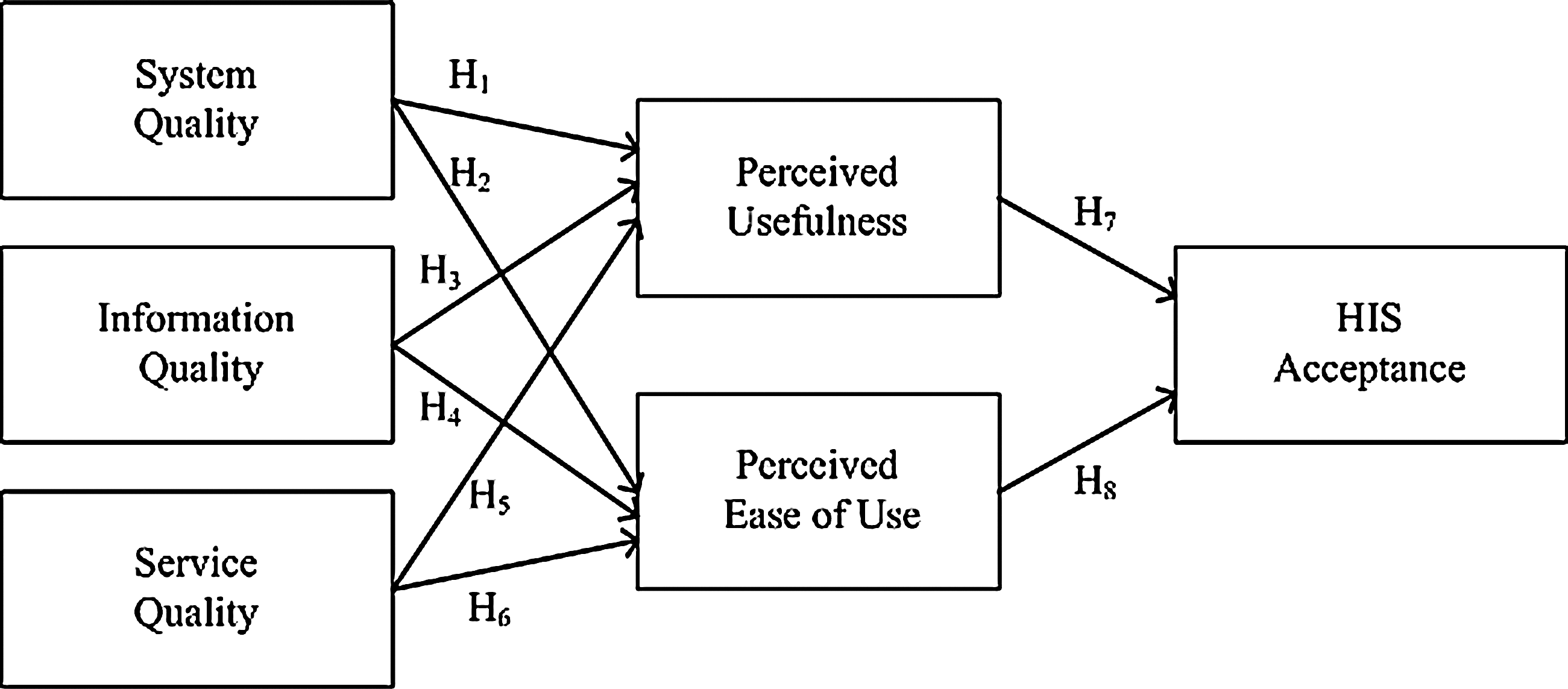
Research framework. H n , hypothesis number; HIS, hospital information systems.
In this model, the first three constructs are quality antecedents of TAM: System quality (the inherent features of HIS, including system performance and user interface), 18 –20 information quality (completeness, accuracy, timeliness, relevance, legibility, and consistency or reliability of the patients' information and reports produced by the system), 21,22 and service quality (the overall support delivered by the service providers of HIS or IT, regardless of whether the services are delivered by the internal department of healthcare organization or outsourced to external providers). 23 DeLone and McLean 17 found that system quality, information quality, and service quality are important factors affecting user satisfaction. Chang et al. 24 indicated that system quality and information quality are key factors affecting perceived usefulness and perceived ease of use of a system. These investigators further suggested including service quality in various contexts. Therefore, the system quality, information quality, and service quality of HIS may have positive effects on perceived usefulness and perceived ease of use.
The constructs of perceived usefulness (users' subjective beliefs towards the benefits of using HIS to achieve job goals within a medical practice),
25
perceived ease of use (the degree to which users believe that using HIS would be free from effort),
4,18
and system acceptance (the attitudes of physicians towards using HIS)
15,18
are the core of most technology acceptance studies. The TAM suggests that perceived ease of use and perceived usefulness in IT/IS determine the attitudes of individuals with regard to IT/IS.
4,6
Users with more positive attitudes towards IT/IS are more likely to be satisfied with the system and in turn view it as more useful. Satisfaction is a precursor to acceptance.
26
Thus, this study uses satisfaction to measure system acceptance. When users perceive it is easier to learn how to use a system, they will have a more positive attitude towards accepting the system. When users perceive the degree of system usefulness as sufficiently high, they become more positive towards and willing to accept the system. Subsequently, they believe using such IS will benefit work performance and will adopt a positive attitude towards the system.
27
–29
Thus, perceived usefulness and perceived ease of use jointly determine HIS acceptance.
4,6
As discussed previously, this study proposes eight hypotheses as follows: 1. H1: System quality of HIS perceived by physicians has a positive effect on perceived usefulness of HIS. 2. H2: System quality of HIS perceived by physicians has a positive effect on perceived ease of use of HIS. 3. H3: Information quality of HIS perceived by physicians has a positive effect on perceived usefulness of HIS. 4. H4: Information quality of HIS perceived by physicians has a positive effect on perceived ease of use of HIS. 5. H5: Service quality of HIS perceived by physicians has a positive effect on perceived usefulness of HIS. 6. H6: Service quality of HIS perceived by physicians has a positive effect on perceived ease of use of HIS. 7. H7: The system usefulness perceived by physicians has a positive effect on HIS acceptance. 8. H8: The perceived ease of use of HIS perceived by physicians has a positive effect on HIS acceptance.
Questionnaire Design and Survey Method
The survey used in this study targeted physicians with over 1 year's experience using HIS in the selected case hospital as subjects. The case hospital was a public facility with 450 beds, established more than 40 years ago. The case hospital was one of the first institutions in Taiwan to adopt HIS, following the introduction of the National Health Insurance Bureau. With the widespread use of the Internet and related technology, this hospital implemented e-hospital and electronic procurement systems to provide user-friendly medical consultation services and reduce operational costs. The hospital established a full-scale picture archiving and communication system in 2008 to provide better clinical diagnostic services and improve patient satisfaction. The hospital is currently planning to adopt radio frequency identification technology to improve patient safety and quality of care. In addition, this hospital is a pilot institute for using next-generation HIS with enhanced functions of electronic medical records in Taiwan. This hospital's selection as a case hospital was based on these factors.
This study used a 45-item structured questionnaire to measure factors affecting physician acceptance of HIS applications. The questionnaire consisted of two major parts. The first part incorporated respondents' demographic data included variables of gender, age, title, education level, and computer experience. The second part investigated factors affecting physicians' acceptance of HIS applications via questionnaire items measured by a 5-point Likert scale (scored from 1=“strongly disagree” to 5=“strongly agree”). The measurement of factors affecting physicians' acceptance of HIS can be summarized as follows: System quality was measured using seven items adapted from Wixom and Todd, 18 whereas information quality was measured using 11 items adapted from Otineo et al. 22 Service quality was measured using eight items adapted from Kettinger and Lee. 23 Perceived usefulness was measured using 12 items adapted from Wakefield et al., 25 whereas perceived ease of use was measured using five items adapted from Wixom and Todd. 18 HIS Acceptance was measured using two items adapted from Wixom and Todd. 18
The initial research framework and its corresponding questionnaire were developed using literature reviews and revised by an expert panel. The expert panel consisted of three members, including one professor of Healthcare Information, one physician with a master's degree in Medical Informatics, and one medical information management practitioner. Expert validity was measured using a Content Validity Index, with a value of 0.8 as the criteria for item selection. 30 Most Content Validity Indexes for measurement items exceeded 0.8. Experts also conducted required semantic revisions of the retained items to ensure item appropriateness and consistency. As a result, the questionnaires used in this study demonstrated high content validity. A pilot test was then conducted on five experienced physicians with over 1 year of experience using HIS. Their opinions were recorded and used for reference in preparing the final draft of the questionnaire.
Results
Descriptive Statistics
Of 131 questionnaires sent out, 81 were returned completed (eight incomplete and invalid samples were excluded); the valid response rate was 64.8%. This high response rate was due, in part, to the full support of top management and to voluntary participation by the case hospital. Motivational gifts also increased incentive to respond. Most respondents (86.4%) were male. About 78% of the subjects' ages ranged between 30 and 50 years. Most respondents were attending physicians (98.8%), and half of them worked in the surgical (25.9%) and internal medicine (24.7%) departments. All respondents had medical bachelor's degrees. Three-quarters (76.5%) of the physicians had more than 9 years of computer experience. All selected subjects therefore demonstrated appropriateness for inclusion in the study. Table 1 shows the respondents' demographic data.
Demographics of Respondents (N=81)
Reliability and Validity Evaluation
This study uses partial least squares, a statistical analysis technique based on structural equation modeling originating from regression-based path analysis for analyzing causal models with multiple constructs, for data analysis. 31 Constructs included reflective indicators, and principal component analysis, provided by partial least squares, ensured the unidimensionality of the constructs. Principal component analysis determined that all indicators significantly associated with only one latent variable, indicating the establishment of unidimensionality. 32 Composite reliability and average variance extraction (AVE) evaluated reliability and convergent validity. The values of composite reliability (>0.87) and AVE (>0.51) of all the constructs exceeded the recommended cutoff values of 0.7 and 0.5, indicating good reliability and convergent validity. One criterion for adequate discriminant validity is that the square root of the AVE for each construct exceeds the correlation between the construct and other constructs in the research model. 33 Most AVEs in this study were greater than the correlation coefficients, demonstrating good discriminant validity. Therefore, this study had adequate reliability, convergent validity, and discriminant validity.
Hypotheses Testing
This study tests the statistical significance of the parameters in the structural model utilizing a bootstrapping procedure. Subjects significantly and positively supported most hypotheses specified in the proposed model, except for H1 and H6 (Fig. 2). System quality (γ=0.264, p<0.01) and information quality (γ=0.584, p<0.001) significantly influenced perceived ease of use, accounting for 59.3% of totally explained variance. Information quality (γ=0.607, p<0.001) and service quality (γ=0.198, p<0.01) jointly and significantly influenced perceived usefulness, accounting for 60.7% of total explained variance. Perceived usefulness (β=0.607, p<0.001) and perceived ease of use (β=0.390, p<0.001) accounted for 54.5% of total explained variance on HIS acceptance.
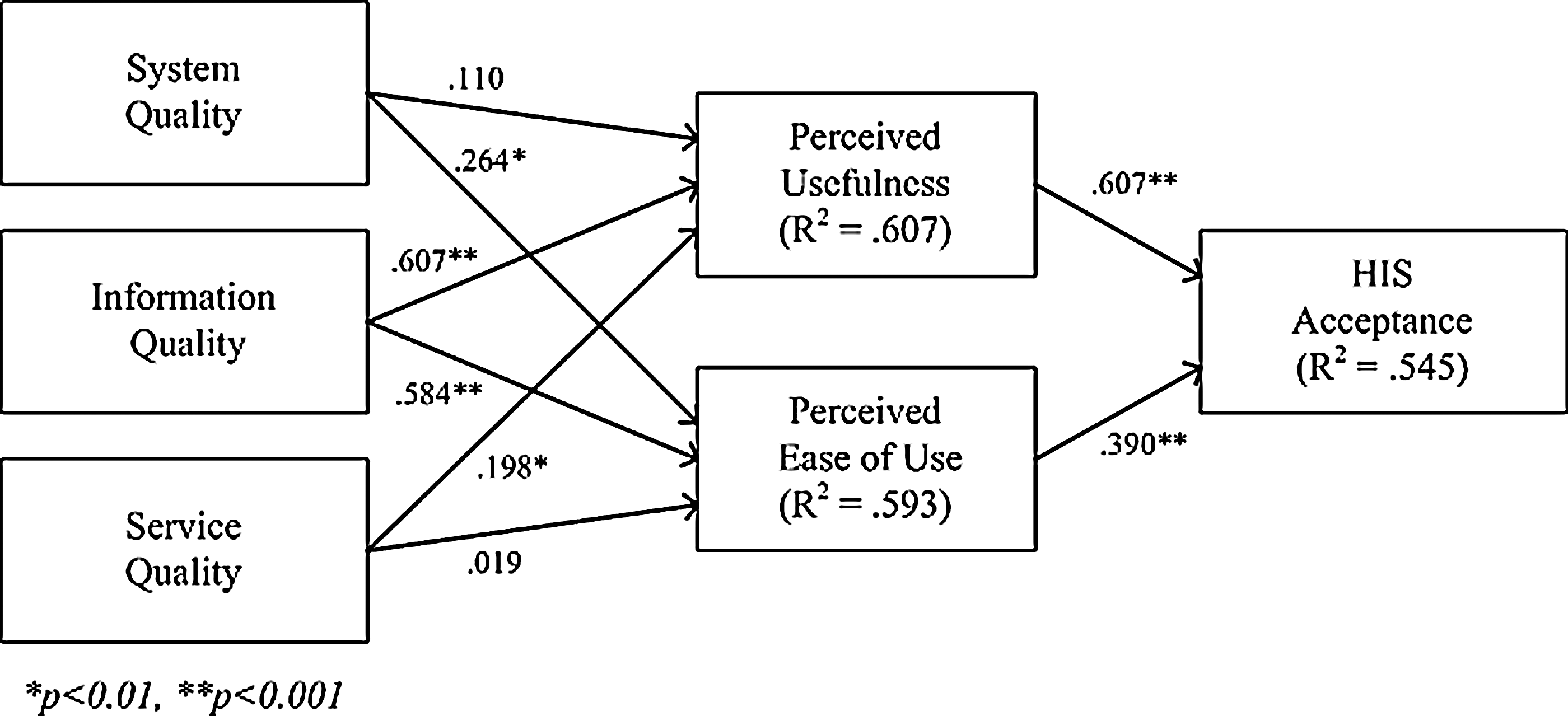
Research results.
Discussion
Key Factors Affect Perceived Usefulness and Perceived Ease of use of HIS
The results of this study indicate that information quality and service quality significantly influence perceived usefulness (R 2=0.607). However, the system quality and information quality significantly affect perceived ease of use (R 2=0.593). Of the three external variables, information quality most significantly influences perceived usefulness (β=0.607, p<0.001) and perceived ease of use (β=0.584, p<0.001). Statistical results demonstrate that HIS information quality, including integrity, accuracy, format, completeness, and timeliness of the patients' information produced by the HIS, all influence physicians' perception of the usefulness and the ease of use of HIS. The results of this study agree with the findings of Yusof et al. 20 in that information quality is physicians' major concern for evaluating HIS because physicians need high-quality information for clinical diagnosis, treatment, and patient care. To fulfill physicians' information requirements, HIS development concerns should include the capability to integrate different data sources, accuracy, timeliness, and completeness of information provided. 25 Healthcare professionals are likely to accept technologies that provide useful healthcare information. This study shows that high-quality information helps to integrate healthcare processes and medical knowledge. 34 Thus, to be accepted, HIS must provide high-quality healthcare information to physicians.
This study reaffirmed that system quality has significant effects on physicians' perceived ease of use of HIS. Improving system quality of HIS would help physicians to better understand patient conditions and to provide effective support of their clinical activities. By their nature, HIS are huge and complicated IS supporting highly specified healthcare tasks and services. The planning stage of HIS development should satisfy the needs of various healthcare professionals in different departments of a hospital. Selecting qualified project members with comprehensive healthcare-related knowledge, good communication skills, and abundant experience in IT/IS adoption can facilitate the development of HIS. Therefore, service quality has significant effects on HIS implementation. 18,23
Physicians' Perceived Usefulness and Perceived Ease of use Affect HIS Acceptance
In this study perceived usefulness (β=0.607, p<0.001) and perceived ease of use (β=0.390, p<0.001) significantly influenced physicians' acceptance of HIS (R 2=0.545). Perceived usefulness was the primary determinant of HIS acceptance, consistent with the evaluation of physicians' acceptance of telemedicine by Chau and Hu. 10 This implies that physicians will consider HIS a useful tool to improve the doctor–patient relationship, internal communications, working environment, and medical quality and are more likely to accept the system. 25 Physicians will also more positively perceive the use of HIS to obtain the required information once the system is easy to use and user friendly. This result does not agree with the findings of Chau and Hu 10 regarding the relationship between perceived ease of use and IT/IS acceptance. Hospitals can realize expected HIS benefits once the primary system users perceive that it is useful and easy to use. These findings are consistent with the views of healthcare professionals regarding the acceptance of systems. 9,10,29,35 –37 Healthcare professionals are fairly pragmatic, focusing on the usefulness of technologies rather than their ease of use. 10 Physicians are likely to accept (or use) HIS when they are considered useful to his or her practice. Other researchers have demonstrated that healthcare providers consider useful, relevant, and high quality to be important attributes of patient health information. 34,36 Thus, physicians with a positive attitude to HIS will have a higher acceptance of HIS. The TAM also suggests that perceived ease of use and perceived usefulness in IT/IS determine the attitudes of individuals with regard to IT/IS. 4 To this extent, information usefulness and ease of use are important factors in the acceptance of HIS.
Conclusions
In adopting HIS, healthcare organizations must ensure the quality of information, as it is closely related to the perception of physicians regarding the usefulness and ease of use. To encourage individuals to adopt and use HIS, managers must facilitate the conditions, training, usefulness, and ease of use of the HIS. Integrating operational procedures and sources of information upon the system's introduction is critical to promoting the acceptance of HIS among physicians. Finally, HIS must provide up-to-date information, cross-linked across various platforms, and real-time availability at the point of care. The proposed research model provides a useful diagnostic tool to evaluate user acceptance of other similar, healthcare-related IT/IS, such as clinical decision support systems and nursing information systems. This study's findings are beneficial for the healthcare industry in terms of assessment of the impact of ITs and formulation of appropriate strategies to increase user acceptance of IT/IS, thereby enabling hospitals to improve hospital management systems and the quality of care.
This study has two limitations. Data derived from questionnaires provided to participants with more than 1 year of experience using HIS. Respondents answered questions based on their perceptions, experiences, and understanding. Thus, the data collected may not be adequately objective. However, because of the nature of this study (exploratory research), the quality of collected data is acceptable. Second, the returned valid questionnaires of this study were relatively few (only 81 copies). However, this represents a high response rate (64.8%) compared with the average response rate (10–20%) for physicians in Taiwan. 38 In addition, previous research has shown a similar situation for lower valid questionnaires but a high response rate (91 valid samples, indicating a 72.8% response rate). 13 As shown, this demonstrates the representative of the sample.
Footnotes
Disclosure Statement
No competing financial interests exist.