




Abstract
Introduction
It has been almost 23 years since the National Aeronautics and Space Administration (NASA) telemedicine spacebridge was deployed to address the medical and public health needs of the earthquake victims of Soviet Armenia. The functioning, infrastructure, and consultations of the telemedicine spacebridge have been extensively documented. 1 –9
On December 7, 1988, a series of earthquakes, the initial 6.9 magnitude, followed minutes later by a 5.8 and subsequent after-shocks of magnitude 5 on the Richter scale, devastated a large portion of the mountainous northwest regions of Soviet Armenia. The city of Spitak was obliterated, with Leninakan, Kirovakan, and Stepanavan in the Gumri region experienced significant damage. Damages to the region's transport and healthcare infrastructure exceeded 14 billion U.S. dollars (USD). 10,11 The earthquake claimed tens of thousands of lives, 15,000 were injured, and over 500,000 were left without shelters. The prevailing and historical building practices, using stones for building materials, time of the day, and the seasonal temperatures were blamed for the high mortality and a comparatively lower number of injured. 12 –15
The ability to transport the injured victims, already inadequate, could not support medically supervised evacuations and in-route care. Fortunately, the casualties were rapidly located by the survivors and transferred to intact hospitals, in the surrounding region and to the capital Yerevan, by private transport (Haik Nikogosian 1989, pers. commun.).
Major medical complications, primarily post-traumatic stress disorder (PTSD), were reported shortly after the disaster among the survivors who lost their relatives. Three months after the catastrophe, an increase in alcoholism and mental disorders was noticed by the Armenia healthcare providers. Ten years after the earthquake, increased morbidity and mortality from metabolic disorders and a high prevalence of arthritis were reported to be correlated with the severity of exposure to the event among the survivors. 16 A follow-up survey of 1,785 from a cohort of 33,743 earthquake survivors indicated that women, geographic location, and personal losses were associated with increased risks of depression, whereas social support and alcohol acted as protective factors. 17 Depression and other psychological disorders were reported among the Armenian children surviving the earthquake. 18 The correlation between the increased incidence of depression and PTSD with the proximity to the disaster area, relocation and resettlements, and loss of one or both parents 16,17,19 has been fully validated in other settings. 20
Observations and Lessons Learned from the Armenia Telemedicine Spacebridge
NASA and the Soviet Union/Russia rely extensively on telemedicine and telemonitoring to provide space crews health and well-being. 3,8,21 Both space faring nations repeatedly highlighted at the annual meetings of the United Nations (UN) Committee on the Peaceful Uses of the Outer Space the potential benefits of telemedicine to the medical practice and disasters on the Earth. 22,23
Space medicine has well-established guidelines and protocols for crew health telemonitoring and care. Space medicine specialists and crewmembers are routinely train in the use of telemedicine. Training sessions involve international partners as well. Thus, it was natural for the two nations to immediately and with the approval of the relevant government agencies to identify telemedicine as a suitable tool to help with the disaster victims.
Even with the official intergovernemental agreement in place, it took approximately 2 months to develop patient consultation protocols acceptable to the American, Russian, and Armenian medical counterparts. Once the protocol was tested and exercised, it took only several days to redeploy a link from the Armenia Republican Hospital to the Ufa medical facility for the consultation on the burn patients. 22
Major observations and lessons learned from the Spacebridge to Armenia are summarized below
24,25
:s 1. The establishment and testing of communication networks, language selection, and protocols for medical consultant interactions and case presentation format before the initiation of actual operations. Lesson learned—The spacebridge communication infrastructure had to conform to satellite and frequencies communications policies of the countries involved and deployed as a distributed network using two-way satellite voice communications, one-way videoconferencing, and facsimile capacity in the months after the disaster. This was the first time that a distributed medical and public health network, linking multiple medical centers in United States, Russia, and Armenia, was deployed. A key lesson learned was that to respond immediately and effectively, a system must already be in place or have the capability for rapid activation. Use of satellite transponders is not always available for use in disaster-stricken areas especially when ground communication infrastructure is damaged. 2. Procedures governing patient protection such as execution of informed consent and safeguarding patient privacy should be established and continuously monitored. Different countries have different practices. In the case of the spacebridge, significant negotiations on the subject of ethics practices took place before the initiation of the consultations. Lesson learned—A standard approach to safeguard patient rights should meet a minimum of international standards and exercised during consultations. 3. Time-zone differences were used fully for a 24/7 operation. The down time was used for patient case preparation, secure distribution, notification of appropriate clinical specialists, and transmission by fax of the most current medical literature on the subject matter. Armenian physicians, proficient in the English language and medical terminology, played a critical role in assuring efficient consultation session. Lesson learned—Since the time difference between multiple international sites can be a challenge, provisions for operational/consultation time and administrative activities for documentation and clinical preparation should be part of the daily planning. Although challenging, the proficiency in English was very beneficial for case preparation, presentation, and consultation. Otherwise, interpretation and translation could add significant time and cost. Time allocation must be preprogrammed and managed efficiently. 4. Properly trained technicians available on-site to handle telecommunication problems and servicing the ground satellite antenna helped minimize disruptions. Lesson learned—Effective operational systems must be staffed with trained personnel especially during the consultation sessions and the down time used for inspecting and testing the networks. 5. This telemedicine activity was one of the first large-scale telemedicine efforts to use a store-and-forward capability to transmit nonidentifiable medical records, including relevant diagnostic imaging (ultrasonography, radiographs, etc.). Lesson learned—This asynchronous mode was deemed highly useful for all clinical case preparation. 6. The spacebridge was planned to be operational for only 2 months. During the spacebridge function, another disaster (accident) occurred on the Kuybyshev Railway near Ufa, Russia, on June 4, 1989, involving mostly children. The accident resulted in 575 fatalities and more than 800 injured, mostly children suffering severe burns. The spacebridge was extended another 30 days to support these victims. U.S., Russian, and Armenian physicians as well as the U.S. Army Brooke Medical Center burn specialists who cared for the victims in the immediate period of the accident were able to participate in consultations. Lesson learned—A fully operational telemedicine system can serve as a network readily adapted and rapidly implemented for several disasters. 7. A portable video camcorder was provided to the Armenia Ministry of Health to conduct an environmental surveillance of the disaster-stricken region and address potential public health threats. The U.S. side warned of possible importation of infections and recommended that all relief workers be properly vaccinated. The earthquake occurred in the winter time, with victims and cattle herds buried on the slopes of the surrounding mountains, covered with snow. A concern was expressed for the water safety, if the contaminated melting snow in the spring finding its way into the potable water system. There were no outbreaks of infections in the aftermath of the disaster thanks to the Armenia public health and medical services interventions. Lesson learned—The importance of this lesson is that in the aftermath of a disaster, the remains of humans and animals must be buried to minimize impact to public health threats. Policies and procedures must be in place to ensure proper burial.
Based on the Armenia spacebridge project, NASA and the USSR/Russia developed several follow-up telemedicine projects, capitalizing on the experience and knowledge gained as a result of the disaster 1. An information technology training and telemedicine center was established at the Moscow State University (1995–1999).
2,3,8
2. The Medical Informatics and Technology Applications Consortium (MITAC), a NASA Commercial Space Center, was established at the Virginia Commonwealth University to develop, evaluate, and promote information and medical technologies for space flight and ground applications. The Consortium was not subject to the governmental and international diplomatic constrains and was able to function as a private and academic entity MITAC was successful in establishing foundations for disaster response and telemedicine around the world (1997–2007).
3
3. A telemedicine training program for medical experts of the Former Soviet Union republics was funded by NASA at the University of Maryland (UMD), College Park, Maryland. The UMD with the help of MITAC trained about 30 specialists 1997 through 2002.
3
Discussion
Disasters will continue to plague communities worldwide. In 2010, the economic impact was a staggering 222 billion USD and over 220,000 deaths. 24 The 2011 estimate for disasters in the United States alone has exceeded 5 billion USD and 300 deaths, leaving many individuals temporarily homeless and without sustenance resources. The UN 2011 projected economic impacts from disasters are expected to exceed 1 trillion USD.
Our experience with the Armenia telemedicine spacebridge showed that major medical and public health benefits can be provided even 3–6 months after disasters. Investment in telemedicine capabilities has also the potential to reduce the overall medical cost for deploying and supporting medical personnel to disaster areas. Space agencies and the military continue to routinely use telemedicine. Battlefield telemedicine continues to evolve using mobile communications and handheld technology. 26 –28 Despite the reported benefits, civilian telemedicine services continue to be underutilized in most disasters.
The Armenian spacebridge highlighted eight prerequisites for a successful deployment and operation of telemedicine in disaster-stricken regions (summarized in Table 1).
Prerequisites for a Successful Telemedicine Implementation
The consultations over the telemedicine Spacebridge to Armenia helped address acute illnesses and trauma (burns). Unexpectedly, many chronic diseases such as psychological sequelae of trauma, substance and alcohol abuse, stress-related metabolic disorders, and public health constituted the majority of the consults. 22 The eight prerequisites for a successful telemedicine operation, identified in Table 1, are compared for three different disasters (Table 2). In the case of Hurricane Katrina, NASA Stennis Space Center in Mississippi, using MITAC-developed technology and space medicine personnel, was able to provide telemedical support to the hurricane victims who took refuge at Stennis. NASA was able to provide support to the trapped Chilean miners, following a large-scale earthquake in 2010, by sharing the knowledge gained from the space missions. 29 Lack of resources and infrastructure prevented NASA to support the victims of the earthquake in Haiti. A significant impediment to the implementation of telemedicine is the lack of availability of the communication infrastructure, training, and sustainability due to financial constraints and agreements between a variety of participants at many levels.
Meeting the Telemedicine Prerequisites in Three International Disasters
NASA, National Aeronautics and Space Administration; VCU, Virginia Commonwealth University.
Telemedicine is rarely considered an integral part of disaster planning, training, and recovery. Telemedicine addressing mental and physical health effects should be included in major guidelines development and standard of care. 30 Based on the NASA experience with the Armenia earthquake and over 20 years of telemedicine operations in Soviet Union/Russia and other countries, we have developed a model of the three phases of disaster consequences affecting community recovery. The three phases consist of the early period (up to 1 month) an intermediate period (6–12 months) and the long-term period (over 12 months) after the disaster. Each phase is characterized by an evolving economic, societal, political, and health landscape, which affect the community functioning and recovery process. Telemedicine can help with community health needs in all three phases. Specifically, telemedicine can assist with the identification of health problems and focus on issue specific to each community. This notional model is depicted in Figure 1.
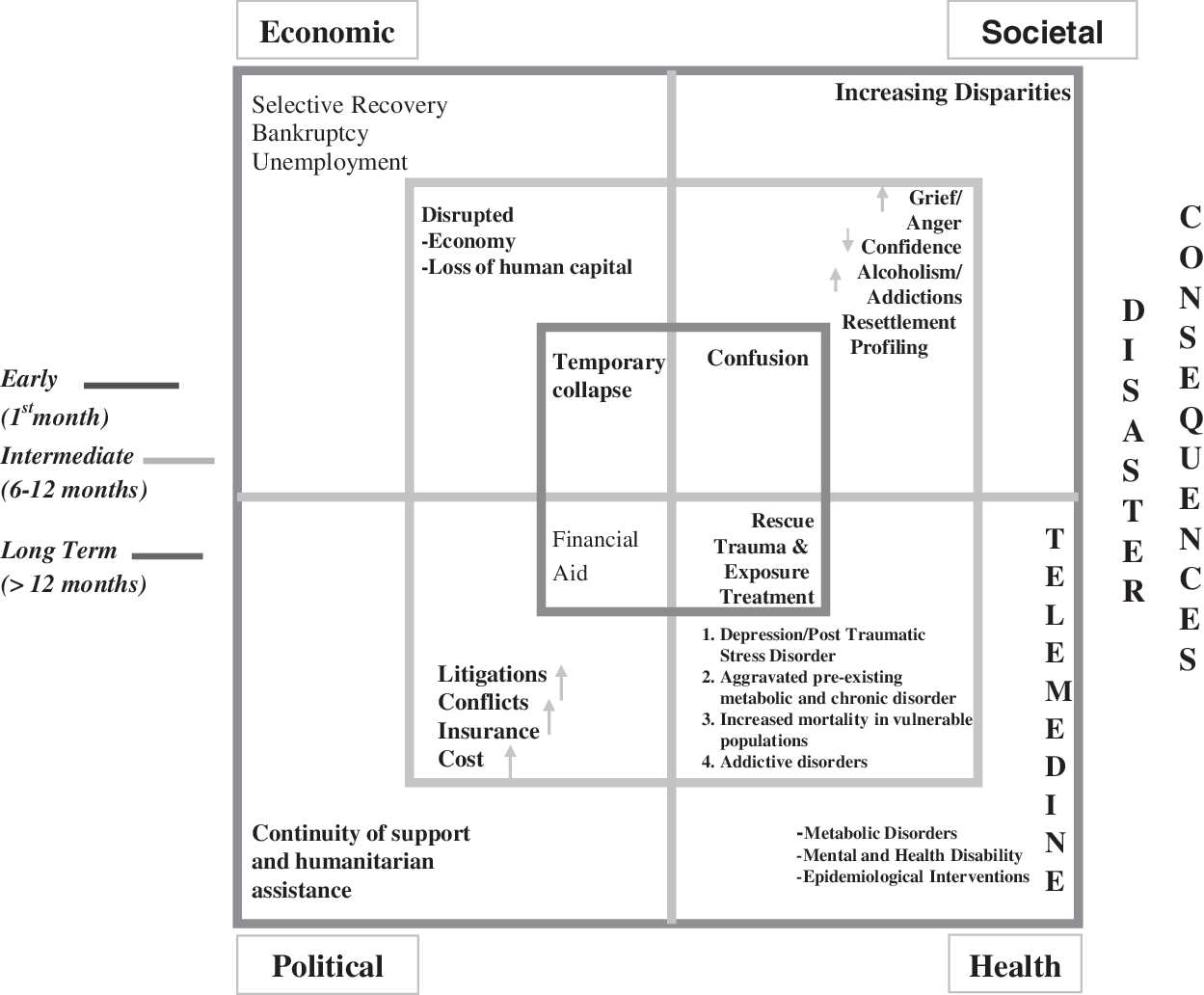
Near- and long-term consequences of disasters and potential application of telemedicine.
Conclusions
A great deal has been learned on how to use telemedicine effectively to respond the medical needs of disaster victims. Despite this wealth of knowledge, major shortcomings continue to preclude the full use of medical technology to help with the medical consequences of disasters. Most disaster-prone areas can be identified beforehand based on the historical trends. Planning for telemedicine should start before a disaster strikes. Mobile technology can be adapted to regional needs, and training exercises should involve the participation of the local healthcare providers. In the aftermath of disasters, constrained resources, destroyed communications and medical infrastructure, constrained access to space-based assets, and the lack of trained local personnel are major obstacles for the use of telemedicine.
Limitations
Spacebridge to Armenia provided a unique, focused, and time-limited experience with telemedicine. Some of the lessons learned have found their way into the modern telemedicine practice. In the last 20 years, technology has evolved and the 1989 spacebridge infrastructure, with the exception of the satellite communication capability, might not be applicable to the current practices. Best uses of information technology and medical networking should be evaluated for incorporation into disaster planning and recovery.
Policy Implications
Natural and human-made disasters require both near-term and long-term interventions to reduce morbidity and mortality among the surviving victims. 31 Telemedicine, information technology, and modern mobile communication technology should be adapted to the disaster preparedness and training.
Footnotes
Disclosure Statement
No competing financial interests exist.