




Abstract
Lack of regular physical activity and high stress levels are the leading causes of several illnesses. There is thus a real need for a personal low-cost and mobile monitoring solution over extended periods to prevent health risks. Based on the above fact, this article presents a system capable of estimating and monitoring both stress and fitness levels without a physical consultation of a medical specialist. The system consists of three main subcomponents: a mobile real-time acquisition of physiological as well as subjective data, an expert model for stress and fitness estimations based on physiological signals collected from wireless vital sensors, and a secure and scalable telematics platform on which the entire system is embedded. Features and tasks performed by the telematics platform will be presented. The experimental part of the work involved a representative number of subjects. Results for 110 subjects whose fitness levels were assessed at different periods of the year and 50 individuals whose stress scores were assessed at different times of the day showed a high correlation of the estimated values with the true ones. The application of such a low-cost monitoring system will improve the quality of service in preventive medicine.
Introduction
Mobile solutions are currently revolutionizing the practice of healthcare because of a series of benefits. Some of these include reducing hospitalization rates, enabling the right care at the right time, cost-effectiveness from the patients' point of view, increasing and improving the patient's monitoring, and finally enabling the health information organization through a structured gathering of all relevant information in one central place.
Modern life is full of frustrations, demands, deadlines, and hassles, and people are repeatedly affected by natural disasters, financial crisis, and work and family troubles. Moreover, negative effects of bad fitness conditions have been commonly reported, especially in the context of today's situation. Living conditions have made this problem even worse. It has been proven that long-term exposure to stress and the lack of fitness practice can lead to serious health problems. This fact does motivate the need for periodic self-control of fitness and stress states in order to help enable the right care at the right time.
In the conception and development of a stress and fitness monitoring system, the following questions have to be answered: 1. Mobility is perceived as one of the challenging factors in the future of healthcare. How does our system enable mobile monitoring of subjects? 2. Fitness in several reports
1,2
has been evaluated by estimating the peak (maximum) oxygen (VO2max) consumption. How do we proceed in order to implement and further improve fitness estimation? 3. A large body of literature suggests that heart rate variability (HRV) analysis can be potentially used for the assessment of stress.
3
However, a practical problem that is so far not well addressed in the literature is to derive some form of quantitative relationship between parameters of autonomic nervous system activity and stress. The major difficulty in establishing this kind of relationship is the differences in behavior among individuals due to different body conditions, gender, age, physical fitness, emotional states, and so on. How can this issue be solved? 4. What are the features of the telematics platform in order to enable a real-time and secure monitoring system?
The system presented in this article provides answers to the above questions. It enables an efficient and cost-effective stress and fitness monitoring of the subjects while they are at home or practicing their daily jobs with their subsequent eventual mobility.
The state of the art in healthcare is strongly affected by the exciting convergence between the medical fields and a series of technological developments in information technology, the increasing quality requirements in patient care, and finally the strongly increasing cost pressure. Telehealth care has become an important issue for implementing novel medical services, and it has become a very promising market for the industry. It is no wonder why big players such as Microsoft® and Intel® have been developing their e-health platforms and related applications in the last few years. 4,5 Google Health's main focus was gathering medical information in one central place. The number of interested users of that service seemed not to increase as quickly as Google has expected. Therefore, Google plans to discontinue providing this service by next year. 6 The reasons behind this failure could be, among others, the following: the lack of information about the service at the consumer side, the privacy issue and trust in the service, the lack of communication and interaction features with the care provider, and the lack of provider relationships and other data sources such as data from insurance companies.
Several projects have been focusing in the conception of platforms for the implementation of e-health applications in the last decades. In 1998, a telematics platform for patient-oriented services was developed. 7 Three years later, a prototype for mobile telemedicine was conceived 8 through which the communication between the mobile phone and telemedical processor was enabled through an infrared interface, which, however, does need a direct line of sight.
Newer platforms have been exploiting recent advances in telecommunication networks. A framework solution for information systems, which could be exploited for research projects in preventive medicine, was described by Holzmüller-Laue et al. 9 This consists of a workflow description, a process communication, a process data computation, and data visualization.
The implementation of different telemedical applications has been introduced in several articles. A service scenario supporting the telemanagement of children with asthma has been embedded in a home monitoring platform as described by Traganitis et al. 10 Promising results of the stress monitoring using distributed wireless intelligent sensor systems have been presented by Jovanov et al. 3 A simple fitness monitoring is presented by Jea et al. 11 However, in the processing phase of reducing the variance within physiological information data (weight, blood pressure, and heartbeat), simple algorithms that do not take into account other facts are applied. In order to handle problems related to noise and missing physiological data, Kumar et al. 12 have proposed a fuzzy filtering algorithm for the preprocessing of the physiological signal.
This article extends the state of the art by solving both problems related to uncertainties arising from individual variations in HRV and problems related to the fact that stress estimation depends on the current stress state. Moreover, novelties of the developed telematics platform on which the system is hosted are presented. The patient is mobile and continuously monitored while not being significantly disturbed in his or her everyday activities.
Materials and Methods
System Description
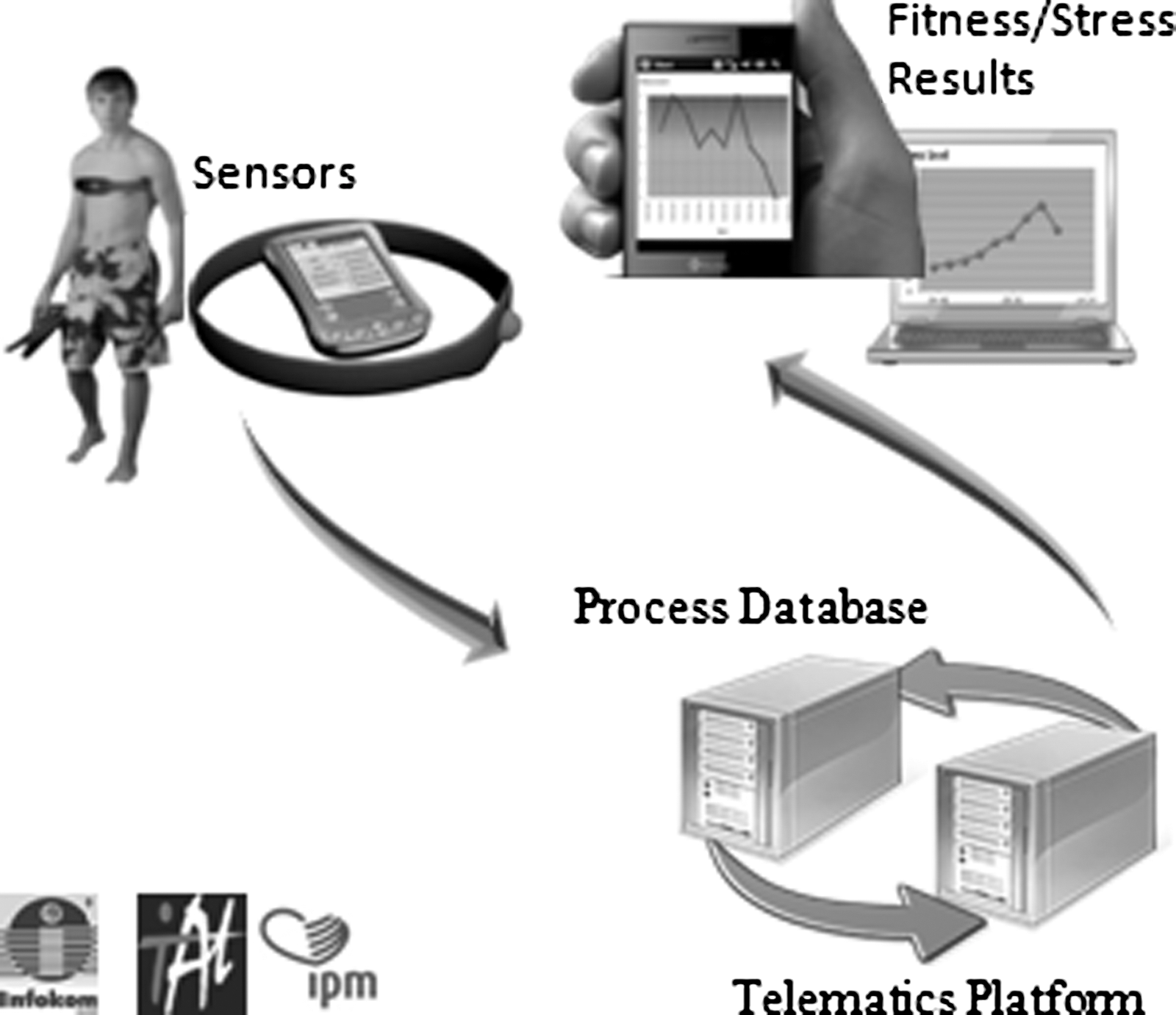
Three main tasks describe the system. Collecting and transmitting the vital signal measurements to the process database is the first task of this project (Fig. 1). The data acquisition system is based on a mobile phone application and a sensor electronic module on a special chest belt for acquiring several physiological parameters and their online transmission to the mobile phone via Bluetooth®. More about mobile data acquisition is explained by Neubert et al. 13
The eHealth-Mecklenburg-Vorpommern system.
The mobile handheld device acts as a control and communication unit, allowing data synchronization and a continuous data transfer to a process database. Through recent advances in wireless technologies, wireless sensors, mobile phone technology (smartphone, iPhone® [Apple]), and Internet technology, a mobility aware health case concept is no longer a big issue.
The process database performs the second series of tasks. The database system is connected to the fitness and stress modules and produces assessment results from primary data. These results are sent through HTTP/HTTPS protocols to the telematics platform. Interfaces to the mobile data acquisition system, to both stress and fitness modules, and to the telematics platform for managing an online analysis are conceived and implemented as explained by Behrendt et al. 14
The telematics platform ensures in its turn the third series of tasks, including, among others, a secure data transport, data storage, and an access control of users to the data.
Fitness Modeling
The VO2max, the accepted measure of cardiorespiratory fitness, is most commonly assessed in the laboratory by indirect calorimetry during the standardized treadmill or bicycle test. Because this testing procedure is strenuous, costly, and time- and staff-consuming, substantial efforts have been directed to other methods for cardiorespiratory fitness estimation. Thus, a large number of exercise and non-exercise models exist for the estimation of VO2max. 1,2,15 –18
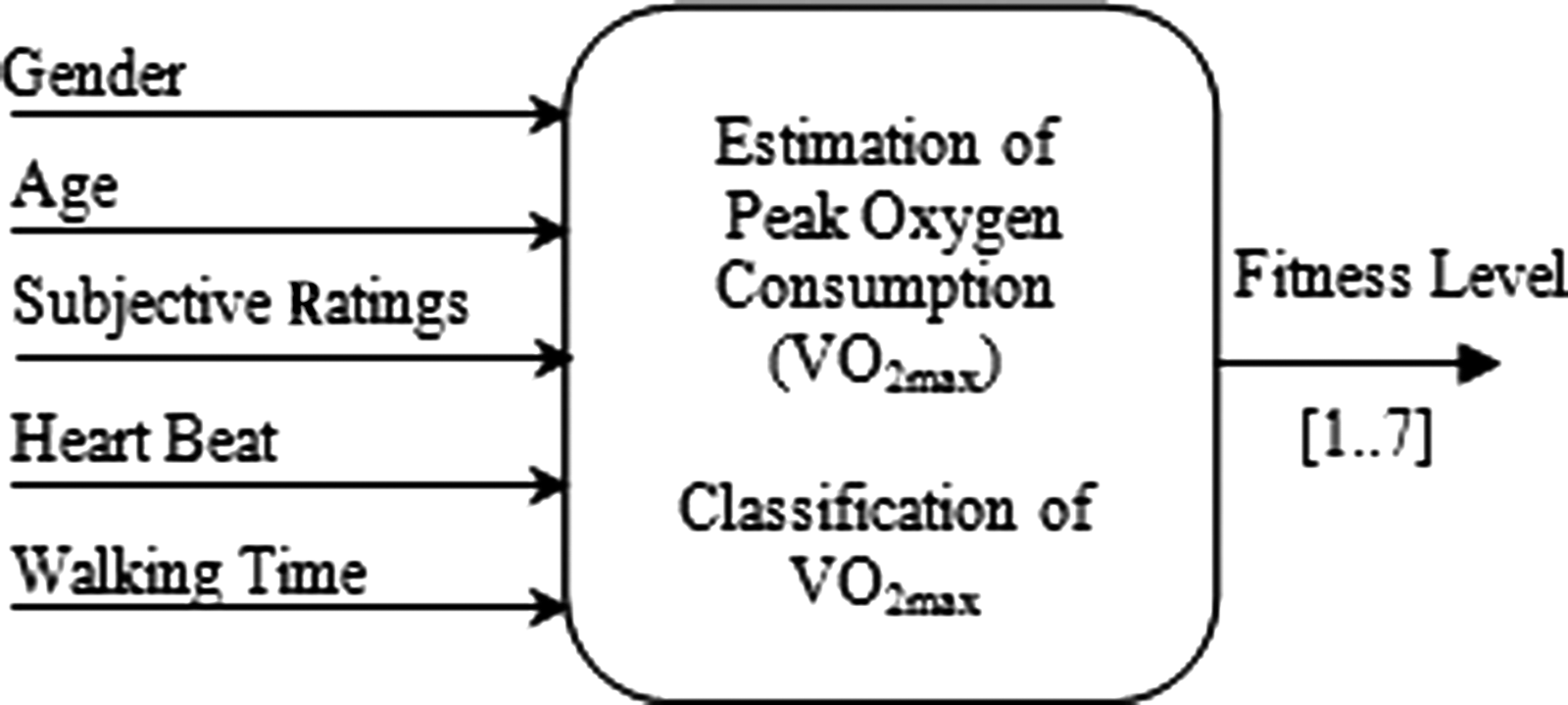
After a literature screening and an internal validation study, an exercise model and a non-exercise model have been implemented in a personal digital assistant application/server application. The exercise model is based on a regression model 19 and includes a 1-mile walk test. While the application guides the user through the testing procedure, data like walking time and average heart rate during the test are automatically analyzed and calculated to estimate VO2max (Fig. 2). The non-exercise regression model uses anthropometric data and subjective ratings of perceived functional ability and physical activity as input variables. 20 Kumar et al. 21 have demonstrated how fuzzy filtering can be used for intelligent interpretation of medical data. This preprocessing of the data could enhance the accuracy in the modeling process.
Fitness module: input/output.
For immediate user feedback, a graphical and verbal classification of the calculated value can be presented on the personal digital assistant screen and on the Web-based portal. 22
Stress Modeling
A novel fuzzy modeling-based HRV analysis method for stress assessment was proposed.
23
The method proposed extracts the features of HRV in the time–frequency domain, and fuzzy techniques are exploited to render robustness in HRV analysis against uncertainties arising from individual variations. The state of the art is extended with a new study whose aim is to develop a fuzzy expert system that gives a highly accurate description of the biomedical signals under the different stress conditions. An integrated approach that combines fuzzy modeling with the stochastic methods has much to offer in developing reliable physiological models and in predicting the stress of the patient. One possible way to do this is as follows
24
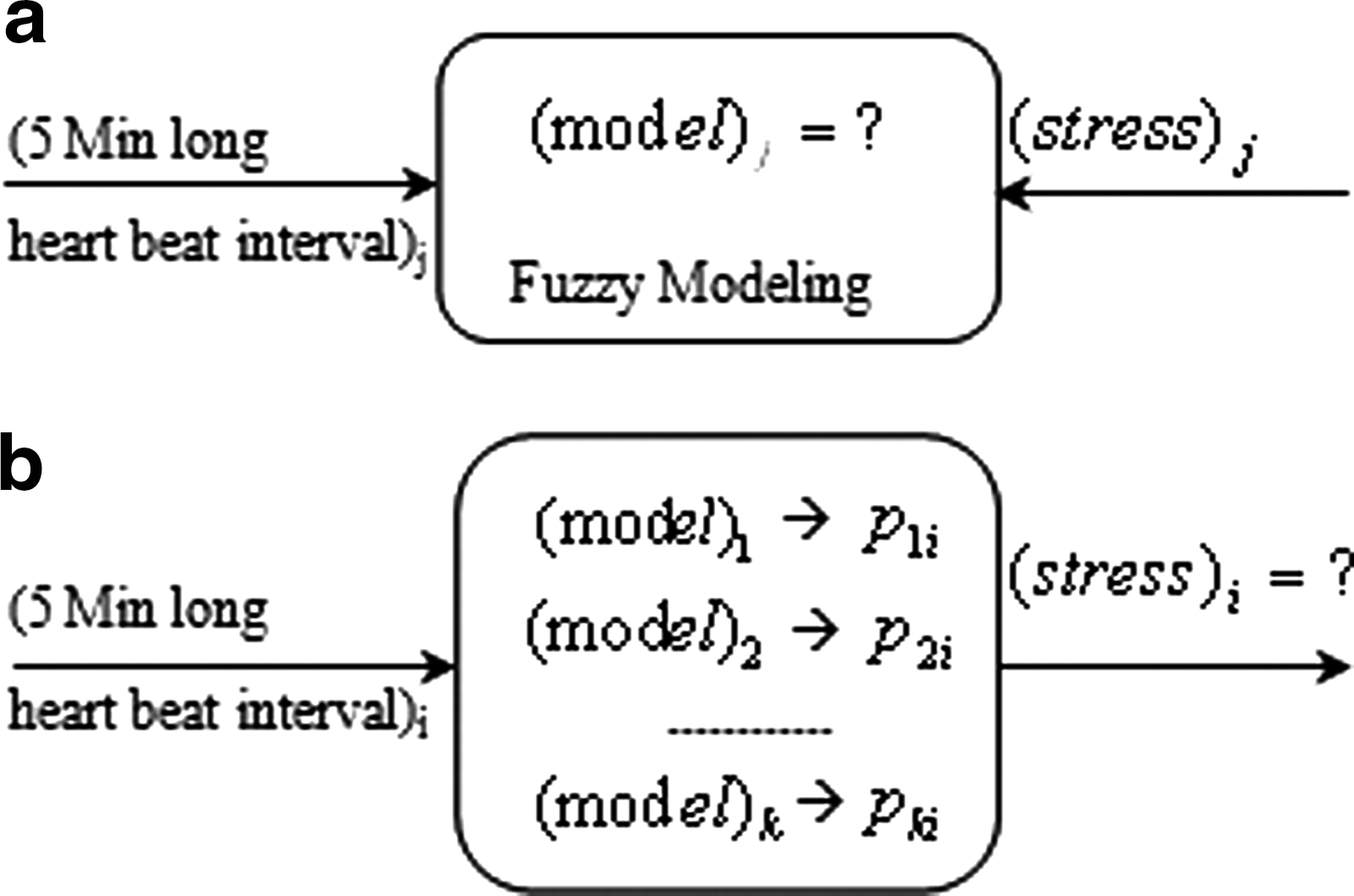
: 1. A history-dependent probability distribution can be considered for the stochastic modeling of the 5-min-long series of R-R intervals recorded under a given stress level (Fig. 3a). 2. The parameters of the distribution (e.g., mean, variance, etc.) can be further assumed as random variables and can be modeled using a stochastic fuzzy model. 3. The stochastic model of heartbeat intervals is individual-specific and corresponds to a particular stress level. Once the different values are available for an individual, an analysis of the given R-R interval series generated under an unknown stress level is performed as follows: a. The given signal is assumed to be generated by a stochastic mixture of a finite number of stress state-specific models such that each model tries to fit a part of the signal. b. The parameters of the stochastic mixture are inferred under a Bayesian framework. The probability that the given R-R interval data belong to a particular stress level-specific model can be calculated as shown by Kumar et al.
25
Stress levels specific to different models are weighted by the respective probabilities in order to provide an estimate of the unknown stress level (Fig. 3b).
Stress modeling principle:
In Figure 3a, Stress=subjective stress level and j=1..k, where k is the finite number of different stress states. In Figure 3b, pji
is the probability that the ith 5-min-long heartbeat interval might have been generated by the jth model, and stress is evaluated as the weighted sum as shown in Eq. 1:
A preliminary study was performed to verify the feasibility of the stochastic fuzzy modeling-based heartbeat intervals analysis method. 25 The results presented suggest that intelligent fuzzy computing-based biomedical signal analysis is a promising method. 25 The algorithms for predicting a patient's stress state from a real-time analysis of physiological data are to be optimized in terms of computational complexity, in order to facilitate the real-time applications. Intelligent fuzzy computing-based stochastic analysis of biomedical signals with potential e-health applications is the novelty of this research. A detailed description of the stress estimation method has been provided elsewhere. 24
Features of the Telematics Platform
Web-based portal structure and user rights
A Web-based portal structure like the one illustrated in Figure 4 has been conceived for the purpose of the eHealth-Mecklenburg-Vorpommern project. Different user categories can log into the password-protected system.

Portal structure in the eHealth-Mecklenburg-Vorpommern system.
The rights attributed to each category are listed on Figure 4. The system administrator can easily register/delete new/old hospitals, fitness centers, rehabilitation centers, etc., in/from the system and create/delete center administrator accounts for every registered institution through the administration portal. The other users can perform the tasks as listed in Figure 4. The Vital Portal is the Web space designed for test subjects/patients in order to be able to visualize their data in a suitable way. Interaction possibilities with their doctors/coaches are enabled in this portal thank to the integrated message system.
Features of the telematics platform
The telematics platform is conceived as client–server architecture. A separation of the implementation of the frontend (Clients C 1,…,Cn ) from the backend (Server, M 1,…,Mi ) modules is realized as illustrated in Figure 5.

Telematics platform client–server architecture.
The clients do communicate via the communication layer with the appointed server modules using standard (SOCKET/HTTP) protocols. The communication layer separates clients from servers on a physical level. A client can only access the functional area allocated to him or her.
The individual server modules do access the databases (DB 1… DBk ) via a kernel and the virtual database layer. This ensures that only authorized individuals and clients can gain access to the data. The virtual database layer realizes a federated unified view of all databases from the application module's point of view.
The other feature of the telematics platform is its ability to form clusters. This enables simultaneous data processing from multiple clients.
Data security and confidentiality are fundamental for telematics platforms used for patient-oriented services. Therefore, the following features have been implemented into the telematics platform in order to address these concerns: 1. A separation of the storage of personal from the storage of medical information during data processing is realized. 2. Any information stored or transferred through the system is encrypted using appropriate methods involving different key sizes. The Advanced Encryption Standard cryptography is the one mostly used in this work. The key size can be chosen from 128, 192, and 256 bits according to the security level needed. The lifetime of the key is the session duration. The encryption engine is built up in a modular way, which allows expansion to other methods. 3. Medical data are transferred without personal information. This guarantees a data anonymity such that in case they are captured by a third person, they will not have any meaning. 4. The services of the telematics platform are protected by authentication methods (login and password) and various authorization levels for the different users. This enables a structured control of the data access for all different user categories. 5. The telematics platform uses modern technologies in information and communication systems, and several extension points do exist so that plug-ins can easily extend its core functionalities.
Experimental Settings
Fitness
The experimental part of the work involved 110 subjects (between 20 and 56 years old) whose fitness levels were assessed at different periods of the year using exercise and/or non-exercise models. The submaximal exercise testing procedure (1-mile walk test) was carried out on a 400-m track as previously described. 26,27 Subjects were guided through the testing procedures by a smartphone application. Heart rate and walking time as well as other input variables (e.g., age and gender) were automatically processed for an instantaneous fitness evaluation on the smartphone/server. The non-exercise model included subjective ratings of the individual's perceived physical ability (e.g., how fast the person could walk or run 1 mile) and the estimated activity level of the last months. 20
Stress
The system developed was tested experimentally on 50 different subjects. The aim was to monitor the stress level of the subjects over a 24-h time period. The stress prediction algorithm should be accepted if it results in a “good” correlation between the predicted values and subjective rating score of stress. The subjective ratings were obtained using the mobile handheld where the software version of the modified National Aeronautics and Space Administration Task Load Index was implemented. The mobile handheld device was programmed to step the subjects through dialogues for inputting the subjective rating score of stress they felt during the last 5 min. The subjective ratings of stress were collected for each subject at different times of the day whenever a certain level of change in the heart rate of the subject was detected. It was observed that the predicted stress values are positively correlated with the subjective rating score of stress with R=0.7729. 24
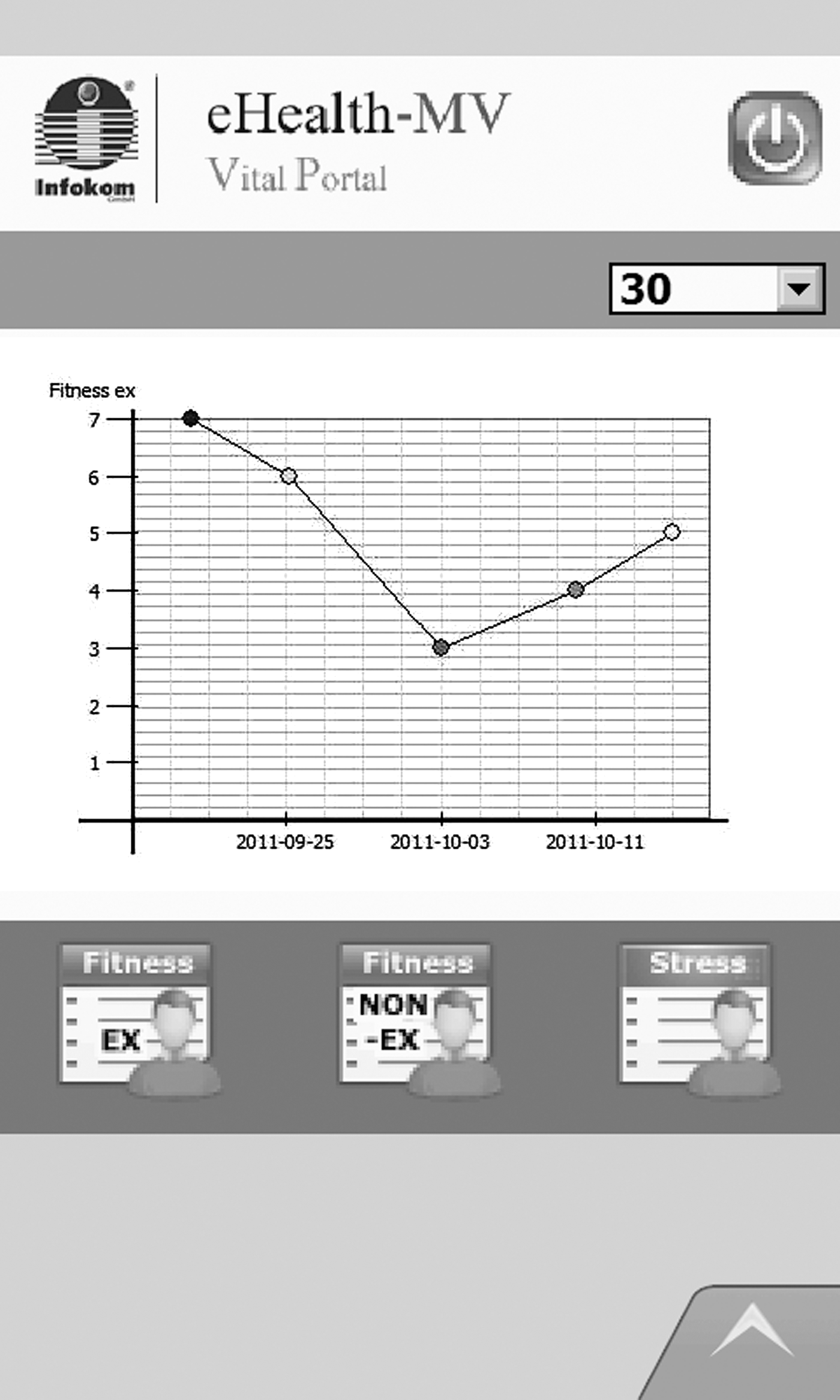
For an immediate user feedback, graphical classifications of the calculated values are presented on the Web-based portal (Fig. 6) and on the personal digital assistant screen (Fig. 7). The results of Figures 6 and 7 belong to one of the real subjects who took part in the experimental phase.

Web-based application screenshot: stress results.
Mobile application screenshot: fitness exercise model result. eHealth-MV, eHealth-Mecklenburg-Vorpommern.
Conclusions
A mobile fitness and stress monitoring system embedded on a secure telematics platform has been presented in this article. The fitness modeling has been conceived, implemented, and successfully tested with 110 individuals. Fitness levels could be classified in seven levels, from an extremely poor to an excellent fitness level. Both the exercise and non-exercise models could provide a high correlation coefficient with the directly measured oxygen consumption (r=0.85 and above) with a low standard error of estimate (4.3 mL/min·kg and below). These obtained accuracies are supposed to be sufficient for cardiorespiratory fitness classification in a general population.
A novel method for stress estimation requiring only a short time series of heartbeat intervals was presented and validated during the test phase. A high correlation between predicted stress level and subjecting rating score of stress provided by 50 subjects during their 24-h monitoring was demonstrated. However, the optimizations regarding the computational complexities and accuracy are still under development.
For an immediate user feedback, graphical classifications of the calculated values are presented on the mobile phone (Fig. 7) and on the Web-based portal (Fig. 6).
The mobile data acquisition of the vital signals has been implemented and tested for the purpose of this project. This could enable real-time collection of vital signals at any time independently of the location.
A secure and scalable telematics platform on a basis of a client–server architecture as illustrated in Figure 5 was developed and could host successfully this fitness and stress monitoring application.
Footnotes
Disclosure Statement
M.C.T., S.K., and P.P. are employees of Infokom GmbH. R.-D.B. is the CEO of Infokom. N.S., K.T., M.H., S.B., M.W., A.R., and R.S. declare no competing financial interests.