




Abstract
Introduction
Musculoskeletal and neurological injuries are a common occupational hazard for both professional and aspiring musicians. To remain competitive, these individuals often endure rigorous practice in order to master advanced skills. The long hours of practice, overuse of fine motor muscles, incorrect ergonomic posture, performance anxiety, and physical strain are contributing factors to performance-related injuries. 1
The field of music performance requires career commitment at a young age. Individuals who choose this career path devote considerable amount of time and energy toward achieving their goal of becoming renowned musicians. Performance-related injuries can have devastating consequences for one's career. In the United States, it was noted that the prevalence of performance-related musculoskeletal disorders was as high as 34–62% in high school music learners and 39–87% among adult music performers. 2 These statistics are rather modest as studies have shown that many professionals are reluctant to disclose their injuries because of a belief that such an admission may be perceived as a sign of vulnerability in this highly competitive field. 3,4 Furthermore, after suffering such injuries, musicians often delayed seeking medical treatment for various reasons, including financial constraints due to self-employment or the lack of trust toward the medical profession. 5 It was also noted that beginning music performers tend to injure themselves more easily than experienced performers and tend to be more willing to seek advice from their music instructors. 6,7 The challenge has been that many music educators may not have adequate training to properly advise students on performance-related injury issues as music curricula often lack such occupational health promotion courses. 8
Playing-related musculoskeletal disorders (PRMDs) have become an emerging clinical and research focus in the field of performing arts medicine. The contributing factors for PRMDs include (1) intrinsic factors, such as age, gender, stamina, flexibility, physical size, muscle strength, muscle tension, and related musculoskeletal issues (misalignment and joint hypermorbidity), and (2) extrinsic factors, such as instrument type, instrument size, performing technique, practice routine, music piece, and ergonomic issues. 9 Besides musculoskeletal-related intrinsic and extrinsic physiological factors, psychological (anxiety and nervousness) and behavioral (level of physical activity and attitude toward injury treatment) factors also play a significant role in PRMDs. 10
Given the extensive list of factors presented above, many music students begin their university studies with preexisting PRMDs with prevalence rates estimated to be as high as 87%. 10,11 According to a Taiwanese survey, when faced with a performance-related injury, 60.4% of college music majors opted for self-treatment or sought assistance from music professors; only 21.6% sought treatment from health professionals. 12 Similar findings were reported in a study conducted by the Royal Academy of Music in which students were found to seek advice from professors prior to seeking medical care. 13 The results of these studies implied the integral role of music professors in “Health Promotion for Music Performers” (HPMP). Furthermore, these studies suggest that promotion of collaborative work between music professors and healthcare professionals can better provide musicians with accurate information concerning PRMDs.
In 2004, the American Performing Arts Medical Association and the National Association of Schools of Music jointly initiated a task force for Health Promotion in Schools of Music. The task force's recommendation emphasized that performance injuries are preventable and that incorporating occupational health-related courses for music majors into higher education ought to be an initial step. Such courses, coupled with wide-ranging intervention measures, were encouraged to promote the self-care required to prevent and reduce discomfort caused by performance injuries. 14 In accordance with proposals made by the Health Promotion in Schools of Music task force, both American and European music institutions have started to promote performance health courses and to adopt collaborative teaching models bringing together medical experts, performance instructors, and music education scholars. 15 –17
Although performance health courses have been adopted by several academic programs in Europe and North America, these programs have only seen limited implementation in countries such as Taiwan. We conducted a preliminary study in 2006, laying groundwork for future collaboration between music educators and medical professionals. 18 The outcome of the pilot study paved a foundation for the team to develop a graduate-level music performance occupational health curriculum for music educators in 2008. Distance-learning was later incorporated in 2009 to facilitate participation from clinicians in other cities of Taiwan.
The use of telehealth to deliver healthcare and professional consultation, particularly in the home setting or in rural area, has been well documented in the past decade. 19 –25 Telehealth has been widely adopted by the field of rehabilitation medicine for patients across all life stages 26,27 as well as for a variety of medical conditions such as after musculoskeletal surgery, 28 –31 stroke, 32 –35 and cardiovascular 36 and neurological 37 –39 rehabilitation. In addition, telehealth has also been used to provide educational training for healthcare professionals. 40 –44 However, there is limited literature on the implication of an e-curriculum that focuses on occupational health for non–healthcare professionals. In this study, the effectiveness of an e-learning curriculum on occupational health promotion for music performers was evaluated. The study focused on two specific research questions: (1) Does the e-learning curriculum change health-related lifestyle and practice behavior, and (2) what types of questions were raised by students through this e-curriculum?
Subjects and Methods
Study Design and Sampling
This was an intervention study with preintervention, postintervention, and 1-month longitudinal measurement. Participants were recruited via convenience sampling from a masters program at the Institute of Music, National Hsin Chu University of Education, Hsinchu, Taiwan. All participants consented to take part in the study.
Intervention
The intervention, the HPMP e-learning curriculum, consisted of three essentials: (1) foundation course (muscular and skeletal structure, psychological health, health-related physical fitness, and preventative care), (2) advanced core course (performance anxiety, performance-related hearing loss, vocal cord self-care, and performance-related muscular and skeletal injuries), and (3) application course (stress management and Alexander relaxation technique, evidence-based performance medicine, and somatic movement therapy) (Table 1).
Health Promotion for Music Performers e-Learning Curriculum
The HPMP e-learning curriculum was implemented over the course of one academic semester (14 weeks), once a week, for a total of 14 100-min classes. The e-learning curriculum was delivered in group format at a distance-learning classroom where participants virtually interacted with interdisciplinary experts from remote sites. Each class was broken down into two periods: (1) a 60-min prerecorded Microsoft PowerPoint/PowerCam presentation, which captured each instructor's image and voice and corresponding slide show and mouse pointer animation, followed by (2) a 40-min interactive live online discussion. The JoinNet multiuser, multipoint videoconferencing multimedia software was used as the platform for curriculum delivery (Fig. 1). This platform allowed students to immediately ask questions through an interactive online discussion board. Students also had the option to submit questions prior to the lecture for real-time online discussion. Students' inquiries and professors' responses were simultaneously displayed on the online discussion board, and all contents were recorded for analysis.
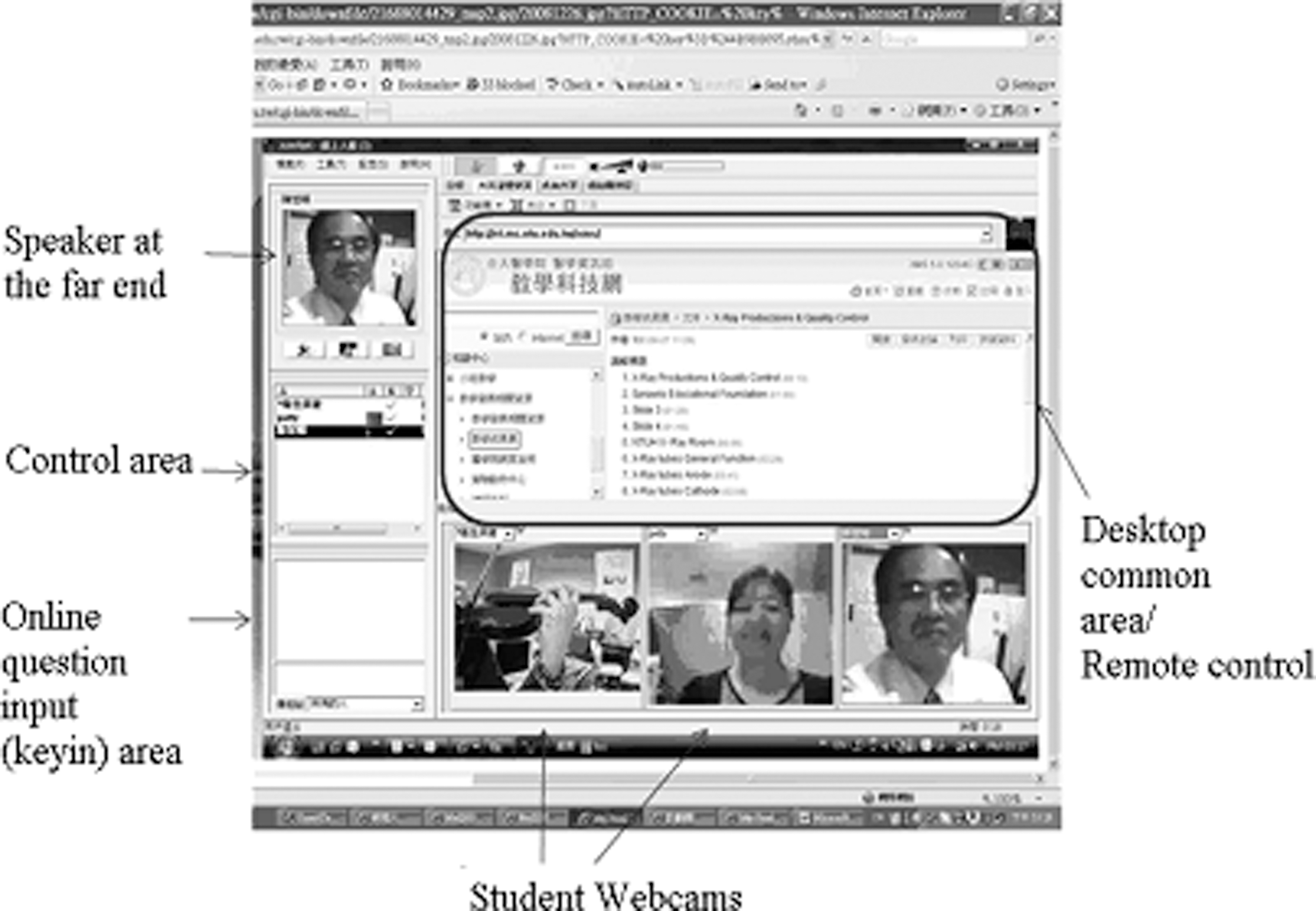
Online curriculum platform through the JoinNet multimedia software.
Measurement
To evaluate the impact of the HPMP e-learning curriculum, the Self-Assessment Questionnaire (SAQ) of Barton and Feinberg 6 that indexed two domains, (1) Practice and Performance issues and (2) Health and Life Style issues, was used. Twelve of the 13 items were adopted from the original instrument (Table 2). Because the practice room at the university where this study took place was a smoke-free environment and none of the participants was a smoker or practiced in a smoke-filled setting, individual avoidance of performing in a smoke-filled room was eliminated from the SAQ. The SAQ items followed the 5-point Likert scale question format, with a rating of 5 representing that the individual “always” used the particular strategy and a rating of 1 indicating that the individual “never” used the particular strategy, resulting in a possible score ranging from 12 to 60 points. The questionnaire was administered at three time points: at the beginning of the curriculum, during the last week of the curriculum, and 1 month after conclusion of the curriculum.
Self-Assessment Questionnaire of Barton and Feinberg 6
Statistical Package for the Social Sciences (SPSS) software was used to analyze the data. Descriptive statistics were used to describe the demographic characteristics of the sample. Paired t testing was used to examine the mean changes. Percentage changes were calculated to estimate the degree of impact. Statistical significance was assessed using an alpha level of 0.05.
Results
In total, 15 participants were recruited and completed the study (14 females, 1 males; mean age, 25±2.9 years). The participants' exposure to the e-curriculum was 100%. Of the 15 students, 6 majored in music education, 5 majored in piano performance, 2 in vocal music, and 2 in woodwind/brass music.
Effectiveness of the E-Learning Curriculum
The impact of the HPMP e-learning curriculum was assessed through the use of SAQs. For Practice and Performance issues items, the mean was 18.80 (±2.76), 19.93 (±2.89), and 21.13 (±4.49) for pretest, posttest, and 1-month follow-up, respectively. Regarding Health and Lifestyle issues items, the mean was 16.27 (±1.94), 17.27 (±3.36), and 18.20 (±3.99) for pretest, posttest, and 1-month follow-up, respectively. The total mean scores were 35.07 (±3.26), 37.20 (±5.67), and 39.33 (±7.99) for pretest, posttest, and 1-month follow-up, respectively. Although there was a trend of improvement in health promotion behavior, the changes were not statistically significant outside of the follow-up to the pretest on Practice and Performance issues items (t=2.73, p<0.05) and follow-up to pretest on the total scores (t=2.51, p<0.05) (Table 3 and Fig. 2).

Self-Assessment Questionnaire mean score trend change.
Self-Assessment Questionnaire Mean Score Comparison
Significant difference.
SD, standard deviation.
Types of Questions Raised by Students
During the 14-week curriculum, students raised a total of 81 questions. These questions fell into four major categories: performance injury (36 counts, 45%), performance anxiety (18 counts, 22%), general physiology (18 counts, 22%), and general psychology (9 counts, 11%). This finding provided a foundation for future curriculum development in which courses may be divided into two major content areas: primary course content would concentrate on performance physiology and injury, and secondary course content would then focus on performance psychological health.
Discussion
This HPMP e-learning curriculum was shown to effectively increase learners' knowledge concerning Practice and Performance–related issues. The e-learning curriculum encouraged future interdisciplinary collaboration by enabling medical experts throughout Taiwan to provide mentoring and consultation to local students via an online digital platform.
The online discussion board was found to be a valuable tool. The teaching assistants collected students' questions prior to and during the online classes. Teacher responses were then posted on the online discussion board along with original students' questions in real time. The utilization of the discussion board not only helped to maximize class participation and interaction but also enabled accurate replication of specific questions, seemingly enhancing information retention and participation during real-time discussions.
The findings suggest that the HPMP e-learning course enhanced student awareness of Practice and Performance issues but was not as influential for Health and Lifestyle issues. The significant improvement in student awareness of prevention strategies for Practice and Performance issues at the 1-month follow-up may suggest a cognitive-behavioral phenomenon where attaining new knowledge results in behavioral changes. In other words, the behavioral change that was demonstrated as a result of cognitive formation is a gradual process rather than an immediate response. This finding is consistent with the study of Barton and Feinberg 6 on the traditional classroom setting. The percentage improvement on total scores from the pretest to posttest was 6.07% in the present study compared with 4.61% in the previous study. 6 Furthermore, the improvement from pretest to the 1-month follow-up in this study was 17.85% in the present study compared with 9.43% for the previous study. 6 Practice and Performance issues items percentage improvement from pretest to posttest and from pretest to 1-month follow-up for this study versus the previous study 6 was 6.01% versus 9.07% and 12.38% versus 13.39%. Health and Lifestyle issues items percentage improvement from pretest to posttest and from pretest to 1-month follow-up for this study as opposed to the previous study 6 was 6.14% versus 1.43% and 11.86% versus 5.26%. These findings suggest that the 14-week e-learning curriculum had a comparable or even more promising impact. In the study of Barton and Feinberg, 6 the participants were young female college freshman (mean age, 18 years old), and the curriculum was delivered in 8 weeks in the traditional classroom setting. In comparison, the participants in this study were graduate students (mean age, 25 years old) majoring in music education.
Limitations of this study included small sample size, a predominantly female demographic, isolated geographic setting, and a very specific sample of music performers and music educators. There was also a lack of control group to evaluate placebo effect.
Recommendations
Music performance involves a series of elaborate and dynamic musculoskeletal movement and fine motor adjustments. In order for medical professionals to correctly evaluate performance action, adequate network speed such as digital video service is required for smooth data transmission of real-time high-definition quality video. In addition, as was noted earlier, many music performers hesitate to reveal performance-related injuries. As such, future online curriculum design may consider adopting anonymous question posting or confidential one-on-one online discussion/consultation.
Although participants in this study gave positive feedback about their experiences with the HPMP e-learning curriculum, no formal data were collected regarding overall student and instructor satisfaction with the curriculum. For future curriculum development, it has been suggested that studies build in a method to measure participant satisfaction.
This survey of the HPMP e-learning curriculum can be modified for other specialized groups such as athletes, actors, and industry laborers to promote occupational health.
Footnotes
Disclosure Statement
No competing financial interests exist.