




Abstract
Introduction
The steady growth of patient numbers increases the pressure on traditional healthcare systems that suffer from both increasing costs and diminishing available resources. Recent advances in communications technologies should enable the design of advanced and cost-effective teledermatological solutions that are expected to improve the care level of services and the life quality of patients and to speed up the shift of healthcare delivery from hospitals to patients' home residences within the community.
The increasing interest in the development of teledermatological applications has been motivated as well by the recent advances in digital imaging based on mobile phones. Smartphones equipped with high-resolution cameras have become available at reasonable prices. Moreover, the number of mobile phone subscribers in the past few years has been growing significantly, and there is a clear trend in developing value-added applications/services for the new generation of cellular networks and related smartphones.
The current research on the convergence front between medicine and information technology is, among others, focusing on developing and testing new ways to utilize cellular phones for home-based healthcare-relevant data acquisition and a related remote interaction with the patients.
The authors 1 have proven that the effectiveness in diagnostics by dermatologists relies, among other variables, on constant or repeated examinations. This implies a frequent visit to the dermatologist and consequently results in a high cost to health system organizations. Fortunately, this difficulty can be minimized by exploiting the features of modern technologies. A study performed by Eminovic et al. 2 shows that a cost minimization through use of teledermatology is guaranteed because this technology will reduce the physical consultation frequency to the medical doctor. The cost reduction is even higher in cases where the distance to the dermatologist is far. A teledermatology system has been proposed 3,4 that enables delivery of dermatology services to the patients at remote areas via distant and specialized medical sites. It also uses the store-and-forward type of telehealthcare, which is based on the concept of sharing information asynchronously and place-independently. Also, it relies on transmitting baseline photography and patient information to a distant expert who provides the consultation. In Massone et al. 5 the mobile teledermatology was shown to be suitable for the care and therapy of patients with emergent or chronic skin diseases. Security issues in electronic health were tackled by Marti et al. 6 ; in this study the authors focused more on issues dealing with confidentiality and authenticity in e-health.
In the conception and development phase of the teledermatology system to be applied for the case of therapy and aftercare of patients with skin diseases, the following questions have to be answered. The answers to these questions constitute the main contributions of this article to the relevant state of the art: 1. What are the general requirements to be considered in developing such a teledermatology system? The requirements dealing with the usability, functionalities, security, and scalability issues are listed in Subjects and Methods, General requirements to the system. 2. How should the overall system engineering be conceived in order to satisfy all the needed requirements? The solution to this question is proposed in Subjects and Methods, Overall system engineering. 3. What is the impact of such a system on the therapy process, and how is the quality of service according to care providers? Feedback from patients, nurses, and dermatologists after the 1-year test phase of the application at the clinic for skin diseases shows answers to these questions and is found in Discussion.
Subjects and Methods
General Requirements to the System
In order to obtain exhaustive and comprehensive functional requirements, several parties, including dermatologists, nurses, patients, and developers, worked closely together during the development process. Regular consultations and discussions were organized throughout the conception phase in order to define the requirements to be fulfilled during the development process of the system. As a result, a list of requirements could be accurately structured and includes the following: • System with an easy-to-use graphical user interface for patients, nurses, and dermatologists • System covers essential functionalities needed by both the patient and the medical personnel • A quick data input for images and text entries • Include an interaction tool such as a message system • Ability to generate a report of patients' data • Ensure a secure data communication and storage • Meet the privacy requirements • Ensure the scalability of the system • Provide an administration level of the system
The concept of the system that satisfies the above listed requirements has been developed as presented next.
Overall System Engineering
System functional scheme
The system's functional scheme is illustrated in Figure 1. Skin images and subjective evaluations of the illness of a patient are captured and sent to the Telematics Platform, independently of time and location, through a mobile phone, as illustrated in Figure 1.

Functional scheme of the “Mobil Neurodermitis” application.
The authorized medical doctors have access to the data provided in the portal. Medical doctors can only see data for patients who have been assigned to them by the administrator.
A program assistant guides the patient through the three important steps: photo taking, input of subjective evaluation, and data transfer to the Telematics Platform.
The performance metrics considered for this work are the usability of the human–machine interface and the effectiveness of the system in assisting both the therapy and the aftercare monitoring of dermatology patients as already mentioned.
Telematics Platform features
The Telematics Platform is a flexible middleware for the integration of different kinds of telemedical applications and services. It is based on modern client-server structures (×86, ×64) and applies up to-date technologies. It has a high performance through the use of multiprocessor and multicore technologies. The platform enables an optimal load sharing through its clustering feature. It allows flexible interfaces to third-party applications and has an integrated user management system. Services such as secure data transport, secure data storage, data encryption, universal and transparent data storage, secure authentication methods, flexible protocol mechanisms, firewall, and virus protection are covered by the Telematics Platform.
Today, data security is an important issue in an increasing technological age. Konstantas et al.
7
have exposed some of the main problems related to the introduction of new mobile health services based on Internet technologies. In order to address these security concerns, the following features have been implemented into the developed platform. • Any information transferred or stored in the system is encrypted. This method allows different key sizes (128, 192, and 256 bits), and the choice can be made based on the security level needed. For more security, keys are session dependent. The encryption engine is built up in a modular way, in order to allow an easy implementation of other methods to the platform. • Personal and medical information is stored separately. • Transfer and storage of medical data are anonymous. In case data are caught by a third person, they will not have any meaning because they just have an identification number. • The platform services are protected by authentication methods that require a login and a password. Moreover, the authorization system that controls the access of different users to defined data sections is integrated.
Results
Mobile Phone Application
The mobile phone application enables the patient to capture and transmit images with corresponding subjective evaluations independent from time and location to a distant expert who can provide the consultation. Two versions of the application have been developed. The first one is suited for Windows mobile-based smartphones as shown in Figure 2, and the second one is suited for Android-based phones and tablets as shown in Figures 3 –5.
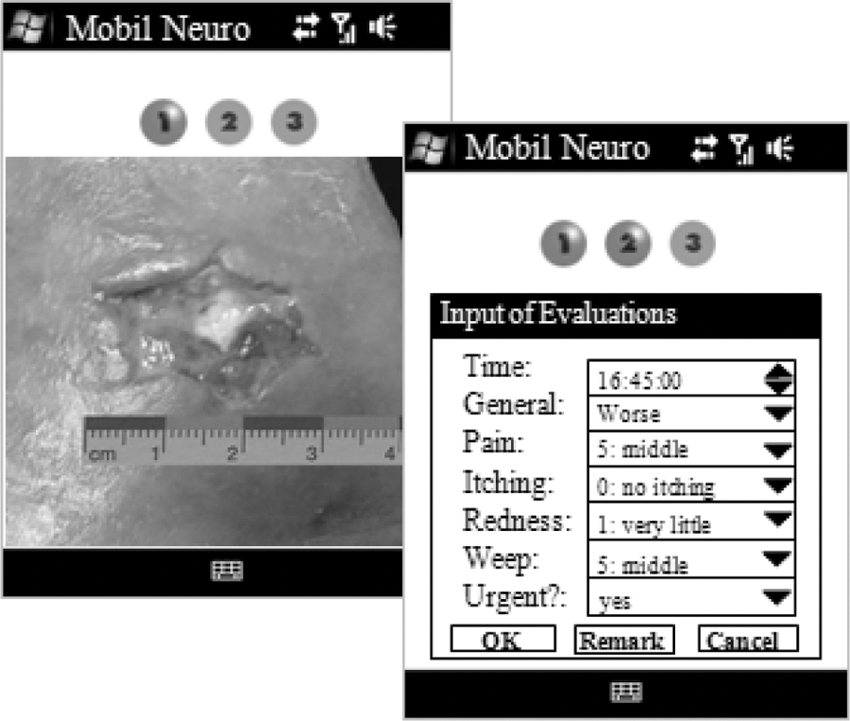
Screenshot of the mobile phone application for Windows mobile-based phones: Step 1, taking the photograph; and Step 2, input of evaluations.

Screenshot of the Android-based application on a Samsung Galaxy Tab. A graphical view of the evaluation data is shown.

Screenshot of the Android-based application on a Samsung Galaxy Tab. Image gallery.
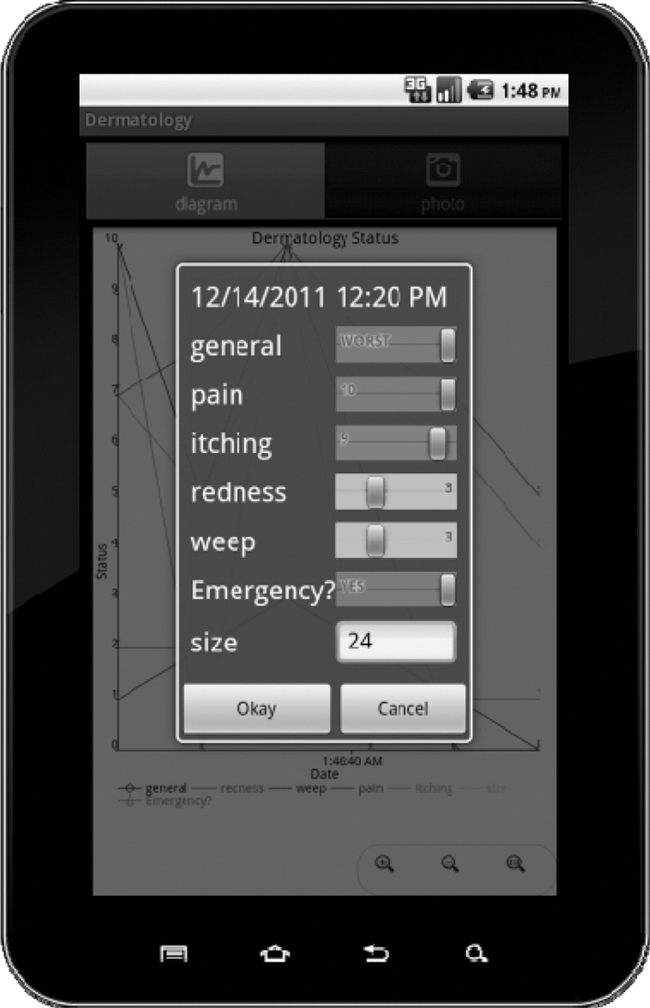
Screenshot of the Android-based application on a Samsung Galaxy Tab. A new evaluation entry can be inputted or edited.
In the Windows mobile version, a program assistant guides the patient through the three steps: taking the photograph, input of evaluations, and sending data to the Telematics Platform.
In Step 1, “photo taking” (Fig. 2), the photo mode of the phone launches automatically after the photo button is clicked. A default label of the image is supplied, but this can be modified. After the photo has been taken, the next step appears automatically. In Step 2, “input of evaluations,” as shown on the mobile phone screen shot of Figure 2, the patient enters values for different criteria characterizing his or her current feeling and state. These will then be associated with the image taken so that the doctor could get images with corresponding state feedback from the patient. When Step 2 is completed, the third step starts automatically. In Step 3, “data transfer,” a communication to the Telematics Platform will be automatically initiated by using one of the available communication channels: UMTS, GPRS, etc. Both images and the subjective evaluation of the states will be transferred to the system.
In the Android-based version, the application is developed such that the Android functions and interaction features are exploited. There are two main views: diagram (Fig. 3) and photo (Fig. 4). In the first view, an interactive graphic of the evaluation data is represented. New entries can be added by clicking on “Add New” in the menu, and existing entries can be edited by clicking on the corresponding point of the graphic as shown in Figure 5. In the second view, images are listed in a gallery with the possibility of viewing the real size through a simple click on the thumbnail preview. All the features of the Android gallery are made available when working with images. The Android-like zooming feature is enabled, and photos are labeled with a number, date, and time when the image was taken. Images can be imported from any other camera device as well.
New added entries are immediately mapped on the graphic as shown in Figure 5. The size of the target surface of the illness is included in this version as one of the evaluation parameters.
The interactions of the Android version are suitable for touch screen displays working with fingers. Big buttons are available on tablets. Moreover, seek bars make the input of the evaluation data easier (Fig. 5). The colors on the seek bars make the evaluation values understandable at a glance.
Online Doctor Portal
In the medical doctors' portal, the authorized doctors have access to data for the patients allocated to them. After a successful login, the doctor sees the list of his or her patients. Different visualizations of the data are available in the menu. The menu point “Evaluation” (Fig. 6) shows the evaluation criteria of skin illnesses. These include general state, pain, itching, redness, and weeping. The values can range from 0 (very good, no pain) to 10 (very bad, maximum pain). A graphical representation of the evaluation inputs in time appears below the table shown in Figure 6. The visualization is related to a selected patient.

Medical doctors' portal functionalities: Data Evaluation view.
Figure 7 presents the next feature, “Photo Compare.” A doctor can choose two skin illness photos from the calendar and compare them to analyze the evolution of the patient's skin illness.
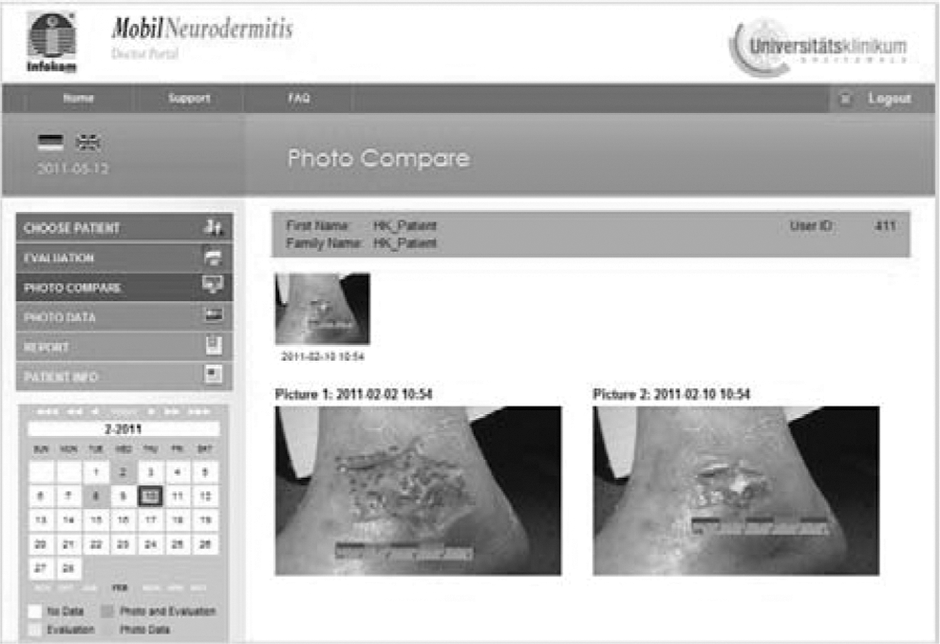
Medical doctors' portal functionalities: Photo Compare view.
The next menu point, “Photo Data,” opens an image gallery. Images from a chosen time period are chronologically listed with a preview possibility, date, and a description of the illness. By clicking on a photo, its original size format is opened.
The calendar is implemented with different colors such that the days containing photos, evaluations, and both photos and evaluations could be easily differentiated. The calendar function depends on the menu location. In the “Evaluation” and “Photo Data” menus, by clicking on a calendar day, the chosen period starts from the selected date. While in “Photo Compare” only available photos on that day are displayed.
Report Creation
The menu point “Report” generates a PDF document that summarizes the patient's data for a chosen period. Different items can be included in the report. These include personal patient information data, table form of the state evaluations, graphical representation of the state evaluation criteria, and four images in the chosen period. This report could be sent to whoever may need it and/or be kept/archived in the patient file.
Administration of the System
The administration level is conceived as follow: the system administrator has the right to register several hospitals into the system using an administration tool. Thereafter, the administrator creates an administrator account for every registered hospital. The administrator of each hospital is given then the right to register patients and medical personal belonging to that hospital through the hospital portal. This portal also allows the assignment between patients and doctors for a defined period. This gives registered doctors the right to access data of patients who have been assigned to them through the doctor portal. Patients are able to access their own data through the patient portal.
Discussion
Experimental Field: Study Description
In order to achieve a positive and realistic assessment of the effectiveness of the system for the targeted medical context, we have worked closely with dermatologists, nurses, and patients. The developed application has been used and tested in a study performed in cooperation with the Clinic for Skin Diseases of the University of Greifswald, Greifswald, Germany. Informed consent for the study was obtained. The experimental fieldwork was performed in three phases.
Phase 1 was conducted for a period of 1 month, and the application was tested by dermatologists. During this time the medical doctors could test both the mobile application and the Web-based portal. At the end of the test, the dermatologists offered their suggestions that could further improve the design and functionality of the system. One of the suggestions was to provide a possibility of comparing two images in order to see the evolution at glance in the Internet portal. Another suggestion was to enable the creation of a PDF report with patient data for a chosen period. These suggestions were implemented before the second phase was started.
Phase 2 consisted of testing the application by nurses for a period of 2 weeks. Nurses are the ones who work the closest with patients and are familiar with their needs. Once again, suggestions for the amelioration of the system were collected and then implemented at the end of the second phase. The nurses recommended that a program assistant for the mobile application be provided to guide the patient automatically through the steps. Because the patients are of different ages, starting from adolescence to the elderly, including a program assistant will ease the use of the application.
Phase 3 consisted of testing the application by patients with different kinds of skin illnesses. As part of an observational study on teledermatology, the Department of Dermatology from the University of Greifswald tested the application “Mobil Neurodermitis” developed by Infokom GmbH (Neubrandenburg, Germany) on patients. Test subjects suffered from skin diseases such as ulcus cruris, eczema, psoriasis, and pemphigus. A majority of the participants were from the ambulatory sector of the Department of Dermatology.
Patients had to take images of their dermatological diseases regularly and supply additional information related to pain, itching, redness, weeping, emergency cases, and general conditions. For this purpose, participants used smartphones with the “Mobil Neurodermitis” application implemented on them for the test period.
In the doctor portal, developed by Infokom, image and evaluation data could be summarized, compared, and analyzed. The navigation in the portal was simple and clear for care providers. This was concluded by care providers who used the online portal for the test period. Doctors and nurses found that the photo images were of high quality and could use them to analyze the skin illnesses. In summary, with correct usage of the application and proficient technical knowledge, great results could be obtained. Moreover, in cases where the complete documentation was undertaken by the nursing service, even higher-quality results were observed. Thus, the teledermatology application is an efficient tool for the nursing services in documenting wounds and establishing contacts to hospitals.
The documentation of psoriasis or eczema was carried out satisfactorily, and the images were of high quality. Young patients were motivated and interested in quality results. This was reflected in the image quality of their data.
For dermatological diseases such as ulcus cruris, eczema, psoriasis, pemphigus, and local limited wounds, the use of teledermatological applications was compatible. During the test period, it was shown that a high compliance, motivation, and a technical affinity are prerequisites for better results. For this reason, some of the elderly participants required technical assistance from their relatives or nurses.
However, we found that some patients with ulcus cruris withdrew from the study because of frustrations with new technology. The lack of motivation for such patients was observed since they had no relatives or nursing services to help them. Some nursing services rejected the use of the application as well because of their limited technical knowledge, lack of time, and addition of an extra task to their jobs.
At the end of the test phase of the application, comments and suggestions were reviewed and implemented. One of the suggestions was the possibility of making a series of images belonging to an evaluation entry. This was an important feature needed for extended medical findings of psoriasis or eczema.
From the 13 patients who took part in the experimental phase of the “Mobil Neurodermitis” system, 10 of them could give positive feedback about it. Two patients withdrew from the study because of frustration with new technology and lack of assistance in taking images at places where he or she is unable to see. One patient withdrew from the test phase because of the lack of motivation. Feedback from all the three groups of users—patients, nurses, and dermatologists—was in general positive. They found the tested application “Mobil Neurodermitis” to be a promising solution for both therapy and aftercare monitoring of dermatology patients. It has also been shown that some patients such as elderly people do need help as they have problems with using mobile phones. This help can then be provided by relatives or nurses who visit them regularly. The problem with the small buttons and character size has been solved by the Android version, which can be implemented on different tablets.
Conclusions
This article has presented a teledermatological solution for the therapy and the aftercare monitoring of patients with skin illnesses. With the developed mobile phone application for Windows mobile and Android systems, patients could be involved in the therapy process by sending images coupled with their respective subjective evaluation of the skin state independently of both location and time. The medical doctors could access patients' data through a secured and easy-to-use Internet medical doctor portal.
The Telematics Platform, which plays the role of an application server including a middleware, database, and back-end layers, could guarantee a secure communication and enables a flexible and a robust system's administration. Features allowing data security including privacy aspects were implemented in the system.
The Android-based version of the application is more user-friendly for the elderly and for those who are technologically challenged; tablets with larger display alleviate the use of the application. Moreover, interactive Android features could result in raising the motivation of younger patients.
The feasibility study performed during the experimental phase could help develop a user-friendly and realistic application that is optimized for the targeted medical context. Results of experimental tests show positive feedback from dermatologists, nurses, and patients about the feasibility and effectiveness of teleconsultation using new-generation communication technologies for supporting both therapy and aftercare monitoring of patients with skin diseases.
Further research studieses should be oriented in digital image processing and photogrammetry in order to get the size of the affected skin area automatically.
Footnotes
Acknowledgments
This article is based on a feasibility study conducted in the frame of cooperation between Infokom GmbH (a German information technology company) and the Clinic for Skin Diseases at the University of Greifswald. The authors thank the Ministry of Economy, Work and Tourism in the Mecklenburg-Western Pomerania region, Germany, for financial support. Special thanks are addressed to the team of the Clinic for Skin Diseases of the University of Greifswald for their cooperation as well as for organizing the test phases of the developed application.
Disclosure Statement
R.-D.B. is the Managing Director of Infokom GmbH. M.C.T., S.K., and P.P. are employees of Infokom GmbH. D.D. and M.J. declare no competing financial interests exist.