




Abstract

Introduction
Critical care is in high demand and two major factors are colliding to create this environment: an aging population that requires more intensive care services and a dwindling number of intensivists available to direct such care. Yet, even when faced with this atmosphere, facilities have not widely adopted tele-intensive care unit (tele-ICU) technology during the past decade—41 command centers staffed by intensivists provided tele-ICU services to 249 U.S. hospitals with 5,789 ICU beds in 2010. 1 In fact, five hospitals installed the systems and have since deactivated them.
Cost and clinician resistance present the greatest barriers to implementation. However, a recent report from the New England Healthcare Institute and the Massachusetts Technology Collaborative found that both an academic medical center—The University of Massachusetts Memorial Medical Center—and two community hospitals participating in a tele-ICU demonstration project decreased mortality and received a return on investment from up-front expenses and one-time operating costs within the first year of operation. Payors also benefited from the reduced cost of care.
“It's a landmark report, because the results are stunning,” said Mitchell Adams, executive director of the Massachusetts Technology Collaborative in Westborough. “We combine them with return on investment, which is critical.”
The report, Critical Care, Critical Choices: The Case for Tele-ICUs in Intensive Care, highlights the need for physician and hospital leadership in facilitating change in practice. Tele-ICUs can present a threat to community local physicians who must share responsibility for care with the telemedicine team. Some just do not want to participate or will deliberately try to sabotage the program. For instance, during the Massachusetts demonstration study, one physician put his coat over the camera in the patient's room, and another ripped the camera off the wall. Ultimately, the protesting physicians were not successful. The participating hospitals continue to use their tele-ICU systems and reap the benefits: a 20% decline in patient deaths at the academic medical center and a 36% decrease in the severity-adjusted mortality rate at one of the community hospitals. However, the other community hospital, which began the study with a 2.1% ICU mortality rate, saw an increase in deaths as case severity rose and physician resistance remained a problem. 1 Even so, the two organizations recommend all hospitals with 10 or more ICU beds implement the technology.
“Community hospitals are where we deliver care, so we must put all of our energy into improving the care and reducing the cost of care in the place where most people get healthcare,” said Wendy Everett, president of the New England Healthcare Institute in Cambridge, MA.
More than 5,000 of the 5,795 hospitals in the United States, 86%, are community hospitals. 2
The Case for Tele-ICU
America's aging population and more people with complex chronic diseases will increase demand for adult intensive care services in the years ahead, but the country will lack sufficient numbers of physicians trained and experienced in critical care medicine. 3,4 Currently, despite data showing improved outcomes when intensivists direct critically ill patients' care, 5 only about one-third of ICU patients are cared for by a critical care specialist. There simply are not enough intensivists, and the Health Resources & Services Administration projects that if current trends continue, “the growing supply of intensivists will be insufficient to provide the optimal level of care to future populations through 2020.” The agency's report suggests that organizational change, including the use of electronic ICUs, offers the potential to improve patient access to quality care.
“We're not going to have enough [intensivists], so how do we use this technology to leverage these people's skills against the need?” Everett said. “It's more efficient, and it solves the supply and demand problem.”
Intensivists and nurses at a tele-ICU command center remotely monitor ICU patients, using telecommunications equipment and sophisticated electronic tracking systems that alert the off-site team of a change in a patient's status (Figs. 1 and 2). Protocols suggest when a change in care should take place, typically, in collaboration with the bedside clinicians.
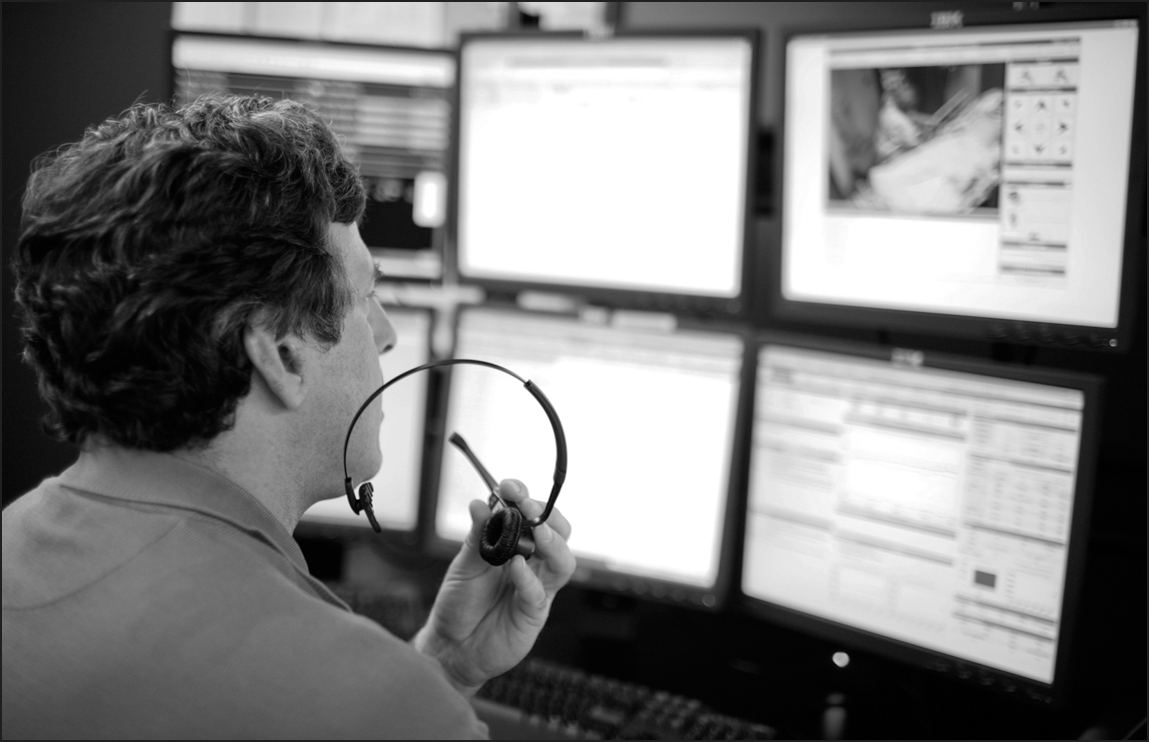
At a tele-ICU, intensivists monitor patients remotely. Photo courtesy: New England Healthcare Institute.

Doctors and nurses monitor critically ill patients in an eICU. Photo courtesy: Philips Healthcare.
Three companies offer tele-ICU systems—Philips VISICU eICU Program, the Cerner INet Virtual, and iMDsoft MVcentral. Hospitals or health systems also can develop their own tele-ICU programs, which is what Lehigh Valley Health Network in Bethlehem, PA, did with excellent results, experiencing a nearly 30% reduction in relative mortality associated with the tele-ICU and related electronic health record and tracking system. All bedside devices communicate with the system. The tele-ICU provides an extra layer of care at night, said Joseph Tracey, vice president of Telehealth Services at Lehigh Valley.
Over the years, studies have shown clinical benefits associated with tele-ICU. In a paper published in 2000 from a team at Johns Hopkins University, which developed the concept, ICU severity-adjusted mortality declined 68% and 46% during two study periods. 6 A 2004 study by VISICU showed a decrease in ICU mortality from 12.9% to 9.4% in two ICUs at a tertiary care hospital. 7 A 2007 report from the University of Pennsylvania Health System in Philadelphia saw a reduction in ICU mortality from 8.4% to 3.1% after implementing an eICU. Penn's mortality was already low, because it had on-site intensivist coverage.
“The fact we saw any reduction in mortality was impressive,” said Benjamin A. Kohl, M.D., director of the Division of Critical Care at Penn and medical director of the Penn E-lert eICU. “Our patients were sicker, but despite that, our mortality dropped.”
Over a 2-year period, Penn also demonstrated a dramatic reduction in ICU length of stay, leading to a total ICU savings of between $6.9 million and $9.3 million and a total hospital savings of between $7.9 million and $10.4 million.
Overcoming the Barriers
Turf concerns serve as a roadblock to successful adoption of a tele-ICU.
“One of the most difficult aspects of implementing an eICU is to get buy-in from the customers, the hospitals,” Kohl said. “It's a matter of getting the nurses and physicians to trust us in the eICU and to work with us to take care of those patients.”
This requires not only a willingness to discuss cases with the remote clinicians but also to input data into the electronic medical record system, which the tele-ICU team can view. Penn has fostered that collaboration by letting the various clinicians get to know each other, so the intensivist is not just a voice coming over the system but a real person. Physicians based at the eICU visit the hospital units, and bedside physicians, residents, and nurses are invited to visit the telemedicine unit.
“Unless you trust the person who is giving advice, the advice they give is worthless,” Kohl said. “Then there's the decision about when to intervene. It's a matter of timing and how you interject. A lot of it is personality aspects.”
Everett promotes shared decision-making between the on-site physician and critical care specialist in the command center. Community physicians, used to operating autonomously, find that difficult, she added.
Tracey has found physicians are often concerned about reimbursement, while others appreciate fewer calls to return to the hospital.
“There are a whole host of human factors and issues involved,” Tracey said.
A sense of “Big Brother” watching also may come into play. Kohl recalled turning on the camera in a room to find two residents placing a central line. Neither was wearing a cap or mask, violating protocol. He reminded them about the proper sterile technique, and they complied.
Although data show that following protocols is important for preventing infection, Kohl finds it difficult to measure the impact of that sort of tele-ICU intervention.
“A lot of the difference we make in patient outcomes is not necessarily in mortality but in morbidity, preventing organ dysfunction or sepsis,” Kohl said.
Clarian Health in Indianapolis uses the Cerner INet Virtual system. Registered nurses at the remote location assist in completing central line insertion checklists (Fig. 3). The health system now enjoys a 90% compliance rate with protocols, and on-site caregivers have added an average of 72 hours per month to the time they spend with patients. Nurses in the Clarian center also facilitate conversations with the Indiana Organ Procurement Organization, saving time for bedside nurses and helping to ensure no potential referrals are missed.

One of Clarian's intensivists consults with an eNurse. Photo courtesy: Cerner.
Although Clarian spokesperson Margie Smith-Simmons did not provide details, she indicated Clarian has witnessed a decrease in ventilated associated pneumonia, blood stream infections, and mortality rates in the past 5 years, in part attributed to the virtual monitoring.
Evidence that demonstrates the clinical and cost outcomes also contributes to buy-in, Everett explained. It requires educating people about the value and helping them surmount the stumbling blocks based on what has worked in other facilities.
“You need a physician champion who can help people understand the clinical and financial benefits and help overcome specific barriers,” Everett said. “You need leadership for any kind of change. It's getting your physician and executive leaders to say, ‘it's in the best interest of the patients, and we're going to do it.’”
Financial concerns are real, but Everett raises the point that the focus often lies on the up-front costs, which she acknowledges are expensive. However, the Massachusetts study found all of the incremental costs associated with the tele-ICU were recovered within the first year. This included about $7 million initially and $3 million in annual operating costs at the academic medical center and $400,000 in up-front costs and $400,000 in annual operating expenses at each of the two community hospitals.
Decreased length of stay and ability to care for more patients generate much of that return on investment. The academic medical center reported a 30% reduction in ICU length of stay and a 26% total hospital length of stay. The net effect was an improved margin of $5,400 per case at the university hospital. With an average annual volume of 4,600 cases, that results in a nearly $25 million contribution to the bottom line. 1
The community hospitals receive the most benefit from being able to retain their patients, increasing ICU volume and severity of cases. One hospital increased retention by 8% and the other by 38%. 1
“Tele-ICU is a technology that enables those patients to get a high-level of critical care medicine in their own community hospital, and it's better for the families, who now do not have to drive long distances,” Everett said.
Payors also saw a benefit with reduced costs of about $2,600 per case, annualized to $12 million a year at the university facility. It saved the payors approximately $10,000 on every patient who could be treated at the community hospital rather than transferred to an academic facility, an annualized savings of about $2.6 million. 1
“I think the payment and finance portion of healthcare reform is going to come together in a way that supports adoption of these sort of innovations,” Everett said.
Implementing Statewide
The team from New England Healthcare Institute and the Massachusetts Technology Collaborative concluded that implementing tele-ICU across Massachusetts could save 350 additional lives, benefit hospitals financially, and save payors more than $122 million annually.
Networking
New England Healthcare Institute
One Broadway, Twelfth Floor
Cambridge, MA 02142
(617) 225-0857
Massachusetts Technology Collaborative
75 North Drive
Westborough, MA 01581
(508) 870-0312
Lehigh Valley Health Network
1650 Valley Center Parkway
Suite 100
Bethlehem, PA 18017
(484) 884-4030
University of Pennsylvania Health System
3535 Market St.
Philadelphia, PA 19104
(215) 662-2560
“The report shows the potential, but it must be effectively managed,” Adams said. “Administrative and clinical leadership has to be aligned, and to the extent they are not, you will have a bumpy road.”
Adding tele-ICUs to all academic medical centers by 2014 and to community hospitals with 10 or more beds by 2015 will require three command centers, each with the computer power to manage up to 500 patients. Everett estimated that a clinical team comprised of one intensivist and four advanced practice nurses or physician assistants could handle 75 patients.
“People have gotten even better results than we did, so we know the improvements in mortality and cost are there,” Everett said.
Everett dismissed concerns about neighboring hospitals sharing tele-ICU command centers, saying that if all community hospitals are providing the same service, it will eliminate competitive advantages.
With fewer than 8% of U.S. hospitals using tele-ICU, the potential exists to improve outcomes and save money with greater implementation.
“It's a technology that is here to stay, and I think it will grow tremendously,” Kohl said. “I think you will see its implementation in rural areas that don't have access to the physicians and technicians we have elsewhere.”