




Abstract
Introduction
The health systems in Brazil and in the world are evolving along with the development of new information and communication technologies applied to the health field. In Brazil, we find the potential for the development and the application of telehealth in primary healthcare.
In 1994, the Health Ministry created the Family Health Strategy Initiative, supporting primary healthcare, which demonstrates characteristics related to the resolution of pre-identified problems by integrating different areas of knowledge and training the participating professionals with the required expertise, always seeking to promote, protect, and recover the health of the individual and of the family. 1 The Family Health Strategy team is composed by different types of professionals located in a primary health center. The team comprises at least one doctor, one nurse, one nurse technician, and one community health agent. The expanded version of the team includes an oral surgeon, a dental health attendant, and a dental health technician. These professionals are responsible for the care of a preset number of families, who live in a specific and delimited geographic region. 2
When we analyze the team providing the healthcare services, it is noticeable that the work has a complex and team-oriented nature as its main characteristics, in which the interactions between the different professionals as well as the multidisciplinary quality of the team are necessary. In this context, nurses need to improve their skills and knowledge, concentrating in three areas: caregiving, health monitoring for individuals and groups, and the management of the healthcare provided. In addition, they need to learn about the basic principles of the Unified Health System and its guidelines for the Family Health Strategy Initiative, like the humanization of healthcare, the accountability of health professionals, and their connection with the users, their families, and others. 3
It is important that health professionals are able to adapt their technical and scientific knowledge to each individual and to each population group and to apply this knowledge according to their socioeconomic and educational needs. This can help establish relatedness between the professionals and the lifestyles of these individuals and their families. 4 Supporting the learning process and continuing education, the Internet represents a valuable resource for the health professional looking for new information, making possible the development of highly interactive, remote, specialized training courses. 5 The Internet offers an opportunity for professional expression based on these needs. 6
The Ministry of Health established the Brazilian e-Health Program with the purpose of training the Family Health Strategy teams and developing healthcare support and permanent education activities. 7 In Pernambuco, the Program allowed the expansion of the Telehealth Center Network of Pernambuco (RedeNUTES), offering telehealth services for 80 municipalities, with a total of 104 telehealth sites and supporting 154 Family Health Strategy teams. 8 Today, RedeNUTES enables the telehealth program to directly benefit around 1,457 health professionals in 11 regional health management centers in the state of Pernambuco, offering tele-education via Web conference courses and telesupport, through remote second opinion, enabling the discussion of clinical cases, the transmission of clinical questions via electronic forms, and synchronous, direct discussions with the RedeNUTES teleconsultants. 8 The teleconsultants who work on the RedeNUTES telehealth program are doctors, nurses, and oral surgeons with different specialties, who can attend to health professionals' demands for a second opinion and present prerecorded courses. In the case of a remote second opinion, the RedeNUTES team of regulators receive the requests and determine which professional is the most adequate to handle the case. This discussion can be done in real time, via a Web conference with a teleconsultant, or asynchronously, via an electronic form. 8 It is in this context that the evaluation and the development of telenursing become important aspects for the support and permanent development of telehealth teams, by recreating real work scenarios and providing professional training that can be used directly in the work environment by simply accessing equipment such as computers with Internet access.
Among the advantages of the telenursing, we can emphasize the easy access to systematized protocols, remote education, research collaboration between learning centers, second opinion sessions, reduced timespan between diagnostic and treatment, and the increase in the healthcare efficiency, improving support for the general population, which justifies the financial investment in the technology for healthcare services. 9 Descriptive studies are justified by the need to publicize activities that demonstrate the importance of telehealth studies, the impact of new nursing practices, and the financial investments made in health informatics and because the information and communication technologies can improve the healthcare provided in Brazil.
The goal of this article is to present a profile of the participation of nurses in the telehealth services developed by RedeNUTES, as a strategy for the permanent training of the Family Health Strategy teams in Pernambuco, Brazil.
Subjects and Methods
This is a descriptive study about the telehealth services developed in Pernambuco by RedeNUTES, from the aspect of healthcare support, especially on permanent education in family health, focusing on the participation of nursing professionals. It addresses a phase in the process of characterization of the telehealth services proposed in a research project, at the doctorate level, and approved by the Ethics Committee of the State University of Campinas, under protocol number 478/2011.
Among the telehealth services offered that included the direct participation of nurses, tele-education (Web conference courses) and telesupport (remote second opinion) were selected for this study. The analysis covers the period from January 2009 through December 2010, using research data stored at RedeNUTES.
Results
The RedeNUTES team of teleconsultants is broad and diversified with regard to types of education and specialties. However, two nurses work as regulators, evaluating requests, and are able to provide opinions and coordinate teleconsultations with other nursing professionals, according to the needed specialty. These nurses are also accountable to evaluate the needs for tele-education and to select professionals to lecture the Web conference courses. To better understand the context of telehealth in Pernambuco, we show, in Figure 1, the flowchart of the telehealth services promoted by RedeNUTES, presenting the work developed during this study.
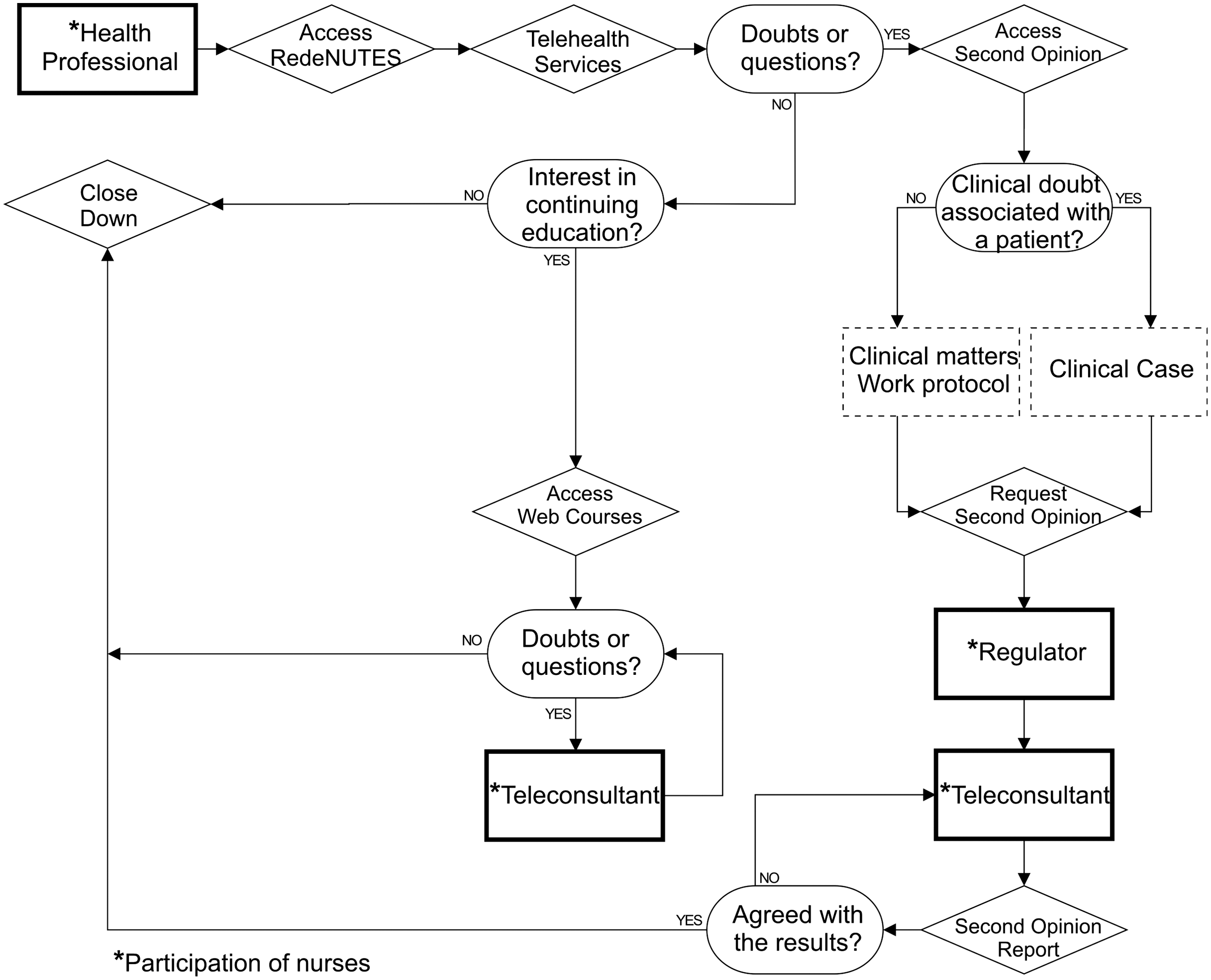
Flowchart of the telehealth services promoted by the Telehealth Center Network of Pernambuco (RedeNUTES), Brazil.
The Web conference courses happen weekly, for 30 min, followed by another 30 min of questions. The schedule of the courses is published at the RedeNUTES Portal, and participation is voluntary. In the case of telesupport for the transmittal of questions, the professional must have a username and a password. The answers are mediated by a team of regulators (who are also teleconsultants), who reroute the questions to specialists, if necessary, and answers are returned within 48 working hours.
Between January 2009, and December 2010, 349 Web conference courses were completed, in different fields, including Nursing, Pediatric and Youth Health, Mental Health, Oral Health, and other general topics. The participation of nurses was recorded for all these different topics. The course participants were all from the Family Health centers, where the median average number of participants was 50 per course, during the 2-year period.
To illustrate the importance of the participation of nurses in this new training method, we show in Table 1, the distribution of the professional categories that were represented in the Web conference courses. It is important to emphasize the participation of nurses in the training courses because, proportionally, among the higher-education professionals, nurses are the ones who stand out. Along the lines of the Web conference course analysis, we see, in Figure 2, that nurses are also participating as lecturers and debaters. In 2009, there were 151 courses, 30.5% of which were lectured by nurses. This percentage increased in 2010, with 33.8% of the 198 courses lectured by these professionals, outnumbering the others.
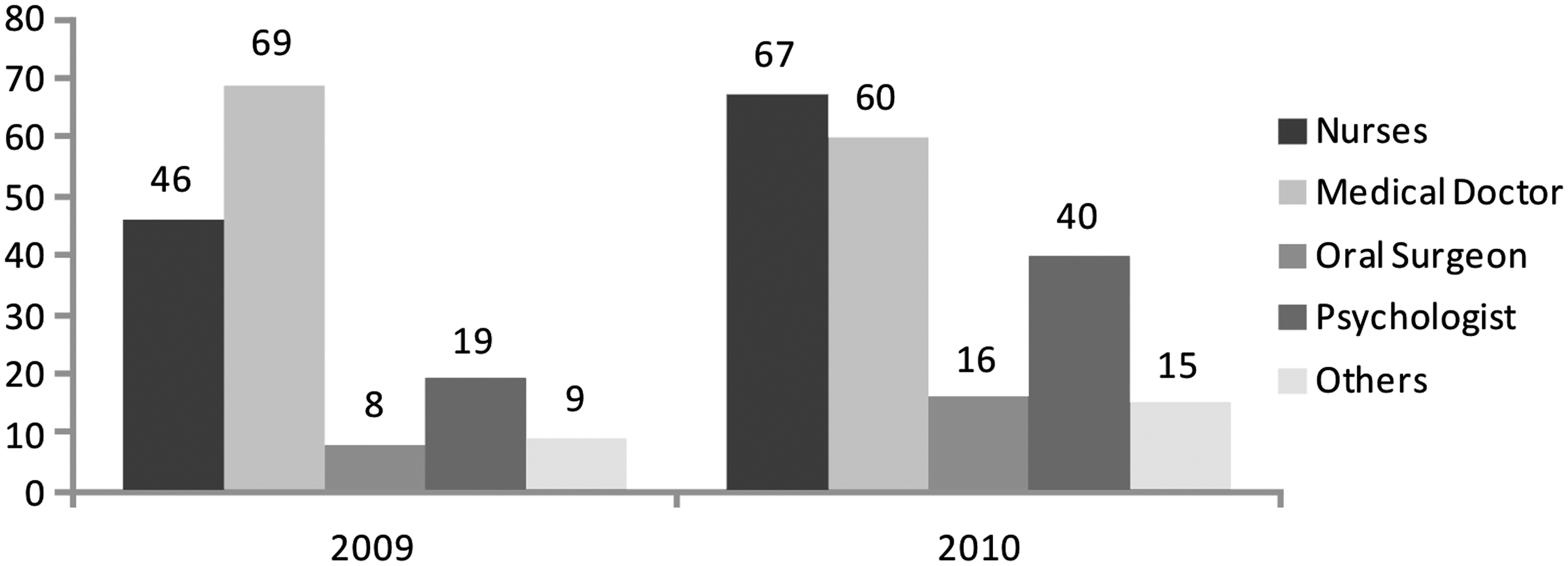
Distribution of the lecturing professionals for the courses in 2009 and 2010, Pernambuco, Brazil.
Cumulative Distribution of Professional Categories Represented in the Web Conference Courses in the Years of 2009 and 2010, Pernambuco, Brazil
The weekly courses via Web conference are published through a schedule posted in the RedeNUTES Portal. The courses are 30 min in duration, and, at the end, participating professionals can submit their questions to the lecturers. Other channels of communications are also available to the health professionals (Table 2) for submittal of questions: electronic forms and Web teleconference sessions (by appointment). In 2009, 1,003 question-based interactions were recorded, and in 2010 the number of questions sent to teleconsultants increased to 2,637. Electronic forms and teleconferences are the main channels of telesupport because they enable health professionals to clarify everyday questions, usually related to a clinical matter, a specific case, or a work protocol.
Distribution of the Channels of Communication Used for Teleconsultations by Health Professionals in 2009 and 2010, Pernambuco, Brazil
It is possible to see, in Figure 3, the importance of the participation of nurses in submitting questions to the telehealth services and as teleconsultants, formulating an opinion regarding a question raised via an electronic form or in a Web conference. In addition to the clear participation of nurses as requesters, the telesupport provided by them accounted for 33% of all the telesupport provided in 2009, with an increase to 48% in 2010. The requests for telesupport sent to RedeNUTES, in 2009 and 2010, made by nurses were grouped according to the topic and to the area of knowledge of the teleconsultants. The areas were identified as gynecology, obstetrics, pediatrics, psychiatry, dermatology, stomatherapy, nephrology, and oncology, among others. Table 3 shows the most popular categories found in the requests for second opinion submitted by nursing professionals. The higher frequency of obstetrics, gynecology, and pediatrics requests can also be seen.
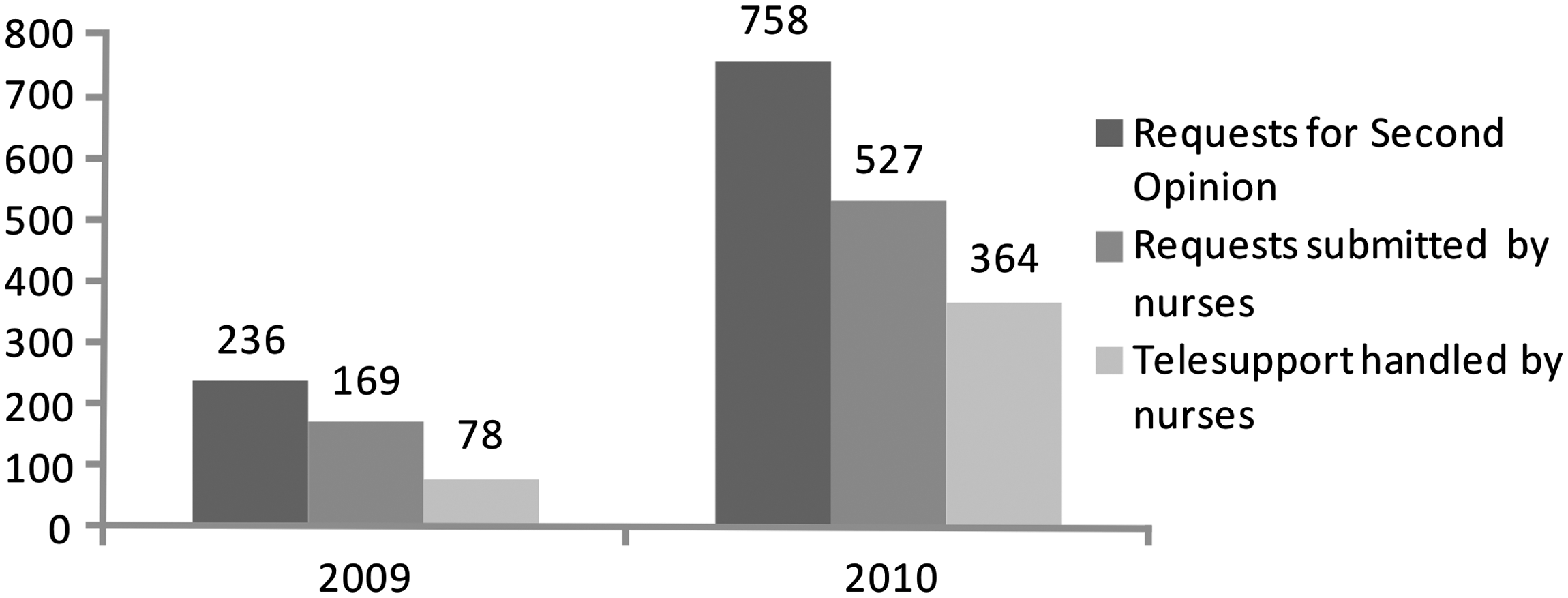
Distribution of the demand for online teleconferences handled by nurses in 2009 and 2010, Pernambuco, Brazil.
Distribution of Telesupport Requests Submitted by Nurses in 2009 and 2010, According to Knowledge Area, Pernambuco, Brazil
Sometimes, when discussing patient cases through teleconsultation, the healthcare professional has the intention of referring the patient to a large health center for specialized treatment. This requires high transportation costs and efforts from the family members and patients. Alternatively, they can use telehealth services for a second opinion. At the end of the teleconsultation, the professional re-evaluates his intention and answers a questionnaire. The results show that it was possible to modify the referrent's intention for 29% of requests for teleconsultation in 2009 and 31% in 2010.
Discussion
The data obtained in this study show that nurses are very active in telehealth services, taking on different roles, as discussed below.
The importance of regulators to mediate the requests for telehealth has a direct impact in the quality of this service. It is an e-health practice when a group of specialists is used to answer requests for second opinion. The regulation service optimizes the response time of the teleconsultants. Each country has its own regulations for the selection of the professional who acts as the information regulator. 10 However, nurses are professionals who are involved with the increasing evolution of information technologies and can contribute positively in this position, based on their broad health education.
About 20% of the nurses participated in teleconference activities as members of the audience. Even though this number could have been higher, nurses made up the majority of the higher-education professionals who took the most advantage of Web conferences. Web conferencing is advantageous for surpassing obstacles and geographic limits. Brazil is vast, and it has poorly distributed resources. The use of remote communication can promote education, research collaboration, and second opinion sessions and therefore bring better support to the population. 9 Studies have shown that the processes of sharing clinical decisions and searching for training create greater possibilities of success for professional practice and avoid the unnecessary use of resources, which interferes with the daily routine of health professionals and has a great impact on support. 11
One of the pioneer activities, in Brazil, involving nurses and telenursing, started with a research group from the Nursing School in the Universidade de São Paulo in 2000. According to the authors, it is important to develop and improve activities that involve information and communication technologies to consolidate telenursing as a field of practice for nurses. 12 The results presented here show that, in Brazil, the initiatives proposed by the Ministry of Health, in partnership with other telehealth programs, allow the application of technology in health fields. In a descriptive study done by the telehealth program of Rio Grande do Sul, for the years of 2007 and 2008, the number of consultations reached 498, of which 22% were related to nursing. 13
Independent of the topic of the Web conference courses and of the characteristics of the telesupport activities documented in this study, we notice that nurses are involved with the proposed telehealth services. This shows that it is important to explore the technology that enables training of these primary healthcare professionals. Health professionals such as nurses, doctors, and dental surgeons, in some cases, are present in a proportional distribution in Family Health Strategy team. 2 It was important for this study to identify the highlighted participation of these nurses in all services. The results show a great relationship between nurses and the telehealth proposal, being a potential area to be explored in further studies.
Just as in other studies, it is expected that the strengths overcome the difficulties. The strengths of this study are directly related to the access of information that healthcare professionals now have. The advantages that stand out in these services are that they overcome geographical barriers, promote training, and provide opportunities to discuss a patient's case with experts.
After 24 months of Web conferences and second opinion services studies, the numbers obtained provide an important feedback to support education and to provide assistance for healthcare professionals. Further studies and financial investments are needed to expand these results and to identify motivational factors. However, cost–benefit and healthcare service studies can clearly define the application of technologies in the field.
Some current limitations observed in this study are common in the literature, 14 such as the low understanding of the benefits brought from the use of technologies by health professionals, the limitations of funding to provide these services to all municipalities, the change in the work routine, and the security and privacy concerns of healthcare.
The data shown here point to the need to explore the topic regarding the application of information and communication technologies in primary healthcare, focusing on nursing. We are witnessing a new reality in Brazil, where we find centers of the Family Health Strategy Initiative immersed in the context of telehealth, and we see that telenursing presents a viable strategy with regard to training professionals and optimizing healthcare in remote centers, where access can be difficult. Despite the difficulties, it is valid to point out that health professionals, because of the needs imposed by the contemporary technological onset, develop skills and competencies, including the use of information and communication technologies, with the purpose of enriching and expanding their professional practice, seeking permanent education and social participation in their field of practice.
Conclusions
We can conclude that even with the technological challenges found in the Family Health centers, nurses participated actively, taking on different roles, such as members of the audience, regulators, lecturers, and teleconsultants, showing that telenursing could be an essential tool in improving the quality of the health services provided to the community. We have shown here practical examples of these activities that could help predict how healthcare will look like in the next few years.
Footnotes
Disclosure Statement
No competing financial interests exist.