




Abstract
Introduction
Some studies have emphasized considerable demand for health-related information in the population. 1,2 Most often health-related use of the Internet is observed in the United States, where studies have found that 56–79% of Internet users seek health information in this way. 3 –5 In Europe, health-related use of the Internet was most frequent in the Northern countries, with Denmark (62%) and Norway (59%) at the top of the list, followed by Germany (49%); the Eastern countries, Poland and Latvia, reported 42% and 35% health-related use of the Internet, respectively, whereas the Southern countries such as Greece had the lowest (23%) health-related use of the Internet, and Portugal had only 30% usage. 6,7
Internet usage gives patients the possibility of obtaining accurate medical information online by quick, convenient, and private access and presents them with the opportunity for better-informed decisions on their own health and greater participation in healthcare processes. 8 In Lithuania the implementation of the National e-Health Service System (NESS) started in 2005. 9,10 Creation of common, user-friendly health information services is the main focus of the NESS development strategy in Lithuania. By 2015, the Lithuanian e-health service system development strategy aims at implementation of the universal use of e-health information tools by patients, primary care physicians, primary healthcare institutions, and hospitals. It should include the use of information and communications technology solutions for complex research and diagnosis, as well as for management of the healthcare system. 9 In general, it is expected that these processes would lead to higher levels of citizens' awareness and involvement in protecting their health and more effective use of available resources for provision and expansion of healthcare services, based on information and communications technologies. 10
With this study we aim to assess the availability of health information for patients and to assess the factors affecting patients' health-related information needs on the Internet.
Subjects and Methods
Study Design and Participants
We studied health information availability and its needs for patients visiting primary healthcare physicians in the Kaunas region of Lithuania. We identified the number of patients registered with primary care institutions in the Kaunas region as a basis for sample size calculations. Using the EPIINFO StatCalc program with the 95% confidence level, we calculated an expected sample size of 297 patients. A cross-sectional study was carried out during the period of July–October 2011. The questionnaires were provided to 307 patients during their visit to their primary care physician. A detailed study flow chart is presented in Figure 1.
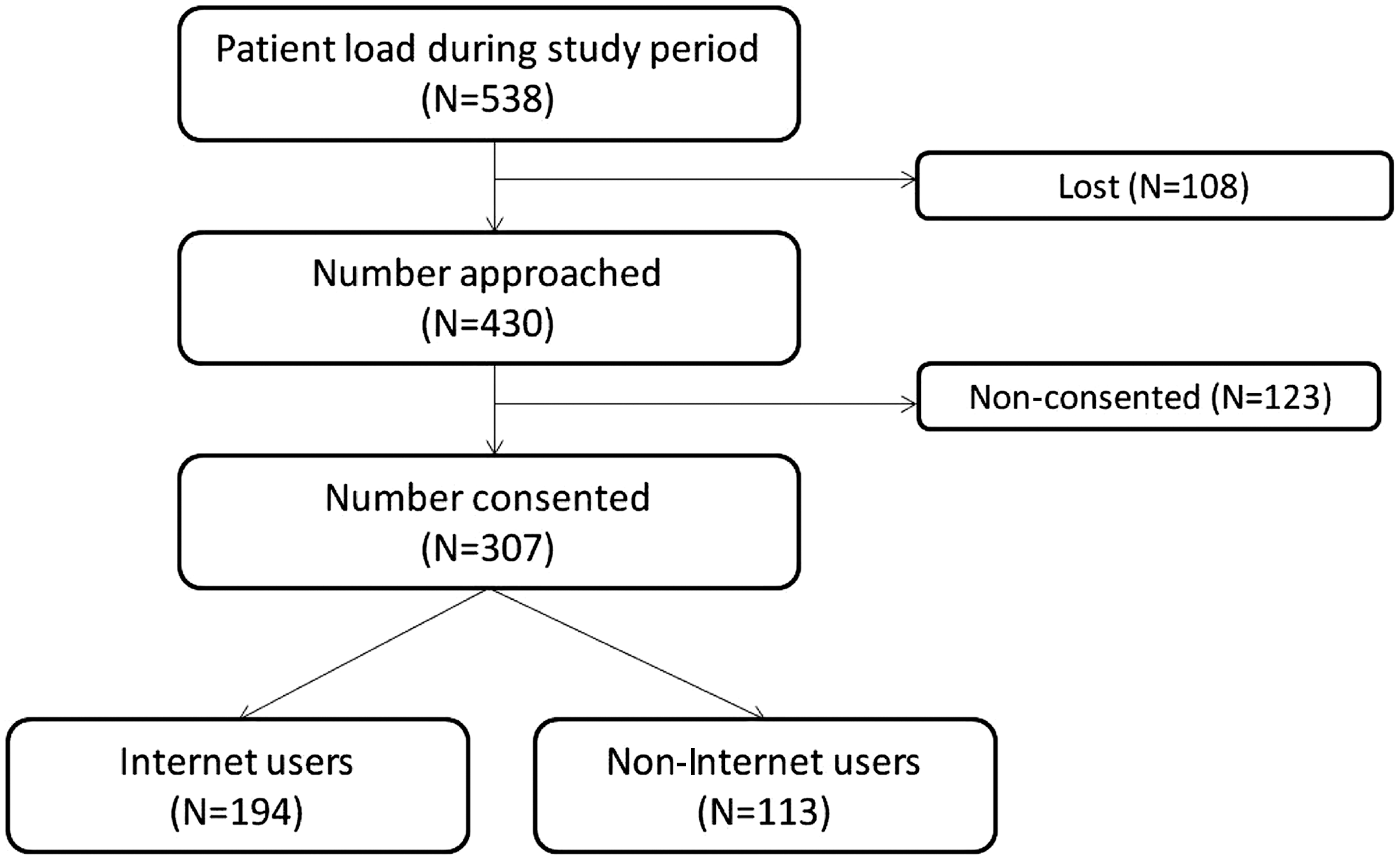
Study organization.
Questionnaire
The questionnaire, consisting of 21 questions, was developed and pilot tested in March–April 2011. The structure of the questionnaire aimed to provide information on respondents' sociodemographic characteristics, Internet use and practice, health information, and electronic health information needs and availability.
Electronic health information needs assessment was performed with the help of questions about all possible health information searches in the past on any aspect of healthcare, in particular about the following: hospitals, physicians, and their working hours; diseases; clinical investigations; drugs and prescriptions; patient health education services; and self-help groups. In the case of a positive answer to any of these questions, it was accepted as a perceived need for health-related information on the Internet. Cumulative numbers of health information searches were calculated. In this analysis, patients with a higher number of different types of health information searches were considered as having higher needs for health information on the Internet.
Statistical Analysis
The data were analyzed with the statistics software SPSS version 15.0 for Windows. Descriptive statistics have been used to describe the main characteristics of study participants. In order to quantify the relationship between dependent and independent variables, we used the multivariate logistic regression methods. Multivariate regression takes into account several predictive variables simultaneously; therefore such a method of analysis enables us to evaluate the influence of the factors with higher accuracy.
Results
The largest proportions of the study population (69.4%) were visiting primary healthcare clinics for physician consultation, half of them regarding drug prescriptions (51.8%), clinical investigations (47.2%), and other specialist consultation (41.0%), or visited their family physician for preventive purposes (17.3%).
Descriptive Statistics
Of study participants, 49.2% were male, and 50.8% were female. The average age was 47.93 years (standard deviation=10.26) years. Of the respondents, 41.0% had lower than secondary or secondary education, 31.3% had professional or college education, and 27.7% of the respondents achieved a higher academic education (university). Of the respondents, 53.4% had declared skills for at least one foreign language. The Internet was used by 63.2% of the respondents. All descriptive statistics are presented in Table 1.
Sociodemographic Characteristics by Use of the Internet
LTL, Lithuanian litas.
A typical Internet user in our study was younger and employed and had a higher education and higher income level than nonusers. Of Internet users, 89.5% had access to the Internet at home. The Internet was accessed daily by 62.0% of the Internet users and by 29.5% at least weekly. Of the Internet users, 16.5% spend less than 30 min on the Internet, and 24.5% spent more than 2 h/day on this type of activity.
Patients' Satisfaction with Availability of Health Information
We compared patient satisfaction with available health-related information versus Internet use status. In general, the respondents declared poor availability of health information throughout all available sources of health information. The most available information for both groups of patients was on registration for physician health services.
Internet users were statistically significantly more satisfied and informed about available health services, such as registration for physician services, health information, electronic health record, clinical investigations, medical consultations, patient health education services, and patient mutual aid groups (Table 2).
Patient Satisfaction with Available Health Information
Factors Affecting Electronic Health Information Needs
47.3% of Internet users indicated use of the Internet to search health information. Average cumulative numbers of different types of health-related information searches were 7.54 (standard deviation=5.2). In order to quantify the relationship between independent factors and Internet use frequency for health purposes, we created the multivariate logistic regression model to predict electronic health information needs among Internet users (Table 3).
Multivariate Logistic Regression Model to Predict Electronic Health Information Needs
CI, confidence interval; IT, information technology; OR, odds ratio.
Our multivariate logistic regression model (Table 3) suggests that higher frequency of health-related information search on the Internet was more associated with female patients (odds ratio [OR], 3.1; p=0.012), having chronic disease (p=0.013), living as a couple (OR, 14.8; p=0.031), having e-health service experience (OR, 7.0; p<0.001), being a daily Internet user (OR, 6.7; p=0.054), and longer duration of Internet use per day (OR, 1.3; p=0.046). Accordingly, information technology expertise and foreign language knowledge do not associate with a higher frequency of health information searching on the Internet. Employment and incomes were excluded from analysis because they did not give significant intercept values in the model.
Discussion
Electronic health information is a new concept in the Lithuanian healthcare system. Use of the Internet includes many dimensions in healthcare, including both local and remote access to health information delivery for patients and healthcare institutions. Also, it facilitates the integration of healthcare industry-related business processes associated with healthcare delivery. 11
Main Findings
Our study showed the Internet as an important source of health-related information for healthcare consumers. We highlighted patient sociodemographic characteristics affecting higher uptake of health-related information on the Internet and also reported poor availability of health information throughout all available sources of health information, especially for non-Internet users.
Comparison with other Studies
More than half of the households in European Union countries have a personal computer and use the Internet at least once a day. 12 According to the recent household survey in Lithuania, 56% of households have personal computers and Internet access, 9 out of 10 computer users use the Internet at home, and most of them (75%) are using computers daily. 13 Between 2006 and 2011 use of the Internet for health purposes in Lithuania has increased from 15.4 to 37.7%. 13 It is assumed that patients' knowledge about available health services can influence health decisions and health service demand. However, not all Internet users use it for health-related information searches. 5,12,14 –17 Some studies showed the most frequent electronic health-related information seekers are young and middle-aged Internet users, 5,14,17,18 people with higher education, 5,12,14,17 –19 the middle to high income group, 12,20 females, 5,19,20 employed, 14 and patients with chronic diseases. 12,14,16,17,19 Our multivariate logistic regression model demonstrated electronic health information-seeking behavior in those who were female patients, having chronic disease, living as a couple, having e-health service experience, being a daily Internet user, and having a longer duration of Internet use per day. Foreign language knowledge and information technology expertise did not exhibit significant associations.
It should be noted that some European Union countries have more developed and more widely spread e-health systems and information services compared with Lithuania. According to a survey in 2009, Lithuanian healthcare consumers had the best knowledge about electronic registration for physician services; meanwhile, knowledge about other e-health services such as electronic referrals and drug prescriptions was commonly absent. 20 Our study showed some improvement in healthcare consumers' knowledge about available e-health services during the period from 2009 to 2011. The Internet users noted better access to health-related information, and they were statistically significantly more satisfied and informed about available health services. However, the majority of non-Internet users highlighted the lack of even basic knowledge about available services. A survey in the United States showed that the health decisions made by patients quite often are influenced by health and medical information they found on the Internet. 19 The advice taken from Internet sources improves their ability to take care of themselves, and it improves the way they get healthcare information. 20,21
Study Strengths and Methodological Limitations
The major methodological limitation of this study is the nature of the cross-sectional study design, which precludes an evaluation of temporal precedence and causal relations of the observed associations. The explored causal relations should be interpreted carefully, and follow-up studies on the situation should be carried out in the future research.
Strengths of the present study should be also mentioned: we used anonymous questionnaires, and we assume that this increased the response rate and patient data protection. Also, we used self-reported questionnaires to compare differences in health information availability among health-seeking populations (i.e., patients visiting the same general practice physician—this allowed us to expect only minor deviation in health-related information provision by the physician); the sample size was sufficient to reflect one primary care physician's practice. It is accepted that self-reported questionnaires are the most common mean by which patient report outcomes on health behavior are evaluated. 22
Future Implications of this Study
We believe that our study provides some insights that will be important for practice, education, and research. Definitely, the need for high-quality and accurate health information is of utmost importance for all groups of patients. But, the most efficient use of e-health system services tends to be among the elderly having chronic diseases. These people traditionally have much lower e-literacy and lack of computer use skills. Accordingly, the urgent need for educational programs to improve e-literacy of the entire population might be suggested. Special attention should be paid to elderly people.
Conclusions
The Internet is an important source of health information in Lithuania. Internet users were statistically significantly more satisfied with available health information than non-Internet users. Our multivariate logistic regression model have high predictive value (p=0.039) and showed that female patients, those having chronic disease, living as a couple, and having e-health service experience, and daily Internet users are the most frequent users of health information on the Internet. Factors confirmed to be significant predictors can be used in development of e-health services oriented to special target groups. This should help to maximize the potential use of the NESS.
Footnotes
Disclosure Statement
No competing financial interests exist.