




Abstract
Introduction
In 2009, we introduced the first use of a videolaryngoscope for remote guidance of a tracheal intubation. 1 At that time, audiovisual data required a wired connection to an existing telemedicine station, which consisted of a mobile computer station with an attached videolaryngoscope. 2 The potential patient care and educational implications are vast; however, because of budgetary constraints many hospitals and emergency medical service systems are unlikely to install the required hardware to provide such a service. Cellular technology has revolutionized medicine as more than 80% of practicing physicians carry a smartphone or smart device. 3,4 Technology has greatly progressed since that first experience with telemedicine-guided airway management. With the capabilities of modern-day smartphones and tablets (i.e., iPhone® [Apple, Cupertino, CA], Android™ [Google, Mountain View, CA], and iPad® [Apple]) and the introduction of modern voice over Internet protocol (VoIP) services such as FaceTime® (Apple, Cupertino, CA), Skype™ (a division of Microsoft, Luxembourg City, Luxembourg), and Tango® (TangoMe, Palo Alto, CA), remote guidance with emergency airway management is a more realistic solution for providers seeking assistance or consultation. We report here our experience with these VoIP services with telemedicine-assisted airway management.
Materials and Methods
Several intubations were performed with remote observation only, to test the video resolution, video and audio data lag, and audio quality of three different VoIP clients (FaceTime, Skype, and Tango). For Skype and Tango, observations were tested on both Wi-Fi and cellular broadband (AT&T and Verizon third generation [3G]) networks. All VoIP clients were tested on an Apple iPhone 4S on both the sending and receiving ends. The intubations were performed with the GlideScope® and GlideScope Direct (Verathon, Bothell, WA), C-MAC® (Karl Storz, Tuttlingen, Germany), and KingVision® (King Systems, Noblesville, IN) laryngoscopes (Fig. 1). All intubations observed were performed in the course of standard patient care on adult patients >18 years old in the Emergency Department at the University of Arizona Medical Center (Tucson). No statistical metrics were performed or collected as this is a preliminary observation of feasibility.
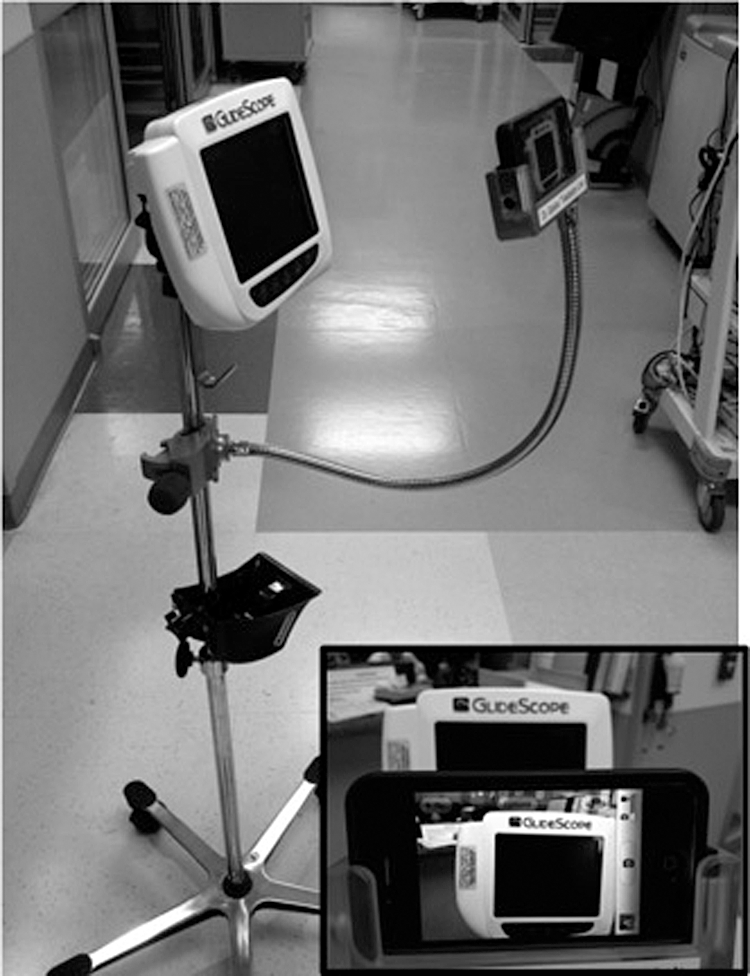
GlideScope telebation unit.
The GlideScope and KingVision devices are designed to be used as videolaryngoscopes, which allow the operator to view the vocal cords via the videocamera placed on the undersurface of the blade. This obviates the need to align the tracheal, laryngeal, and oral axes required to visualize the vocal cords with a direct laryngoscope blade. The GlideScope Direct and C-MAC are designed to be used as either a direct laryngoscope or a videolaryngoscope via a regular direct laryngoscope blade with an attached videocamera on the distal undersurface. This design allows teaching opportunities with the supervisor observing the screen as the operator performs direct laryngoscopy, as well as a backup videolaryngoscope if the operator fails to obtain a view with the direct technique.
Results
Once it was determined that remote guidance was feasible, several intubations were guided by one of the authors with one of the following: FaceTime, Tango over the 3G network, or Skype over Wi-Fi. All three clients were used successfully in the following situations: guided intubation with the operator performing direct laryngoscopy with the GlideScope Direct, guided videolaryngoscopy attempt with a standard GlideScope at an outside hospital, and several videolaryngoscopic intubations with the C-MAC and GlideScope at our medical center (Figs. 2 and 3). All intubations were successful on the first attempt and performed by residents with an attending physically present if needed; however, they were guided real-time by one of the authors remotely. Table 1 describes the performance of each of the three VoIP clients.
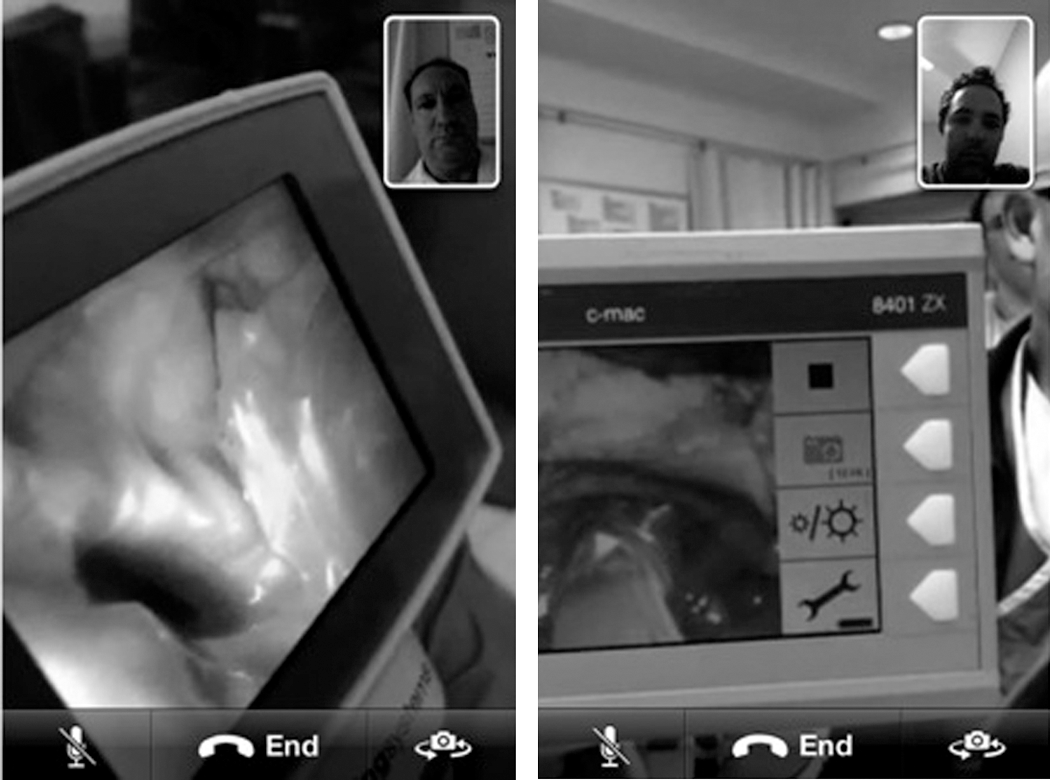
iPhone view of telebation with
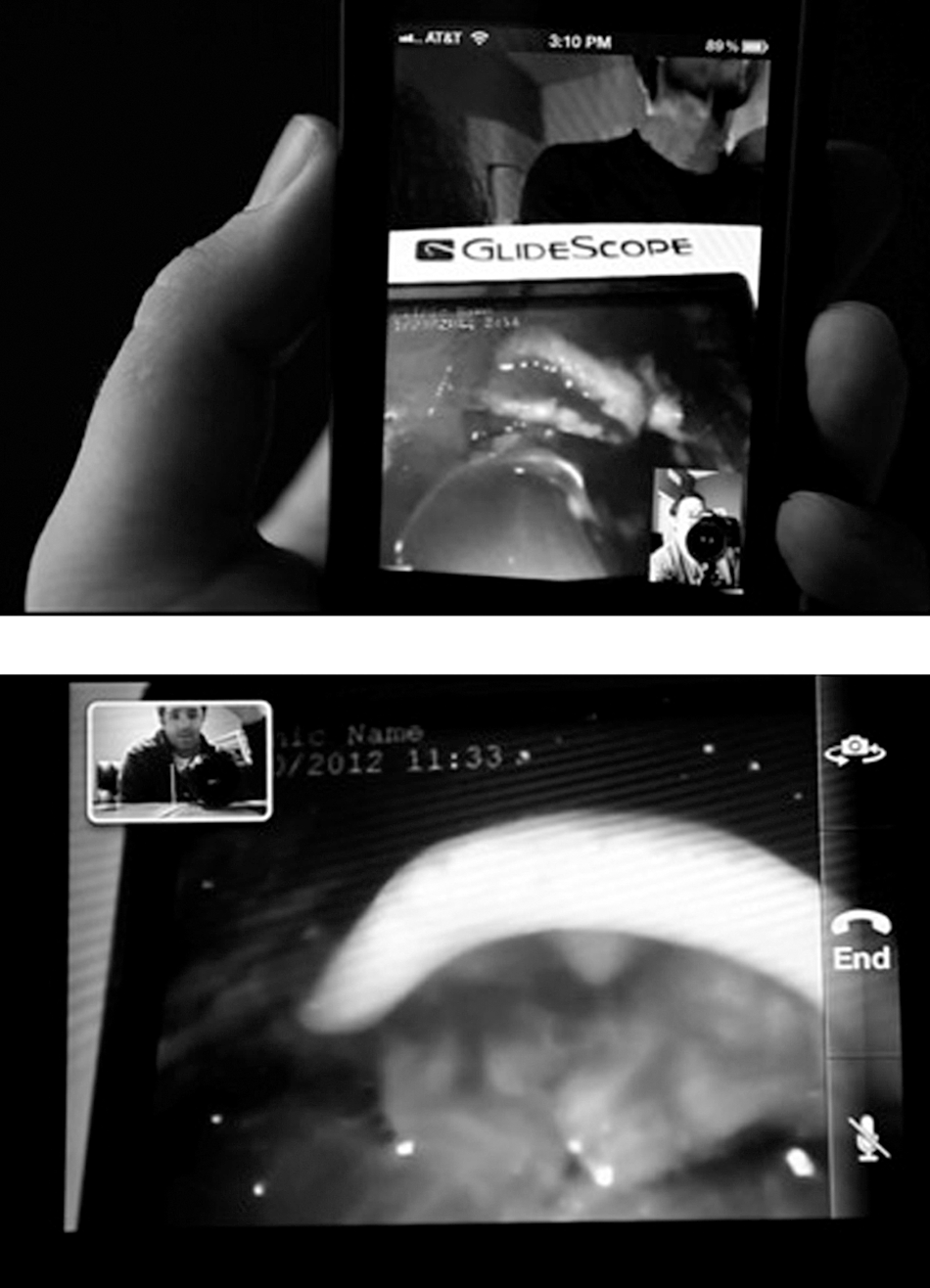
iPhone view of GlideScope over
Performance of Three Voice over Internet Protocol Clients
Based on the authors' subjective experience and evaluation of quality, reliability, and confidence in ability to provide guidance with image/audio transmission.
FaceTime encrypts with unique user and session ID numbers. If FaceTime is used on a WPA2 Enterprise network, data are 128-bit AES encrypted.
Skype uses 256-bit AES encryption.
Tango calls are encrypted, but the company does not release their encryption standard.
3G, third generation.
Discussion
Videolaryngoscopy has become increasingly popular in emergency medicine over the last decade. Even though multiple varieties currently exist in the market today, the technology is evolving rapidly. Research done in the operating room, sim lab, and emergency department has demonstrated that videolaryngoscopy is at least equivalent to, 5 –8 if not better than, direct laryngoscopy. 9 –11 In novice users, videolaryngoscopy shows a clear advantage to direct laryngoscopy. 10,12 –15
The combination of a videolaryngoscope with a telemedicine network provides a potentially powerful educational as well as patient care tool. In 2001, Levitan et al. 16 found that simply watching videos of intubations performed with videolaryngoscopes improved success rates by 41.4%. Howard-Quijano et al. 17 found improved success rates by real-time video-assisted teaching compared with traditional methods. Chung et al. 18 in 2008 devised a three-camera system to set up a simulation in two emergency departments. They mounted anterior and lateral cameras that provided the remote physician with views of the patient's positioning and a third video feed from a videolaryngoscope. They showed an improved speed of successful intubation (94%) with teleconsultation compared with 63% without consultation. Boedeker et al. 19 successfully used a C-MAC and Skype to test intubation of a manikin in the field with the Nebraska Air National Guard.
We have performed 12 either remotely observed or assisted intubations using several different videolaryngoscopes and VoIP clients. When used over a Wi-Fi network, FaceTime provides the best audio quality compared with Skype but equivalent video quality and data lag. FaceTime provides a superior audio and video quality compared with Skype when Skype is used over 3G wireless broadband, which suffers an unacceptable data lag and image decay. Fourth generation (4G) LTE networks potentially provide less data lag and acceptable transmission quality and should be tested when more widely available. Both FaceTime and Skype can provide HIPAA-compliant encryption. Tango provides a quality image and audio quality over both Wi-Fi and wireless broadband; however, it is unknown if the encryption meets HIPAA standards. There are other commercially available VoIP clients that may provide similar utility. Videolaryngoscopes with smaller screens attached directly to the handle (i.e., KingVision, Pentax Airway Scope, McGrath, etc.) present a challenge in that an iPhone or similar device used for the telemedicine transmission may obscure the view for the operator. This problem is not encountered when using devices with larger screens detached from the blade (C-MAC, GlideScope).
Conclusions
With the improvement in VoIP technology, as well as cellular broadband networks and higher-resolution cameras on smartphones and tablets, telemedicine can be used more readily with videolaryngoscopy not only to improve training and education, but also to provide real-time remote guidance in difficult airway management. The cellular broadband technology allows for a faster, simpler, and more cost-effective form of communication. Future studies should be designed to more accurately assess data transmission of each proprietary application and method of transmission, to evaluate 4G networks, and to evaluate the utility in pediatric/neonatal intubations.
Footnotes
Disclosure Statement
No competing financial interests exist.