




Abstract
Keeping patients with complex medical illnesses up to date with their preventive care and chronic disease management services, such as lipid testing and retinal exam in patients with diabetes, is challenging. Within a commercially available electronic health record (EHR) with a secure personal health record (PHR), we developed a system that sends up to three weekly reminders to patients who will soon be due for preventive care services. The reminder messages reside within the secure PHR, which is linked to the EHR, and are displayed on a screen where patients can also send to the physician's office an electronic message to request appointments for the needed services. The reminder messages stop when the patient logs on to review the reminders. The system, designed with patient input, groups together all services that will be due in the next 3 months to avoid repeatedly messaging the patient. After 2 months, the cycle of reminders begins again. This system, which is feasible and economical to build, has the potential to improve care and compliance with quality measures.
Introduction
Patients with multiple complex diseases often do not receive appropriate preventive care, nor do they receive appropriate monitoring and therapies for chronic conditions such as diabetes, heart disease, and congestive heart failure. 1 –8 There are many reasons for this, including fragmentation of care among specialists, 9 the lack of patients' participation in their own care, 4 and the inherent complexity of caring for patients with multiple diseases and risks. 1,2
The appropriate application of health information technology meant to be used by providers has been shown to improve process and clinical outcomes for many individual diseases. 10,11 For providers, active reminders at the time of decision-making have been found to be more successful than passive access to protocols, 12 –15 and simple mechanisms that allow the reminder function to facilitate ordering of needed services have improved the performance of such systems. However, similar reminders have rarely been used to directly engage patients in their own care.
The effectiveness of the use of personal health records (PHRs) by patients has been mixed. Although patients will use and view information on their own PHR, 16,17 there is little evidence that current PHRs improve the receipt of prevention services. 18 The purpose of the Self-Management and Reminders in Technology (SMART) project is to test whether an interactive PHR that engages the patient with active reminders linked to mechanisms for reducing prevention gaps can improve adherence to prevention guidelines and improve cardiovascular risk in patients with coronary artery disease, diabetes, or either hypertension or high cholesterol requiring medication that must be monitored. Data collection is ongoing. This report describes the design of the system and its early utilization by participants.
Existing Infrastructure
This project was conducted at the University of Pittsburgh Medical Center (Pittsburgh, PA), which uses an electronic health record (EHR) (EpicCare; Epic Systems Corp., Verona, WI) in its outpatient facilities. The EHR contains a decision-support regimen, including a health maintenance (HM) module, which tracks services, procedures, and tests for which a patient may be due. The system has defaults set for age- and sex-appropriate general preventive health services. For example, for patients between the ages of 50 and 85 years, the module shows that a colonoscopy is due every 10 years. Members of the healthcare team can add, delete, or change the interval of a topic for a patient by applying modifiers, so that the physician can change the colonoscopy interval to every 5 years for a patient who requires more frequent screening.
The list of HM topics is modified for chronic disease management or medication monitoring. Practitioners receive alerts recommending that they add the appropriate modifiers to HM for certain conditions or medications. For example, if a patient has diabetes, physicians are prompted to add the corresponding modifier, which places biannual A1c testing and annual urine albumin to creatinine ratios, lipids, and eye exams on the HM module.
The existing infrastructure includes a PHR linked to the EHR. 19 Through the PHR, patients can view a substantial amount of their EHR information, including their HM. From the PHR HM screen, patients can send a request to their provider's office to schedule needed services. SMART was designed to further improve the PHR by adding a more active component that alerts patients to needed services.
Design of SMART
In order to assure the application was patient-centered, we discussed the design of the reminders with two small groups of patients who were active users of the PHR. The following design decisions were made (Fig. 1): 1. Participants receive an electronic reminder message once a targeted service is due or about to be due (see Item 3 for time frame). 2. The reminder message includes information about every service that is due within 3 months, along with a link to the HM module in the PHR and information about how to request the tests from the doctor's office. 3. A message is triggered 2 weeks before tests that are easily scheduled, like blood tests (category A services), and 2 months before tests requiring more time, like colonoscopies (category B services). 4. Participants who do not log into the portal get up to three weekly electronic messages. A postal letter accompanies the last reminder. The letter contains the same information as the electronic message. It also informs the patient about the PHR message and gives troubleshooting information in case the patient is having trouble accessing the PHR. 5. Once a participant has logged into the portal or has received three weekly messages, he or she will not receive another reminder message for 2 months. After 2 months, when health services are due, the sequence begins again.
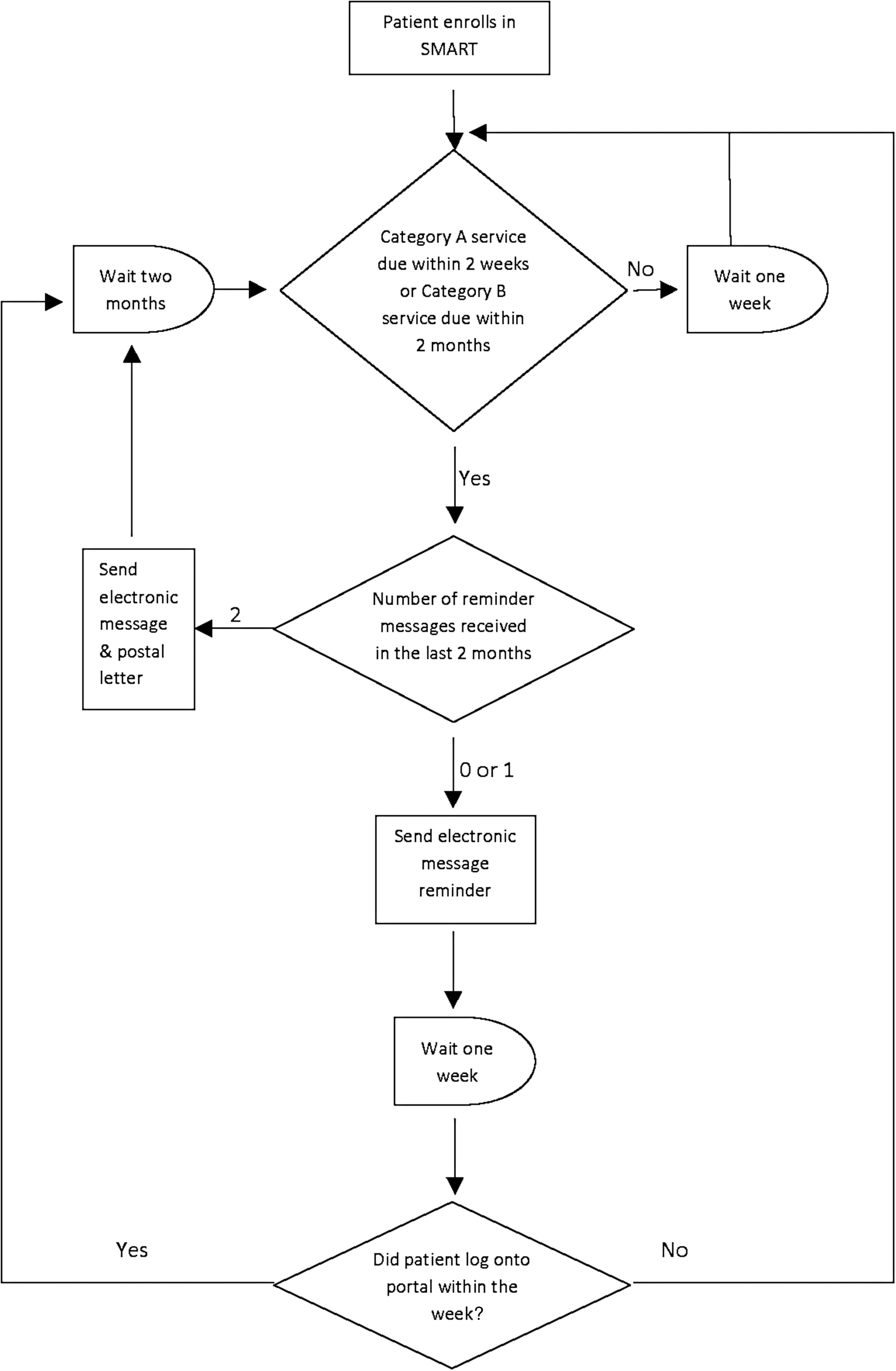
Flowchart of reminder messages and letters. SMART, Self-Management and Reminders in Technology.
We used the EHR's capacity for user-run real-time reporting to allow designated personnel using a special account to run reports that identify participants who should receive the first, second, or third reminder in each cycle. A staff person would run the reports on a weekly basis and send the participants on each list the correct electronic reminder message or letter. The EHR allowed the person running the reports to send the reminder messages or letters to all of the participants on the reports directly from the screen showing the report results.
To implement this work flow, four separate reports were written. The design of the reports is outlined in Table 1. Each of the reports includes those SMART participants who meet specific criteria regarding whether they have targeted services that are about to be due, how many reminder messages they have received in the last 2 months, and whether they have logged in since receiving a reminder message. Because all reminder messages are sent from a specific, dedicated account, the reports identify messages sent from that account as reminder messages.
Report Logic for the Self-Management and Reminders in Technology Program
Blood and urine tests are considered “about to be due” when they will be due within s weeks. Tests that take time to schedule (e.g., colonoscopies, eye exams, mammograms, Pap test) are considered “about to be due” when they will be due within 2 months.
Initial Results
We are evaluating the effectiveness of the active PHR under a demonstration grant from the Agency for Healthcare Research and Quality. Recruitment to evaluate the effectiveness of SMART began on July 26, 2010, and was completed September 2011. We recruited individuals who had (1) coronary artery disease or (2) congestive heart failure or (3) who had hypertension or hyperlipidemia and were taking a medication that required routine laboratory monitoring (e.g., lipid-lowering drug). They were excluded if they did not speak English or were not willing to use the PHR. Subjects were randomized to receive the modified, active version of the PHR described here or to continue to receive the standard version of the PHR. In total, 1,169 subjects have been enrolled, with 584 in the active arm receiving reminder messages. The intervention and control groups are demographically similar (Table 2), and the study population is similar to our clinic population (data not shown). The participants in the active reminder arm have received a total of 3,524 messages as of March 2012, and nearly 65% of patients logged in to the portal upon receiving the first message of a cycle. In a few cases, subjects noted that they had had procedures, the completion of which was not reflected on the HM module. The analytic and programming work effort involved in configuring SMART was approximately 60 h.
Demographic Data of Participants
Participants were able to select more than one race.
PHR, personal health record; SD, standard deviation.
Conclusions
By using simple tools available in a commonly used EHR, we constructed a system of electronic reminders that are sent directly to patients to increase patient awareness of tests and procedures that are recommended for preventive health care, medication management, or chronic disease management. Our development efforts demonstrate that patients can be active contributors to the design of such a system, and our early results demonstrate that a wide variety of patients can and will use the PHR and that patients can be actively engaged, with significant numbers logging in to check the reminder messages. At the conclusion of the study, further analysis will investigate whether this translates into improvements in care.
Footnotes
Disclosure Statement
No competing financial interests exist.