




Abstract
Introduction
Teledermatology entails the use of communication technology to provide dermatologic care. Implementation of teledermatology has been successful in improving access to dermatologic care and patient outcomes, while maintaining diagnostic accuracy and concordance, compared with conventional in-person dermatology. 1 –6 As mobile technology continues to mature, clinicians have found novel applications of teledermatology through the mobile platform. 7,8 Studies have shown mobile teledermatology to be valuable in providing more immediate connection between patients and providers, more convenient upload and transmission of images and clinical data, and potentially more rapid response time because of immediate availability of the clinical information. 9 –12
There are relatively few comprehensive, commercially available mobile teledermatology applications. For groups interested in starting a mobile teledermatology program, selection of the appropriate application can be challenging. Having pretested evaluation criteria allows for efficient, systematic assessment of mobile teledermatology applications and identification of features important for comparison. Although applications evolve constantly, criteria that are based on clinical relevance, efficiency, and usability will continue to be important for assessing future applications.
The primary aims of this study are to determine evaluation criteria of mobile teledermatology applications and to compare the major mobile teledermatology applications in the United States. We anticipate that the results from this study will help users determine important parameters in choosing the appropriate mobile application for clinical use.
Materials and Methods
Selection of Mobile Teledermatology Applications
We conducted a search of the iOS (Apple Inc., Cupertino, CA) and Android (Google Inc., Mountain View, CA) application markets in the United States as of September 7, 2012 to identify potential mobile teledermatology applications. Applications with a niche focus (e.g., moles only) or that did not allow for consultations between physicians were excluded. This yielded two major, commercially available mobile teledermatology applications: AccessDerm (version 1.0; Vignet Corp., McLean, VA) and ClickMedix (version 1.3; ClickMedix LLC, Rockville, MD). Both applications meet the American Telemedicine Association standard for teledermatology applications. 13
Evaluation Process
For each application, we developed and submitted 10 identical cases. We applied a set of a priori pretested criteria that were originally developed for comparison of teledermatology applications on non-mobile platforms. 14 In brief, these criteria were established through a query of the American Telemedicine Association Teledermatology Special Interest Group and the American Academy of Dermatology Telemedicine Task Force. 14 After seven iterations, we developed new evaluation criteria to reflect matters specific to the mobile platform. The evaluations were performed by a multidisciplinary group of dermatologists, information technicians, and potential users. In-depth interviews with the developers were conducted to gain further insight into application capabilities.
Results
Evaluation Criteria for Mobile Teledermatology Applications
The 13-point evaluation criteria encompass three major domains: (1) technical specifications, (2) user experience and workflow, and (3) integration and scalability (Table 1).
Evaluation Criteria for Mobile Teledermatology Applications
HIPAA, Health Insurance Portability and Accountability Act.
Technical specifications entail the types of mobile platforms supported by the application and how the application handles information security, transmission of media, and data storage. These factors are especially important in mobile applications, given the need for multiplatform communication and the concern for information security over a telecommunication network.
User experience and workflow cover the user-friendliness of the application interface as well as how the application facilitates communication between referring and consultant providers. In addition, how the application addresses follow-up patient care is also considered. These user experience and workflow features will be central to provider satisfaction.
Integration and scalability address the degree to which the mobile application can communicate with or be integrated into existing electronic medical record and billing systems. In addition, responsiveness of the application to accommodate significant increases in consult volume is relevant. Finally, cost-effectiveness of the mobile application relative to its capabilities is important to consider.
Application of Mobile Teledermatology Criteria to Existing Applications
We summarize the results of our evaluation in Table 2. In this section we highlight the aspects of our evaluation most likely to be relevant for healthcare professionals when selecting a mobile teledermatology application.
Summary of Feature Comparison Between Major Mobile Teledermatology Applications Using Evaluation Criteria
DICOM, Digital Imaging and Communications in Medicine; HIPAA, Health Insurance Portability and Accountability Act; SMS, short message service.
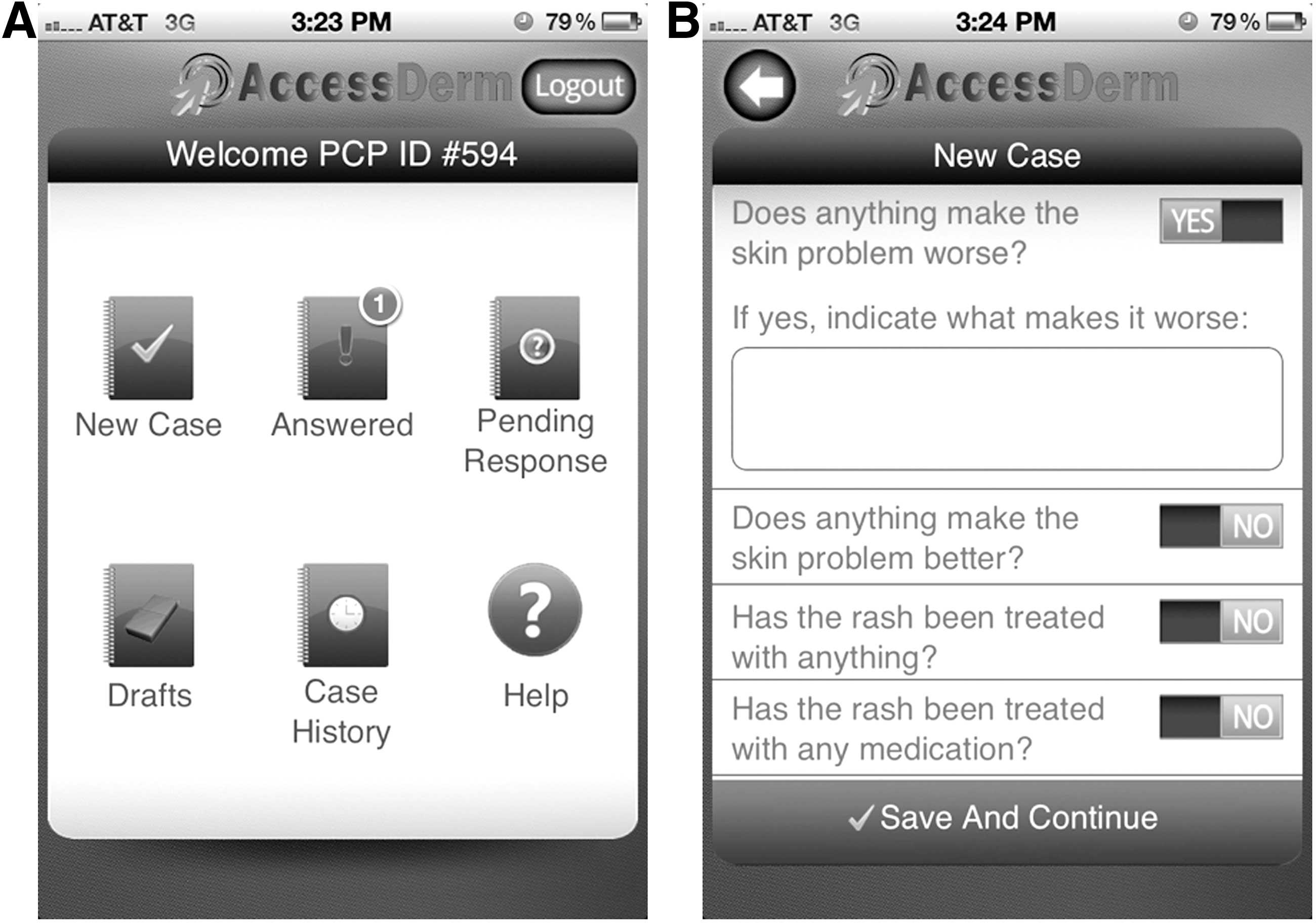
The AccessDerm version 1.0 application's strengths lie in accessibility and ease of use. The application is supported on multiple platforms, improving accessibility. The application also supports push notifications and e-mail to facilitate communication between referring providers and consultant dermatologists. The user interface is simple and streamlined, which makes it easier for providers to learn how to use the application (Fig. 1).
The ClickMedix version 1.3 application offers several notable unique features in addition to its intuitive workflow and layout (Fig. 2A). The ability to tag a picture to a body diagram allows for easy labeling of patient images (Fig. 2B). The built-in camera tutorial and image feedback field give active instruction and feedback for referring providers to improve upon image acquisition skills. Lastly, the Web interface offers built-in analytic tools that allow for a very comprehensive and informative method for viewing data.

Discussion
Teledermatology continues to be an active and growing field of practice in the United States. 15,16 The use of mobile applications in teledermatology will expand healthcare access and possibly provide improved patient outcomes. 17 –19 Therefore, the selection of a secure, user-friendly, and robust mobile teledermatology application is essential.
The mobile teledermatology application evaluation criteria presented here offer an efficient and systematic approach to the selection process. Together, these criteria address technology factors, provider priorities, and workflow and communication preferences. Individual criteria within these categories offer an infrastructure for further assessment of mobile teledermatology applications.
A potential limitation to mobile teledermatology evaluation criteria is the pace of technological advancement. As future applications are developed, new technology may enable features that are not specifically addressed in our evaluation criteria. A challenge in the evaluation was to maintain stable versions of each application, as software updates can frequently change application capabilities.
This evaluation revealed several important areas of further development in mobile applications for teledermatology: (1) increased integration with existing systems of electronic medical records, (2) availability of built-in reimbursement and billing capability, and (3) mechanisms for easy recall of previous consults on the same patient for longitudinal follow-up. As mobile technology continues to progress at a rapid pace, comparative analysis and user feedback will lead to further improvements in the field of mobile teledermatology technology.
Footnotes
Acknowledgments
The authors thank developers Dave Klein and Praduman Jain of Vignet Corp. and Ting Shih of ClickMedix, LLC for communicating with the research team regarding the capabilities and functionalities of their applications and allowing us to trial demo versions of their platforms.
Disclosure Statement
No competing financial interests exist.