




Abstract
Introduction
Adolescence is a unique time of development, with many changes occurring simultaneously. During this transition, adolescents develop complex and important healthcare needs. In addition, high levels of engagement in risky behaviors can lead to lifelong health problems that are often overlooked by providers. This may be due to the fact that adolescents underutilize physician offices and are more likely to be uninsured than any other age group. 1 However, even for those adolescents receiving primary care, one-third report their doctor does not discuss desired topics at their health visit. 2 In addition, these visits are often short, and counseling is suboptimal. 1
Mobile phone technology is currently on the rise. Over 75% of U.S. adults and over 70% of teens own a mobile phone. 3 A key function of mobile phones is text messaging (up to 160 characters of text delivered instantaneously), and 75% of mobile phone owners have text message capabilities. 4 Nearly 70% of parents report text messaging with their children 5 ; over 60% of teens use text messaging, 6 with no significant differences reported in racial/ethnic group, household income, or parent education levels. 3
Text messaging is cost-effective and improves adult appointment attendance. 7 However, no identified studies have assessed the general capability or willingness of teens to receive health-related texts from their physician's office. We hypothesize parents and teens will be open to receive text messages from their healthcare providers but anticipate some parental discomfort with teens receiving text messages directly.
Subjects and Methods
Parents and teens (12–17 years old) at the Wesley Teen Clinic (Wichita, KS) were asked to complete a set of surveys. The initial questions defined the capability and willingness of parents and their teens to receive text messages from their healthcare providers. There were also questions regarding specific types of information that teens would be interested in receiving and parents might approve. Teens were also asked about how they perceived their parents would feel if they received this information directly. Surveys were available in hard copy or electronically (via Survey Monkey) using computer kiosks in the waiting room. Approval was received from two local Institutional Review Boards. Data were analyzed using the Statistical Package for the Social Science (SPSS) version 17.0 (SPSS, Inc., Chicago, IL).
Results
Of the 93 pairs who began the survey, 47 (51%) qualified and completed both the teen and parent surveys. Nearly 90% (n=42) of parents and 68% (n=32) of teens were female. Over half of parents (53%; n=25) were white compared with 44% (n=20) of teens; 22% (n=10) of both were Hispanic. Mothers completed 38 (81%) of the parent surveys. Nearly half of the parents were 31–35 years old (45%; n=21), and the majority of adolescents were 13–15 years old (58%; n=27).
Nearly all (44; n=94%) parents owned a mobile phone, and 87% (n=41) were able to receive text messages. Sixty-seven percent (n=31) communicated via text message with their teen at least once daily, 23% (n=11) at least once per month, and the remaining 9% (n=4) never. Most parents were supportive of allowing their teen to receive text messages from the physician (89%; n=42), 4% (n=2) were not supportive, and the remaining 6% (n=3) chose not to answer. Parent comfort level varied by topic (Fig. 1).
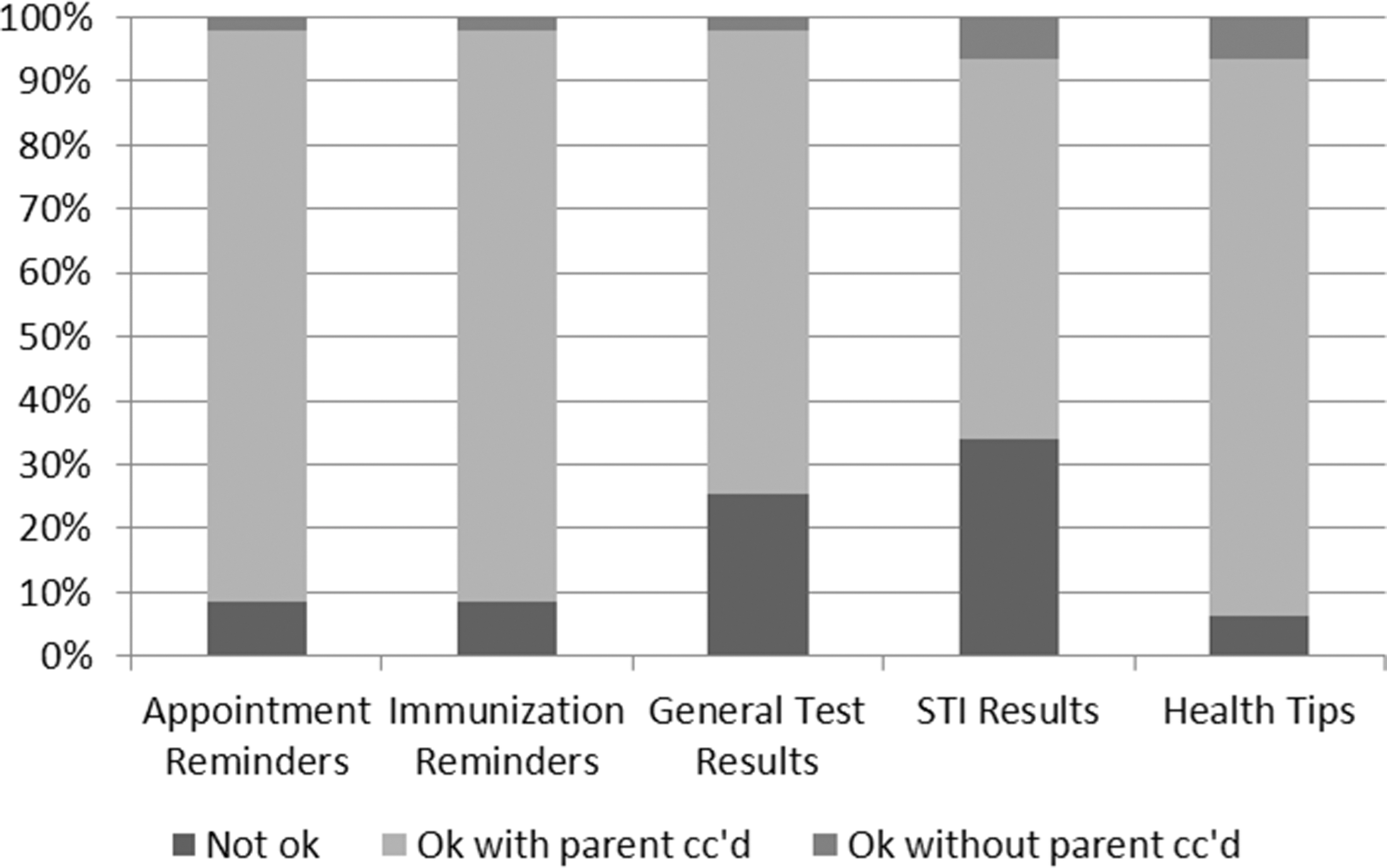
Parent comfort with teens receiving texts by topic. STI, sexually transmitted infections. cc'd, copied.
All teen respondents (100%) owned a mobile phone capable of receiving text messages. All (100%) text messaged their friends, whereas 83% (n=39) texted their parents and other family, and 17% (n=8) texted their teacher. Most (85%; n=40) teens would be open to receiving text messages from their doctor. Teens were most interested in appointment (81%; n=38) or immunization (53%; n=25) reminders, general test results (for example, strep [53%; n=25]), and general health tips (47%; n=22). Fewer were interested in sexually transmitted infection test results (36%; n=17). Over half felt their parents would be supportive of them receiving text messages directly (55%; n=26).
Discussion
Teens appear to be open to receiving text messages from their physician, but parents were less supportive of this. Parents were most likely to allow their teen to receive text messages regarding appointment reminders, immunization reminders, and general health information. However, few would allow their teens to receive information regarding general (e.g., strep throat) test results or sexually transmitted infection results. There is obvious hesitancy in parents to allow their teens direct personal health information and test results, but the reasons are not made clear by this survey. Adolescence is a time of unequivocal development, over a diffuse number of years, where parental monitoring remains critical to ensure that teens gradually become more independent. 8 Parents seem aware of this need in their responses and would prefer to receive a copy of any text message sent to their teen.
Most teens had accurate perceptions about parents' preference for them not to receive text messages directly without parents' knowledge of the content. Despite teens' comfort with text messaging, few were interested in receiving general health information via text. However, several studies have successfully used text messaging to improve teen health, especially for those with diabetes. 9 Further study is needed to identify why teens do not want this information and what, if any, health tips they would find valuable.
Limitations in this study included single geographic area, small sample size, self-report nature, and inability to determine cause-and-effect relationships. The inability of parents or teens to recognize and/or use the patient kiosks and confusion regarding how the survey pair worked, as well as low census in the teen clinic while this survey was being administered, may have contributed to the low number of participants and usable surveys.
Both parents and teens endorsed using texts for appointment reminders; this could improve attendance because few adolescents receive preventative care. 10 Parents were willing to allow their teens to receive health information but were not ready to turn over responsibility to their teen. Future research should evaluate the efficacy of using text messages for communication with teens to improve care and utilization of services for adolescents.
Footnotes
Acknowledgments
This work was supported by the Wichita Center for Graduate Medical Education and a Level 2 grant from the Kansas Bioscience Authority.
Disclosure Statement
No competing financial interests exist.