




Abstract

I am proud to say that I did my graduate work at the University of Michigan. I attended the School of Public Health in 1988 and 1989, and this is my first return visit to this campus. When I arrived in Ann Arbor yesterday, I walked around the campus, and I walked over to the School of Public Health. I did not recognize it. They have done so much rebuilding and renovation, it is absolutely gorgeous. They have bricked over the bridge and created a beautiful archway. There are a number of glass conference rooms. The twin buildings are very beautiful. I am happy to be back in Ann Arbor. It is spring, and the weather is wonderful, not like the winter, when it could be a little oppressive. When I was in graduate school, I didn't spend much time outdoors because of the winters. But the bad weather contributed to helping me get good grades. Another reason why I'm very excited being here is because of all of you. This is a meeting of telehealth celebrities. You are the founders, the experts, and the innovators. I am very happy that Dr. Bashshur organized this meeting, and I get to be with all of you for the next day and a half.
Dr. Bashshur asked us to stick to our topics and to observe our time limits, so I will quickly go through my slides. I will start my presentation with a brief introduction of the Health Resources and Services Administration (HRSA) and then focus on the Office for the Advancement of Telehealth (OAT). HRSA is considered to be the access to healthcare agency in the Department of Health and Human Services. The largest program in HRSA is the Community Health Center Program, and it is located in the Bureau of Primary Health Care. HRSA has different agencies and departments that focus on workforce, human immunodeficiency virus/AIDS, maternal and child health, the 340B Drug Pricing Program, organ donation, and rural health.
Many of you know my predecessor, Dena Puskin. She started in the Office of Rural Health Policy (ORHP) about 23 years ago, and she served as the original director of OAT beginning in 1988. Different administrations have found different homes for this Office. About 2½ years ago, it was moved back into the ORHP; the rationale for relocating OAT to the ORHP was based on the goal of advancing telehealth as a means to improve access to quality care for rural populations.
ORHP supports several different community-based programs, hospital- and state-based programs, border health programs, and now telehealth programs. Additionally, ORHP reviews programs and policies and funds rural health research. ORHP provides grants for up to 4 years, and the expectation is that funded programs would be able to sustain their operations long after the termination of federal funding. Hence, ORHP is communicating the essentials and requirements for sustainability, and more specifically how we can support building capacity with a potential for self-sustainability and how best to utilize grant funds to support the next cohort.
Over the last 3 years, the ORHP has coordinated its work around the President's Improving Rural Health Initiative, which, among other priorities, places special emphasis on building a programmatic evidentiary base. Hence, our office is currently focusing on building a programmatic evidentiary base, which I will discuss further.
Advancing the use of telehealth technologies for improving access and quality of health care services for rural and underserved populations is our mission. Nonetheless, it is not about the technology per se, but rather how the technology is used. To this end, our Office supports four grant programs, contracts, and partnerships. The four grant programs are the Licensure Portability Grant Program (LPGP), the Telehealth Network Grant Program (TNGP), the Telehealth Resource Center Grant Program, and the Flex Rural Veterans Grant Program.
The LPGP is aimed at reducing legal licensing barriers to interstate clinical telehealth practice. The Federation of State Medical Boards reduces the redundancies that complicate and delay the process of obtaining licensure in multiple jurisdictions. The Federation also promotes the utilization and expansion of telehealth services across state lines while not compromising the level of protection for patients that is provided by state licensure. Our second LPGP grantee is the Association of State and Provincial Psychology Boards, and they create mechanisms to streamline the licensure process for psychologists through the following programs: a Credentials Verification and Storage Program, Certificate of Professional Qualification in Psychology, Interjurisdictional Practice Certificate, and Psychology Licensure Universal System.
The purpose of the TNGP is to demonstrate how telehealth technologies can help expand access, coordinate, and improve the quality of health services. The TNGP consists of two components: (a) the traditional hub-and-spoke model, where funding is provided to build such networks, and (b) the home telehealth program, which supports residential management of chronic illness. In total, we are supporting 23 projects. A new cohort of 14 grantees was funded beginning September 1, 2012, and they will be funded for up to 4 years. In 2013, we anticipate funding 9 additional projects, depending on the availability of funds. Beyond that, we plan to fund telehealth networks focusing on different aspects of telehealth and care models, depending on emerging priorities and developments in this field. In general terms, the present is a continuation of the past. But, we are cognizant of the need for greater flexibility in future funding in order to respond effectively to emerging situations and to learn from our experience, to build on what works and avoid what does not. That is why the evidentiary base is so important. Moreover, the underlying technology is changing, and we have to utilize the latest and most effective tools to achieve our mission. For example, we noted that currently only 1 among 23 grantees is exploring m-health, or the use of mobile technology in healthcare delivery. OAT cannot ignore the enormous potential of mobile handheld devices. Therefore, in the future, we would like to explore these new capabilities to find out what works, how well it works, in what settings, and also what does not work.
Figure 1 is a map of our telehealth resource centers (TRCs). The TRCs are funded to provide technical assistance to rural communities and HRSA grantees that are interested in starting or enhancing a telehealth program. They worked collaboratively. They have a joint Web site, which contains tools for starting a telehealth program, with an operations manual that includes step-by-step instructions. They conduct monthly Webinars that are free and open to the general public, and they arrange monthly meetings with each other. They also present at state, regional, and national meetings. One of the resource centers, the Telehealth Technology Assessment Center, is not visible on this map. It provides unbiased information about telehealth technologies for rural communities and HRSA grantees across the country. It also provides significant technical assistance to the TRCs so that they are better able to help the communities in their respective states or regions. The Telehealth Technology Assessment Center is a valuable resource for information on telehealth technologies.

Telehealth resource centers (TRCs).
OAT recently assumed responsibility for the administration of the Flex Rural Veterans Grant Program (Rural Veterans). The mission is of the Rural Veterans program is to help eligible entities coordinate innovative approaches, collaborative networks, and virtual linkages to increase the delivery of mental health and other healthcare services deemed necessary to meet the needs of veterans of Operation Iraqi Freedom and Operation Enduring Freedom. This grant program will facilitate access to quality healthcare for rural veterans and their families, as well as other residents living in rural census tracts as defined by HRSA. The grantees employ regional approaches, networks, and technology to collaborate with the Department of Veterans Affairs and other rural healthcare providers to improve access to healthcare for rural veterans. To date, we have three grantees, now in the second of their 3-year term. We just submitted a report to Congress on the status of this program.
One of the emerging priorities in our office is the evaluation of our programs. Grantees are required to conduct their own evaluations, as well as submit their data to OAT. OAT completed an evaluation of these data in 2006, and a report to Congress was submitted. We are planning to do another evaluation of data based on information from 2006 to the present and also submit the results in another report to Congress.
I am keenly interested in drawing lessons from the experiences of funded projects and in publishing the results for the benefit of the larger community. Publication and dissemination of information are important. Grantees can learn from each other, and the wider community can learn from these funded activities. The knowledge gained from the experience of one cohort should be transmitted to future cohorts, and the cumulative knowledge will assure continuity and progress in telehealth in general.
HRSA launched a cross-federal workgroup on telehealth, “Fed-Tel,” that includes membership from agencies and offices across the Federal government that have an interest or investment in telehealth. The purpose of this group is to reduce organizational silos with respect to telehealth, facilitate telehealth education and information sharing among the members, coordinate funding opportunity announcements and other programmatic materials, and summarize the key telehealth activities of the participants. This group evolved from the Joint Working Group on Telehealth (JWGT), which was formally established in 1995 in response to a request from the office of the Vice President of the United States. The JWGT prepared two congressional reports, testified in front of the Federal Communications Commission on telemedicine issues, and prepared formal responses to the Federal Communications Commission and other regulatory initiatives, including commentary on technical issues, such as electromagnetic interference with medical devices. Fed-Tel is the latest iteration of the JWGT and has about 100 members, representing 26 different agencies and offices. This group has been meeting for 1 year. It meets every other month via conference call and face-to-face twice a year. Some participants occasionally express surprise upon learning what other agencies are doing in this area and their overlapping interests. This would occur even within the same agency, where people were not fully aware of similar activities. One of the outcomes of these meetings was the development of short-term and long-term goals and the development of a comprehensive inventory of telehealth-related programs.
I would like to make a couple of points about the future of telehealth. Figure 2 is a photograph of my family: the children on the ends are my kids, and the ones in the middle are my nephews and my niece. When thinking about realizing the promise of telemedicine, technology is not going to be the issue. You see my kids are quite savvy in the use of technology. My son has a DSI. My daughter has my BlackBerry. The two boys are playing with a Wii remote, and the baby in the middle has my Kindle Fire. They know how to operate everything. They know how to Face Chat, how to make telephone calls, connect to Wi-Fi, and download applications. They figured this out on their own, and even teach me how to take advantage of the capabilities of mobile technologies. In the future, technology itself is not going to be a barrier; it is all the other issues that Dr. Bashshur was talking about, such as workforce, licensure, connectivity, and reimbursement, that may remain as problematic in the future. These are the things we need to talk about and to resolve.
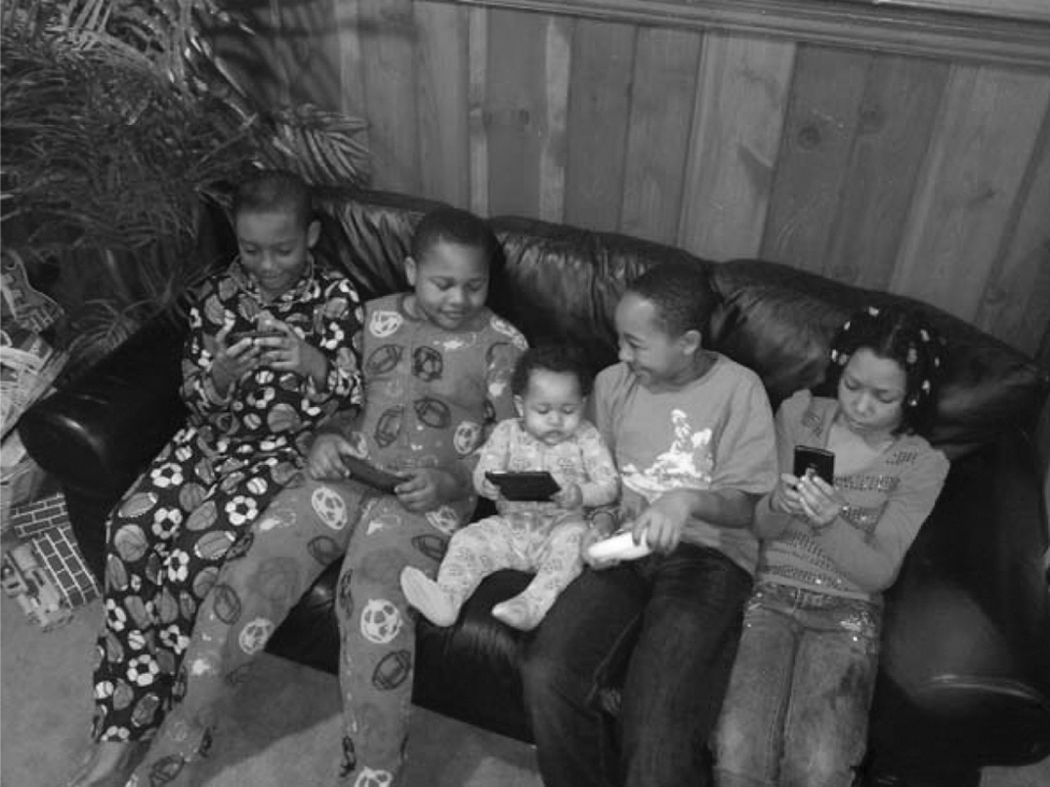
The Pruitt family using a variety of technologies.
Finally, I would like to invite you to submit your ideas and suggestions for the future to our Office. You will find our door and ears open for new ideas to move the field forward. I am new to this group, and I am open to novel ideas. I would like to make our Office an even more effective force in exploiting/utilizing the capabilities of information and communication technology to serve the healthcare needs of our people wherever they live and whatever their constraints.