




Abstract
This article reviews the history, current status, and future plans of the Partners HealthCare Center for Connected Health (the Center). Established in 1995 by Harvard Medical School teaching hospitals, the Center develops strategies to move healthcare from the hospital and doctor's office into the day-to-day lives of patients. It leverages information technology to help manage chronic conditions, maintain health and wellness, and improve adherence to prescribed regimen, patient engagement, and clinical outcomes. Since inception, it has served over 30,000 patients. The Center's core functions include videoconference-based real-time virtual visits, home vital sign monitoring, store-and-forward online consultations, social media, mobile technology, and other novel methods of providing care and enabling health and wellness remotely and independently of traditional time and geographic constraints. It offers a wide range of services, programs, and research activities. The Center comprises over 40 professionals with various technical and professional skills. Internally within Partners HealthCare, the role of the Center is to collaborate, guide, advise, and support the experimentation with and the deployment and growth of connected health technologies, programs, and services. Annually, the Center engages in a deliberative planning process to guide its annual research and operational agenda. The Center enjoys a diversified revenue stream. Funding sources include institutional operating budget/research funds from Partners HealthCare, public and private competitive grants and contracts, philanthropic contributions, ad hoc funding arrangements, and longer-term contractual arrangements with third parties.
Overview
Established in 1995 by Harvard Medical School teaching hospitals, the Center for Connected Health at Partners HealthCare System (the Center) in Boston, MA, develops new strategies to move healthcare from the hospital and doctors' offices into the day-to-day lives of patients. Anticipating the inevitable shift of the locus of care from the provider to the person, the Center leverages information technology—cell phones, sensors, computers, networked devices, and simple remote monitoring tools—to help providers and patients manage chronic conditions, maintain health and wellness, improve adherence to medical and lifestyle regimen, and increase patient involvement in managing their health and clinical outcomes. Since its inception in 1995, it has served over 30,000 patients. The Center evaluates new technologies and also conducts feasibility studies and randomized controlled clinical trials. Its efforts are guided by practical considerations, including an emphasis on what works and what does not. Its ultimate goal is to change the way doctors and nurses deliver clinical services and to enable patients to manage their own health. The Center's mission focuses on education, community service, and clinical excellence. Among its recurring educational activities is an annual 2-day meeting (
Priority Focus Areas
The Center has an enduring commitment to developing new and nontraditional technology-based avenues to enhance access to care. These include videoconference-based real-time virtual visits, home vital sign monitoring, store-and-forward online consultations, and other methods for providing care and enabling health and wellness, including social media and mobile technology.
In its early days, the Center's mission was limited to remote access to specialty care. The objective was to serve as an institutional specialty resource for Partners HealthCare. Today, the Center has expanded the scope of its activities to incorporate enabling healthcare innovation and new methods of access.
Among the Center's current priorities is to facilitate an orderly shift in the locus of care from traditional settings to the patients' environment by facilitating wellness through self-management tools that encourage individuals to take an active and engaged role in their health and wellness. These tools include targeted education and feedback that encourage healthy lifestyle and are applied in several chronic conditions, including obesity, hypertension, and diabetes.
Range of Services
Research
The Center's research team tries to focus on identifying innovative ways to address challenging problems in healthcare delivery. Its research portfolio includes feasibility pilots, one-arm trials with matched control samples, and randomized controlled trials. Some projects are commissioned and funded internally at the Center or through interdepartmental collaborations with Partners HealthCare System and affiliated colleagues. Others are funded through competitive governmental and industry-sponsored grant and contract applications. A selected sampling of current and past projects
1
includes smartphone apps that incorporate the use of sensors and behavior feedback, promoting lifestyle modifications in individuals with chronic diseases, such as: • text messaging, empowering patients with chronic illness to increase physical activity
2
• in-home sensors and algorithm-driven feedback, preventing falls in home-bound populations • improving medication adherence via a device placed in a person's home • deploying social media tools to improve follow-up and reduce exacerbations in teens with asthma
3
• building a predictive model using behavioral characteristics to stratify patients with heart failure by risk of re-admission • a user-friendly Web-based return on investment tool, demonstrating the cost savings of remote telemonitoring in patients with congestive heart failure.
This research program constitutes an essential component of the Center.
Advisory
Since its inception, the Center has met with numerous technology developers, contracted with several of them, with a consistent focus on prudent investment in technology, one that has the maximal effect on quality of care and health outcomes. The Center works with providers, payers, not-for-profits organizations, technologists, entrepreneurs, and innovators in the following advisory ways: • Assisting in the design, development, and evaluation of connected health programs tailored to specific conditions, specific populations, and specific settings. Representative examples include advising on videoconferencing-based virtual visits, e-visits, customized text-messaging programs for clinical use, provider-to-provider telemedicine case consultations, and remote monitoring of various medical conditions. • Use of the Center's proprietary Technical Evaluation Methodologies for evaluating connected health tools (devices and solutions) and mobile applications (apps) • Convening patients, clinical end-users, and other experts to provide feedback and insights on proposed connected health products and services • Convening 2-hour, intensive, fast-paced engagements known as “red team reviews.” These are geared towards start-ups that are developing innovative and disruptive solutions to deliver care. Proposed solutions are presented to the Center. It, in turn, provides immediate clinical, research, business, technical, and customer engagement/support feedback. A venture capitalist also participate each red team review.
Programs
The Center has ongoing programs in heart failure, hypertension, diabetes, and other chronic conditions, as well as online second opinion program and enhanced medical education and training activities that have been integrated across the Partners HealthCare network. Some of these programs are highlighted below: • Diabetes Connect and Blood Pressure Connect. These programs offer patients and their care providers a way to keep track of their blood sugar and blood pressure readings, respectively,
4,5
and to collaborate on a care plan between office visits. Almost 1,000 patients in the Partners HealthCare System have been enrolled by their providers into these programs. • Connected Cardiac Care. This is a home telemonitoring and education program for patients with heart failure who are at risk for hospitalization. The program involves daily vital sign monitoring and uses “just in time” education and care coordination to keep patients at home. • Partners online specialty consultations. This program offers patients and their treating physicians worldwide online access to leading specialists at Massachusetts General Hospital, Brigham and Women's Hospital, and Dana-Farber/Partners Cancer Care. In the majority of cases, the specialist consultant would offer an alternative diagnosis, treatment plan, or treatment options.
6
The service is offered as a benefit to members or employees of interested employers, payers, and benefit management organizations. • Mobile health. Using technology already in most patients' hands, the mobile health initiatives provide personalized, interactive, multilanguage education, and reminders to diverse patient populations. At-risk patients in urban community health centers are receiving messages for a healthy pregnancy from their obstetrical team and midwives. Pregnant patients about to deliver at the Brigham and Women's Hospital will be “getting ready for discharge” at 32 weeks with targeted educational information. Appointment reminders, supportive messaging, and educational content are provided to large populations of patients to help keep them connected and engaged as they go about their daily lives. • Collaborative media services. Since the Center's inception, this team has provided videoconferencing and streaming media services that facilitate clinical interactions and teaching and learning for clinicians and patients worldwide. The Center's technical expertise includes podcasting and Web conferencing, streaming media hosting, and cross-platform video on demand.
Role of Connected Health at Partners HealthCare System
The Center is a division within the Information Systems Department of Partners HealthCare. Partners HealthCare is a not-for-profit, integrated healthcare system in Boston. Founded in 1994 by Brigham and Women's Hospital and Massachusetts General Hospital, Partners HealthCare includes community and specialty hospitals, a physician network, community health centers, homecare, and other health-related services. With approximately 60,000 employees—including physicians, nurses, scientists, and caregivers—Partners is the largest private employer in Massachusetts. The Partners institutions maintain a total research budget of more than $1.4 billion.
The Center has a current staff of 45 employees. It is situated at the Partners corporate level and is a strategic and priority area of interest for Partners in helping to fulfill its mission of teaching, patient care, research, and community service.
The Center serves as an enterprise-wide knowledge repository and center of connected health activities and works extensively with other service areas throughout Partners. These include community health centers, Partners HealthCare at Home, departments of psychiatry, dermatology, neurology, medicine, and surgery, Partners International, and Partners Community Health.
The Beacon Hill Telemedicine initiative is an example of an internal collaboration at Partners HealthCare that has created a convenient avenue of access to care for patients. This initiative, one of the Center's “Virtual Visit” programs, was developed in collaboration with The Beacon Hill primary care clinical practice at Massachusetts General Hospital. It uses videoconferencing technology to alleviate the burden of travel to an urban center for follow-up appointments. It is secured by a Web application called BlueJeans (Fig. 1). Patients are able to interact with their Boston-based care team at the Beacon Hill practice directly from their own homes in suburban Greater Boston using their home computers.
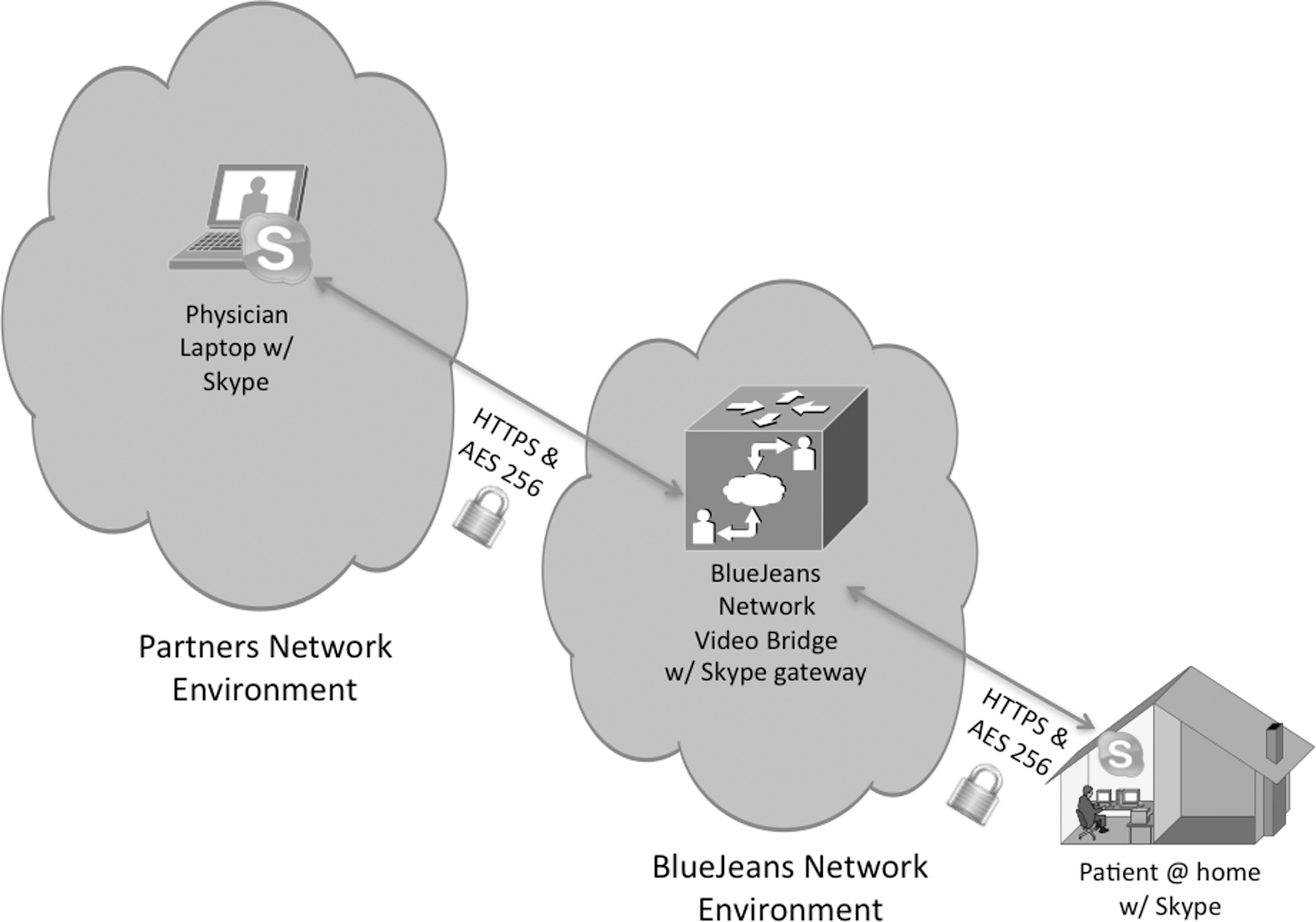
BlueJeans Network Environment.
Impact
The Center currently provides connected health services through its chronic care management programs, as follows: • Connected Cardiac Care. This program, currently in its 7th year of operation and developed and operated in conjunction with Partners HealthCare at Home, serves approximately 400 congestive heart failure patients per year. Over the years, the program has demonstrated a 50% reduction in re-admission rates, translating to about $1 million in savings for the system. In addition, the program has demonstrated high rates of satisfaction with both providers and patients. In a recent survey with cardiologists and other referring physicians, a greater than 90% satisfaction rate of the program in its current form was reported. Similarly, more than 90% physicians reported that they would recommend the program to others. The Center's current work on this program involves efforts to improve efficiency by triaging patients into subprograms of different intensities, based on disease severity. The Center is also considering the feasibility of expanding the program to other cardiac diseases such as post-myocardial infarction, atrial fibrillation, etc. • Diabetes Connect. This program has served almost 1,000 patients with type 2 diabetes. Patients are expected to upload their blood glucose readings and view their trends online. The Center found that hemoglobin A1c was reduced by almost 1.5 % among active patients and 0.8% among the inactive, within 1 year of starting on the program.
4
These results have led to a focus on patient and provider engagement and to operations to reduce effort and ability of patients and providers to improve adoption and engagement. • Blood Pressure Connect. Blood Pressure Connect aims at enabling patients to maintain their blood pressure levels through a Web-based program. Overall, systolic pressure decreased by 6 mm Hg (95% confidence interval, 4–8 mm Hg; p<0.0001). The effect was most pronounced in those with baseline blood pressure over 160 mm Hg (25 mm Hg; 95% confidence interval, 18–32 mm Hg; p<0.0001).
5
• Partners specialty online consultations. Through the years, over 10,000 patients have obtained specialty consultations through this service. A recent review of a small sample of cases (330 oncology cases from January to December 2011) revealed that Partners physicians have altered treatment plans in 42% of cases and used supplementary treatment options in almost 46% of cases.
6
They offered a new diagnosis in 4% of cases and deemed the existing diagnosis inconclusive in almost 10% of cases. They also eliminated portions of their original treatment in 19% of cases and recommended against all further treatment in 6% of cases.
6
The Center has evaluated the impact of simplifying technology on clinical outcomes, operational efficiency, and rates of adoption. A small clinical pilot compared the use of wireless mobile technology with landline connections. It revealed that patients measured themselves more frequently when given wireless technology (median, 0.66 versus 0.20; p=0.013). These patients also uploaded their readings sooner (within 4 days versus 7 days; p=0.017) and more frequently (median, 0.46 versus 0.1; p=0.0001). 7 As a result, the Center is gradually incorporating wireless mobile technologies wherever appropriate and triaging the most difficult patients to these technologies.
Business Model and Sustainability
Since its inception, the Center has engaged in a planning process to guide its annual research and operational agendas. Strategic goals and departmental priorities are established for the year, and a longer-term vision is set for the ensuing 3–5 years. All of the Center's activities, whether contemplated, in process, or ongoing, must advance the Center's mission in teaching, patient care, research, or community service. The strategic roadmap is reviewed regularly, and progress is monitored on an ongoing basis. Modifications are made upon the consent of the Center's management team.
From a financial perspective, the Center's guiding principle has been to strive toward a diversified revenue stream. To meet this objective and avoid a concentrated revenue source risk, the Center has sought to cast a wide operational and relationship net and deliver value and attract support from a broad cross-section of stakeholders, as described below.
Several of the Center's programs are supported via internal institutional funds. These programs are considered important tools to aid Partners in achieving better population health and chronic illness management. In addition to institutional funding, which accounts, variously, for approximately 33–40% of the Center's annual operating costs, the Center has been the recipient of public and private competitive grants and contracts, philanthropic giving, ad hoc funding arrangements, and other, longer-term contractual arrangements, of both the annual retainer and pay-as-you-go, fee-for-service nature. Several of its third-party contractual relationships are long term, 10 years or more in duration.
The Center has enjoyed long-term loyalty and commitment among its staff. This represented an operational asset that has aided the Center in its business planning and operational growth. In addition to its staff, the Center has relied upon several consultants and the advice and support of senior leadership within Partners HealthCare, physician, nursing, and allied health clinical champions, and third-party governmental, academic, and industrial supporters. The Center has maintained an active presence and involvement in various trade associations and professional societies. This has added to the continuous learning environment and an ever-growing network of contacts and collaborators.
All of the Center's activities are categorized among the following six business units: (1) research, (2) connected health initiatives, (3) collaborative media, (4) public events and policy, (5) advisory services, and (6) online consultations. For each business unit, the goal is service excellence and break-even operations. Within each business unit, for all activities project plans and project management methodologies are in place. Financial results are reported monthly and reviewed carefully among the management team.
Future
The current generation of Connected Health programs at Partners HealthCare is poised to grow throughout the enterprise. The Center will serve primarily as an innovation incubator. As its programs mature and are ready for deployment at scale throughout Partners, the Center will develop a rigorous approach to assure successful deployment. Two anticipated examples of this phenomenon are as follows: • The Center's remote monitoring data repository, which allows for vital signs gathered remotely to be easily incorporated into our information technology infrastructure, will soon be connected to the electronic record. This will enable Partners clinicians to view the data in the electronic record. Similarly, patients will be able to access their remote monitoring data via the Partners patient portal. As these changes occur, any vestige of innovation/experimentation associated with the platform will have ended, and full-scale integration into mainstream, enterprise-wide information technology service will result. This will promote care coordination and enable, for example, remote monitoring of heart failure patients. • The Center's online consultation software will be offered enterprise-wide at Partners as a “white label” service for departments or clinicians wishing to expand their online capabilities, either as a convenient and augmented service offering to their current patient pallet or as an organized, efficient, and proven pathway to channel random and ad hoc consultation requests that currently come via phone, fax, e-mail, and word of mouth.
As Connected Health programs move to scale, the Center's work will expand in multiple ways. Patient and provider demographics, quality and cost pressures, new payment models, an increasingly mobile lifestyle, and learning from other industries suggest an inevitable quest toward a distributed care mode in which the locus of care shifts away from the provider setting to the community. The Center will focus on three keys critical for future development: 1. The ability to use connected health and other data to micro-segment the patient/consumer population and offer them highly specific messaging tailored to their specific needs and intended to motivate improved health and increased engagement 2. The ability to automate various care processes using software agents, robots, and targeted messaging 3. The ability to use the phenotypic data generated via connected health programs to compare with increasingly highly defined genotypic data, allowing refined approaches to diagnosis and therapy.
Among those who have dedicated their careers to this field, questions that are often asked include: • What are we missing? • How can we move faster? • Are there policy considerations that we aren't dealing with but should? • What other groups can we enlist as colleagues and help move the field forward together?
These are questions of success, confidence, and good will. As our nation faces vexing healthcare challenges of cost, quality, and access, we are bound to consider connected health, e-health, mobile health, telemedicine, etc., in its search for solutions.
Footnotes
Disclosure Statement
All authors derived salary through their employment at Partners HealthCare's Center for Connected Health. For each of the authors, no other competing financial interest exists.