




Abstract

The First Armenian International Congress on Telemedicine and eHealth, “ARMTELEMED: Road to the Future,” was organized and held October 14–16, 2011, at the Russian-Armenian State University in Yerevan, Armenia (
The Opening Ceremony speakers represented virtually all national stakeholders in the field of telemedicine and e-health, including government, academia, and industry. These included the Deputy Minister of Health, Dr. Sergey Khachatryan, the Chair of the Parliamentary Commission on Healthcare, Professor Ara Babloyan, the Secretary-General of the International Telecommunication Union, Dr. Hamadoun Toure, and the Organizing Committee co-chairs, the Armenian Association of Telemedicine President, Dr. Georgi Chaltikyan, the President of the Russian-Armenian (Slavonic) University, Professor Armen Darbinyan, and the Executive Director of the Union of Information Technology Enterprises, Mr. Karen Vardanyan. The program of the first day consisted of four Plenary Sessions, incorporating state-of-the-art presentations delivered by distinguished faculty from around the world (Table 1). The sponsors of the meeting are highlighted in Table 2.
Participating Faculty and Areas of Focus
CEENet, Central and Eastern European Networking Association; EKENG, the Armenian electronic administration agency; ISfTeH, International Society for Telemedicine and eHealth; ISOC, Internet Society.
Sponsor Organizations
Partner Bank.
The second day began with the sponsors' session led by industry keynote speakers, and continued with eight scientific presentations from six countries. The day culminated in an expert panel on e-health with an opening keynote by Dr. Adriana Velazquez Berumen from the World Health Organization, a presentation on the Armenian eHealth plan by Dr. Arthur Ghulyan from the Government's electronic administration agency EKENG, and a lively discussion on the best pathways to design, develop, and implement an efficient e-health program for the country.
The Congress was attended by a wide variety of individuals from over 20 countries, including the United States, the United Kingdom, Germany, France, Russia, Ukraine, Moldova, Georgia, Qatar, etc. Table 3 highlights the distribution of attendants, including those who attended virtually. Figure 1 illustrates the breadth of expertise of the attendees.
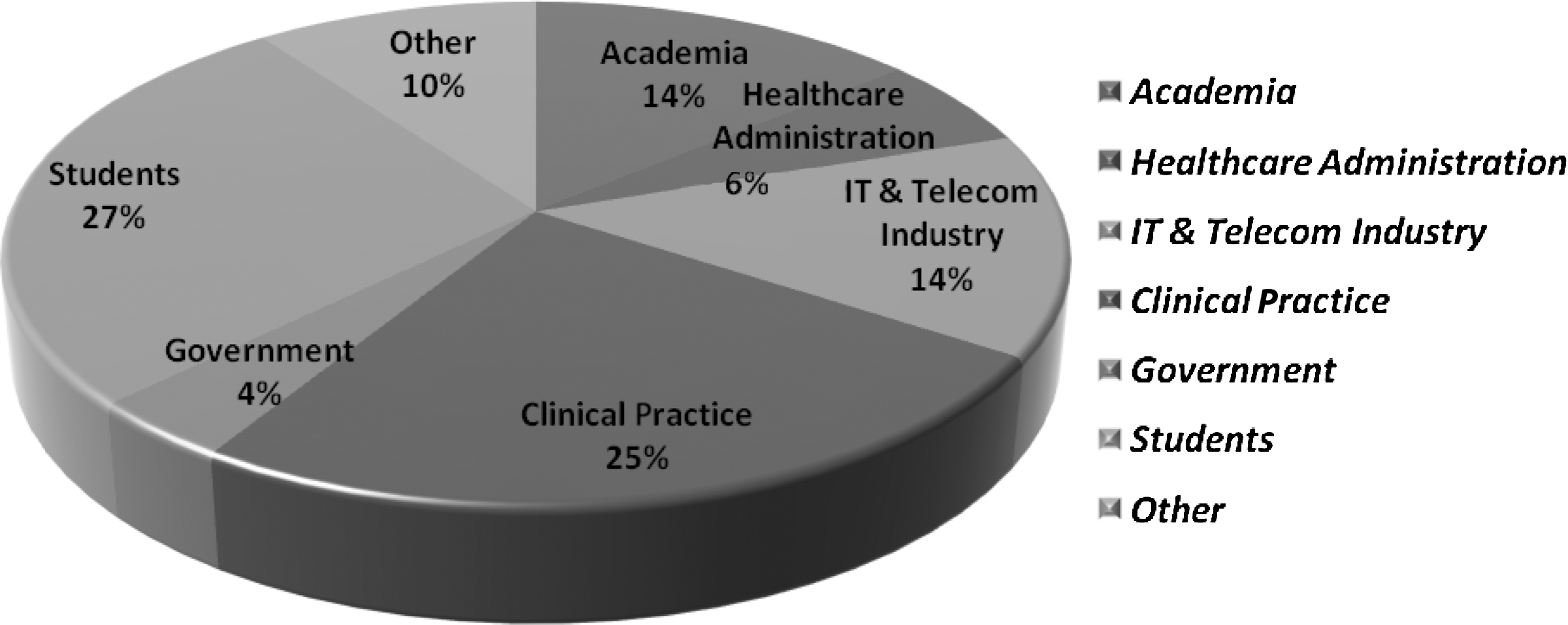
Distribution of participants according to their field of practice (with “Other” including non-governmental organizations, foundations, media, pharmaceutical, and unclassified). IT, information technology.
Attendance Statistics
Such attendance and interest clearly showed that even though health information and communications technology (HICT) in Armenia is still in its infancy, there is significant potential for development and, most importantly, understanding of importance of information and communications technology for healthcare by all involved stakeholders, including regulatory bodies, healthcare industry, information technology and telecom industry, and academia, among others.
The Congress included an educational track, the International School of Telemedicine and e-Health, which was organized under the auspices of the International Society for Telemedicine and eHealth and the American Telemedicine Association and co-funded by the German Academic Exchange Service. A total of 75 participants took part in the seminar, including 5 faculty, 50 regular attendees (more than half were German Academic Exchange Service alumni from Armenia and Georgia), and 14 student attendees.
The seminar consisted of six comprehensive lecture units covering virtually all aspects of telemedicine and e-health at beginner's level, as well as a hands-on session provided by AMD Global Telemedicine and Medweb. It was the first educational undertaking in the field of telemedicine and e-health of such magnitude and scope to be conducted in Armenia and as such drew considerable attention from the professional community. All seminar sessions were recorded and will soon be published on DVD. Moreover, the seminar was designed as the inaugural session of a regular educational course on HICT by an international faculty, and preliminary work on such course is already underway.
The major outcomes of the congress, in accordance with the goals and priorities set are summarized as follows: 1. For the first time ever all Armenian HICT enthusiasts were given an opportunity to attend a series of state-of-the-art lectures and presentations by world-renowned experts and telehealth pioneers, who shared their experience in establishing telemedicine and e-health programs. 2. Those in the country who had been working in the field were given an excellent chance to present their work to the international community. 3. The Congress provided domestic and international HICT enthusiasts with many new networking and collaboration opportunities.
The Congress also provided a foundation for the development of a set of recommendations for further development of national telemedicine and e-health programs in Armenia. In addition, it provided an exceptional platform for bidirectional exchange of experience, networking, and collaboration and should become a regular scientific and educational event, to boost developments in the field of information and communications technology for medicine and healthcare.
A Participant Feedback Evaluation Survey was organized after the Congress took place. In total, 150 questionnaires were sent electronically to attendees, and 67 complete responses were returned (response rate of 44.7%). The questionnaire consisted of nine multiple choice questions related to the attendees' overall satisfaction with the organization and conduct of the Congress and the quality of information presented; one free text field was reserved for additional comments and suggestions. The survey results demonstrated a very high level of satisfaction with the Congress and the overall importance of further developing HICT. Thus, 95.5% and 97.0% of respondents were either “very satisfied” or “satisfied” with the overall organization of the Congress and the quality of information, respectively, while the venue, facilities, staff, and materials of the Congress satisfied 100% of attendees. Furthermore, 52.2% said the information presented was “very useful” to them or their organizations, and 46.3% said it was “somewhat useful”; 61.2% consider their knowledge and understanding of telehealth “significantly improved” as a result of the Congress, whereas 34.3% said “moderately improved,” and only 4.5% said “not at all improved.” Most notable is that 61.2% of respondents said the Congress exceeded or much exceeded their expectations, 95.5% will “definitely” or “most probably” be attending the next such meeting, and 97% will recommend it to others.
Summarizing the above, despite the inherent difficulties of organizing such a highly specific professional forum for the first time in an environment with little previous exposure to and experience in the field, despite some unavoidable shortcomings and deficiencies on the part of the organizers, the First Armenian International Congress on Telemedicine and eHealth overall proved a remarkable success and set a favorable background for future practical, scientific, and educational developments in the field of HICT in Armenia and in the entire South Caucasus region.