




Abstract
Introduction
The management of cancer patients has become increasingly multidisciplinary and requires coordination among specialized oncology services to support primary care physicians. Typical patient care can include the initial diagnosis, staging, and a treatment plan. This is followed by neoadjuvant chemotherapy, definitive surgery, palliative surgery, and postoperative management with perhaps adjuvant therapy. The matter of diagnostic precision, staging, timing, sequence, and coordinated intervention has come to be the expected standard in cancer care.
However, in developing countries such as Pakistan there are very limited specialized oncology centers to provide effective comprehensive patient care. 1 Most of the teaching hospitals in Pakistan lack specialized cancer treatment facilities. The consequence is that surgical oncology practice results in patients making frequent visits to various clinical centers for each phase of care, including initial workup by surgeons, tissue diagnosis by histopathologists, staging investigations by radiologists, and a management plan by the oncologist, which may involve surgery, chemotherapy, or radiotherapy followed by or prior to surgery. The entire process is time consuming and may cause delay in management of the patients. 2 –4 At times patients drop out of the treatment plan after being routed among the centers, undergoing new registrations in each center, repeating similar investigations, and getting tired of presenting medical histories at each point. The entire process is annoyingly discontinuous and inconsistent with effective health information exchange among caregivers. As a result, surgeons often manage patients themselves with little input from the oncology team. This may lead to increased morbidity of such patients. 5,6
Holy Family Hospital (HFH) in Rawalpindi, Pakistan, a 1,000-bed teaching hospital, is equipped with two advanced surgical units to support general surgical, urological, and orthopedic patients. The teaching hospital lacks an onsite oncology support center. Cancer patients are instead referred randomly for oncological referral to NORI Hospital in Islamabad, which is approximately a 1-h drive from HFH.
Access to comprehensive oncology consultation can be improved by applying telemedicine principles to create a virtual cancer center with joint care decision making via teleconferencing. Such principles provide teleoncology with a variety of potential benefits, including enhancing primary care clinicians, access to referrals, expanded opportunities for continued medical education, reduction of unnecessary referrals, and smooth coordination of patient care. 4 Advancements in technology are increasingly being used to overcome barriers in healthcare access and utilization. 6 –8 The purpose of this study is to describe the infrastructure, consultative process, technical aspects, and the initial evaluation of these meetings.
Materials and Methods
A video communication link was established between HFH (the surgical site) and NORI Hospital (the oncology site) using DSL connectivity. The conference room at each site is equipped with a Polycom® (San Jose, CA) VSX™ 7000 VTC camera and a 42-inch liquid crystal display monitor (Fig. 1). A standardized format was adopted for preparation and organization of each session during these multidisciplinary meetings. The preparation for the session starts with case selection at each site, which is done by consultants at each site during daily ward rounds and outpatient disease clinics, and each case is assigned a specific number by the ward clerk and is allocated to one resident physician. The resident uses a standard format of PowerPoint® (Microsoft®, Redmond, WA) slides to prepare the case presentation. This format includes slides of demographic data, history and examination details, images of the lesion, radiological investigations, and histopathological slides. The final slides include a proposed management plan.
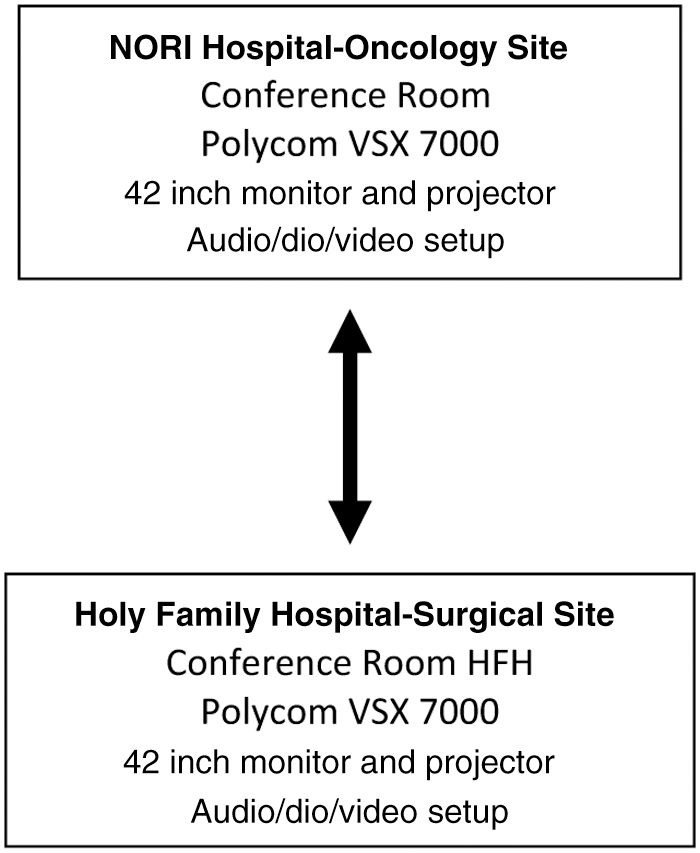
Technical equipment used for multidisciplinary management meetings.
The teleoncology sessions are scheduled every Friday morning when all members of the individual departments are present at both locations. The case is presented by the assigned resident at the respective site; the radiology and the histopathology investigations are explained by relevant consultants or the senior resident of the relevant department (radiology and pathology). The assigned resident proposes an initial treatment strategy at the respective site. This is followed by input from the team at the other site through their virtual presence. The case is discussed in detail, and the final treatment plan is developed jointly after the discussion. The final treatment plan is included on slides in the original PowerPoint presentation. In cases where patients need to be transferred to the other site as part of the final treatment plan, referrals are scheduled and noted in the plan. The printout of the final treatment plan is attached to the patient file and is sent to the other site along with the patient in cases of the referrals. Similarly, the case presentation as per assigned number is e-mailed to the other site and stored in the database of the corresponding departments. Once the final treatment plan is executed, the cases are discussed again in subsequent meetings for follow-up.
All the information for each patient is stored in the department databases in the form of case presentations and relevant radiological and histopathological data and operative images. This study is the initial evaluation of the system from November 2009 to December 2011.
Results
In total, 71 teleoncology sessions were conducted, and 264 patients were discussed. The mean age of the group was 51±16.2 years. Most (74%) of these patients were presented by the surgical department, whereas the remainders were presented from the oncology center. Breast and gastrointestinal malignancies were the most common cases, comprising 67% of the total cases, followed by endocrine and skin and soft tissue tumors. The mean duration for each case discussion was 13 min (range, 7–32 min). There was a significant change in the final joint treatment strategy from the initial proposed treatment calculated as a 31% instance of minor changes and a 12% instance of major changes. Patients lost to follow-up or withdrawn from the protocol during interhospital referrals have dropped significantly from 36% to 19% by using these multidisciplinary management meetings. Similarly, the operative oncological workload for the surgery team has increased almost threefold, which is a key factor in the enhancement of the oncological surgery skills of new consultants and residents (Fig. 2). The HFH gynecology department has started using this videoconferencing facility for their cancer patient discussions, and the surgery department of another hospital in Rawalpindi is in the process of establishing a similar setup in their hospital to link with NORI Hospital for the same objective.

Operative work at the surgical site shows an increase after incorporation of multidisciplinary management meetings. GIT, gastrointestinal.
Discussion
The practice of medicine is changing. Technology has brought new avenues to augment healthcare delivery thorough the existing medical infrastructure. In 1998, the World Health Organization defined telemedicine as “the delivery of healthcare services, where distance is the critical factor, by all healthcare professionals using information and communication technologies for the exchange of valid information for diagnosis, treatment and prevention of disease and injuries, research and evaluation, and for the continuing education of healthcare providers, all in the interest of advancing the health of individuals and their communities.” 6,7,9 Telemedicine has proved its advantages in almost every clinical specialty.
Although there are many telemedicine programs in Pakistan, few have offered teleoncology services. Teleoncology has been defined as delivering clinical oncology services at a distance and has come to encompass the use of electronic devices to aid clinical diagnosis, treatment, and follow-up based on the transfer of video, images of clinicians and patients, and data including pathology and radiology images, graphics, and text. 2,4,10 Teleoncology through virtual multidisciplinary management meetings should usually focus on three areas: confirmation of diagnosis, evaluation of joint treatment strategy, and follow-up. 5 –7 In facilities where cancer patients are being managed on surgical floors in the absence of cancer wards, the oncological support through virtual multidisciplinary management meetings has a great impact on refinement of the treatment strategy. 1,8,9 In more than 40% of our patients the treatment strategy was refined after joint discussions between clinicians, clearly showing the positive role of teleoncology. Similarly, it is a support for those oncological centers that are outside the main tertiary-care centers and for patients who need to be referred to surgical centers for operative intervention. In our study, 74% of the patients were referred by the surgical team, clearly showing that most surgical cancer patients present on the surgical floor via emergency or outpatient consultation.
Breast cancer was the most common malignancy in our study group, and most of these patients had advanced disease on presentation where immediate surgery was not the recommended treatment. Referring such patient for neodjuvant chemotherapy to the cancer center before and adjuvant chemotherapy after surgery is the strategy that was mostly followed after joint discussions as per cancer guidelines with the expectations for better outcomes. 11,12 These patients were effectively scheduled at both centers without the need for repetition of investigation and multiple clinical diagnostic sessions because of one joint discussion through the teleoncology session. This has proved very important in continuity of care for the patient and significantly reduced the patient dropout rate.
Another positive impact is continued medical education for healthcare professionals 12,13 In our study, the operative skills of the surgeons in cancer have improved because of increased channeled referrals directly from the cancer center, which is significantly higher than routine practice in a teaching hospital of a similar nature.
It was learned during the study that practicing teleoncology through these virtual meetings has a great impact on patient outcome through coordinated care. The preparation and organization of such sessions are practical and possible with minimum expertise requirement and better incorporation of existing facilities and expertise. Moreover, the hub cancer centers can be linked similarly to larger numbers of surgical sites for improving coordinated care without any additional cost required at the hub site in countries that have limited specialized cancer facilities. The technology of telemedicine has a great potential for a developing country like Pakistan with limited oncology centers and may well be used in future by various departments of teaching hospitals for access to national and international cancer experts through cooperative virtual meetings. Currently most of these surgical centers are managing surgical oncology patients in a virtually isolated environment because of the nonavailability of oncological facilities in the same institution, and hence there is increased demand to incorporate this methodology to improve patient outcome. It is also clear that the specialists at the two sites have developed much closer professional ties and common practices through their participation in a virtual medical staff.
Conclusions
Teleoncology can become an important tool in the management of cancer patients in countries where oncological facilities are limited and are not present under one roof. It decreases the burden both to the medical services and to the patient's family. It is easy to practice and ensures the continuity of the care through a coordinated medical approach.
Footnotes
Disclosure Statement
No competing financial interests exist.