




Abstract
Introduction
Computerized management of healthcare data is becoming more widespread, both among the workers in the sector (healthcare institutions, hospitals, clinics, etc.) and among citizens (access to booking systems, consultation of personal data, access to laboratory results, etc.). Under the label of e-health and m-health, new forms of healthcare data access and sharing are being evaluated, and many systems for remote monitoring and transmission of biometrical data have been designed and tested (i.e., telemedicine, telemonitoring, and the like). 1
However, some challenges arise when considering the actual possibilities of applying these systems to an entire national population or to a large portion of it. 2 –4 Among these numerous difficulties, it is important to stress the presence of a considerable digital divide in the targeted population for these kinds of monitoring devices. 5
In fact, the digital divide is larger in the elderly population with low formal education, and, moreover, there are substantial differences in broadband Internet service at the territorial level: cities are normally better connected than small villages and farmland. 6 –9
Therefore, there are at least two factors that can prevent the spread of the above-mentioned systems: a lack of familiarity with information and communications technologies (ICT) and the limited Internet connection availability (Wi-Fi or cable) in given areas.
As those individuals suffering from chronic disease are predominantly elderly people, it is crucial to gain a better knowledge of the current situation, in order to understand both the limits likely to prevent a concrete application of these new systems and the numbers of the chronically ill population that can be reached with them. 10,11
The aim of this study is to estimate the number of people with potential cardiovascular problems able to access the Web, both in percentage and in absolute number, with respect to the populations of 11 European countries. With regard to the Italian situation, a chronological comparison is also presented, in order to acquire additional elements for understanding how quickly the digital divide can be overcome.
The presence of cardiovascular chronic illness is, from an epidemiologic point of view, the most widespread, not only in Italy but also in Europe and in industrialized countries. 12 By using official statistical sources and specific surveys carried out in several European countries, this article presents some data on the Internet accessibility of individuals over 50 years of age, taking also into account their cardiovascular chronic condition; the difficulties in the passage from trials to the effective distribution of telemedicine systems could be also due to the digital divide in the target population.
Nevertheless, the experience acquired during a telemedicine project in Italy 13 tells us that being able to access the technical devices (especially when they are easy to use) helps in overcoming the difficulties a person might experience with the device itself, especially when this person understand its usefulness. Therefore, the chance to use a monitoring device might be a drive to overcome the digital divide, at least with the help of technology-oriented relatives. Appropriate ways of inclusion might increase the potential numbers of patients to be treated with telemedicine and e-health systems. This inclusion process might become crucial in order to increase the involvement of elderly people and a challenge to overcome their digital divide. 14,15
Materials and Methods
Data
With regard to Europe, we used data of the Survey of Health, Ageing and Retirement in Europe (SHARE) (
The SHARE survey is a multidisciplinary and cross-national panel database of micro-data on health, socioeconomic status, and social and family networks of more than 85,000 individuals (approximately 150,000 interviews) 50 years of age or older, and it is coordinated by the Munich Center for the Economics of Aging, Max-Planck-Institute for Social Law and Social Policy, Munich, Germany. The survey's research design is based both on an American survey (the Health and Retirement Study) and on an English one (the English Longitudinal Study of Ageing).
In 2001, there were 16 countries participating in the SHARE survey (4th edition). During this edition, a question on the interviewees' skills in using the Web was included for the first time; it is then possible to cross-correlate the answers to this question together with diagnoses of cardiovascular chronic illness. Unfortunately, this question was not asked of the whole longitudinal sample, but only of the people recruited for the first time in the survey. Thus, only data from the 11 countries that have a fair number of interviews were taken into consideration for analysis.
Regarding the Italian situation, data deriving from the Istituto Nazionale di Statistica (ISTAT) (
The SHARE and the ISTAT data were analyzed by applying the sample weights provided by each survey.
In addition, in a comparison with the official ISTAT Multiscopo data, information was collected during enrollment of patients for the project ASCOLTA, the Italian word for “listen” and acronym of “Assistenza domiciliare allo SCOmpenso cardiaco attraverso le Tecniche Avanzate di communicazione digitale,” a survey carried out in Pisa in 2011 (see Appendix 1: The ASCOLTA Project). All 166 patients who booked a medical examination at the Ambulatorio Scompenso e Continuità Assistenziale del Dipartimento Cardiotoracico belonging to the University of Pisa (a heart clinic based at the Cisanello Hospital), between October 19 and December 7, 2011, were asked to answer a questionnaire with the aim of comparing results; the questionnaire (see Appendix 2: Questionnaire Used for the ASCOLTA Survey) was constructed by using some of the questions asked in the ISTAT Multiscopo survey. An interviewer approached each individual patient in the waiting room of the clinic and explained the goal of the research. Then, the interviewer asked the patient to answer a few questions under a privacy agreement. The interviewer was provided with either a tablet or a smartphone connected to a Wi-Fi network and was able to insert responses using the platform
Among the 166 interviewed patients there was a slightly prevalence of men, and their average age was 73 years, whereas on average the women were 5 years older (Table 1).
Patients Interviewed by Gender and Age
Data are from the 2011 ASCOLTA survey.
SD, standard deviation.
Indicators
Some indicators allowed us to carry out a comparative analysis of the data available. For each of these indicators, the calculus criteria relative to the statistical source used are reported in Appendix 3: Calculus Criteria of the Indicators Used: • Presence of cardiovascular pathologies: a binary indicator (0=absence; 1=presence) • Web access: a binary indicator (0=absence; 1=presence) • Web use: an ordinal indicator: a. a passive use: looking for information (general and specific) and reading newspapers b. a social use: sharing information with friends/family/acquaintances (e-mail) and people with common interests (blogs, forums, chatrooms) c. an active use: beyond exchange of information and social contacts managing, the Web is used also as a service instrument (online banking and service management)—this indicates people are more familiar with the use of the Web. • Classification of family:
a. living alone b. living as a couple without child(ren) c. living as a couple with child(ren) d. living together with a person or persons 50 years or younger e. living together with a person or persons older than 50 years of age • Classification of digital divide:
a. people who are excluded: they do not access the Web from home, and no one in the family uses the Internet. b. people who are ready: they have Web access from home, and they use the Internet. c. people who are connected, ready to be taught: they have Web access from home and do not use the Internet, but someone in the family does. d. people ready to be connected: they do not access the Web from home, but they use the Internet.
Results
European Context
Considerable numbers of the European population over 50 years of age are affected by cardiovascular diseases. According to the SHARE survey it has been estimated that for more than 77 million people living in the countries where this survey was carried out, a physician diagnosed at least one of the pathologies considered (that is, 50.5% of the population older than 50 years of age) (Table 2).
Population >50 Years of Age by Country and Presence of Cardiovascular Disease in the Year 2011
Data are in thousands and were obtained from the Survey of Health, Ageing and Retirement in Europe (
Considerable differences can be observed by country: the presence of cardiovascular diseases in the same age segment ranges from 38% in Switzerland to 66% in Hungary (Fig. 1).
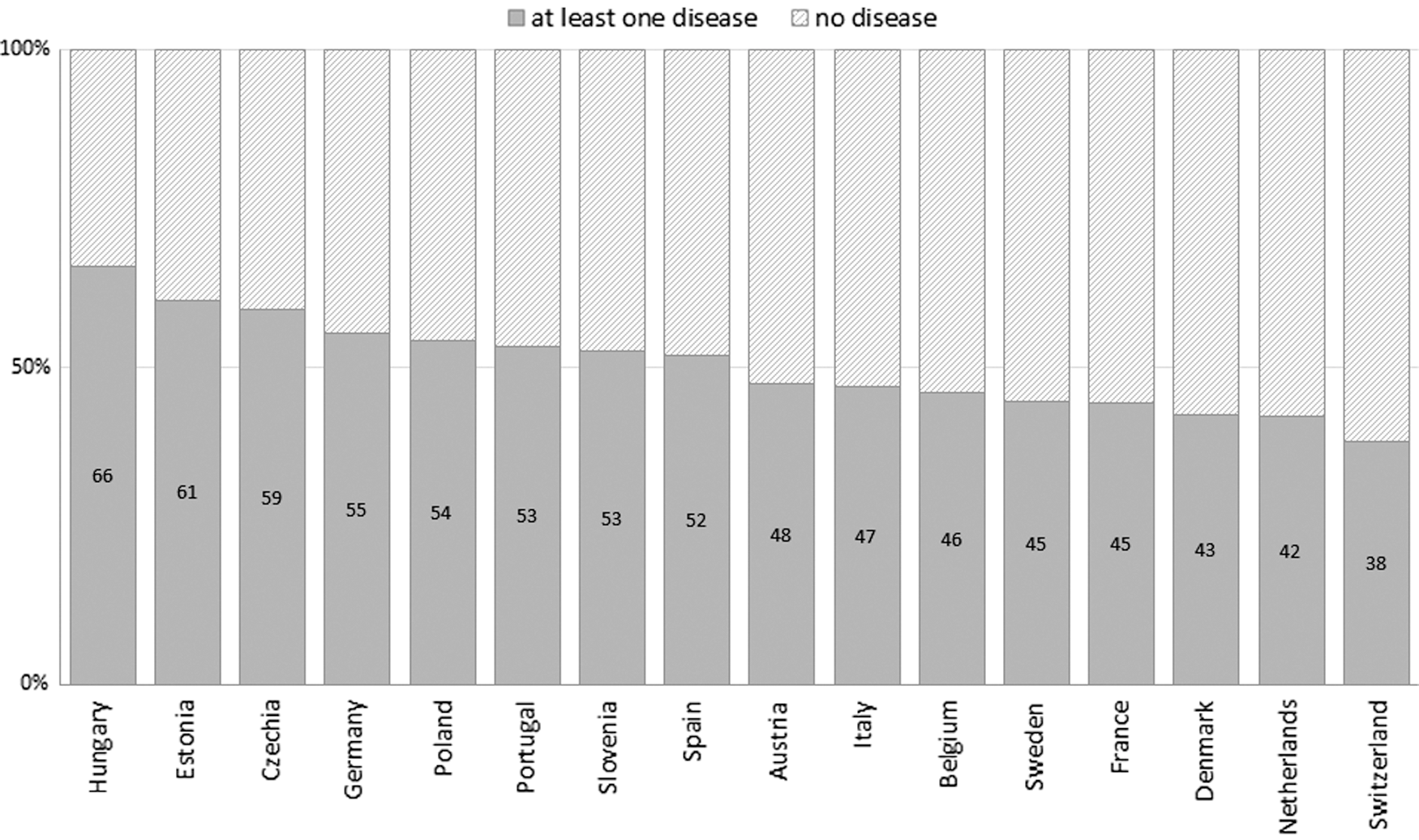
Population >50 years of age with cardiovascular disease by country in 2011.
Yet, to understand the size of this large population that could be involved in telemedicine applications, it is necessary to verify how many of these people are connected to the Internet.
In regard to this, it has to be pointed out that the age segment analyzed (over 50 years of age) is surely suffering from the digital divide more than the other age segments. It has been shown that at the European level, only 40% of the population in the age segment between 55 and 74 years of age use the Internet regularly, whereas almost three-quarters of families, that is, 73%, have Web access. 16 This might lead to the assumption that the reasons for this digital divide can be found in the motivations to use the Internet or in ICT skills. 17
When focusing on the digital divide analysis only with regard to the population suffering from cardiovascular issues, it is important to take into account that in the 2011 SHARE survey there was only one question concerning Web use, and this leads to an underestimate of the numbers of people who have Internet connection. Furthermore, the question was asked only of new participants (thus, the longitudinal sample was excluded). Therefore, especially for some countries, the number of available answers was very low. Consequently, only the countries having a number of answers that could statistically guarantee significant results (national estimates with a standard error below 1%) and whose results were consistent with the ones coming from other sources were chosen for analysis.
With regard to the age categories involved in the SHARE survey, a comparison was carried out with the Web user's distribution provided by Eurostat
18
(
The analysis of the results obtained from the countries included in the SHARE survey shows that only 31% of the population over 50 years of age use the Web. However, it is important to point out that for people suffering from cardiovascular diseases, this percentage drops to 24%. Also in this case, the country differences are relevant: on the one hand, 53% of the people with a cardiovascular risk in Switzerland are Web users, and, on the other hand, there are corresponding percentages below 20% in the countries of Southern Europe (Italy, Spain, and Portugal) (Table 3 and Fig. 2).

Population >50 years of age by presence of cardiovascular disease and Internet use by country in 2011.
Population >50 Years of Age by Country, Web Use, and Presence of Cardiovascular Disease
Data are percentages and were obtained from the Survey of Health, Ageing and Retirement in Europe (
The Italian situation appears to be critical, and therefore it needs to be further studied.
The Italian Situation
According to the SHARE data Italy has a larger digital divide relative to other European countries. Yet, it is possible to further analyze the situation by using the ISTAT Multiscopo data: more specifically, by carrying out a comparison of 2 years (2007 and 2011), it is possible to obtain indications on the short period trend. The percentage of the >50-year-old Italian population who suffer from a cardiovascular disease was mostly stable in the 2 years considered (Table 4). At the same time, a substantial increase (12%) in Web access from the home in the same age segment can be noticed (Table 5).
Italian Population >50 Years of Age by Presence of Cardiovascular Disease in 2007 and 2011
Data were obtained from the Istituto Nazionale di Statistica Multiscopo Surveys in 2007 and 2011.
Italian Population >50 Years of Age by Home Web Access in 2007 and 2011
Data were obtained from the Istituto Nazionale di Statistica Multiscopo Surveys in 2007 and 2011.
After correlating the two variables (having a cardiovascular disease and Web access), it is safe to state that the Web access increase refers both to healthy and to ill populations (Table 6).
Italian Population >50 Years of Age by Home Web Access and Presence of Cardiovascular Disease in 2007 and 2011
Data were obtained from the Istituto Nazionale di Statistica Multiscopo Surveys in 2007 and 2011.
Thanks to a greater number of observations, the ISTAT Multiscopo survey allows for a more detailed analysis of the age segments (Fig. 3).
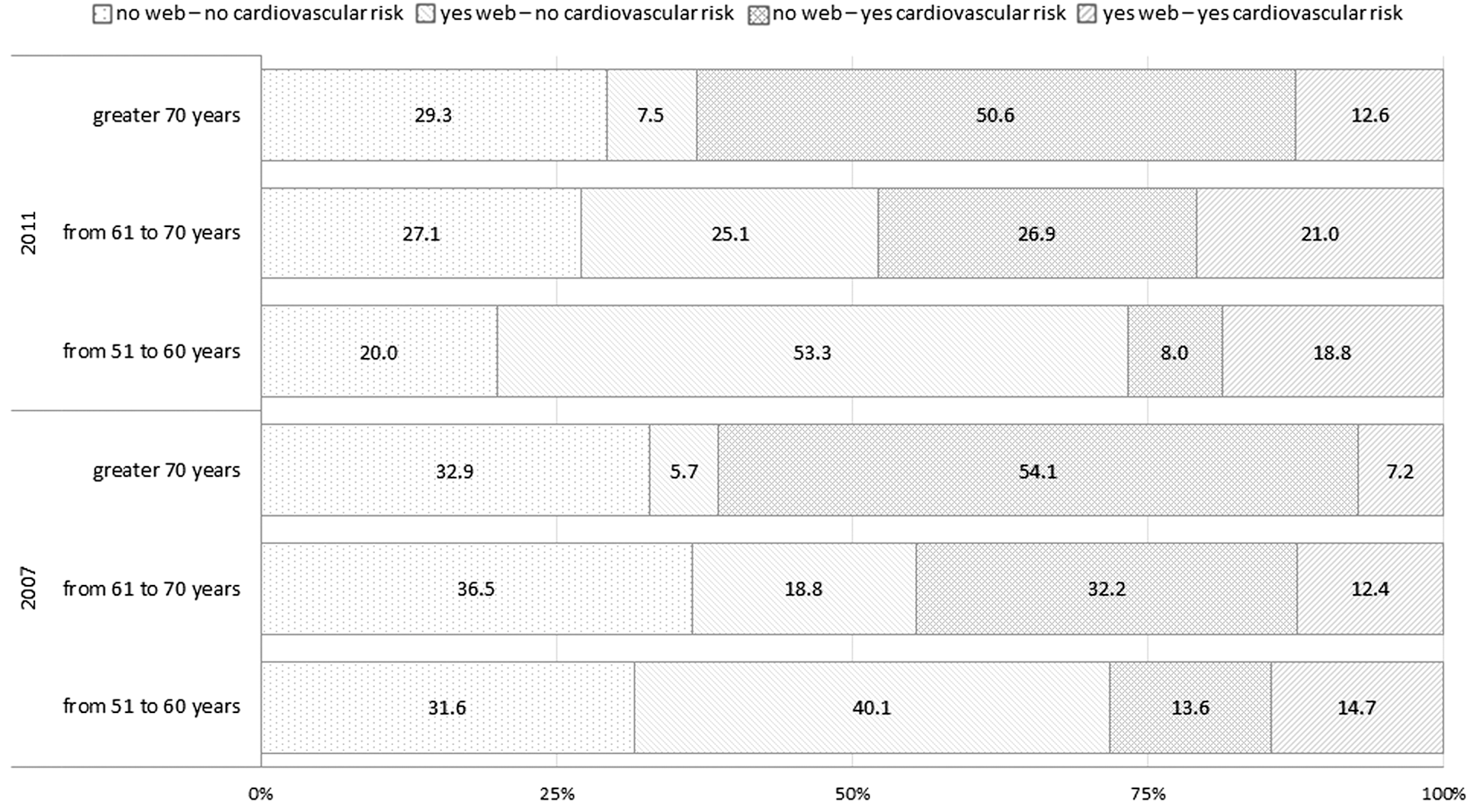
Italian population >50 years of age by home Web access, presence of cardiovascular risk, and age in 2007 and 2011.
In order to highlight how important the Web access is among those who might be involved in telemedicine programs, that is, among those with a cardiovascular risk (at least one pathology), an interesting finding needs to be highlighted. It is possible to observe that, on the one hand, from 2007 to 2011 the number of ill people increased among the oldest age segment, whereas on the other it stayed stable among those younger than 70 years of age. As well, the proportion of people with Web access increased among all age categories (Fig. 4).
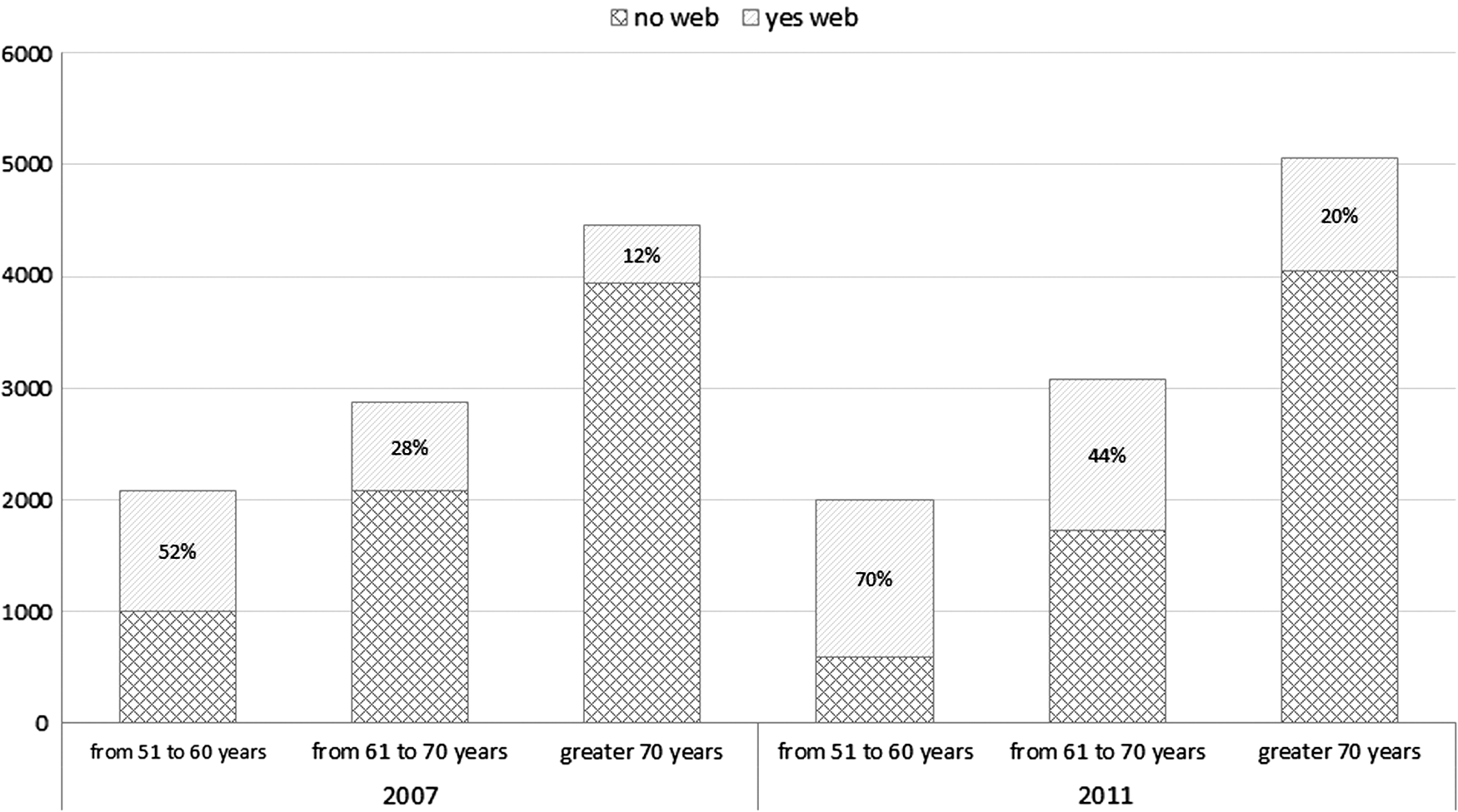
Italian population >50 years of age with home Web access by presence of cardiovascular disease and age in 2007 and 2011.
In general, in 2011 37% of people with a cardiovascular risk had Web access. However, when considering those who actually used the Web, only 17.1% of people with a cardiovascular risk did so—this finding is consistent with the SHARE results (Table 3 and Fig. 2).
An explanation for the increasing Web access among the older age segments might be that it mostly concerns those living with children (Table 7).
Italian Population >50 Years of Age by Type of Family and Home Web Access in 2011
Data were obtained from the Istituto Nazionale di Statistica Multiscopo Survey in 2011.
As for the Italian situation, the digital divide for people over 50 years of age can be clearly recognized. People ready to use e-health systems are about 4.5 million, of which 1.5 million already suffer from cardiovascular diseases; improvements can be implemented in the future, considering that nearly 5 million Italians over 50 years of age (of which 2 million already suffer from cardiovascular diseases), although not able to use the Internet, own a home Internet connection (Table 8) and could be convinced to acquire or improve their ICT skills.
Italian Population >50 Years of Age by Type of Digital Divide and Presence of Cardiovascular Disease in 2011
Data were obtained from the Istituto Nazionale di Statistica Multiscopo Survey in 2011.
The Digital Divide Among Patients (Direct Survey)
The questions asked of patients suffering from heart failure who were treated at the clinic in Pisa are listed in Appendix 2: Questionnaire Used for the ASCOLTA Survey. It is possible to view the questions' sequence and the absolute and relative frequencies obtained for each question.
Two-thirds of the interviewed patients did not have the possibility to access the Internet from home; this is similar to the ISTAT Multiscopo estimates.
The main device available to access the Web was a desktop computer, which was used as the only device by more than 40% of the families with an Internet connection. Fewer than 25% had a laptop or both a portable and a desktop device. In the group of Internet users, almost everyone had an ADSL connection, which was also a Wi-Fi connection in slightly less than 50% of the cases.
Half of the patients who had (hypothetically or for sure) a wireless connection surfed the Internet almost on a daily basis in the 3 months prior to the survey. Their Internet usage was quite developed and socially oriented toward sharing. Indeed, 50% actively used the Web, 35% used it socially, and only 15% passively used the Web.
These results match with those referring to the Italian population in general. However, caution must be used when making comparisons because of the limited number of interviewed patients (Table 9). The fact that, both among patients and among Italians suffering from cardiovascular risk, most people use Internet skillfully has to be considered a very positive finding, and it allows us to assume a likely acceptance of telemedicine and/or distance-monitoring systems through ICT tools.
Italian Population >50 Years of Age with Home Web Access and Internet Used in the Last 3 Months by Web Use and Presence of Cardiovascular Disease in 2011
Data were obtained from the Istituto Nazionale di Statistica Multiscopo Survey in 2011.
The experience our research group gained through the ASCOLTA Project shows that elderly people with few ICT skills overcame the virtual barrier and learned how to connect to the Web because they started to appreciate new technologies. As evidence of the good will and the ability of elderly patients in bridging the initial gap, it should be stressed that none of the enrolled patients dropped out, and their commitment rate was 93.1%. The patients were asked to use the system once a day, starting from the first implementation until March 30. Because not everyone started on the same day, the total number of connections should have been 276; instead, it was 257. The individual connection rate varied between 70% and 172%, meaning that some of the patients skipped some connections, and others connected more times than they had to.
Furthermore, all patients but 1 continued the trial beyond the official end of the project on a voluntary basis. This shows that when real benefits are perceived, it is possible for people of all ages to overcome the difficulties involving ICT technologies. 13,19
With regard to the trial development, since the first week and immediately after the initial briefing, more than 60% of patients made the connections without any help from other people, and the remaining 40% asked for and received the collaboration of a member of the family who gladly helped. In the closing meeting the members of the patients' family said that they felt they were supported in dealing with their chronic condition. 13,20
Additional information might be acquired by asking to those who cannot access the Web from home and have a member of the family suffering from a chronic pathology whether they would have be interested in activating an Internet connection from home if a remote monitoring system was implemented.
Discussion and Conclusions
The presented results, despite the variety of sources, allow us to piece together a uniform picture.
Our direct survey highlights that the percentage of patients suffering from a certified heart failure who have an Internet connection from home is 31%. Among them, there are reasonable numbers of patients (57.1%) who have (at least basic) ICT skills, and these ICT skills are used fairly frequently. It is significant to underline that 70% of this group uses the Internet to look for health information. Therefore, they would be ready to test e-health devices. Furthermore, half of this group actively uses the Web.
It is also interesting to notice that there is a proportion of patients who are aware of having an Internet connection at their home but are still not very well informed. A possibility, in order to include this group, would be that relatives living with them would serve as a way to overcome the digital divide. In our sample this group amounted to only 20 out of the 52 patients (38.5%): they have Web access at home, and they declared they can ask their family to help with the computer.
The opportunity for patients to use the Internet to monitor their chronic condition can serve as a challenge to reduce the digital divide gap and, furthermore, to increase their social inclusion. 21,22
It is also true that the presence of elderly people who are not isolated (or living with younger members of the family) might be a more common situation in Italy relative to other European countries; thus this might be proven not to be true in other cultural contexts. 23 Conversely, the digital divide is wider in our country, so it is interesting to take into consideration whatever strategy might help overcoming it.
The survey carried out in Tuscany shows that looking for health information is a feature shared by all types of patients. The cause of this behavior relies most probably in suffering from a chronic pathology.
The results obtained by the ASCOLTA Project open the way to some considerations and operational proposals.
We acknowledge that habits are very difficult to change. Hence, in order to help the diffusion of telemedicine it might be useful to use the action research methodology proposed by Lewin 24 to support the change of food habits. This methodology is used in several social contexts to encourage change in attitudes, behaviors, and social dynamics. 25 –27 This approach is based on the idea that awareness, dialogue, conversation, and democratic decisions taken by a group are more effective than conferences and advertisement campaigns in persuading people to change their behaviors. Working with small groups of patients (composed of both patients who are already enrolled in remote monitoring trials and skeptical patients) with the involvement of a doctor and a trainer might meet the goal of involving an increasing number of patients in e-health programs.
It is interesting to notice how, with adequate actions aimed at improving the familiarity with technology, the number of people for whom the use of e-health tools could rise significantly in Italy.
In the future, new research and coordinated surveys by countries (both in Europe and in other countries) to monitor the digital divide in chronic disease patients would be highly beneficial. 4,28
Footnotes
Acknowledgments
This article uses data from ISTAT Multiscopo Surveys (
Disclosure Statement
No competing financial interests exist.