




Abstract
Introduction
As quality of life increases and the general population rapidly ages, the average individual spends over $368.00 every year on improving his or her exercise habits and health. 1 Addressing this demand, a diverse range of easy-to-use health equipment is consistently being released; however, most products do not take consumer motives into account and thus become unused and repurposed into decorative pieces and drying racks, just a couple of months after purchase. 2,3
However, as smart media are increasing in supply, there are more healthcare services catering to the smart devices being developed. 2,4 Healthcare services incorporating information and communications technology include not only simple exercises, but also games that emphasize playability while inducing physical activity. Thus, research regarding service platforms using the rapidly developing smart technology, as well as content and service operations, is necessary to supply and popularize these services at a low cost. 5
Yet, despite an increase in user demand for such programs and the rapid growth of technological developments in this area, the health service market remains stagnate. According to various studies, the leading reason why consumers do not use health equipment or services is a lack of entertaining content capable of inducing motivation for exercising. 4,6,7
With the emergence of an interface in a new form from a traditional interface, such as an existing keyboard and mouse, the individual-oriented game culture is changing to a family-oriented game culture. In particular, as there are more studies and greater interest in the field, (e.g., quality of life technology), interfaces are being developed not only for general users, but also for minority groups such as the disabled and the elderly, and interactive visualization and interactive systems that use various body parts or specially designed hardware as an interface are being studied. 8 –11 These systems should be designed to provide users with economic and spatial interface and allow them to experience intuitive and active game environments; simple interface systems should be established to allow general users to easily use the system. A sense of spatial realness that cannot be experienced in existing games is needed, and content that can be interworked among various content industries (games, e-learning, rehabilitation, and education for children) is essential. 12,13
N-Screen services refer to the wide range of content supplied over the Internet via various screens, such as TV, personal computer (PC), or mobile devices, embedded with a shared software platform. 14 Users are thus able to selectively use desired content, regardless of time or place, and use this content through various terminals. The most prominent change in media usage caused by the use of N-Screen services is the introduction of one-source multi-use and adaptive-source multidevices. 15 N-Screen combines various on- and offline networks and operation systems to provide services over any platform and device and supplies a convenient and satisfying user experience. 16 Still, the expansion of N-Screen services across markets is a slow process. According to research by the Educational Broadcasting System, the most prominent reason for the underwhelming use of N-Screen is that the content provided has not been satisfying enough to merit one's paying for it. 17
Existing research regarding N-Screen services has mainly addressed overall performance or interactions among various N-Screen services, 18 potential intentions for using N-Screen services, 19 and factors affecting buying motives 20 in regard to N-Screen services. Most of these studies are strongly characterized by the fact that they were conducted at the time N-Screen was introduced onto the market, when consumers were inexperienced with N-Screen technology. In addition, many studies have focused on the profitability of businesses offering N-Screen consoles and services. 21 –24 Many of these investigated how environments for integrated content operation may evolve over time. 18,25
Choi 25 investigated how N-Screen use affects content consumption across various media, and Han and Lee 18 examined how N-Screen use affects at-home TV-watching behaviors. Lee et al. 26 researched usage motives for N-Screen services and investigated consumer satisfaction for various features of N-Screen services.
The Technology Acceptance Model is a classic construct for identifying the factors affecting the acceptance of new technology or media, such as N-Screen services. 27 –29 The Technology Acceptance Model was applied to many technologies, including smartphones, ground-wave digital multimedia broadcasting, and smart TVs. Several studies, such as those by Oh, 30 Joo and Park, 31 Lee and Lee, 32 Park, 33 and Lee and Choi, 34 have applied the Technology Acceptance Model to N-Screen services.
Early N-Screen services consisted of digitally synchronizing music, films, photographs, documents, and more across multiple devices, as well as allowing screen-sharing across multiple screens. Presently, N-Screen services are being used to access digital content anywhere, anytime, via the sharing of e-mail, contacts, and work documents. One representative healthcare service that uses N-screen is the Fitbit® (Fitbit Inc., San Francisco, CA), which is a wearable device on the wrist that analyzes calories burned and provides diet information by monitoring steps, distance, calories burned, number of stairs climbed, and active minutes for 24 h. This content is presented in a form of N-Screen, such as an online dashboard and mobile application (app). It measures weight, body fat, and body mass index and provides information in combination with a smart scale. In Korea, H Company applied an N-Screen-based, life-logging healthcare service platform, which the company developed independently for the first time in this country, for its employees. By using a smart kiosk installed in the company, users can regularly browse personal health management and health content. By downloading a health maintenance app, they are provided with a customized regimen for health maintenance. The users receive training from the linked sports center, and they can improve their dietary habits with a customized healthy lunchbox, which is shipped daily. However, most services provided with healthcare devices are only accessible via DVD and lack feedback regarding the quantity of exercise done, as they are just games using virtual reality; thus, they are products providing entertainment to the average consumer. 35,36 These services are also difficult to use by consumers of all ages. 37 Older consumers may risk falling over while using these. 3
The contents that lead to health promotion through actual exercise have the following disadvantages. First, adding modified or new contents is difficult, and the consumers cannot adjust the exercise level to fit their physique. Second, feedback regarding the data on the amount of exercise done or their most recent physical condition is not provided.
Additionally, there are various sports games that can be enjoyed online; however, there are many problems associated with these games, as well. First, as consumers focus more on game functions than athletic functions, there is a danger of game addiction. Second, most of these games cannot be expected to encourage exercise as they only involve mouse and keyboard handling, as opposed to full-body movements. Third, most of the products are only usable on one type of device or require specialized technology or devices; therefore, they cannot compete as a tool for improving health in the era of smart technology. These contents are major contributing factors for a lack of exercise.
In the past, TVs, computers, and cell phones could be clearly distinguished from one another by form, but now, with the exception of several specialized features, they offer similar content and data and carry out similar functions. Connectivity among smart devices is becoming increasingly important, and with the smartphone at the heart of this trend, the development of content and apps catering to this need for connectivity is urgently needed. The present study created content that closely simulates outdoor walking to make at-home walking simple and entertaining. This service was paired with a device to develop and evaluate an original, content-centered walking product.
The purpose of the current study was to apply N-Screen services, which centrally involve Internet-dependent, mobile, PC, and Internet protocol TV (IPTV) apps to healthcare services to develop interactive games for improving health that will inspire interest in exercise in its users. The study aimed to investigate user satisfaction and consumer intentions toward accepting and continuously using health improvement games using N-Screen, to identify the factors involved in encouraging the use of health improvement services in the future, and to propose plans for improving health through effectively and continuously affirming one's motivations for exercising.
Materials and Methods
Hardware
In the present study, digital content and a walking mat capable of recording personal workout progress and providing real-time feedback were developed, using Internet-based N-Screen services. The program was designed to provide smart, entertaining content by suggesting an athletic, scientific exercise program meant to improve health. The primary goal of the program was to promote exercise through walking using a game interface. A crucial point of focus for the game was to develop technology and content that will strongly motivate users to engage in continued exercise. For this purpose, personal physical assessments and workout-related details were logged in a database to visually provide sex- and age-related statistical data including overall ranking, team ranking, ranking by age, rate of improvement, etc., to the user during the game (Fig. 1).

Smart walking device.
Software
The program consists of mat-specific exercise content for users of all ages, which recognizes various movements of the left and right foot and allows users to develop reflexes, balance, agility, and more. The story-based game entices users to continue gameplay by providing educational content on the theme of animal protection, intriguing in-game items that may arouse one's curiosity, and predicted future progress to build up anticipation for the next day's playing.
As shown in Figure 2, in-game location, time, calories burned, speed, and scores from in-game items are displayed. Based on real-life parks and mountainous regions located in South Korea, the game uses herbs and animals as points of motivation, thus requiring one to walk naturally on footpads, as if on an actual hike, and score by pressing arrow keys to pick up items while avoiding obstacles by jumping over them.
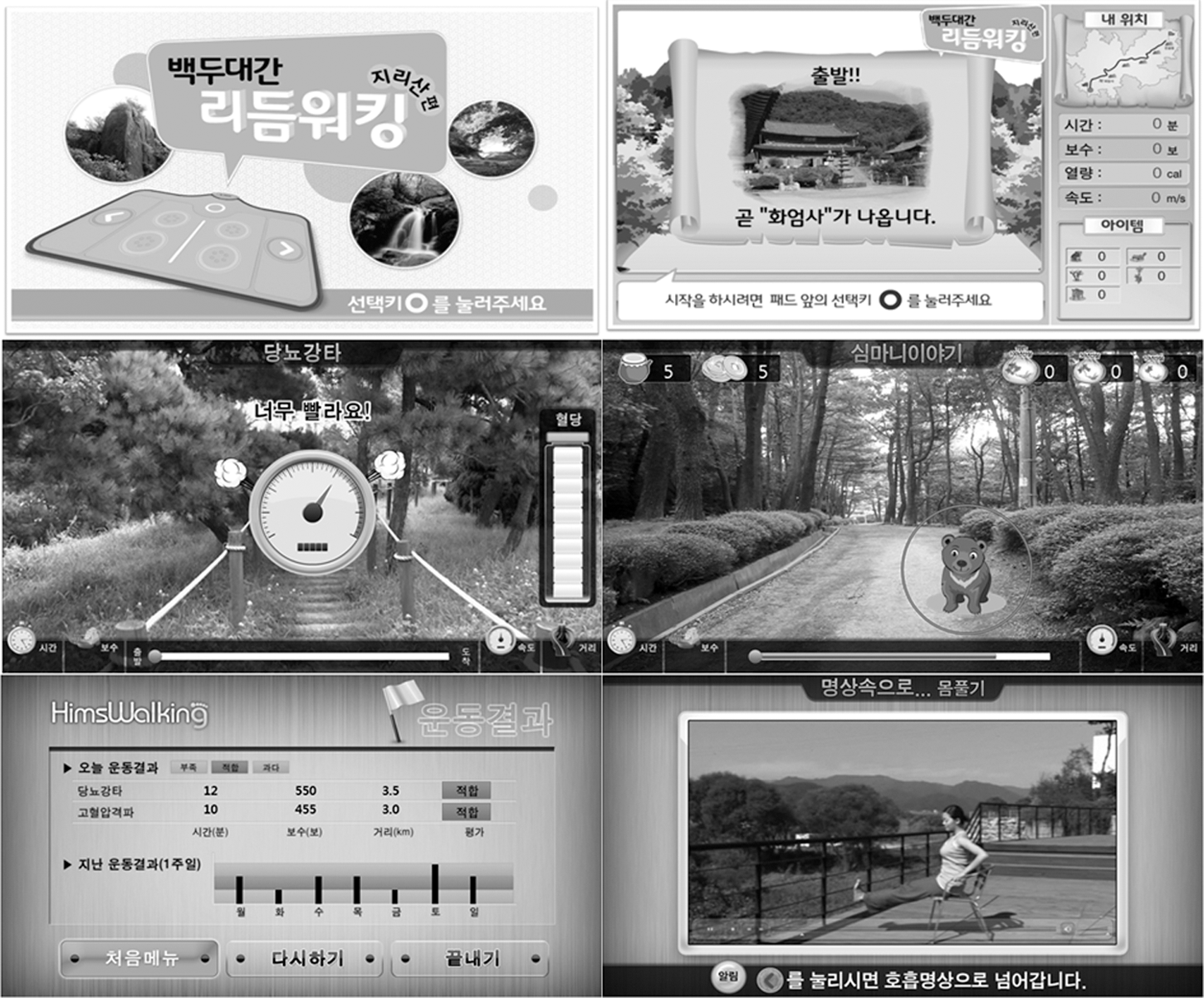
Software.
The background music includes real-life sound bites of birds, insects, water, and wind; as well, sound effects alert the user to the occurrence of special events. All exercises last approximately 10 min, although this may vary depending on the number of obstacles in the way or the walking speed of the user. The game ends when one arrives at one's destination or runs out of in-game energy. Energy is lost when an obstacle is ignored; the acquisition of wild ginseng, an in-game item, affects one's ranking in the game.
The animals that appear in the software are endangered animals in Korea; they would be unfamiliar to people born more recently and encountered only in a book. In addition, because the game story is based on an actual oral Korean folk tale, or traditional story, the content is familiar to adults, who can promote our culture to children. Also, background music includes real-life sound bites of birds, insects, water, and the wind, providing nostalgia for hometown life and a coziness that one cannot feel in a city. Users may compare the results of their exercise session with others' average scores and view their past scores through graphs. The “through meditation” feature helps users to stretch via instructional videos on meditation, breathing, and stretching exercises to facilitate continued exercise. Users can follow along with the video to stretch; they may also follow along with audio instructions to work on breathing exercises.
Procedures
An experiment targeting 100 male and female adults residing in Seoul was conducted to evaluate a customized health maintenance app that uses a healthcare walking system. Confirmation of subjects' intention to participate and available dates for the experiment were obtained on the subway in front of the Seoul City Hall and in front of Dongguk University. Subjects were asked to visit the laboratory at Dongguk University. In experiments on human test subjects, as in this study, an appropriate number of test samples was calculated based on the mean and dispersion of the samples. In addition, it was assumed that the data follow a normal distribution without excessive bias. To supplement this, it was necessary to collect data that could be applied in the analysis of social statistics. With the exception of two outliers, the data of 98 participants were statistically analyzed through SPSS version 15.0 software (SPSS, Inc., Chicago, IL).
The experiment consisted of 10 min of content use, and 98 participants conducted a total of 294 trials using the same set of content over three different screens: the desktop PC, personal mobile or tablet PC, and smart TV (Fig. 3). In order to discourage any learning effects, the order in which the devices were used for each participant was randomized. The total of 98 test subjects includes 48 males and 50 females. Of the total, 20 subjects were 20 years of age or below, 31 fell within the 21–40-year-old age group, 26 were in the 41–60-year-old age group, and 21 subjects were 61 years of age or over.

N-Screen application of content and test screen.
The N-Screen-based walking content was evaluated through the following three methods. First, a comparison analysis was conducted for the N-Screen-based walking content scores and standard exercise content scores. Participants who had experience with existing exercise-related content in any format were instructed to rate the quality of the N-Screen-based walking content, as well as their own personal satisfaction with the program, on a 5-point scale; a paired t test was later conducted with these data. Second, the usability of the smartphone, PC, and IPTV was evaluated to assess the screen-handling and visual effects involved in using the N-Screen-based content. Participants were instructed to rate the ease of handling N-Screen material, as well as N-Screen visual effects, on a 5-point scale; usability was analyzed by sex and age via t tests and analyses of variance. Finally, a correlational analysis was conducted between the level of regular exercise and user satisfaction. The survey questions are given in the Appendix.
Results and Discussion
Evaluation of Walking Content via Comparison Analysis with Regular Exercise Content
Reliability, effectiveness of exercise, and overall satisfaction with the quality and results of both N-Screen-based and regular exercise games were investigated. As shown in Table 1, the quality of existing exercise programs was perceived to be higher than that of the programs developed in this study, although this effect was not statistically significant. Existing content may have been perceived to be more complete, overall. On the other hand, trust in the results of the exercise, the effectiveness of the exercise, and overall satisfaction were all perceived to be higher for N-Screen-based walking content. Thus, in order to commercialize the program developed in this study, the content should be further developed to seem finished and complete.
User Satisfaction for Standard Exercise Games Versus User Satisfaction for the Developed Product
p<0.05, b p<0.01.
df, degrees of freedom.
Furthermore, as shown in Table 2, when user satisfaction was compared between the group that intended to use N-Screen-based walking content in the future and the group that did not, those who intended to use the program in the future found the quality of the contents to be excellent, trusted the results of the program more, and were more satisfied with the program than the group that did not intend to use it later on.
User Satisfaction for the Group Intending to Use the Developed Contents in the Future Versus User Satisfaction for the Group Not Intending to Use the Contents Later
p<0.05, b p<0.01.
As shown in the results presented in Tables 1 and 2, the focus should be on the completeness of the quality of the content in order to increase the use of the developed product and to commercialize the product.
Usability Evaluation of N-Screen Contents
To analyze whether there were differences in usability or satisfaction by sex or age according to the type of N-Screen services, a t test and an analysis of variance were conducted. Although the sex of the participant did not show a statistically significant difference, the age of the participants did, as shown in Table 3. The analysis of variance included Duncan's post hoc analysis. This study collected data using a 5-point Likert scale. In the comparison of the two groups, a t test was conducted while assuming the Likert scale was an ordinal scale. At the same time, a chi-squared test was conducted while assuming the Likert scale was a nominal scale. The results of the chi-squared analysis showed that there was not a significant difference in overall result values compared with the t test, and thus the t test was more appropriate for interpreting the results.
User Convenience by Age Range
Age groups with the same number represent groups that are statistically indistinguishable.
p<0.01.
PC, personal computer.
Scores for all variables showed differences across the four age ranges. Usability, in regard to smartphone, smart TV, and PC use, was found to be higher for younger participants. In terms of the devices, older participants found large-screen, smart TVs difficult to use but had no difficulty viewing the screen. On the other hand, for participants under 40 years of age, the size of the screen did not greatly affect their general satisfaction with the N-Screen-based program.
It may be concluded that, although it is effective to provide exercise content services to younger generations through a diverse range of devices, user satisfaction for older generations may decrease with diversity. More specifically, although older users may feel highly satisfied with watching a TV screen, they may have difficulty using the functions of the TV. Therefore, walking content requiring minimal operation should be developed for older users who expect to use the content frequently.
A method for handling the screen is more important than the screen size. Users were more satisfied with familiar screens or handling methods (PC or mobile). It was found that users are less satisfied with TV when they faced difficulties in manipulating the screen with a remote control, despite the familiarity with the screen. In the case of TV, the screen should be developed in a form that requires almost no screen-handling.
User Satisfaction by Level of Regular Exercise
The relationship between the level of regular exercise and user satisfaction was analyzed. The more a user was engaged in regular exercise, the less satisfied he or she was with N-Screen content in general. The correlation between the amount of regular exercise and the effect of the type of exercise is −0.345, which is statistically meaningful. Furthermore, the correlation between the amount of regular exercise and the degree of satisfaction with services is −0.223. In addition, the more a user was engaged in regular exercise, the less effective he or she found the exercise suggested by the N-Screen content. As the content developed in this study is walking content, users who are engaged in heavy exercise are less satisfied with the effectiveness of the exercise. This study's walking content should target older users. However, if the content incorporated simulated marathon conditions, where exercise intensity was increased and the time limit exceeded 10 min, or full-speed standing jumps were possible, the user base would likely increase.
Conclusions
The present study created content that closely simulates outdoor walking, making the user feel as if he or she is actually walking outside, which makes walking easy and fun, even at home. Moreover, the developed product was an original content-centered walking program paired with a compatible device and then evaluated on its performance.
The perceived quality, trust in the results, effectiveness of the exercise, and general user satisfaction with the walking content using the N-Screen services, which includes the use of mobile devices, PCs, and IPTV, were measured. In general, trust in the results, effectiveness of the exercise, and general satisfaction were found to be high among participants. The low perceived quality of the product may be due to the fact that it has not yet been developed for commercialization and thus suffers in quality in comparison with other existing exercise programs. In terms of the usability of N-Screen services, usability for smartphones, smart TV, and PC was found to be high for younger users; however, older users showed great satisfaction only with the TV screen, although they still found it difficult to use. Walking content meant for use by the elderly population should be simplified in development. The more a user was engaged in exercise on a regular basis, the less satisfied he or she was with the program, showing a negative correlation; thus, content with higher effectiveness of exercise should be developed for those who exercise often.
The present study may increase motivation for exercise through the development of a walking system based on the N-Screen program, which makes the most common and effective forms of exercise—walking and running—accessible indoors. The outcome of this study offers insight on how to develop content and which groups should be targeted for developers who seek to develop exercise content that apply to N-Screen technology. As a result, expensive household aerobic exercise equipment such as treadmills and exercise bikes can be functionally replaced, and the supply of high-quality health content is expected to contribute substantially to public health promotion.
Footnotes
Acknowledgments
This work was supported by the Ministry of Culture, Sports and Tourism, Korea, under the Sports Industry Technology R&D program supervised by the Korea Sports Promotion Foundation (grant APP01201204112008).
Disclosure Statement
No competing financial interests exist.