




Abstract
Introduction
Mobile applications (apps) are defined as software programs designed to run on mobile devices, particularly smartphones. 1 Health and fitness apps are abundant in the current market. A quick search in the Apple App Store 2 and Google Play 3 and yielded more than 32,700 health and fitness apps. Research suggests that approximately one in five smartphone owners has at least one health-related app. 4 Research of the uses, content, and impacts of health and fitness apps has begun to draw the attention of scholars. Most of these studies focus on the content and features of current health mobile apps. 5 –7 There is a paucity of studies focusing on health and fitness apps from the users' perspective. Compared with the adoption rate of apps in the categories of gaming (60%) or social networking (47%), 8 it is relatively low for health and fitness apps (19%). 9 From the perspective of health and fitness app developers as well as health educators or researchers, it is important to understand what predicts or prevents health app adoption and continued use so as to better design and promote them. Because their adoption could have significant public health implications, 10 our goal is to better understand how individuals perceive the use of health and fitness apps and their intention to continue to use these apps in the future.
A widely used theoretical framework to understand a user's adoption or continued use of a new technology is the Technology Acceptance Model (TAM), 11 which has been empirically tested in numerous technological contexts. 12 –14 The Unified Theory of Acceptance and Use of Technology (UTAUT) 15 Model was proposed with four constructs to assess people's technology acceptance: performance expectancy, social influence, effort expectancy, and facilitating conditions. The UTAUT Model was later extended to the Extended UTAUT (UTAUT2) Model by adding three additional constructs: hedonic motivation, price, and habit. Different from the previous technology acceptance models, which focus more on the organizational context, UTAUT2 emphasizes the consumer use context. Age, gender, and experience were proposed to moderate the relationship between the variables and behavioral intention. 16 We have adopted UTAUT2 in the present study of consumers' health and fitness app use and focus on the behavioral intention of continued use. The following section introduces each construct of our model (Fig. 1) based on UTAUT2.
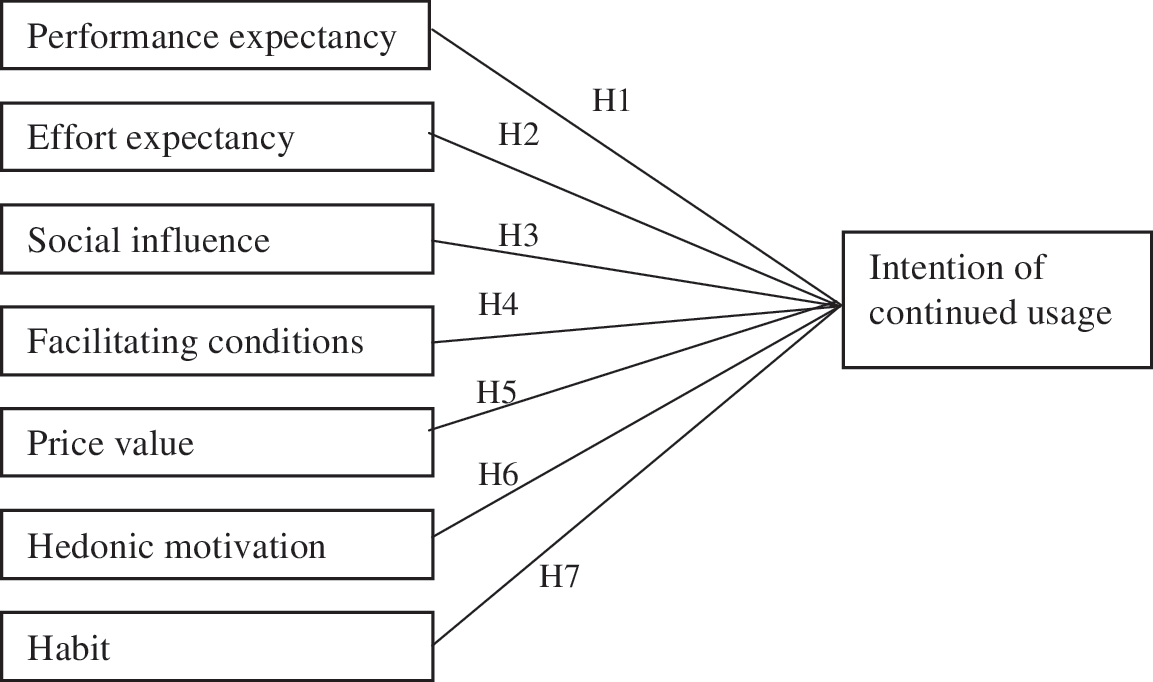
Conceptual framework.
Performance Expectancy
Performance expectancy is defined as the “degree to which using a technology will provide benefits to consumers in performing certain activities.” 16 It reflects the utilitarian value for users using the technology, which has been recognized in other technology acceptance models, such as perceived usefulness in the TAM, 11 extrinsic motivation in the Motivational Model, 17 and relative advantage in the Innovation Diffusion Theory (IDT). 18 The utilitarian benefits from using health and fitness apps include monitoring a health situation and managing and controlling particular health conditions. These health benefits can increase users' motivation to continue using this app.
• H1: Performance expectancy is positively associated with users' intention of continued use of a health and fitness app.
Effort Expectancy
Effort expectancy is “the degree of ease associated with consumers' use of technology”—a concept that has been supported by other technology acceptance models. 16 The TAM 11 described it as perceived easiness of use, and the IDT 18 described it as ease of use. Health and fitness apps are designed to make it simple and convenient for users to manage health-related behaviors. The more effort users need to devote to an app, the less likely they will continue to use it over time.
• H2: Effort expectancy is positively associated with users' intention of continued use of a health and fitness app.
Social Influence
Social influence refers to the degree to which individuals perceive that others important to them believe they should use a technology. 15 The construct of social influence in the UTAUT Model was adopted from the Theory of Planned Behavior of Ajzen, 19 which examined the influence of subjective social norms on behavioral intention. The UTAUT Model tested and found that social influence had a significant influence on an individual's behavioral intention. Mobile apps make it convenient for users to connect with people who they think are important to them, which strengthens their social influence in this context.
• H3: Social influence is positively associated with users' intention of continued use of a health and fitness app.
Facilitating Conditions
Venkatesh et al. 16 considered the concept of facilitating conditions to be similar to perceived behavioral control in the Theory of Planned Behavior. Facilitating conditions are explained as factors in the environment that either facilitate or impede acceptance of technology. Facilitating conditions include many aspects that can influence the actual behavior directly, such as the training or knowledge individuals obtained. 20 Some health and fitness apps may require more knowledge or resources from users than the others. As a result, knowledge of how to use mobile apps can also influence users' continued usage. Users with better knowledge of how to use the apps are more likely to keep using them.
• H4: Facilitating conditions are positively associated with users' intention of continued use of a health and fitness app.
Hedonic Motivation
Hedonic motivation is defined as “the fun or pleasure derived from using a technology.” 16 It has been shown that hedonic motivation (enjoyment and playfulness) is an important factor in technology acceptance. 17,21,22 In terms of health and fitness apps, although they are not designed purely for hedonic motivations, many of them also include some entertaining features in order to keep users involved and engaged. The designs of some apps even include “gamification”—the practice of using game-like features or mechanics to make the interfaces more appealing and entertaining. 23 Several mobile apps used for health promotion purposes were found to use entertaining features as a promotion strategy. 24
• H5: Hedonic motivation is positively associated with users' intention of continued use of a health and fitness app.
Price Value
The price value concept in UTAUT2 is based on the concept of product value. 16 Price value is defined as consumers' cognitive trade-off between the perceived benefits of the applications and the monetary cost for using them. 16,25 Three types of price schemes exist in the current app market: free, paid, and freemium. Free apps are free to download and use; paid apps have to be paid for by the user, before downloading. Freemium apps provide an opportunity for consumers to try an app for free before they decide to buy additional features. 26 Consumers expect higher quality or better service if they pay more for it. 27 Even for free apps that cost no money, consumers expect benefit from the app to continue to use it because otherwise the app is taking storage space on the smartphone that could have been used for other apps that bring net benefit.
• H6: Price value is positively associated with users' intention of continued use of a health and fitness app.
Habit
Habit is conceptualized as self-reported perception of automatically engaging in a certain behavior, which has been found to be a significant predictor of mobile Internet use. 16 In the context of mobile communication technology adoption, the stage of habitualization was found to strongly affect the expected outcome and the habit strength. 28 Smartphone habitualization has reached a very high level in the United States. The data from the Pew Research Internet Project Survey showed that mobile apps are becoming part of many smartphone users' daily habit, and 38% of health and fitness app users use apps to track their exercise, 31% to monitor diets, and 12% to manage their weight. 4
• H7: Habit is positively associated with the intention of continued use of a health and fitness app.
Materials and Methods
Participants
Participants were students recruited from the communication college at a major Midwestern university in the United States through a subject pool system for extra course credit. In total, 317 students who have used health and fitness apps participated in this study. Participants' ages ranged from 18 to 36 years, with an average age of 21 years, 74% were white, 78.9% were female, and the average annual total family income was between $100,000 and $124,999. On average, participants had 31–40 apps on their smartphone and had used a smartphone for 60 months. On a weekly basis, participants used 11–15 apps, on average. On a daily basis, participants spent 151–180 minutes on average using the mobile phone. Participants reported that they use health and fitness apps several times a week on average. On average, they paid $1.38 for an app.
Procedure
Participants completed a survey hosted through the online survey platform Qualtrics. After individuals who did not have a smartphone were screened out, participants were asked to answer questions about their general mobile app usage. Participants were asked to name one health and fitness app they used most frequently and its usage frequency. Then they were asked to evaluate the health and fitness app they just named with the seven factors in the UTAUT2 model. They were also asked about behavioral intention to continue using this app. Demographic questions were asked in the end.
Measures
The measurements were adapted from Venkatsh et al. 16 All items were measured on a 7-point Likert-type scale, ranging from 1=strongly disagree to 7=strongly agree. However, two items for facilitating conditions were eliminated during the model development process due to low standardized loadings. Table 1 summarized the details of the measures.
Estimates of Measurement Model, Cronbach's Alpha, Means, and Standard Deviations
SD, standard deviation; SE, standard error.
Analysis
We used structural equation modeling to test the proposed relationships among the variables. Maximum likelihood was used for parameter estimation.
Results
Model Fit
The model fit indexes were as follows: chi-squared was 606.54, degrees of freedom was 224, and the p value associated with the chi-squared test was 0.00. The comparative fit index was 0.94, and the root mean square error of approximation was 0.07. The fit indexes suggested that the model fitted the data adequately and was comparable to other mobile apps studies that adopted the UTAUT2 model. 29,30 We also compared with other UTAUT2-based studies in health-related technology adoption context. The current model explained 63% of the variance (R 2=0.63), which was comparable to the adoption study in the telemedicine domain. 31
UTAUT2 16 suggests that gender, age, and experience significantly moderate the relationship among facilitating conditions, hedonic motivations, price value, habit, and behavioral intention. We explored these moderators in our model and found no statistically significant moderation effects. Therefore, these potential moderating variables were not included in our model (Fig. 1).
Measurement Model
The Cronbach's alpha for each construct was calculated, and all of the alpha values were above 0.8. All the loadings of the measurement model were statistically significant (Table 1). The covariances between the residuals of the predictors were also estimated (Tables 2 and 3).
Covariance Matrix Estimates
p<0.05, b p<0.01, c p<0.001.
Correlation Matrix Estimates
p<0.05, b p<0.01, c p<0.001.
Hypotheses Testing
The results supported the first hypothesis (γ=0.38, p<0.05): performance expectancy was an antecedent to behavioral intention of continued use (Table 4). The second, third, and fourth hypotheses were not supported by the data. Although effort expectancy, social influence, and facilitating conditions were all positively associated with behavioral intention, our findings indicated that the relationships were not statistically significant. Participants reported very high level of effort expectancy, with a mean of 6.09 out of 7, and the standard deviation was small (0.79) compared with other variables. This ceiling effect might be part of the reason why we did not detect significant effect of effort expectancy on behavior intention. Also, the effect size of effort expectancy was small, as the standardized coefficient was only 0.022. 32 The standard deviations of social influence and facilitating conditions were not too small (1.33 and 0.91, respectively). However, their effect sizes were small (0.038 for social influence and 0.10 for facilitating conditions), which might explain why we were unable to detect the effects of the two variables given the sample size of our study.
Estimates of the Structural Regression Model
p<0.05, b p<0.01, c p<0.001.
SE, standard error.
The fifth, sixth and seventh hypotheses were supported by the results. Specifically, hedonic motivation (γ=0.13, p<0.05), price value (γ=0.12, p<0.05), and habit (γ=0.20, p<0.05) were positively associated with individuals' intention of continued use of the health and fitness apps. These findings suggested that the UTAUT2 Model was partially suitable for the health and fitness app adoption scenario.
Discussion
The purpose of our study was to gauge determinants for continued use of health and fitness apps based on the UTAUT2 model. 16 The results showed some factors in UTAUT2 had significant influence on continued use of health and fitness apps, yet some were unexpectedly not related to continued use.
As expected, performance expectancy did positively predict an individual's intention of continued use of a health and fitness app. This finding is consistent with the literature in technology use contexts, such as TAM, 11 TAM2, 17 and IDT. 18
Hedonic motivation had a significant effect on technology acceptance. Our finding in the context of health and fitness app use was consistent with previous research. 17,21,22 The results suggested that even for technologies that are primarily used for utilitarian purposes, in this case health management, fun and interesting features are important to encourage continued use. The participants in our study were young adults who found hedonic value to be important. This finding has implications for health educators, researchers, and app designers that when designing or implementing a health and fitness app (e.g., physical activity app) for the younger audience, the element of game and fun should not be overlooked.
The price of an app has been described as a functional value that plays a role in an individual's decision to use a mobile app. 33 This is also clearly indicated in our results, which showed that price value had a significant impact on a person's intention to continue using a health and fitness app. Although many apps are free, it does not mean that people will always continue to use it, especially if it does not bring value. On the other hand, people may be willing to pay for an app if they can receive value from it.
Falling into a regular pattern or routine causes a person to do certain things without consciously thinking about them. The same can be applied to technology use. 34 The integration of smartphones and apps into people's daily activities forms regular habits. This habitual usage, as our results show, affects one's intention to continue using a health and fitness app. This finding stresses the importance of apps' features that facilitate habitual use. This is probably even more important for health and fitness apps that mostly are designed to help manage habitual health-related behaviors.
Effort expectancy, or the amount of effort a person anticipates having to put into using a particular technology, has been shown to have an effect on a person's intention to use technology. 16 Our results, however, indicated that this construct did not play a significant enough role to affect a person's intention of continued use of a health and fitness app. This might be due to the advancement of smartphone interfaces in terms of usability, which reduces the amount of effort people might need to put in for usage. Besides this, our participants were college-aged communication students, who are comfortable with such technology. The ceiling effect, as indicated by the high mean value and small variance in the sample, further supported our argument. Facilitating conditions also did not show a significant effect on a person's intention to continue using an app. The reason for this might be similar to those of effort expectancy.
Finally, social influence was not found to keep to behavioral intent. Although peer influence seems like an important factor in determining what people use, the UTAUT2 Model uses subjective norms 33 as an influencing factor (i.e., if people suppose using a particular technology [or app, in this case] is expected by those they consider significant, then they would use it too). However, the lack of significance seen in our results could be indicative of descriptive norms, 35 where their app usage might depend on what an individual perceives to be the actual norm. Future research needs to further explore the different types of social norms and social influences in the context of technology of adoption.
We do acknowledge that our study has a few limitations. First, the current study used college students as the sample, which also had a relatively high family income. Therefore, the findings may not represent the general public, including older adults or people with chronic diseases, who might use health apps differently from our sample. Our sample also included more females than males. However, as we only included participants who had a health and fitness app, this gender gap might be indicative of the user population of health and fitness apps. Second, we only focused on the continued use of a health and fitness apps. Future research can also examine the predictors of the intention to use a new health and fitness app or the actual use. Third, this study only pretested the adapted measures with several participants. Also, the measurement instrument was not adapted by adding heath-specific contexts or wording. Future studies should consider modifying the measures for facilitating condition and social influence with context- and group-specific information followed up by a pretest.
In conclusion, the result of our study provides empirical evidence for the UTAUT2 Model in the health and fitness app use context. This information can be used by app creators to focus more on the factors that actually affect an individual's decision to continue to use an app. Focusing on the significant constructs that we found, they could create apps that may provide users with enjoyment while using it, live up to the expectations the users have of it, have a good price value, and could be incorporated into their daily routine so as to form a habit. The findings can also help health professionals make decisions on which apps to recommend to their clients in order to pursue or maintain a healthy lifestyle. For instance, health professionals do not necessarily only recommend free apps. Paid apps with value will be acceptable. Although the model is for serious health purposes, fun apps should be recommended. Health professionals should understand that habit is important to continued use and thus should encourage clients to include health apps into their daily routine to form a habit for continued use.
Footnotes
Disclosure Statement
No competing financial interests exist.