




Abstract
Introduction
The growing need for psychiatric care is currently being exacerbated by an aging population, an increase in numbers of veterans requiring psychiatric support in the aftermath of military service, the influx of patients from the Patient Protection and Affordable Care Act, and the concentration of specialists in urban settings with more limited access in rural and less desirable areas. 1 –3 The United States and the world are facing a shortage of psychiatrists and allied mental health professionals. 4,5 There are an estimated 80 million Americans without adequate access to mental health professionals. 6 A majority (55%) of the nation's 3,100 counties have no psychiatrists, psychologists, or social workers, 2 and the numbers of psychologists and social workers are far greater than that of psychiatrists in the United States (11 psychiatrists per 100,000 population). 7 Only 65% of adults with a serious mental illness in 2012 received any treatment, with the most common being a prescription. 7 Factoring in moderate and mild mental illness, the majority of adults received no mental health treatment in 2012; the numbers are even smaller among children, with only 20% of those receiving treatment. 7 The Association of American Medical Colleges estimates that the country needs 2,600 more psychiatrists to eliminate the 3,900 mental health professional shortage areas. 4 The shortage of psychiatrists is expected to grow with the aging population, with 59% of practitioners found to be over the age of 55 years. 6 Furthermore, psychiatry has the highest annual turnover rate of any medical specialty at 12.5%. 6 Figure 1 illustrates the shortage of mental health clinicians in the United States.

Mental Health Professional Shortage Areas (HPSAs) in the United States by priority scores. 23 Reproduced with permission from the Rural Assistance Center.
Telepsychiatry, in the form of videoconferencing, has shown great promise in redressing access and workforce distribution issues. 8 However, telepsychiatry alone cannot resolve the psychiatric workforce shortage. Locum tenens, from the French “holding place,” is the practice of healthcare professionals being paid to take over the position of another professional, especially where the need justifies the often higher fee. Locum tenens has been the more traditional solution in the field to address psychiatric workforce shortages.
We wanted to review and compare the current trends in locum tenens and telepsychiatry to address psychiatric workforce needs with a focus on the role and implications for the field of telepsychiatry in this area.
Materials and Methods
A search was conducted of the literature and relevant Web sites, including PubMed, Google Scholar, and
Results
Internet searches revealed over 120 locum tenens companies in the United States. The market for placing locum tenens psychiatrists is dominated by five companies: Staff Care, CompHealth,
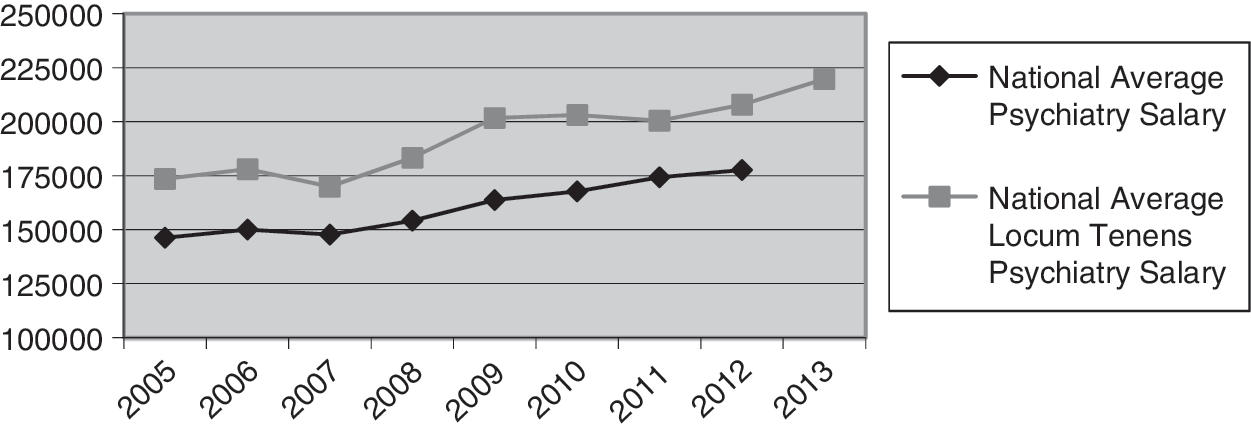
The one published article on the quality of locum tenens psychiatrists showed that locum tenens psychiatrists provided slightly lower levels of value to psychiatric treatment teams compared with non–locum tenens psychiatrists. 11 Comparatively, articles on the quality of telepsychiatric care have generally found it to be as effective as face-to-face care. 8,12 There are potential cost and coordination advantages to telepsychiatry. 13,14
There are an estimated 600 companies in the newer and less organized telepsychiatry industry. 15 In 2013 a small percentage (13.1%) of U.S. healthcare facilities used telepsychiatry 6 (15.4% in 2010 in another survey 7 ). Broader data on the use of telemedicine do show a trend of increasing use, with 43.5% of healthcare facilities using telemedicine in 2013. 6 In 2014, Medicaid in 43 states and private insurance in 19 states were paying for telepsychiatry as a result of state legal requirements. 16 Locum tenens psychiatric recruiters who were interviewed reported that telepsychiatry is, by far, the fastest growing part of their companies. They and telepsychiatry company employees cited report the ability to work from home being one of the number one draws for telepsychiatry positions. The fill rate for telepsychiatry positions at one locum tenens company was 89%, much higher than for face-to-face locum tenens psychiatry. When the recruiters are unable to fill locum tenens psychiatry positions, they often help the facilities set up telepsychiatry services (phone interview with J. Brocksmith). One Web-based employment site listed the average salary for a telepsychiatrist in 2014 as $113,000, 17 well below the $182,660 that the average psychiatrist in the United States made in 2013. 18 Although it is unclear, the reason for this may be an artifact of more part-time work by those who choose the work because of the convenience of schedule and home location. 19
Conclusions
Both telepsychiatry and locum tenens psychiatry are increasingly playing a role in addressing the distribution and access issues of regional and localized shortages of psychiatrists in the United States. Although information in these industries is protected for proprietary reasons, the data we have found do show increasing use and increasing demand, as would be expected given the increasing shortage of psychiatrists. Both are viable alternatives to face-to-face psychiatry, as the limited academic data available suggest that although locum tenens psychiatry has been found to be slightly inferior to routine psychiatric care, telepsychiatry has generally been found to be equivalent to face-to-face care.
The overall number of psychiatrists in the United States is not likely to increase unless the number of residency positions were to increase significantly (from 2005 to 2010, the number of psychiatric residency positions did increase somewhat, from 1,286 to 1,395). 20 Allied health professionals, such as physicians assistants and nurse practitioners, may play an increasing role in prescribing for mental health conditions; however, training programs for them in psychiatry are limited, and they generally require supervision from a physician to prescribe. 2
Although more has to be done to address the overall shortage of psychiatrists in the United States, locum tenens psychiatry and telepsychiatry are two established and growing tools that will see widespread adoption as shortages of physicians worsens. Telepsychiatry positions are often filled by locum tenens psychiatrists, and a greater proportion of psychiatry positions in the future may be expected to be locum tenens, telepsychiatry, or both. Telepsychiatry can be used as a care force multiplier by increasing the accessibility to supervision of allied care professionals as well as by the implementation of emerging models of telepsychiatry such as store-and-forward telepsychiatry and virtually integrated behavioral healthcare through which team-based care increases the number of patients for whom a psychiatrist can provide oversight. 21,22
Preliminary data suggest that telepsychiatry may also have some advantages in terms of lower cost than locum tenens and more sustainable long-term services. Ultimately, healthcare reform and marketplace dynamics will continue to shape these evolving models of psychiatric workforce coverage. If current trends continue, systems that demand face-to-face psychiatry may find themselves paying more to locum tenens companies to recruit from among a dwindling pool of psychiatrists, whereas others may employ a lesser number of psychiatrists more efficiently by using telepsychiatry.
Footnotes
Acknowledgments
We would like to acknowledge the support of the Psychiatry Residency Program at the University of Colorado, Denver, as well as the University of Colorado Depression Center.
Disclosure Statement
No competing financial interests exist.