




Abstract
Introduction
The process of blood donation and transfusion is multifaceted, involving the collection of blood, labeling of the product, testing components for infectious disease, providing the blood for transfusion purposes, cross-matching the blood with the intended recipient, and finally the transfusion of the blood product itself. 1 A blood bank system can be described as having two entities. These include independent blood banks, which collect, store, and distribute blood products, as well as ambulatory and hospital-based blood banks, which are involved with the transfusion of blood products. The goal of each setup is the same: to supply blood products and components to hospitals for transfusion into patients. 2 Given the fact that blood is both a valuable commodity, stemming from its life-saving properties, and a highly corruptible product, it goes without saying that blood and blood components need to be regulated and safeguarded during collection and administration of transfusions. The entire process must be monitored and documented to ensure blood product viability and to avoid potential pitfalls in the process such as errors in blood typing and outdating of products. 3
Safe transfusion of blood products is key to patient safety. Reducing errors in the blood collection and distribution process is vital to improving the quality and success rate of healthcare delivery. 4 Although most people would think the highest risk is the potential exposure to infectious bacterial and viral agents, the most dangerous condition occurs from mistransfusion, which is an incompatibility between the blood product and the individual receiving the blood. 5 It has been estimated that 1 in 14,000 transfusions involved ABO incompatibility and that transfusion to the wrong recipient accounted for nearly 40% of those errors. 6
The supply chain is defined as including all parts of a system that are either directly or indirectly responsible for providing a service or product to a customer. This includes but is not limited to manufacturers, suppliers, transportation, warehouses or other forms of storage, retailers, and consumers of the product themselves. This definition applies as well to the supply chain that exists in the blood bank and healthcare relationship. 7
There are various factors that can lead to errors in the blood bank supply chain. Human error, such as incorrect blood typing or cross-matching of donor units with recipients, can occur. In a 10-year study covering the state of New York that ended in 2000, it was documented that 14% of ABO-incompatible transfusions were due to sample collection errors. 6 According to Davis et al., 8 blood bags may be improperly or incorrectly labeled during any of the various stages in the supply chain due to similar-sounding patient names, misidentification with regard to trauma or infant patient populations, understaffing of blood banks, or lost or misplaced labels.
The results of an international study published in 2007 detailed how the current blood labeling system is not as effective as it could be with regard to blood product storage and subsequent transfusion. 9 The most common form of identification used today in regard to blood storage is the ISBT 128 barcode technology, an internationally standardized system for identification, labeling, and processing of human blood, tissue, and cellular therapy products. 10 This technology has existed for some time and has demonstrated a reduction in blood management and supply chain problems. However, errors still exist due to limitations of the technology, such as the need for close proximity for scanning and tracking of the labeled product. This is one reason that a more effective means of ensuring the success of the blood bank supply chain should be investigated. 8
Radiofrequency identification (RFID) can be viewed as the next technological step in product scanning technology. 11 An RFID system has three components, consisting of the RFID tag on the desired product, the reader that scans the tags, and a computer database that allows the information on the tags to be disseminated. 12 RFID tags consist of three components: a self-contained circuit that stores the information in the tag, an antenna that is responsible for information transmission, and the packaging that holds all components of the tag. 13 There are three main versions of RFID tags: active (which contains an internal battery that lasts for 3–5 years and emits a signal to alert the user to replace the battery when it is dying), passive (no battery, powered by the reader itself), and semi-passive (has the capability to detect environmental fluctuations). The last category is very important in regard to blood bank supply chain integrity, as the product must be kept at a specific temperature. 11
RFID is a more advanced and effective tool in product management than the barcode system in several ways. RFID is not hindered by the need to be physically near the product being scanned and is capable of reading more than one product at a time. 14 In addition, a RFID chip has the ability to be automated and store more information about the blood product such as temperature, expiration date, and time of collection. 15 The improvements in efficiency that the RFID system offers in comparison with barcode systems could be beneficial to the supply chain in the blood bank system, with increased safety, quality, and efficiency in the delivery of blood to patients. RFID utilization could help alleviate vital issues such as blood type errors and outdating, along with the subsequent financial costs associated with these problems. 3
The purpose of this research article was to analyze and determine the benefits and barriers that exist in the utilization of RFID technology to improve the efficiency and safety in the blood bank supply chain, as measured by increased control of the supply chain, lower financial overhead, and increased patient safety and satisfaction.
Materials and Methods
The methodology of this qualitative study was a literature review and review of case studies. To determine the benefits and barriers of implementing RFID in the blood bank supply chain, the literature review followed a systematic approach. The research method, illustrated by Figure 1, is an adaptation of the conceptual framework by Yao et al., 16 which shows the benefits and barriers to implementing RFID in the blood bank supply chain. The use of this framework is appropriate because it states the process of RFID utilization. It is similar to any project development in that the process is circular: it begins with identification and definition of the problem(s) and includes development of possible solutions to the problem(s). In this case, the solution is RFID usage in blood bank management. Through process assessment, the need for RFID is examined, and the technology is adopted as seen feasible. Once adopted, the benefits and barriers of the technology can more easily be identified, and barriers can be addressed (Fig. 1). Furthermore, this conceptual approach has been successfully replicated in previous studies, including adoption of electronic prescribing, tele-intensive care unit, and RFID, thus supporting its internal validity. 17 –20
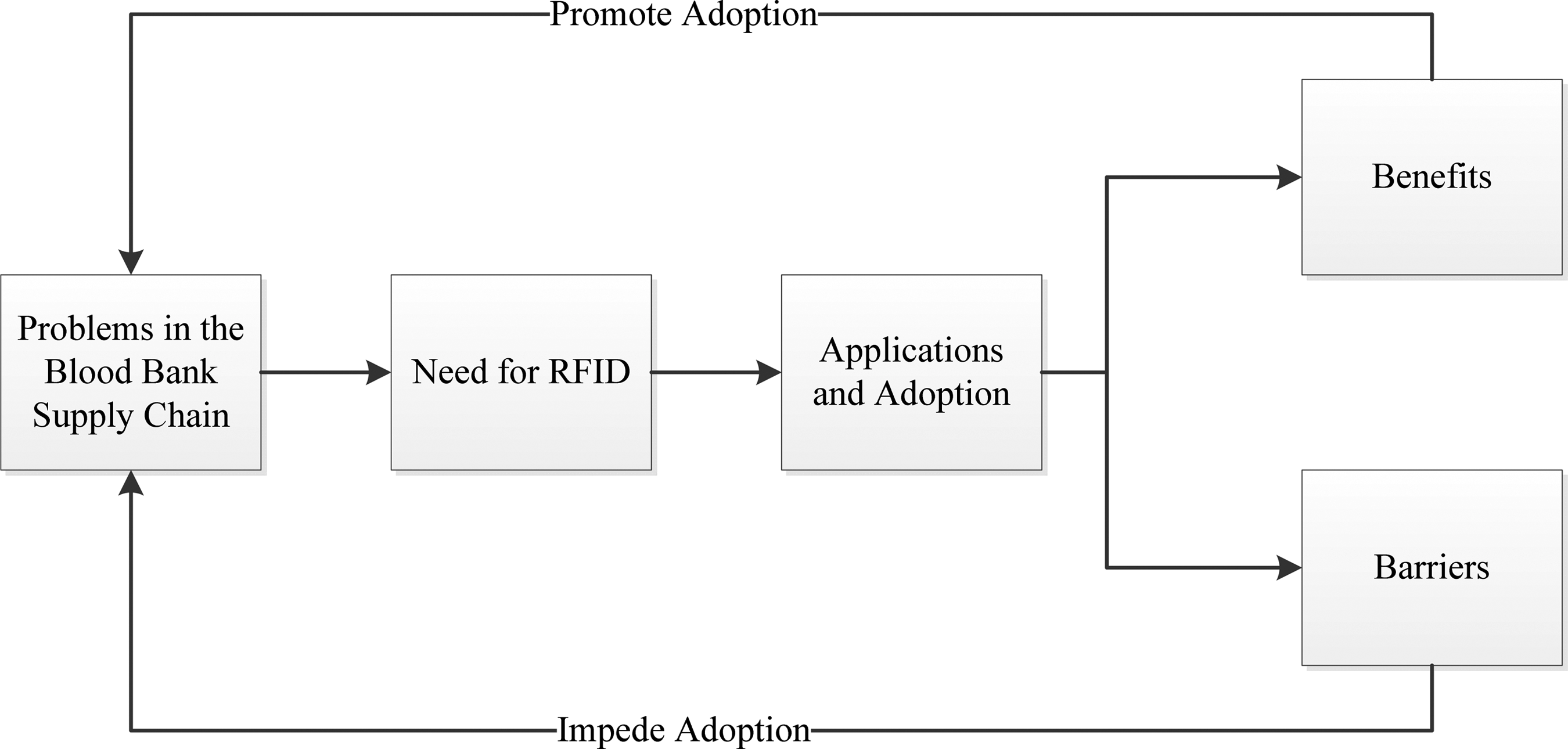
Conceptual research framework. RFID, radiofrequency identification. Adapted from Yao et al. 16
The study was conducted in three stages: (1) identifying literature and collecting data (2) analyzing and evaluating the literature, and (3) categorizing the literature found.
Step 1: Literature Identification and Collection
The key phrases “RFID” OR “supply chain” OR “perishable supply chain” and “blood bank” OR “transfusion” OR “blood management” OR “benefits” OR “barriers” were searched through online scholarly databases. Databases searched included EBSCOhost, PubMed, Academic Search Premier, ProQuest Nursing, RFID Journal, Google Scholar, and Google. The searches revealed multiple academic journals, as well as organizations such as the American Red Cross and the Institute of Electrical and Electronics Engineers consortium, which provides statistics on the blood bank supply chain and RFID use.
Step 2: Literature Analysis
The literature review generated 65 initial sources, and only 56 were selected based on the uses of RFID and the underlying benefits and barriers. Because RFID has only been used relatively recently in supply chains, searches were limited to sources published from 2000 to 2014 in the English language. Articles were then thoroughly researched and deemed useful if they presented the benefits or barriers to using RFID. Given the technology- and enterprise-oriented nature of the present study, literature was selected for review based on technological, organizational, and financial impacts. Articles were also considered useful if they contained information about the current status of blood banks and their supply chains. The literature search was performed by R.H., T.H., S.D., and P.M. and validated by A.C., who acted as second reader and also verified that the references met the research study inclusion criteria.
Step 3: Literature Categorization
Abstracts of the articles were reviewed first in order to determine if they would answer the research criteria. If the articles were deemed to satisfy the criteria, they were then analyzed, and categories were created based on the findings. The findings are presented in the following results and categorized under the major subheadings of “Blood Bank Supply Chain Overview,” “Benefits of Adoption,” and “Barriers to Adoption” of implementing RFID into the blood bank supply chain.
Results
Blood Bank Supply Chain Overview
Supply chains for perishable products, such as blood, pose specific and unique challenges. By definition, a perishable product has a limited life span for which it can be used, after which the product must be discarded. 21
Immense demand poses another problem for the blood bank supply chain. According to the American Red Cross, there is a need for 39,000 donations every day in the United States, and, on average, blood center inventories are adequate to meet only a 2-day demand for products. 22 Due to this short shelf-life and limited donations, it is essential to establish the most efficient and practical supply chain for blood product delivery. 21 The supply chain with regard to blood bank management can be viewed like any other just-in-time method supply chain. 23 According to Sabbaghi and Vaidyanathan, 24 there are eight key processes that make up the supply chain management process: customer relationship management, customer service management, demand management, order fulfillment management, manufacturing flow management, supplier relationship management, product development and commercialization, and returns management. According to the same authors, four of these processes have been identified as areas where RFID could play a critical role: demand management, order fulfillment, manufacturing flow management, and return management.
Table 1 shows the results of pre- and posttest pilot studies using RFID systems in the supply chain and healthcare facilities practicing transfusion medicine.
Results of Tests and Pilots Conducted on the Implementation and Utilization of Radiofrequency Identification Systems in Transfusion Medicine
RFID, radiofrequency identification.
In general, outcomes of the studies researched revealed positive outcomes. The top results showed an increase of 63% in efficiency and a reduction in lost product by up to 87%. 30 Return on investment in one study was found to be between 2 and 5 years, with an increase in productivity of 10%. 32 Inventory savings were significant, with one pilot program saving $300,000 by using RFID to monitor inventories. 28 Chang et al. 26 also found that RFID implementation in a blood center decreased misidentification of blood products by 19% (Table 1).
Benefits of Adoption
As illustrated in Table 2, there are numerous benefits to using RFID. Wicks et al. 33 stated that use of RFID allows for assurance that blood products are stored and transported under acceptable conditions throughout the supply chain. Through the use of temperature sensors, RFID can be used to constantly monitor product storage temperature as required by blood bank accrediting bodies. 8 The College of American Pathologists also recognized that RFID tags allow for positive patient and product identification, thereby decreasing the risk of transfusion to the wrong patient or transfusion of incompatible units. 34 Automation related to the use of RFID also increases efficiency by allowing for automated product receipt/transfer and inventory management. 10 Other benefits include the ability to read multiple tags at once, tags that are able to store more information per chip than a barcode, and scanners that have the ability to instantly identify and capture data. 35
Benefits of Implementing Radiofrequency Identification in the Blood Bank Supply Chain
RFID, radiofrequency identification.
There are many benefits to using RFID for blood bank product inventory management. Adopting RFID can create current and accurate information in regard to the inventory of finished goods, work-in-progress, and in-transit stages with reliable dates. 39 RFID can deliver timely data that would aid in efficient distribution of blood. 24 A key benefit to using RFID is the ability to track a single item through the entire supply chain. RFID has allowed for the reading of multiple tags at once and does not require line of sight to do so. 40 Those RFID characteristics lead to increase automation, consolidated operations, and reduced logistical mistakes. 39 Blood collection centers would be the same as the manufacturing aspect of the supply chain. Using RFID increases the velocity and visibility of products within the blood supply chain. 39 Using RFID in the reverse logistics of the blood supply chain would also be beneficial, allowing every unit of blood to be traced back to time of donation and streamlining facility product return management by using electronic security markers. 24
Another primary purpose of RFID in blood bank management would be to reduce waste and supply shortages. In 2006, 1,276,000 units of blood out of 15,688,000 were reported as being outdated, and the average cost of disposing of “red bag” waste was $600/ton as reported by Waste Management, Inc. 23,41 Although the benefits of RFID are numerous, there are several factors restricting the use of RFID in the healthcare setting.
Barriers to Adoption
Table 3 lists literature reviews that illustrate potential barriers to implementing RFID. The initial issue to overcome has been the price of implementing an RFID system. 10 Estimated costs for implementing RFID range from $20,000 dollars for a small installation to over $1 million dollars for a large organization. 45 Furthermore, the cost of tags that may or may not be reusable can average about 10 cents versus the normal 3 cents for a standard bar code. 33 There is also a clear need for creating standardization in RFID tagging, including standards for tag placement, types of tags used, and the type of information stored on tags, as well as alleviating the concern of interference with current medical equipment. 45 Due to the wireless nature of RFID technology, there are also concerns with personal health information being intercepted or misused. 51 One of the most prominent barriers is that there is no ability to accurately determine if there will be a positive return on the RFID system investment, or how long it will take to see the return. 49 The American Association of Blood Banks in 2011 also expressed safety concerns regarding the biochemical and morphological changes, if any, that RFID tags may have on blood products. 52
Barriers to Implementing Radiofrequency Identification in the Blood Bank Supply Chain
RFID, radiofrequency identification; ROI, return on investment.
Discussion
The evidence shows that there is room for improvement in the blood bank supply chain and product distribution to patients. With the American Red Cross providing over 40% of the nation's blood supply, the threat of only having a 2-day supply of blood at any given moment is a crucial consideration. In addition, with 1,276,000 out of 15,688,000 blood units reported as unusable, it is obvious that transport and storage issues within the blood bank supply chain system must be addressed. Although metadata and analytics may be used to address the issues surrounding transport and storage of blood units, using RFID to assist with automation of the supply chain, decreasing human error, and increasing speed and efficiency can help increase the available supply to distributors, while also decreasing outdated products, and avoiding the time lag involved in analytic processes. Additionally, for every ton of waste that is reduced, it will save $600 in disposal fees.
RFID possesses positive characteristics for patient care and employee efficiency. In pilot studies RFID has shown the ability to increase efficiency and productivity in the healthcare facilities administering transfusion services. Healthcare organizations that use RFID have access to accurate and timely patient information. This allows these healthcare organizations to decrease the rate of misidentified patients ranging from 3% to 10%, and because mistransfusion is the number 1 cause of problems observed in transfusion services, any increase in safety should be welcomed.
It seems that the initial startup and maintenance cost of implementing RFID is the main deterrent keeping the healthcare sector from embracing RFID. Current financial obligations including operating costs required from mandates such as “Meaningful Use” with the needed adoption of expensive technology like electronic medical record/electronic health record, computerized physician order entry, and electronic prescribing, ordered by the Affordable Care Act and the Health Information Technology for Economic and Clinical Health (HITECH) Act and the implementation of the ICD 10 in October 2015, have delayed additional resources from being spent in RFID. 19,53 –55 The cost of implementation of RFID systems is significant and requires strategic planning to ensure adequate return on investment. An additional barrier for implementing RFID is privacy and security. Loading an RFID tag with patient information potentially allows that information to be stolen or misused. However, there are measures to secure the data, but encryption adds additional costs. In order to reach the full potential for an RFID system, blood bank centers and healthcare organization need to be willing to spend the required funds and to use the resources necessary to create and maintain an RFID system.
This study was limited due to the restrictions in the search strategy used, such as the number of databases accessed. Publication and researcher bias have also affected the value and sources used for the inquiry. Although RFID is not a new technology, only a few facilities have implemented an RFID system due to cost constraints and the need to address more immediate technology changes, thus limiting the amount of useful searchable publications. For the intent of this study, an exhaustive and comprehensive review was not feasible due to the abundance of studies of heterogeneous quality. Future research such as a meta-analysis should be conducted to assess more precisely the effects (i.e., cost and savings).
Practical Implications/Recommendations
In several ways, the practical implications of RFID technology use can already be viewed through its adoption and use in other healthcare settings. In the case of transfusion medicine, RFID technology allows for prompt and accurate blood transfer from donor to recipient, as well as improved accuracy in pretransfusion testing and decreased product waste due to outdating and loss.
The adoption of RFID technology could have similar benefits and implications to the blood bank supply chain as in the aforementioned areas associated with transfusion medicine. RFID could help ensure that the correct blood shipment arrives at the appropriate hospital. This improved accuracy would arise from the increased visibility of the supply chain and would further lead to improved process time cycles, which would help alleviate some of the current supply issues. 33 In situations where blood centers require a “look back” or recall on a specific blood unit, RFID would allow for the location of the blood in real time, ensuring its prompt removal from available inventory. The ability to identify and recall a single unit versus an entire shipment is another positive benefit on blood supply and distribution. 33 One final and important implication of RFID in regard to blood bank management is the storage and maintenance of supplies. Siemens, a for-profit corporation involved in multiple areas of the medical field, has formed a partnership with the Medical University in Graz, Austria, to develop a form of RFID that contains temperature sensors. The labels are able to monitor any and all temperature changes in the product, further ensuring the viability of the blood. 56
Conclusions
It is necessary to carefully assess the benefits of RFID usage in healthcare, prior to implementation. The findings of this study suggest that although cost constraints are a major barrier to RFID adoption in healthcare facilities, the potential benefits far outweigh the barriers. With regard to the blood bank supply chain, the use of RFID has several benefits, including increased transfusion safety, improved inventory management, and decreased product loss. With further development and usage, RFID systems can have an overall positive impact on healthcare outcomes and aid in decreasing healthcare costs through decreased product waste.
Footnotes
Disclosure Statement
No competing financial interests exist.