




Abstract
Introduction
The combination of excess weight and lack of physical activity (PA) is associated with several chronic conditions, including diabetes, cardiovascular disease, and many cancers. 1 –3 With over a third of U.S. adults obese 4,5 and half not meeting recommended levels of 150 min/week of moderate- to vigorous-intensity PA (MVPA), 6,7 developing low-cost interventions to increase PA levels is a public health priority.
Interventions to increase PA have involved several modalities, including in-person (individual or group), telephone, and Web-based counseling/coaching approaches. 8 –11 More recently, there is growing interest among health behavior researchers in mobile health interventions that use mobile devices. 12
In the United States, mobile phone usage is ubiquitous, and in 2012, approximately 86% of subscribers reported using short message service (SMS) text-messaging. 13 Researchers agree that text messaging has the potential to reach large audiences, including traditionally underserved populations, 14 and possibly serve as an inexpensive intervention modality. 15 Previous studies have shown that text messaging as a primary mode of communication can be successful for diabetes management, 15 –17 smoking cessation, 18 –23 and diet and/or PA for weight loss. 24 –27 In these studies, text-messaging components were used in a variety of ways, ranging from simple reminders for medication adherence to rapid feedback on PA performance. Several studies with text messaging as the main intervention component to promote PA have reported higher levels at follow-up compared with their respective comparison groups, 28 –35 with a few showing no improvement. 36 –38 It is unclear, however, whether these study effects were associated with the content (and/or intensity) of the text messages or simply because participants were responding to behavioral cues 39 as they received text messages that were reminding them to increase their activity levels. There is evidence that simple cues or prompts such as signs can be sufficient to increase the use of stairwells. 40 –43 We hypothesize that prompts delivered as text messages could be equally effective at increasing daily PA.
An analysis of different behavioral strategies across 122 dietary and PA intervention studies concluded that the greatest behavioral change effects were achieved using self-monitoring plus at least one other self-regulatory technique (i.e., intention formation, specific goal setting, review of behavioral goals, and feedback on performance). 44 New commercially available wearable sensors/devices with integrated Web sites and mobile applications (apps) such as the Fitbit® One™ (Fitbit Inc., San Francisco, CA) offer a user-friendly tool for enhanced self-monitoring of PA (compared with traditional recordkeeping using diaries) that can help users to deploy their self-regulatory skills. These trackers allow users to collect objective measures of their own PA levels with a wearable device/sensor (an accelerometer), upload these data onto a personal Web site/mobile app account, view daily summary data to obtain more detailed feedback on their PA performance, and set/review goals. Wearable sensors/devices like the Fitbit One possess the technology that allows users to collect and monitor large amounts of their own PA data. However, there is a scarcity in the published literature on the usability of these devices and their effects on increasing PA.
The primary objective of this study was to test the effects on PA level of a technology-based intervention that delivered simple prompts using SMS text messaging in conjunction with the Fitbit One for self-monitoring. The study sample consisted of overweight and obese adults (mostly women) who were interested in increasing their PA. 45 A secondary objective was to examine the usability and effects of a wearable device/sensor (the Fitbit One) on PA levels. Specifically, the 6-week study tested and compared the effects of daily SMS-based PA prompts plus self-monitoring with the Fitbit One (intervention group) versus self-monitoring with the Fitbit One only (comparison group). Outcome measures were number of steps and minutes of PA by intensity level using two accelerometers: the Actigraph (Pensacola, FL) GT3X+ (primary measure) and Fitbit One (secondary measure). The Actigraph GT3X+ is a valid and reliable measure of PA among adults 46,47 and thus provided primary measures of PA change from the baseline week to Week 6. The Fitbit One's technology allowed collection of additional days of PA measurement throughout the entire study period (up to 49 days). A study aim was to test the feasibility of the Fitbit One as a daily measure of PA without limitations in the number of days. A priori power and sample size estimates were calculated to compare likely differences in change in steps (primary outcome) between study groups. We hypothesized that SMS-based PA prompts plus the Fitbit One would show a greater increase in PA levels than the Fitbit One alone at 6-week follow-up.
Materials and Methods
Study Design and Participants
A two-group design was used to test the effects of daily text messaging as simple prompts to increase PA in a sample of overweight and obese adults (Fig. 1). Initial eligibility criteria were screened over the telephone and included being a nonsmoker, 18–69 years old, overweight or obese (body mass index [BMI] ≥25 kg/m2), not meeting recommended levels of PA (<150 min/week of MVPA), 48 ability to safely increase PA, which was assessed using the Physical Activity Readiness Questionnaire, 49 text-messaging capabilities on a personal mobile phone, and meeting operation systems' requirements for the Fitbit One on a personal computer. Additionally, participants were eligible if they indicated willingness to increase their PA levels within 1 month of screening.

Participant flow (CONSORT diagram).
The study recruitment pool consisted of 177 subjects, of whom approximately 69% were women who had consented during their mammography appointments at the University of California at San Diego (UCSD) to be contacted for future research opportunities. Additionally, 19% were recruited via word-of-mouth and 12% from flyers that were posted throughout the community, including the UCSD and San Diego State University campuses. In total, 117 participants completed the initial telephone eligibility screening. The UCSD Institutional Review Board approved (on January 3, 2013) the study protocol and consent, and all participants provided written informed consent.
Intervention
Baseline clinic visit and run-in period (prior to randomization)
Eligible participants were inactive and overweight/obese adults with varying history of PA and invited to a 1-h baseline clinic visit at UCSD Moores Cancer Center. The visit included a baseline questionnaire and measure of height (Seca® [Chino, CA] stadiometer) and weight (Scale-Tronix [White Plains, NY] medical scale) to verify self-reported height and weight taken at telephone screening. To set the PA agenda for all participants, study personnel provided participants with a brief 5-min intervention to review motivation, set goals (i.e., toward 10,000 steps/day), and plan for challenging situations. They also provided print materials from the U.S. Department of Health and Human Services (the 2008 Physical Activity Guidelines for Americans). 48 Participants were randomized to one of two study groups: Fitbit One alone or Fitbit One plus SMS text messaging.
Study personnel demonstrated how to wear the Actigraph GT3X+ (on an elastic belt clipped at the hip) and Fitbit One (clipped at the pocket, hip, or bra), as well as other functions of the Fitbit One (e.g., charging the tracker, wirelessly uploading data, and navigating the Fitbit Web site and/or app). They also demonstrated how to access personal Fitbit accounts for daily summaries of PA levels (i.e., steps, minutes of PA by “lightly active,” “fairly active,” and “very active” minutes) and highlighted the importance of charging and uploading the tracker almost every day to minimize missing data. Participants wore the Actigraph GT3X+ and Fitbit One devices concurrently for 7 days to assess baseline PA levels and to demonstrate their ability to use the Fitbit One. A “valid” day of measure was defined as wearing both devices concurrently for a minimum of 600 min/day. Only those who provided at least 5 valid days with at least 1 weekend day from both devices met the eligibility criteria for randomization.
Intervention group: self-monitoring with Fitbit One plus SMS text-messaging prompts
Intervention participants were asked to indicate three preferred times of the day to receive text message prompts to engage in PA. The study used a commercial text-messaging Web site (
Comparison group: self-monitoring with Fitbit One only
Participants who were randomly assigned to the comparison group were also asked to continue wearing the Fitbit One tracker and upload data every day for the duration of the study.
Outcomes
PA assessments: Actigraph GT3X+ and Fitbit One
This study objectively measured PA using two types of triaxial accelerometers: (1) the Actigraph GT3X+, a well-validated assessment tool 46,47 that does not provide feedback to the individual, and (2) the Fitbit One, a more recent assessment tool that has not been well validated but does provide feedback on both the tracker and Web site/mobile app. The comparative validity of the Fitbit One measure will be addressed in a separate article. In this study, we examined number of steps (primary outcome) and minutes of PA by intensity levels.
Actigraph GT3X+
The maximum recording time of an Actigraph GT3X+ accelerometer is approximately 19 days before it needs to be returned to the study site for recharging. Therefore we provided participants with these accelerometers to wear for two weekly periods: at baseline (Week 0) and at the end of the intervention (Week 6). A minimum of 600 min/day was used as the cutoff for a valid day of measurement. 50 Data were processed using ActiLife version 6.10 software (Actigraph) (using Troiano default settings 50 ) for nonwear bouts, spike tolerance, and days with less than 600 min of measurement. Changes from baseline to Week 6 were calculated for steps per week and minutes per week of MVPA and total PA.
Fitbit One
The Fitbit One accelerometer can be recharged by participants using a USB cable, and it also wirelessly uploads data to the participant's personal computers or mobile devices. An initial validation report on Fitbit One (based on treadmill PA) has been published. 51 The Fitbit offers an added advantage to the Actigraph GT3X+ in that it can provide continuous measurement of PA across the entire study period. As this is a relatively novel device, one of our study aims focused on the usability of the Fitbit One as a self-monitoring system. Fitbit One measures of steps, fairly/very active minutes, and total active minutes were collected for Weeks 0, 1, 2, 3, 4, 5, and 6.
Study personnel accessed participants'
Baseline questionnaire
Participants completed a brief self-administered questionnaire during the baseline clinic visit that included items on demographics (i.e., age, sex, race, and education), text-messaging use, previous Web and/or app use for PA, personal and environmental factors associated with PA including motivation, and attitudes pertaining to self-monitoring and text messaging. Participants were also asked to rate on a 4-point scale (from “Very Confident” to “Not at All Confident”) their answers to the question “How confident are you in your ability to increase your current physical activity levels to 150 min/wk of moderate-to-vigorous intensity physical activity in the next 6 weeks?” Three items with Likert-type responses were used to calculate a composite index score to assess baseline text-messaging use: (1) number of days used in a typical week, (2) average number of messages received per day, and (3) average number of messages sent per day. Participants' scores were categorized around the median split to determine whether their baseline text-messaging use was “frequent” or “infrequent.”
Follow-up questionnaire items
Participants were asked to complete a 5–10-min telephone questionnaire at follow-up that assessed attitudes/behaviors pertaining to each intervention component (i.e., Fitbit tracker, Web site, and/or text messages). Participants were asked to rate on a 5-point scale from “Very Often” to “Never”: “On a typical day, I checked the Fitbit tracker to see (a) how many steps I've taken (b) how much distance I've travelled and (c) if the flower grew taller (for intensity).” They were also asked “In a typical week, I logged onto my Fitbit account…” and to rate their response on a 5-point scale from “Everyday” to “Never.” Items on text messaging included “The three daily text messages that prompted me to be physically active were…” with responses on a 3-point scale of “Too many” to “Too few,” as well as an open-ended item, “Please describe in your own words how the text messages were useful or not useful in increasing your physical activity levels.”
Sample Size
Power and sample size estimates were calculated a priori to test the primary hypothesis that the group provided with the Fitbit One plus SMS-based PA prompts would have a greater increase in number of steps at follow-up than the group provided the Fitbit One only. From the literature 52 –55 we assumed that the combined intervention effect on the standardized mean difference in steps would be at least 17% higher at follow-up than for the Fitbit only group. We assessed power at 80% with an alpha level of 0.05 for a two-sided two-sample t test. Allowing for 10% attrition, these calculations required us to enroll a minimum of 54 participants in the study.
Randomization
A study personnel member who was not involved in baseline clinic visits used a permuted-block randomization procedure to allocate participants into study groups. Participants were contacted by e-mail to notify them of their group assignments.
Statistical Analysis
To assess if baseline demographic and lifestyle factors were comparable between randomized groups, we applied two-sided t tests for continuous variables (i.e., age, BMI, PA levels defined as steps and minutes by intensity level measured by the Actigraph GT3X+) and chi-squared tests for categorical variables (i.e., sex, education, race/ethnicity, text-messaging use, previous Web and/or app use for PA). A mixed-model repeated-measures analysis 56 was conducted to test and compare PA effects between intervention and comparison groups. An important advantage of this modeling paradigm is that subjects with partially missing data can still be included in the models, thus potentially avoiding selection biases that would result from including only subjects with complete data (i.e., all 7 days of Actigraph GT3X+) (see Cnaan et al. 56 and Holzapfel et al. 57 ). The outcome in the models was daily estimates of PA from the Actigraph GT3X+ at pre- (baseline), and postintervention (6-week follow-up) with up to seven measures per time point. A random subject-specific intercept was included to model between-subject variability, and fixed effects were time (i.e., pre- and postintervention), group, and the group by time interactions. A statistically significant group by time interaction indicated whether pre- to postintervention changes in PA differed by study groups. All analyses were adjusted for daily wear-time minutes of the accelerometer. Mixed-models were for three outcomes: (a) steps (b) minutes of MVPA, and (c) minutes of total PA. Adherence to modeling assumptions was tested using residual plots (e.g., Q-Q plots to examine if residuals followed a Gaussian distribution).
To examine trajectories of activity over the 6-week period, mixed-model repeated-measure analysis were conducted for Fitbit One measures of PA levels at Weeks 0, 1, 2, 3, 4, 5, and 6 for (a) steps, (b) minutes of fairly/very active minutes, and (c) minutes of total active minutes. These analyses were also adjusted for wear-time minutes. All reported p values were considered statistically significant at an alpha level of <0.05. Analyses were conducted using SAS version 9.3 software (SAS Institute Inc., Cary, NC).
Results
Study Sample
In total, 67 participants were randomized from January 2013 to January 2014
The study sample was 91% female, 61% college graduates, and 67% non-Hispanic white, with a mean (standard deviation) age of 48.2 (11.7) years (range, 19–66 years) and a BMI of 31.0 (3.7) kg/m2; 49% were overweight (BMI 25–29 kg/m2), and 51% were obese (BMI ≥30 kg/m2) (Table 1). At baseline, 50% reported that they frequently used SMS text messaging. Thirty-nine percent reported previously using a Web and/or mobile app for PA. Randomization achieved comparable study groups except for baseline confidence level in meeting recommended MVPA by the end of the study period. Baseline PA levels indicated significant group differences in steps (p=0.05) and MVPA (p=0.04) between those who were “Very Confident” versus “Confident” or “Somewhat Confident” (data not shown). Accordingly, overall and stratified analyses by baseline confidence level were conducted using the primary PA data.
Participants' Baseline Characteristics
Data are mean (standard deviation) values or percentages.
A three-item composite index score assessed “frequent” and “infrequent” text-messaging use: (1) number of days text messaging used in a typical week, (2) average number of text messages received per day, and (3) average number of text messages sent per day.
Previous Web and/or application (app) use specifically to monitor physical activity (PA).
Chi-squared or t tests, alpha level p<0.05.
BMI, body mass index.
Actigraph GT3X+: PA Change from Baseline to Week 6
Primary assessment of PA was measured using the Actigraph GT3X+ at baseline (Week 0) and 6-week follow-up. Device wear times were comparable across assessment periods and group, which suggests results were not skewed by more or less PA that was collected depending on the amount of time devices were worn: baseline medians were 7 days (range, 5–7 days) and 843.8 min/day (range, 601.0–1,178.3 min/day), and 6-week follow-up medians were 7 days (range, 5–7 days) and 872.5 min/day (range, 607.3–1,110.3 min/day) (Table 2). There were no between-group differences in changes for steps or minutes of PA by intensity level (group by time interactions, p>0.1). However, there was a significant within-group increase of +4.3 (standard error [SE]=2.0) min/week of MVPA from baseline to Week 6 (p=0.04) in the comparison group.
Change in Physical Activity Levels Measured by Actigraph GT3X+ from Baseline to 6-Week Follow-Up, Adjusted for Wear Time
Data are mean (standard error) values.
Mixed-model repeated-measures (group by time), alpha level p<0.05.
Mixed-model repeated-measures three-way interactions (group by time by baseline confidence) for steps: p=0.63; moderate to vigorous physical activity (PA), p=0.60; all intensity PA, p=0.67.
Significant, within-group increase, p=0.04.
A significant difference in baseline confidence levels in achieving PA goals suggested the need for stratified analyses. In the overall analyses, three-way interaction terms were tested in each model that included baseline confidence level (group by time by baseline confidence level) and were not significant for any of the outcomes. Nonetheless, we conducted stratified analyses by baseline confidence level, and the results indicated no between-group differences (group by time interactions, p≥0.2) (data not shown). In summary, the findings suggest that participants in the comparison group achieved a small increase in MVPA at 6-week follow-up (within-group difference from baseline to Week 6) and that baseline confidence level did not moderate this effect.
Fitbit One: PA Levels at Baseline and Weeks, 1, 2, 3, 4, 5, and 6
Fitbit One measures of PA were collected at baseline (Week 0) and Weeks 1, 2, 3, 4, 5, and 6 (Fig. 2). When comparing the pattern of PA over the 6-week period, there were statistically significant group by time interactions for (a) steps (p=0.02), (b) fairly/very active minutes (p<0.001), and (c) total active minutes (p=0.04), with the intervention group having on average higher activity levels over the 6 weeks compared with the comparison group.
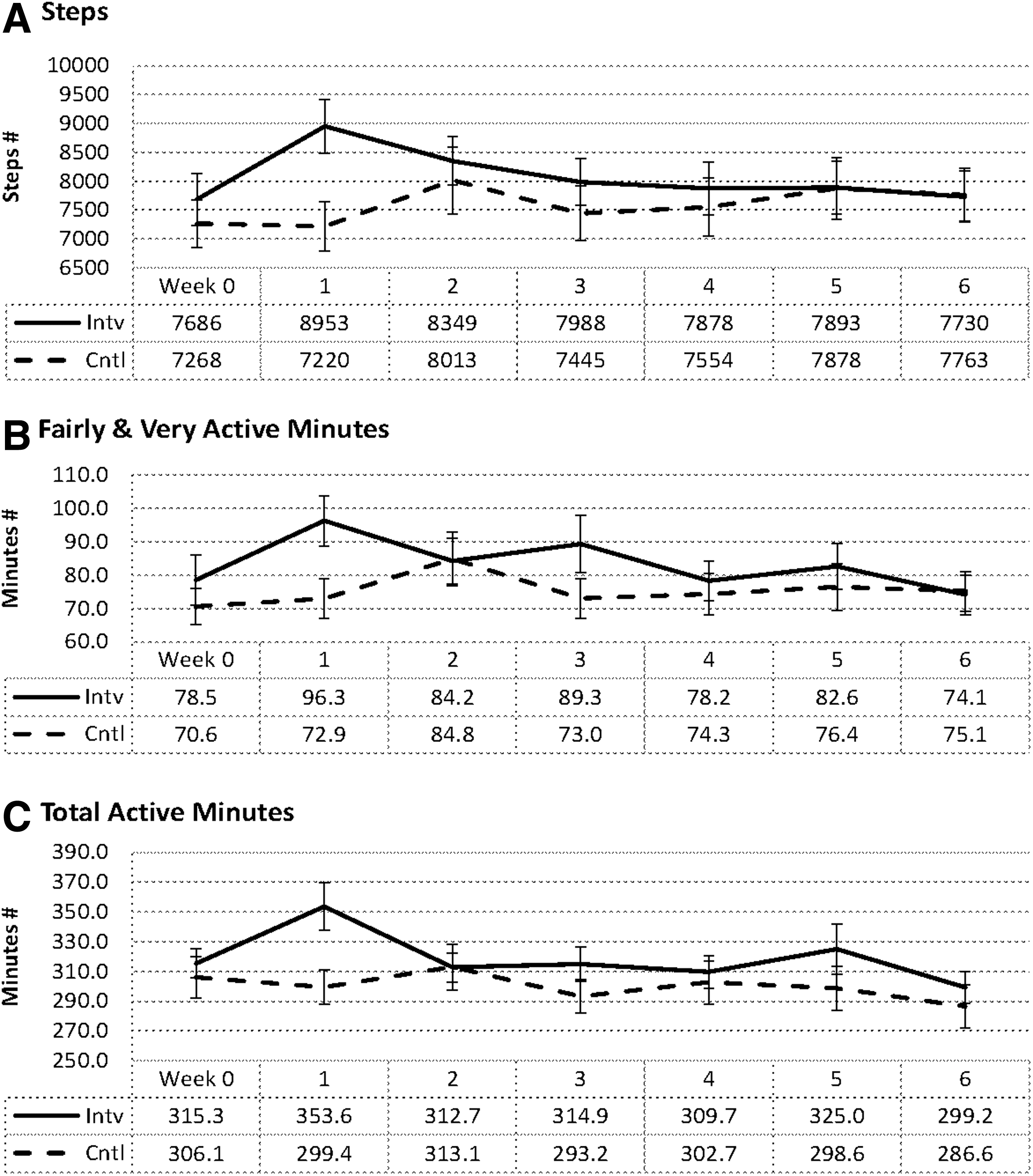
Weekly physical activity levels measured by the Fitbit One from baseline (Week 0) to Week 6, adjusted for baseline wear time:
To further investigate the intervention effects across time, group differences in PA were examined at each week compared with baseline in the mixed models: group by time interactions indicated significant between-group differences in PA change from baseline to week 1 for steps (p=0.01), fairly/very active minutes (p<0.01), and total active minutes (p=0.02). These PA changes, however, were short term and not maintained through Weeks 2–6. In a further examination of these results within each study group, at Week 1, the intervention participants significantly increased their steps by +1,266 (SE=491; p=0.01), fairly/very active minutes/week by +17.8 (SE=8.5; p=0.04), and total active minutes/week by +38.3 (SE=15.9; p=0.02) (Fig. 2). During the same period, there were no significant changes in PA levels in the comparison group: steps, −48 (SE=240, p=0.84); fairly/very active minutes/week, +2.3 (SE=4.1, p=0.57); and total active minutes/week, −6.7 (SE=11.7, p=0.55) (Table 3).
Summary of Changes in Physical Activity Levels Measured Using the Actigraph GT3X+ and Fitbit One from Baseline to Week 1 (Short-Term Effect) and Baseline to 6-Week Follow-Up, Adjusted for Wear Time
Mixed-model repeated-measures (group by time), alpha level p<0.05, adjusted for baseline wear time (in minutes/week).
Between-group significance.
Within-group significance (p=0.04).
FA+VA, fairly active+very active; FB, Fitbit One; MVPA, moderate- to vigorous-intensity physical activity; PA, physical activity.
In summary, these data suggest that the Fitbit One (comparison group) was able to achieve a small within-group increase in MVPA at the 6-week follow-up among a sample of overweight and obese adults. This small within-group effect was significant in the Actigraph GT3X+ measures of PA. In the present study, it was feasible to collect daily objective measures of PA using the Fitbit One for up to 49 days throughout the study period. Analyses of these data suggest that a combination of daily SMS-based PA prompts and the Fitbit One (intervention group) increased PA levels for steps and minutes of PA by intensity, although only for a short-term period of 1 week. Therefore, daily SMS-based PA prompts in combination with a Fitbit One device were not able to achieve sustained (i.e., 6-week) PA change. Instead, Fitbit One alone may help to increase MVPA at 6 weeks in overweight and obese adults. However, further research is needed with larger sample sizes and longer study periods to elucidate these findings.
Follow-Up Attitudes and Behaviors on the Fitbit One and SMS PA Prompts
At follow-up, a greater proportion of comparison (versus intervention) participants reported that, on a typical day, they viewed their Fitbit trackers “Very Often” or “Often” for steps (90% versus 71%) and distance (70% versus 55%). Those who self-reported that they frequently viewed their tracker were associated with greater increases in PA (even more so compared with the Web site). In the intervention group, approximately half indicated that the three daily text messages were “Too Many.” Additionally, in an open-ended question about the text-messaging intervention, a common response among participants was that they had stopped reading them altogether when they noticed that the messages were “automated.” Other notable phrases were that the messages were “inconvenient,” “annoying,” and “impersonal.”
Discussion
This study focused on a technology-based intervention to increase PA in a sample consisting mostly of inactive and overweight/obese women. Providing a technology-based self-monitoring device (Fitbit One) led to a small and statistically significant (within-group) increase in MVPA (in minutes/week) from baseline to Week 6. The intervention group included three daily SMS-based prompts to undertake PA, which were associated with increased PA over the first week, but this effect was lost by Week 2 of the 6-week intervention.
Self-Monitoring (Fitbit One) Only
Results from the follow-up questionnaire indicated that participants in the comparison group, compared with the intervention group, was more engaged in using the Fitbit tracker, which might help to explain their small increase in MVPA at follow-up. These findings support several studies that have shown a positive association between self-monitoring and PA change. 58 –62 In the present study, the Fitbit tracker allowed participants to access quick readings of their PA performance throughout the day. It is unclear as to why comparison participants were more engaged compared with those in the intervention. A possible explanation might be that, although the randomization procedure achieved group comparability on most variables, there was a difference in baseline confidence level in their ability to increase PA. Therefore, it is possible that the comparison group had higher baseline confidence or self-efficacy to increase their PA levels. 63 However, further analyses also indicated that this small increase in MVPA within the comparison group was probably not moderated by baseline confidence.
Another possible explanation for the higher level of engagement in the comparison group might be that, because they only had the Fitbit One, they relied solely on that device. In contrast, the intervention group also received daily SMS-based prompts, which at follow-up they indicated were too frequent and automated. Thus, the text messages could have distracted them from further engagement in the study. It is important to note that, although the improvement in MVPA was significant in the comparison group, the effect was small and not accompanied by an increase in daily steps. Therefore, these findings need to be replicated before we can consider them as evidence to support that simply providing a wearable sensor/sensor for self-monitoring would be sufficient to increase PA in inactive overweight/obese adults.
Short-Term Effects of SMS PA Prompts
In this study, adding automated daily text messages as simple prompts for PA was not associated with increased PA at follow-up. However, using the Fitbit data, we were able to analyze change throughout the study period. During the first week, there was a significant increase in PA, which suggests these messages were able to serve as cues (or reminders); however, this effect was not maintained by the second week and into the remainder of the study. Indeed, many participants reported that they quickly stopped reading the daily texts when they discovered that the messages were not tailored to their performance. In addition, three messages a day as reminder messages were perceived too frequent to be helpful. Clearly, these SMS-based prompts were not effective in motivating change in PA levels for more than the first week.
Previous studies have used more intensive messaging strategies than simple prompts to promote PA. 28,30 –35 A 9-week study used automated messages to help participants identify/reduce barriers and identify motivating benefits. 29 However, this more intensive messaging intervention reported similar results to the present study—an increase in MVPA that was not maintained after the first week (assessed using a wrist-worn accelerometer). 29 The similarity in results between the two studies suggests that it might be the automated nature of text messaging rather than the content and/or frequency of messages associated with the studies' inability to maintain study effects for longer than a week. In the present study, it is possible that participants no longer felt accountable once they realized that the text messages were automated, which might explain the loss of PA effects. Other studies have reported longer-term effects but did not include objective measures of PA 32,34,35 ; self-reported measures can easily be biased in many trial settings. In future studies, we recommend reducing the frequency of messages if they are used as basic cues/prompts. However, in order for these cues to be motivational, the messages might need to include some level of individually tailored (and/or adaptive) feedback on PA performance. For example, wearable sensors/devices like the Fibit One could include push notifications with PA feedback to cue users to increase their PA levels.
Study Limitations
The study sample consisted of overweight and obese adults, mostly women who were participating in breast cancer screening within a clinic in a tertiary teaching hospital and indicated an interest in a PA study. Therefore, generalizability of these results is limited. This intervention might have had better success with a sample of adults that was more representative of the general population and among those with higher motivation to increase their PA levels. Participants were asked to concurrently wear the Actigraph GT3X+ and Fitbit One at baseline. Therefore, participants were inadvertently exposed to some PA intervention with the Fitbit One during baseline measure of PA and prior to the start of the study, which could have diminished the effects of either the Fitbit One and/or text messaging. A strength of this study was the use of the Actigraph GT3X+, which is a valid and reliable measure of PA. 46,47 A validation study has compared Fitbit One measures with the Actigraph GT3X+ for steps that were taken on a treadmill, 51 and validation in a real-world setting is currently underway. More generally, improvements are needed in these technologies for more accurate measures across an array of activities beyond steps (e.g., cycling and swimming).
Conclusions
Results from this study suggest that simply providing a wearable sensor/device for self-monitoring of PA was insufficient in achieving increases in target PA levels in a sample of overweight and obese adults consisting mostly of women. Future studies on wearable sensors/devices may require closer examination of engagement levels with the technology and level of help needed to achieve target PA levels. The addition of daily automated text messages as simple reminders in conjunction with the wearable sensor/device did not help to increase PA levels. These data suggest that text-messaging interventions likely require more individualized and/or adaptive strategies such as feedback on PA performance. More research is needed to investigate an optimal intervention package that feature wearable sensors/devices to effectively promote PA change. Text messages (or even push notifications via mobile apps) may be part of such an intervention, but results from this study suggest that messages should be more responsive to participants' individual PA performance.
Footnotes
Acknowledgments
This research was supported by a gift from the Carol Vassiliadis family and in part by grant CA-113710 from the National Cancer Institute. The study would like to acknowledge UCSD undergraduate interns Quynh Nguyen and Amy Nham for their assistance in study implementation.
Disclosure Statement
No competing financial interests exist.