




Abstract
Introduction
As of 2013, 36.9% of adult males and 38.0% of adult females worldwide had a body mass index of 25 kg/m2 or greater. 1 In the United States, 68.5% of adults were classified as overweight or obese. 2 Public interest in obesity is also high in Korea. According to the Fifth Korea National Health and Nutrition Examination Survey, among those who were 19 years old or older and obese, 60.3% had tried to lose weight in the previous year. However, the obesity rate within this group remained at 31.9%. According to the standards set by the World Health Organization for the Asia Pacific region, weight loss is recommended not only for people in the obese range (body mass index ≥28 kg/m2), but also for those in the overweight range (body mass index ≥23 kg/m2), those who have a waist size ≥40 inches for males and ≥35 inches for females, and for those who have at least one obesity-related medical indication, such as diabetes, prediabetes, hypertension, dyslipidemia, or insomnia. 3 A 10% reduction in initial body weight not only can reduce the risk factors for diabetes and heart disease, but it can lead to reducing the dosages or discontinuation of medications for diabetes or heart disease. 4 Moreover, losing weight can also enhance one's quality of life, provide energy, and improve one's mental health by increasing self-respect. 5,6
Mobile health (m-health), which is a form of e-health, refers to a health service that uses mobile communication devices. 7 In the case of weight loss, mobile interventions that reminded the users about obesity assisted in changing their dietary habits, reducing their consumption of foods with high fat content, and reducing the sizes of specific body parts. 8 Moreover, an application (app) for the promotion of walking among friends further encouraged the users to take part in more walking through the use of technologies that alerted them with notifications. 9
Along with recent advances in smartphones, social network services (SNS) have also advanced. SNS promote health-related communications among various users 10 and also motivate positive behavior changes. 11 Because people use SNS mostly because they are fun, 8 using gamification elements, including game-based thinking and mechanics, could engage users in problem solving 12 ; thus, weight loss could be accomplished through game care. In this way, users can reach the ultimate goal of health by interacting, competing, and cooperating with their friends while enjoying a game. 13 Losing ≥10% of body weight and keeping it off for at least 1 year is referred to as maintaining weight loss. However, only approximately 20% of all people who attempt weight loss actually do maintain their weight in this manner. 14
The objective of this study is to design and develop a smartphone app that uses social networks to support friends in a competition to lose weight and to test the app's efficacy.
The specific research hypotheses are: 1. There will be a difference in the degree of motivation experienced before and after using With U (the name of the app). 2. The body weight of the users will decrease after using With U. 3. Using With U will create intentional, continued weight loss.
Materials and Methods
Preliminary Survey
A preliminary survey was conducted using the 2013 American Heart Association/American College of Cardiology/The Obesity Society Guideline for the Management of Overweight and Obesity in Adults,
3
the 2013 revised version of Facts About Obesity from the Korea Ministry of Health and Welfare (Seoul),
14a
and content from the Web site of the Korean Society for the Study of Obesity (
App Components and Design
The Mechanics-Dynamics-Aesthetics (MDA) framework 15 is a conceptual model used to combine gaming with systematic thinking to create non–game apps. 12 The MDAM framework is derived from adding the component of “modification” to the MDA framework; this component aims to separate the successes and failures of the MDA's pure function through quantitative or qualitative verifications in changes. 16 The goal of MDA is esthetics (i.e., fun), whereas the goal of MDAM is user modification. When the concepts used for the components and design of With U were entered into the MDAM framework, the results were as follows:
Modification settings
First, we chose the modifications. The modifications sought through With U were “motivation to lose and maintain weight loss” and “weight loss” itself.
Esthetics settings
Second, we set up esthetics to generate interest. Of eight expressions related to esthetics, challenge, fellowship, expression, and submission were selected as items (Table 1).
List of Esthetics
BMI, body mass index; SNS, social network services.
Mechanics and dynamics settings 16
It is difficult to distinguish mechanics from dynamics, so we regard these as a single component. The mechanics for eliciting the above-mentioned items chosen as elements of esthetics are referred to as game mechanics and comprise elements that entice meaningful user responses 12 ; these included feedback, scores, levels, rankings, challenges, and social engagement loops. Regarding scores, users could obtain With U points during a period of competition. To obtain these points and win the competition, participants must lose weight and solve various quizzes. Attendance at With U and Facebook activity also awarded points to participants. After the competition, winners and losers of the competition were determined on the basis of their scores.
Primary Functions
Microsoft (Redmond, WA) Visio® (2010) was used to display the primary functions of With U in use case diagrams and flowcharts. Figure 1 shows the primary functions and actors of With U in a use case diagram. Table 2 shows the use case descriptions of the primary functions.
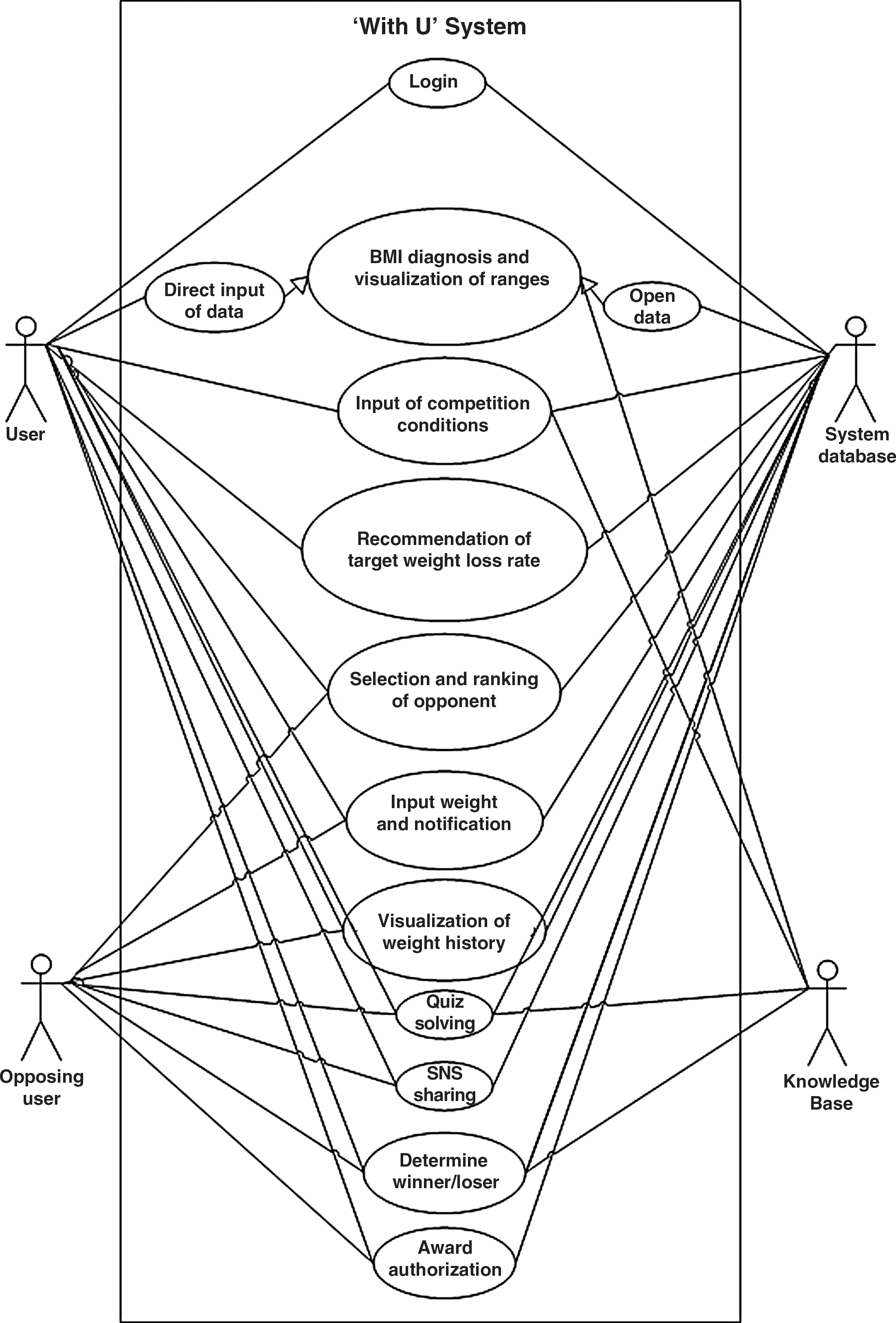
With U system: use case diagram. BMI, body mass index; SNS, social network services.
Primary Functions in the With U System
BMI, body mass index; SNS, social network services.
App Implementation (Initial Form)
Microsoft PowerPoint® (2013) was used to design the user interface. With U was developed as a hybrid app incorporating Web language with a health avatar platform that used flowcharts. Moreover, With U uses Web sockets to communicate with the server; the code for communicating with the database was created as a JavaServer Page using UltraEdit. The implementation environment was iOS.
Usability Evaluation
For the initial usability evaluation of the app, one nursing informatics professor and four experts with graduate degrees in either nursing informatics or medical informatics served as evaluators. The result was a mean score of 63 points, which was lower than the mean of 68 points obtained from 500 studies that used System Usability Scale tools. 17 As such, the researcher and evaluators drafted a list of revisions and supplements.
Revisions and supplements
According to this list, the researcher and development team made revisions and supplements to the app across 15 weekly meetings.
App Implementation (Final Form)
Figure 2 is the screenshot of the final form of the app. Once the competition begins, the user must enter his or her weight daily. The goal achievement rates of the user and opponent are saved and visually presented (Fig. 2).

Final form of With U.
Study Design
This study used a one-group, pretest–posttest design, in which users who knew each other used With U for a total of 4 weeks in 1:1 pairings. This study described pilot testing of With U so the period was only a month. In addition, user experience was investigated in interviews during the posttest. Moreover, the body composition analyzer was used before and after the experiment.
The participant selection criteria were as follows: 1. Those who were obese, morbidly obese, or overweight, who had a waist size of ≥35 inches for males and ≥32 inches for females, or who had obesity-related medical conditions. However, anyone with a history of obesity-related surgery was excluded. 2. Those who were not currently dieting 3. Those who were between the ages of 20 and 40 years and used a smartphone
When the sample size was calculated via G*power version 3.1.5, the result was 15 pairs. However, because it was difficult to find participating pairs who actually satisfied all of the inclusion criteria, 10 pairs were recruited. Although everyone completed the 4-week experiment, sufficient physical data were not received from one participant, so the outcome analysis was performed on data from nine pairs.
Questionnaires
Motivations for weight loss
The researcher in this study revised and supplemented questions from an instrument by Lim and Kang, 18 which was designed to use inherent factors in general individualistic behavior changes to measure motivation for academic achievement. After questions with factor analysis values of <0.5 were eliminated, 19 questions remained. The reliability coefficient was 0.866.
Intentions for continuing weight loss
The Intention to Continue Scale, developed by Jung 19 and adapted by Yu, 20 was revised and supplemented for this study. The instrument consisted of four questions. The reliability coefficients by Jung 19 and Yu 20 were 0.89 and 0.713, respectively; in this study, it was 0.678.
Usability evaluation
The System Usability Scale developed at Digital Equipment Co. Ltd. (Reading, United Kingdom) is an instrument with proven reliability that has been used to conduct surveys in many usability studies. 17 Our instrument consisted of 10 questions, and the reliability coefficient was 0.860.
Body Composition Analyzer
Body weight, height, body fat percentage, abdominal fat percentage (waist–hip ratio), visceral fat, and arm muscle circumference were measured with the InBody 720 (Biospace, Seoul) using bioelectrical impedance analysis.
Procedure
Prior to beginning the study, approval was sought by the Seoul National University Institutional Review Board. Data analysis was performed using SPSS version 21 software (SPSS, Inc., Chicago, IL). A Kolmogorov–Smirnov test, descriptive statistics, paired-samples t test, and a correlation analysis were performed. Reliability was analyzed using Cronbach's alpha.
Results
General and Physical Characteristics
Of 18 users (nine teams), there were 12 males and 6 females. The participants were mostly in their 20s and 30s, with two participants in their 40s. Occupation was evenly distributed. Fifteen participants earned a monthly income of <3 million KRW. Seventeen participants had attempted weight loss in the past 2 years, and nine possessed at least one factor that was closely related to obesity; seven were classified as being overweight, whereas six and five were classified as obese and morbidly obese, respectively (Table 3).
Sample Characteristics
BMI, body mass index.
Changes in Motivation and Physical Characteristics in Pre- and Postintervention and Intention to Continue
Motivation showed an increase from the pre-experiment mean score of 48.67 points to a post-experiment mean score of 54.22, which was statistically significant (t = −4.092, p = 0.003). Among the physical characteristics, mean body weight showed a statistically significant decrease from 80.18 kg before use to 79.29 kg after use (t = 7.418, p < 0.001). The intention to continue for postintervention weight loss was measured using an instrument with a maximum scale of 20 points; the result was a mean score of 15.44 (Table 4).
Changes in Motivation and Physical Characteristics in Pre- and Postintervention and Intention to Continue
p < 0.01, b p < 0.05.
AMC, arm muscle circumference; SD, standard deviation.
Moreover, the numbers +1, −1, and 0 were assigned according to whether motivation and physical characteristics during the 4 weeks had increased, decreased, or remained unchanged, respectively. As a result, motivation showed an end value of +7, whereas body weight, body fat percentage, waist–hip ratio, visceral fat, and arm muscle circumference each showed values of −10, −8, −7, −6, and −10, respectively (Fig. 3).
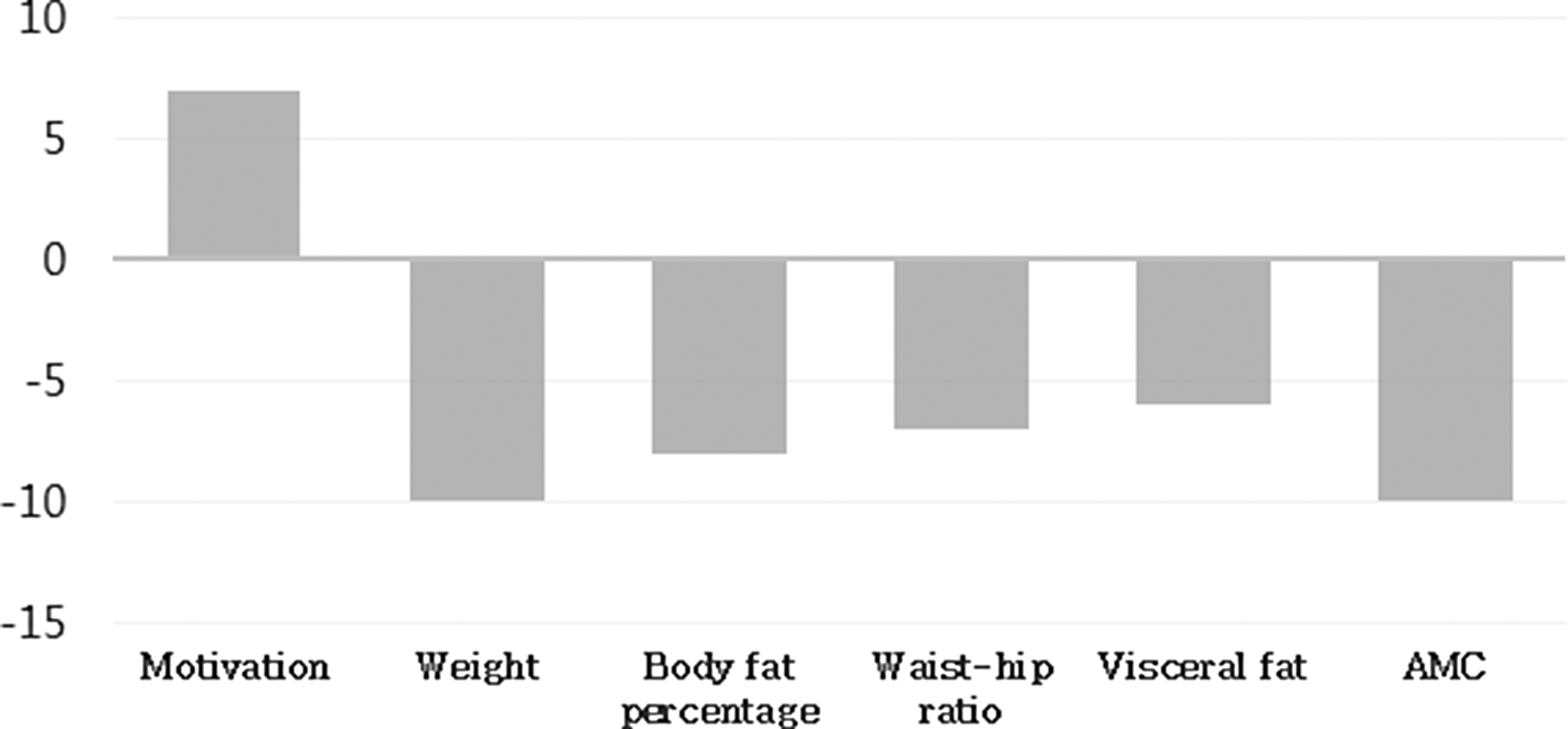
Changes in motivation and physical characteristics pre- and postintervention. AMC, arm muscle circumference.
With U Scores
With U scores, which are related to actual With U use, were analyzed. The mean point was 31.06. Moreover, change in motivation was greater in the loser group (mean = 9.00) than the winner group (mean = 2.11), as were changes in body weight and visceral fat. To understand the significance of this, correlation analysis was conducted to investigate how With U scores, which determine the winners and losers, are related to changes in motivation (Table 5).
Correlation Coefficients Between With U Score and Change in Motivation (n = 18 Individuals)
p < 0.05, b p < 0.01.
Analysis of Postintervention Interview Results
All 10 teams completed the 4-week experiment and interviews. Each team was assigned a letter sequentially, starting with the team that showed the most positive changes in physical characteristics during the 4 weeks. Users who experienced weight loss or decreases in three of the five physical characteristics were labeled as being in the “positive,” whereas those who experienced weight gain or increases in three of the five physical characteristics were labeled as being in the “negative” (Table 6):
• Case 1: Changes in physical characteristics are positive for both participants. There were five teams in which both members did well. The commonality these five teams shared was that they were all students or researchers from the same workplace. They may have had opportunities to meet with each other 10–20 times during the experiment. Furthermore, there were two teams composed of one man and one woman in this classification.
• Case 2: Changes in physical characteristics are positive for only one of the two participants. There were four teams in which only one of the two members did well. These four teams were all made up of people in their 30s from different workplaces. The team that showed the most distinctive differences was Team I. Unlike the other three teams, the users in Team I had different occupations—an office worker and a professional. Moreover, they were not actual friends, but rather acquaintances because their wives were friends. These four teams had face-to-face meetings with each other zero to three times during the competition.
• Case 3: Changes in physical characteristics are negative for both participants. In one team, Team J, neither member benefited from using With U. The members had different occupations and workplaces. They were not friends, but they had previously met through a mutual friend. Moreover, because J-a and J-b lived in different cities, they did not have opportunities to meet during the competition.
Characteristics of With U Users
Discussion
With U Development
The six structural elements that can engage a user in a game are rules, goals, feedback, competition, social relationships, and stories. 21 In With U, there are “rules” and “goals” for weight loss associated with scoring points, and “feedback” is directly realized through the weight measurement being sent via notifications and weight loss being visually presented by numbers and illustrations. The “social relationship” of competing for weight loss against a real-life friend includes the “story” of “competition.” It is believed to be possible to engage the users in weight loss. In particular, in a competitive game, such as With U, feedback that accurately shows who is winning is important. 15 With U was designed with this purpose in mind to provide the most immediate and direct feedback possible to the users via rankings, the competition status menu, the graph view menu, and pop-ups. Smartphone users frequently use them to communicate, 22 and because the With U social engagement loop, created during the development of With U, was designed to stimulate the desire to communicate, it is believed to have satisfied users' social networking desires.
Application of With U
Motivation, physical characteristics, and intention to continue
Using With U resulted in statistically significant increases in motivation (t = −4.092, p = 0.003), perhaps because although the user was not dieting prior to the experiment, learning the exact degree of obesity from the body composition analyzer motivated him or her to lose weight, and With U is used with a friend in a similar situation. Moreover, users who lost by smaller margins showed greater increases. The users are rewarded through sociopsychological processes, such as self-efficacy and social approval. Becausee these rewards have the power to make the users feel good, they can induce long-term participation. 23 Furthermore, when game and SNS elements converged, values associated with competitiveness, achievement, and engagement are more highly regarded. 24
Seventeen of the 18 participants (93.5%) indicated in the presurvey that they had attempted weight loss but were still either overweight, obese, or morbidly obese. However, the weights of the users decreased after using With U (t = 7.418, p < 0.001). Arm muscle circumference also showed a decrease (t = 2.478, p = 0.038). As such, the numbers +1, −1, and 0 were assigned according to whether changes during the 4 weeks had increased, decreased, or did not change, respectively. As a result, motivation was seen to increase, whereas physical characteristics all decreased.
The mean score for intention to continue was 15.44 points among the nine teams. If a user has a strong will to lose weight, genetic or environmental influences the user possesses can be overcome with the help of another 25 ; hence, the intention to continue weight loss holds great significance. In an actual study on 2,957 overweight or obese participants, the rate of continuing weight loss for 6 years was higher in the group with intention to continue than in the group without such an intention. 26
Interviews
From the interview results, we classified the cases by changes in physical characteristics. The analysis showed interesting results.
In the two teams consisting of users of the opposite sex, Teams D and E, both members from both teams had positive physical characteristic changes. This finding is similar to the result of another study on competitive environment and gender that reported that transactions between the opposite sexes were superior to transactions between members of the same sex. 27
Furthermore, both users in the same team with the same occupation and workplace had positive physical characteristic changes. Even if the occupations were the same, if the workplace was different, physical characteristic changes varied. When both the occupations and workplaces were different, the physical characteristic changes either varied greatly or were negative for both users. Although the actual competition took place through a smartphone app, the weight loss itself must take place in real life; hence, having more opportunities for face-to-face meetings is believed to have a positive influence on weight loss. This is consistent with the study results that suggest enjoyment is amplified when games are played with someone else. 28
Finally, more direct and closer relationships between the competing users resulted in more positive physical characteristic changes. Team I, which had the widest physical characteristic differences between two users, and Team J, in which both users showed negative changes, comprised users who did not have a direct relationship with each other. Instead, they had met through their wives or a mutual friend. This is consistent with the recommendations of the Korean Endocrine Society and the Korean Society for the Study of Obesity, which suggest that social relations, such as friendships and family relationships, are helpful in promoting weight loss. The social engagement loop used in this study was more active when the relationship between the users was more closely knit and there were more opportunities for face-to-face meetings. In conclusion, this study is significant because it obtained meaningful results that showed that more direct and closely knit relationships within social networks are more helpful in weight loss.
In the future, to satisfy more users from more diverse age groups, a more universal user interface by a professional designer will be needed. 29 Moreover, because the number of participants was limited and the study lasted only 4 weeks, a future longer-term study with more participants will be needed. Finally, there is the need to develop and test the efficacies of different forms of smartphone apps that use social networks for health management.
Footnotes
Acknowledgments
This work was supported by the National Research Foundation of Korea grant 2010-0028631 funded by the Korean Government. The authors thank Professor Ju Han Kim and his research team and the With U participants.
Disclosure Statement
No competing financial interests exist.