




Abstract
Introduction
U.S. military families are experiencing high obesity rates similar to the civilian population. 1 The Department of Defense's Military Health System (MHS) is one of the largest healthcare providers in the United States, serving approximately 9.2 million active duty service members, retirees, spouses, and children. The annual cost to the MHS for morbidities associated with being overweight exceeds $1 billion. 2 The preschool age has been suggested as an opportune time to intervene for the prevention of obesity. 3 According to the Department of Defense's 2013 demographics report, there are 495,156 preschool children (0–5 years of age) whose parents are active duty members. 4 The ages of the majority of active duty members' children range between newborn and 5 years of age, constituting 42.04% of minor dependents. Additionally, selected Reserve members collectively have 213,781 children between the ages of 0 and 5 years, which is 29.82% of the total number of selected Reserve members' children. 4
Efforts to engage parents in traditional face-to-face health education interventions have been difficult due to time demands and schedule conflicts, 5 which could be even greater for military parents due to 24/7 work demands and deployments. E-learning may be a convenient way to reach military parents of preschool children if parents have access to this technology.
Thus, this study investigated the current level of personal technology usage by military service member families and assessed their needs and interests in regard to health/nutrition information. This needs assessment is crucial for researchers and educators to design further studies and intervention programs for obesity prevention in military families.
Materials and Methods
Survey Instrument
The Technology Usage in Military Family (TUMF) questionnaire was developed based on a previous study 6 and this study's research questions. The initial questionnaire was first reviewed by a military veteran, who was part of the research team, and modified based on his suggestions. Then, the TUMF questionnaire was reviewed and approved by the directors of Family Services at each military base. The final TUMF questionnaire included four sections: (1) computer and Internet usage, (2) telephone and mobile device usage, (3) attitude and knowledge about behaviors related to obesity prevention, and (4) demographic information. Participants required approximately 10–15 min to complete the TUMF questionnaire.
Sample
Participants were active duty service members, spouses of active duty service members, or family members of active duty service members, 18 years of age and older, with a child between the ages of 3 and 5 years enrolled at the Child Development Centers (CDCs) at one of two selected military bases (one Army and one Air Force) in the southwestern United States. Prior to the start of the study, the researchers visited the two bases to explain the purpose of the study to base administrators and to schedule dates for data collection. Participants who completed the survey were eligible to enter a drawing (1:100 winning ratio) for a tablet computer (estimated price of $329) as an incentive.
Procedure
The TUMF questionnaire data were collected using a convenience sampling method. Participants were approached at the two CDCs when they came to drop off or pick up their children. The researchers explained the purpose of the study, answered any questions, and provided consenting parents with a copy of the questionnaire to complete. Parents who completed the questionnaire received a raffle ticket for a tablet computer. To increase the response rate, the researchers also prepared an envelope with the TUMF questionnaire for the parents whose children were absent on the days that data were collected. Enclosed in the envelope was a letter to inform them about the purpose of the study, a copy of the questionnaire, and a raffle ticket. If parents chose to participate in the study, they returned the completed survey and raffle ticket to their CDC office. The drawing for the tablet computers was held 1 week after the data collection was completed at each base.
Data Analysis
The data were analyzed using IBM (Armonk, NY) SPSS Statistics 21 software. Descriptive statistical analyses were conducted to identify the participant's demographic information, computer and Internet usage, telephone and mobile devices usage, and attitudes toward health/nutritional information. In order to avoid losing data, pairwise deletion was used for missing data.
Results
Participant Characteristics
There were 233 Army military parents and 55 Air Force military parents who participated in the study, with response rates of 65.5% and 46.6%, respectively. As for the characteristics of the participants, the mean age was 30.51 years (standard deviation = 6.72) for Army parents and 31.71 years (standard deviation = 5.59) for Air Force parents. These mean ages were slightly older than the national mean ages (29.3 years in 2013) for both Army and Air Force active duty members. 4 The majority of participants were female (69%) and had a college degree or higher (62%). For ethnicity, the sample was primarily white (41%), with substantial minority representation from African Americans (25%) and Hispanics (22%). Table 1 displays the demographic characteristics of the participants.
Participant Characteristics
SD, standard deviation.
Computers and Internet Usage
Table 2 depicts the overall computer and Internet usage and the typical uses of computers at home. Laptop computers were most frequently used at home to access the Internet, followed by tablet and desktop computers. For those participants who owned a tablet device (Army, 56.7%; Air Force, 76.3%), the majority of parents reported that they had an iPad® (Apple, Cupertino, CA) (n = 134), followed by a Samsung (Seoul, Korea) tablet (n = 40) and a Kindle™ (Amazon, Seattle, WA) (n = 39) (data not shown). Overall, the most typical at home uses of the Internet for these military parents were for shopping (Army, 64.4%; Air Force, 90.9%). Other uses included Skype™ (Microsoft, Redmond, WA) for voice/video communication and school/education purposes, followed by work, finding parenting information, and health education or health support, and, lastly, for the purposes of entertaining such as reading news, books/reading, sports, and gaming.
Computer and Internet Usage Among Military Families
Percentages may not sum up to 100% because respondents chose more than one answer.
PC, personal computer.
When asked how many hours per day they use the Internet via smartphone and personal computer (laptop, desktop, and tablet), the majority of the participants said that they used the devices less than 3 h/day (Air Force, 50.9%; Army, 39.1%), although around 30% of participants from both bases said they usually use them 3–6 h/day (Fig. 1). Compared with the national Internet usage pattern, which is 2.1 h/day, military parents have a similar usage as those of civilian adults in the United States. 7
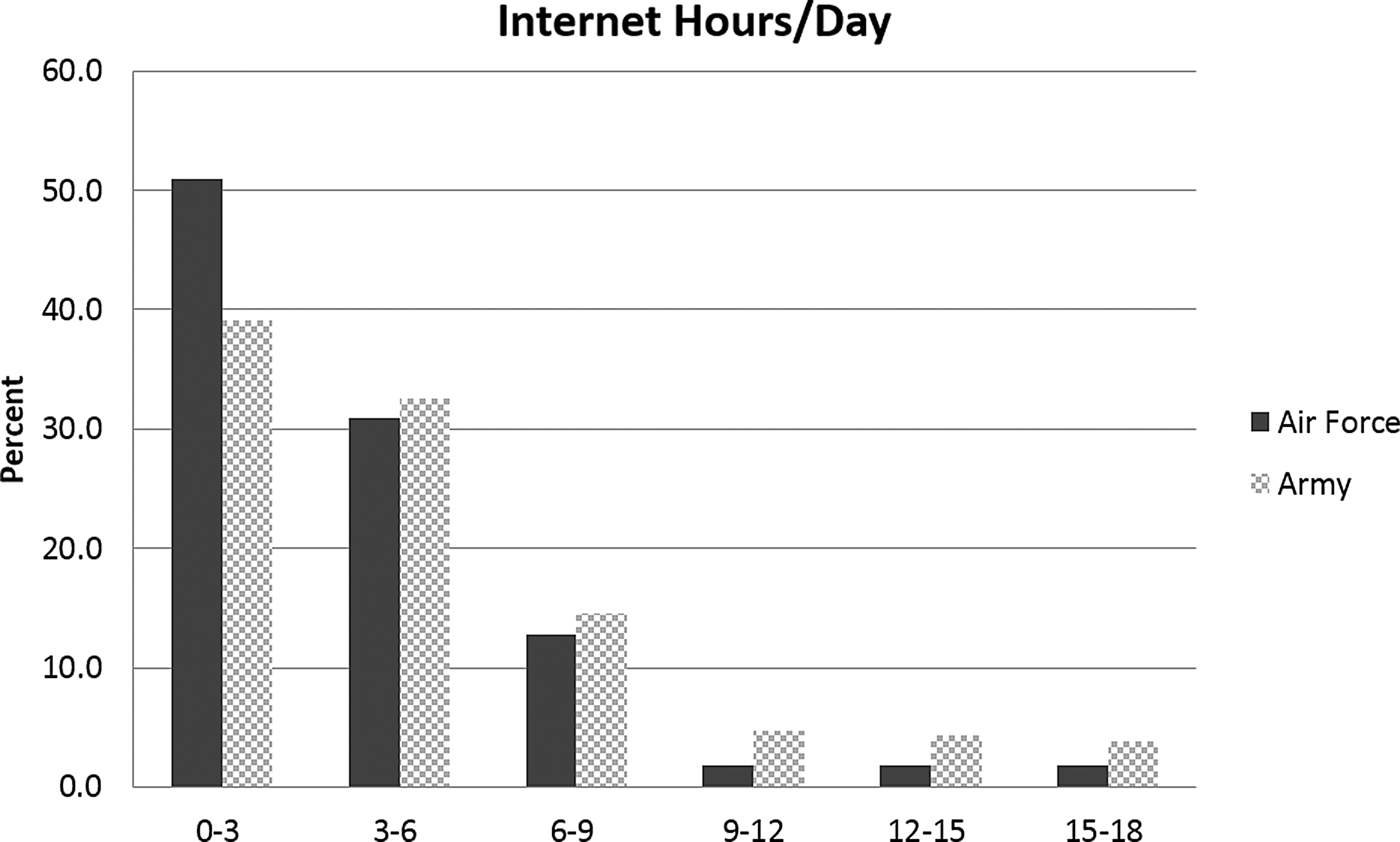
Internet usage per day among military parents.
Table 3 summarizes the Internet-related usage behaviors among the military parents at home, including Internet connection, common browser and search engine used, e-mail service providers, social media, and music platforms. Over 95% of participants indicated that they had Internet access at home, which surpassed the national Internet penetration rate (74.4%). 8 Most parents reported that they had a cable connection (Army, 78.6%; Air Force, 85.5%) [t(285) = 1.347, p < 0.01], whereas fewer reported having a satellite connection (Army, 17.1%; Air Force, 9.1%) [t(285) = −1.44, p < 0.01] (Table 3). These results suggest that the Internet may be an effective way to connect with military families who have young children. For the parents who had an Internet connection, we asked if they had access to a wireless connection at home. Overwhelmingly, almost all of the parents had a wireless connection if they had Internet service at home (Army, 95.7%; Air Force, 100.0%).
Internet Usage Behaviors Among Military Families
Percentages may not sum up to 100% because participants chose more than one answer.
The results showed that most parents used Internet Explorer (Army, 64%; Air Force, 69%) as their primary browser for the Internet. Approximately 38% of the parents used either Firefox or Google (Mountain View, CA) Chrome as their primary browsers. Regarding search engine preference, more than 90% of parents used Google when they searched information online. Thus, Web site developers targeting military families with young children should consider optimizing their Web sites for Internet Explorer, Firefox, and Google Chrome. There were no significant differences in browser, search engine, or e-mail usage between the two groups.
When asked about the e-mail service used at home, some military parents used more than one e-mail service from companies such as Gmail, Yahoo, Hotmail, and other e-mail service providers, including those from Internet service providers such as AT&T and Comcast. More than 50% of military parents used either Gmail or Hotmail services, with some using both.
In regard to social media usage, many participants had more than one social media account. More than 90% of military parents at both bases reported having a Facebook account, whereas fewer reported using Pinterest, Twitter, Yahoo messenger, or other social media platforms. There was no significant difference in Facebook and Pinterest usage between the Army and Air Force parents. However, Army parents used Twitter [t(285) = −1.786, p < 0.001] and Yahoo Messenger [t(285) = −1.565, p < 0.01] more frequently. When asked how many times a day they usually logged on to check their social media sites, the Army parents reported checking their social media sites on average 5.4 times per day (standard deviation = 5.0), whereas the Air Force parents checked their social media sites 3.14 times per day (standard deviation = 3.4). Because over 90% of the participants indicated that they had a Facebook account and usually checked it multiple times a day, social media such as a family-service Facebook page is an important message venue for conveying information to military families. During the study, the researchers learned that several social groups on Facebook had been created for local military communities. Using the military Facebook accounts may reach many more local military families who do not send their children to the military CDC.
Telephone and Mobile Device Usage
Table 4 summarizes the telephone/mobile devices that the military parents use at home. The majority of the participants indicated that they use a personal smartphone at home (Army, 75.5%; Air Force, 67.3%), followed by a personal cell phone (Army, 39.5%; Air Force, 49.1%). For those parents who owned a personal smartphone, 56.4% of them reported that they have an iPhone® (Apple), whereas 43.0% of participants reported that they have an Android™ (Google) phone such as a Galaxy S3 (Samsung) or HTC (New Taipei City, Taiwan) Evo. When asked what activities they typically use their phone for, most reported using them for making phone calls and texting (more than 85%), which is consistent with a recent study of soldiers' personal technologies usage. 6 The military parents also used their smartphones to take pictures and videos, search the Internet, use social networks, e-mail, listen to music, and use applications (apps) (Fig. 2). When asked how many hours per day they use a mobile device, such as a smartphone or tablet personal computer, for various activities (such as searching the Internet, using apps, and using social networks), the Army military parents reported an average of 1.6–2.6 h/day, and the Air Force military parents reported an average of 1.2–1.7 h/day spent on each of the activities (Table 5).

Telephone/mobile device usage at home by military parents. Apps, applications.
Phone Usage at Home
Percentages may not sum up to 100% because participants chose more than one answer.
The Time of Using Mobile Devices on Internet, Applications, and Social Networking at Home
Max, maximum; Min, minimum; SD, standard deviation.
Participants who had smartphones were asked if they had nutrition/health apps on their smartphone. Approximately, 44% of Air Force military parents answered “Yes,” whereas over 38% of Army military parents agreed. There were four major types of apps reported: (1) fitness, (2) calorie control, (3) healthy food/recipe, and (4) health lifestyle apps. Most of the apps reported were fitness apps, such as My Fitness Pal, Army Physical Fitness Test, Runkeeper, Muscle Fitness, and Map My Walk. For healthy food/recipe app examples, participants reported using My Plate, Fooducate, Allrecipe.com, and the Food Network. For calorie control, apps such as Calorie Counter, Calorie Tracker, and Weight Watchers were reported. Lastly, S Health and Spark People are examples of overall health lifestyle apps that participants reported using to help track food intake, exercise, and sleep. Participants showed a greater interest in fitness apps, possibly due to the military's fitness requirements. Apps may provide good entry points for engaging military parents to obtain nutrition/health information for their children.
Attitude Toward Health/Nutritional Information
To assess their needs for health/nutrition information, participants were asked to self-report their knowledge of health/nutrition and their interest in learning more about these topics. At both bases, more than half of the participants reported that they knew about health/nutrition and were interested in learning more (Army, 56.2%; Air Force, 58.2%) (Table 6). Overall, approximately 70% of participants said that they were interested in learning more about health/nutrition (regardless of previous knowledge on health/nutrition).
Attitude Toward Health/Nutrition Information
It is important to understand military parents' knowledge of some factors that can contribute to the prevention of childhood obesity, such as limiting screen time and increasing fruit and vegetable intake. 3 In terms of screen time, family time spent looking at TV, computers/tablets, videos/games, smartphones, etc., was determined (Table 6). Although more than half of the Air Force parents reported that their families had used 2 h or less of screen time most days for the last 30 days, only 32% of Army parents agreed. For both bases, approximately 30% of parents (Army, 33.5%; Air Force, 30.9%) reported that their families used 2 h or more of screen time each day, and they did not plan to limit screen time at home in the next 30 days. Finally, the military parents were asked if they believed that too much screen time is linked to obesity and sleep problems. About 25% of the parents (Army, 24%; Air Force, 26%) answered either no or do not know (data not shown). Approximately 30% of these military parents reported that their families used 2 h or more of screen time compared with 65% of U.S. children 4–11 years of age in the 2001–2004 National Health and Nutrition Examination Surveys who used 2 hours or more of screen time per day. 9 Although it is encouraging that military children may not participate in as much screen time as nonmilitary children, screen time is still an important possible behavioral target for intervention programs because one-third of children in these military families could benefit.
In regard to nutrition knowledge related to fruits and vegetables, parents were asked how many cups (fist-sized portions) they or most adults should get each day (Table 7). The majority of parents answered 3–5 cups per day, which is correct (Army, 69.5%; Air Force, 67.3%). For the statement “fresh, frozen, canned, and dried are all good choices for fruits and vegetables,” about 30% of parents answered false, which is incorrect (Army, 33.9%; Air Force, 27.3%). When asked if it is true that about 75% of children and adults do not eat enough fruits and vegetables on a daily basis, almost all the participants answered true, which is correct. As approximately 30% of the military parents did not agree with the true statement “fresh, frozen, canned, and dried are all good choices for fruits and vegetables,” this lack of knowledge in appropriate and economical choices (frozen, canned) could explain the gap between their recognizing the need to eat more fruits and vegetables and actually practicing it. In a 2007 supermarket survey with adults, Reed et al. 10 found that only 1% of the sample knew that canned and frozen fruits and vegetables were good options, and, furthermore, even when the interviewers told them this, 46% still said they would only buy fresh versions. Thus, in addition to knowledge regarding recommended amounts of fruits and vegetables, knowledge about the benefits of canned and frozen fruits and vegetables (economical, less waste, less preparation time, etc.) as well as preparation demonstrations and tastings should be included in intervention efforts to encourage attitudinal and behavior changes.
Nutrition Knowledge Related to Fruits and Vegetables
When asked what channel would they prefer to receive health information or healthy recipes, over 60% of the Army military parent participants preferred e-mail (63.5%), whereas fewer preferred Web sites (30.5%), apps (11.2%), or social media (7.7%) (data not shown). Air Force military parents preferred e-mail and Web sites fairly evenly (46.3% and 48.1%, respectively), whereas fewer preferred apps (13.0%) or social media (11.1%).
Discussion
Our research findings suggest that military administrators, health educators, and Web/app developers could focus their education efforts on effective communication channels (e.g., Facebook) and promotion strategies (e.g., Google AdWords) to develop education programs on obesity prevention for military parents of preschool children. For device platforms, the results suggested that military parents are ready for getting information via various devices (laptop, desktop, tablet, and smartphone). System developers may need to give equal consideration to iOS and Android systems as both systems are equally popular. In addition, Web site developers targeting military families with young children may optimize their Web sites for Internet Explorer, Firefox, and/ or Google Chrome.
Although the participants had nutrition/health knowledge in some areas (e.g., number of recommended cups of fruits and vegetables most adults should get each day), there are still gaps that need to be addressed as 30% of participants did not know that fresh, frozen, canned, and dried are all good choices for fruits and vegetables. Even though over 95% of military parents may be knowledgeable about the recommended amount of fruits and vegetables per day, most military service members still do not consume enough, indicating a disconnect between knowledge and behavior. 11 The TUMF survey enables health educators to uncover practical ways such as mobile apps/Web sites, social networks, games, etc., to disseminate nutrition/health information for obesity prevention among military families with young children. Overall, both bases showed similar technology usage patterns in terms of computer and mobile devices usage on the Internet. However, the Air Force base parents had a slightly higher knowledge level of nutrition/health information than Army base parents.
As with any research, the results of this study should be interpreted in light of its limitations. First, the present study used a convenience sample from the CDCs of two military bases (one Army base and one Air Force base). Thus, the results may not represent the military parents who did not send their children to military CDCs due to family arrangements or economic restraints. Second, because the data were collected in two southwestern U.S. states, some of the results may be a product of factors such as the geographic location or resources available in those specific military bases. Thus, it may limit the generalizability of the study results to military families with children in the United States. Lastly, with the rapid development of new personal technology, the study may inherit the disadvantages of the cross-sectional study (i.e., the results could soon become outdated). However, given the scarcity of published literature on technology usage and military parents' knowledge of nutrition/ health information, the present study provides a valuable segment to inform e-health interventions for obesity prevention. A future research suggestion is to investigate the prevalence of obesity among child and adult family members and its relationship to parents' nutrition/ health knowledge, with a comparison between Army and Air Force participants. Also, future intervention research may incorporate other independent variables that may affect military family members' health behaviors, such as motivational factors related to personal tracking of health behaviors using technology.
Conclusions
The TUMF survey identified the personal technology usage and knowledge of health habits that may influence childhood obesity among Army and Air Force military parents of preschool children. To the authors' knowledge, this study is the first to investigate technology use and knowledge of nutrition/health information in military parents of preschool children. The results indicate that a nutrition/health intervention using smartphones and the Internet may be feasible among military parents. Given the scarcity of data among military parents and the need of early childhood obesity intervention, the researchers believe that the results may help future researchers and educators to tailor their efforts on using technology in early childhood nutrition/health education in military families.
Footnotes
Acknowledgments
This research was sponsored by the College of Human Sciences' Internal Research Grant Program at Texas Tech University. The authors thank Denise Vanderwarker, GS-12, DAF, Airman and Family Services Flight Chief, Cannon Air Force Base, and Deborah Trexler, Director of Youth Education Support Services, Child, Youth & School Services, Fort Bliss Army Base, for their assistance.
Disclosure Statement
No competing financial interests exist.