




Abstract
Introduction
The rate of weight gain among young women is greater compared with other life stages. 1,2 The Coronary Artery Risk Development in Young Adults (CARDIA) study found women 18–30 years of age at baseline gained 7.2–11.8 kg over the next 10 years. 1 Similarly, the Australian Longitudinal Study on Women's Health reported a mean weight gain of 6.3 kg over 10 years in a cohort of young women 18–24 years of age at study commencement. 2 More women are also entering early adulthood overweight or obese. The prevalence of obesity from 1995 to 2011 doubled (from 8.6% to 17.2%) among 18–24-year-old Australian women. 3 Weight gain during young adulthood places women at increased risk of depression, polycystic ovarian syndrome, infertility, type 2 diabetes, and coronary heart disease later in life. 4,5
Recent systematic reviews of weight management interventions for young adults highlight the difficulties of reaching and retaining them in obesity treatment. Poobalan et al. 6 reviewed 14 weight loss interventions for young adults (18–25 years of age) and found small samples (16–67 participants) with several studies failing to reach the required number of participants. A systematic review of weight management interventions targeting young women (18–35 years of age) also reported small sample sizes (23–129 participants) and low retention rates postintervention (54–100%). 7 Furthermore, the rate of recruitment and retention among young adults in obesity treatment is inferior to that among adults. Compared with older adults participating in a standard behavioral weight loss program, young adults (18–35 years) were less likely to enroll (7% of sample) and had lower session attendance (52% versus 74%), retention rates (67% versus 95%), and mean weight loss (−4.2 kg versus −7.7 kg) at 6 months. 8
Therefore novel intervention approaches are required to reach, engage, and retain young adults in treatment. The use of information technology has been proposed as a potential method to facilitate recruitment and retention due to the high level of usage and therefore appeal to young adults. 9 For example, in Australia 96% of 18–24 year olds have access to the Internet in their home, 10 and almost 90% use a smartphone. 11 Young women commonly use technology to access health information, including information about nutrition, physical activity, and weight management. 12 Poobalan et al. 6 also highlighted potential gender differences in intervention preferences, which suggests programs for young men and women need to differ in their approaches. This is not surprising given the physiological and behavioral differences between men and women. There is also growing evidence that targeted health communication, which involves defining a population subgroup based on common characteristics (such as age and/or gender) and providing information in a manner consistent with those characteristics, 13 is more likely to engage individuals. 14
Therefore this article describes the development and implementation of a targeted e-health weight loss program for young women (18–30 years of age). The three aims of this article are as follows: 1. To summarize the results from formative research to gauge young women's interest and preferences for an e-health weight loss intervention, 2. To describe the features of the targeted e-health intervention developed, and 3. To evaluate the acceptability of the e-health intervention and estimate the treatment effect on weight-related outcomes.
Aim 1: Formative Research
MATERIALS AND METHODS
Study design
A subset of data from a survey of young women 15 was used to determine their interest in an e-health weight loss program and their preferred means of program delivery.
Participants and recruitment
Women 18–30 years of age currently living in Australia were recruited via advertisements on the University of Newcastle's Web site and social media. Survey completers were asked to share the survey link with others in the target group via e-mail and/or Facebook. Participants entered a prize draw to win 1 of 10 gift vouchers valued at AU $150 each. The survey was open from July 31, 2012 to September 30, 2012. Ethics approval was obtained from the University of Newcastle Human Research Ethics Committee.
Data collection
The online survey was developed and managed using Survey Monkey (
Preferred Methods Reported by Young Women to Receive/Engage with Key Components of Effective Weight Loss Interventions
You will be asked to choose goals for your weight loss journey, and register them with the program. How would you prefer to keep a record of your goals?
As part of the program you will be encouraged to log the foods you eat, and the exercise you do in a diary 4 days per week. How would you prefer to complete the diary?
As part of the program you will be asked to weigh yourself each week. How would you prefer to log the weight record with the program?
As part of the program you will be encouraged to talk to other members of the weight loss program as well as program staff. How would you prefer to talk to or engage with other members of the program and/or staff?
As part of the program you will receive educational and motivational messages from program staff weekly. How would you prefer to receive the educational and motivational messages?
As part of the program you will receive feedback from program staff on your progress toward your goals. How would you prefer to receive this feedback?
NA, not applicable; SD, standard deviation.
Reported Likelihood of Young Women Engaging with Key Components of Effective Weight Loss Interventions
Likelihood of using the program component if delivered using the preferred method from the previous questions (Table 1).
SD, standard deviation.
Demographic data were collected including date of birth, marital status, highest level of education, and income. Participants were asked to report their height (cm) and weight (kg), and body mass index (BMI) (= weight [in kg]/height [in m]2) was calculated.
Statistical analysis
Only data for overweight or obese (BMI ≥25.0 kg/m2) young women were included. Basic descriptive statistics were computed using Stata version 11.0 software (StataCorp, College Station, TX). Likert scale data are presented as mean ± standard deviation (SD) scores, as well as the number and proportion of participants who selected each option.
RESULTS
Eligible survey responders (n = 274) were young (24.4 ±3.2 years), overweight/obese (BMI, 30.9 ± 5.6 kg/m2) women, predominantly born in Australia (92%, n = 252), never married (68.8%, n = 161), and with post–high school qualifications (e.g., certificate or university degree) (62.1%, n = 170). Most (94.9%) were interested in participating in a weight loss program designed specifically for young women delivered using information technologies (“very interested,” n = 163; “interested,” n = 63; and “somewhat interested,” n = 33).
Table 1 summarizes results for preferred methods of receiving or engaging with key intervention components. Respondents indicated they would most prefer keeping a record of their program goals and self-monitoring dietary intake, physical activity, and weight using a smartphone application: goals, 52.2% ranked 1; food and physical activity, 67.9%; and weight, 60.2%. Half (54.2%) indicated they would prefer engaging with other members of the program and staff via an online discussion forum. Approximately one-third indicated they would most like to receive educational messages via an e-mail newsletter (30.5%), by text message (30.9%), or as part of social media (28.5%). Almost half (46.2%) preferred receiving feedback on progress toward weight loss goals via a smartphone application, with 30.5% preferring e-mail.
Table 2 summarizes participants reported likelihood of engaging with the different program components if delivered via their preferred method. The majority (79–93% likely/highly likely) indicated they were likely to participate in goal setting, self-monitoring, and read educational materials. Only 40.3% of respondents suggested they were likely to interact with other members of the weight loss program.
Aim 2: Program Description
In addition to young women's preference for an e-health weight loss intervention identified in Aim 1, the program was informed by best practice guidelines for obesity management in adults, including cognitive behavioral therapy strategies for weight management 16,17 and evidence for effective e-health weight loss interventions. 18 –22
Be Positive Be Healthe was a 3-month weight loss intervention that aimed to help participants achieve a 5% weight reduction. Participants set dietary intake and physical activity goals related to key behaviors influencing young women's weight management (increasing fruit and vegetable intake; boosting moderate to vigorous physical activity; decreasing intake of energy-dense, nutrient-poor food, including alcohol and fast foods; and reducing the amount of time spent sitting). 23 –25 All program components focused on these key eating behaviors and physical activities and cognitive behavioral therapy strategies. 16 The program included seven components that were delivered using technology: (1) Web site (Fig. 1); (2) online quizzes with automated individualized e-mail feedback reports; (3) goal setting; (4) online discussion forum; (5) smartphone application (Fig. 2); (6) e-mail newsletters (Fig. 3); and (7) text messages. Program components were further targeted to young women by considering their specific motivations for wanting to control their weight (i.e., “feel better about themselves,” “increase self-confidence,” “improve health”), 15 as well as primary barriers to weight management (i.e., time, motivation, cost). 15 Branding and graphic design throughout the program materials also reflected young women (e.g., images of young women). Specific details of the program components and how they align with cognitive behavioral therapy strategies are described in Table 3.

Be Positive Be Healthe Web site.

Easy Diet Diary application.
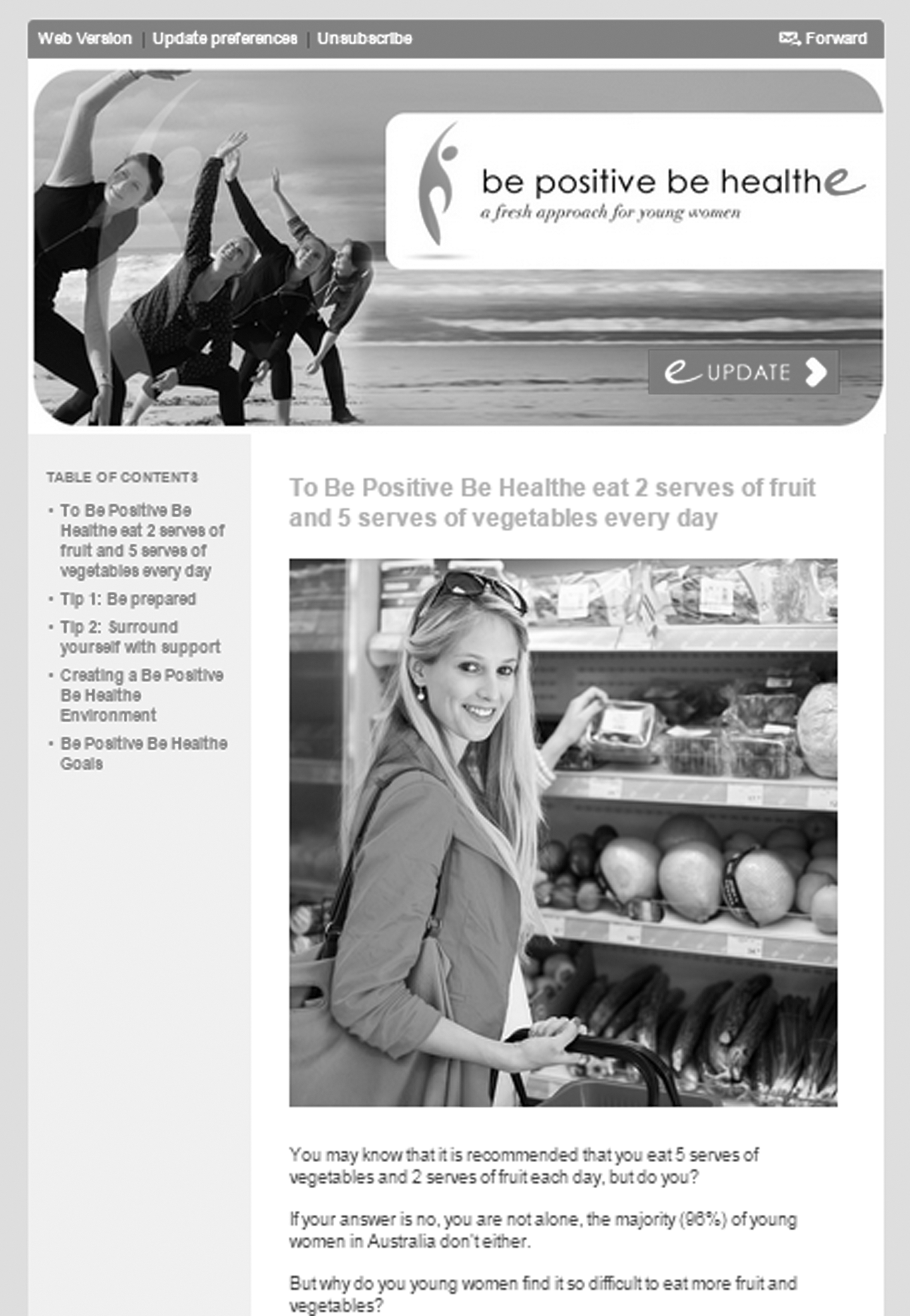
Be Positive Be Healthe electronic newsletter.
Be Positive Be Healthe Program Components and Alignment to Cognitive Behavioral Therapy Strategies
CBT, cognitive behavioral therapy; SMS, short message service.
Aim 3: Evaluation
Materials and Methods
Study design
This was a pre–post single-arm study conducted from September to December 2013. Ethics approval was obtained from the University of Newcastle Human Research Ethics Committee.
Participants
Women 18–30 years of age with a self-reported BMI of 25–29.9 kg/m2 were recruited. Eligibility criteria included having a computer and iPhone® (Apple, Cupertino, CA) with access to the Internet, moderate level of computer and smartphone skills, weight stability over the previous 6 months, not currently pregnant or breastfeeding or planning to become pregnant in the next 3 months, no metabolic disorders, not taking medications that affect weight, and being able to attend the University of Newcastle campus on two occasions for measurements.
Recruitment
Young overweight women who completed the online survey (Aim 1) and indicated interest in being contacted about future weight loss studies (n = 111) were invited to participate via e-mail. The study was also advertised on the University of Newcastle blog and social networking sites.
Intervention
Participants received access to the Be Positive Be Healthe program, as described in Aim 2, for 3 months.
Data collection: Program acceptability
Participants completed a 3-month postprogram survey and were asked to rank overall acceptability on a 5-point Likert scale, from strongly agree ( = 5) to strongly disagree ( = 1), as well as the attractiveness (“was visually appealing”), comprehension (“provided me with useful information about”), usability (“was easy to use/receive”), and ability to persuade/engage (“helped me to attain my weight loss goals”) of the individual program components. Each participant's use of the e-health tools was objectively tracked, including number of Web site log-ins, completion of online quizzes, discussion forum posts, number of e-mail newsletters opened, and number who downloaded the smartphone application.
Data collection: Estimation of treatment effect
Weight-related measures were taken at baseline and after 3 months. Height was measured to 0.1 cm on a portable stadiometer (model BSM370; InBody, Cerritos, CA). Weight, fat mass, and fat free mass were measured without shoes and in light clothing using bioelectrical impedance analysis (model 720; Inbody). Waist circumference was measured to 0.1 cm using a nonextensible steel tape measure.
Participants received an AU $25 gift voucher to cover costs of attendance at data collection sessions, as well as a summary of their individual anthropometric measurements at study completion.
Statistical analysis
Program acceptability measures are presented as mean ± SD, with higher scores (maximum of 5) indicating greater acceptability. Changes in weight-related outcomes from baseline to 3 months were calculated for those who completed the program, as well as for all participants who commenced the program. For dropouts it was assumed the measurements remained the same as at baseline (i.e., baseline observation carried forward). Differences in weight-related outcomes from baseline to 3 months were tested using t tests in Stata version 11.0 software.
Results
Of the 111 initial survey respondents invited to participate and the 24 additional inquiries from other study advertisements, 35 women were screened for eligibility, and 26 met all inclusion criteria. Eighteen women (mean age, 22.8 ± 3.2 years; BMI, 27.3 ± 1.6 kg/m2) enrolled. All had completed high school education or above, the majority were born in Australia (94.4%, n = 17), and most (72.2%, n = 13) were single/never married. Twelve (66.7%) women completed the 3-month follow-up assessments for the primary outcome of weight, and 11 women (61.1%) completed the remaining measurements. There were no significant differences in baseline characteristics between completers and dropouts, other than marital status. Participants in de facto relationships were significantly more likely to dropout.
Acceptability
Participants visited the program Web site a mean of 3 ± 2 times (range, 0–8), with 94.4% (n = 17) visiting the Web site at least once. Most (88.9%, n = 16) completed the first online quiz, 44.4% (n = 8) did the second quiz, and 5.6% (n = 1) did the third quiz. There were 22 posts to the discussion forum, including five posts by the moderator. One-third of participants (n = 6) added at least one post to the discussion forum, and most (94.4%, n = 17) opened at least one e-mail newsletter, with the number opening newsletters ranging from 38.9% (n = 7) for Newsletter 6 to 94.4% (n = 17) for Newsletter 1. All text messages were successfully sent. Twelve (66.7%) participants downloaded the Easy Diet Diary smartphone application.
Eleven participants completed the process evaluation questionnaire. All reported accessing the Web site and online discussion forum and receiving/reading the text messages and e-mail newsletters. Nine (82.8%) reported completing at least one of the online quizzes and reading the feedback report. Five (45.5%) reported completing the goal setting. Overall, four participants reported they were satisfied with the program, five were neutral, and two were dissatisfied (mean, 3.4 ± 1.0).
Table 4 summarizes the mean rankings for program acceptability. Participants found all program components visually appealing (mean scores, 3.9–4.4). The online quizzes with feedback reports, e-mail newsletters, and text messages were ranked highest for providing useful information about nutrition and physical activity. All program components were ranked moderately (means, 2.8–3.1) for helping participants attain their weight loss goals, with the e-mail newsletters ranked highest with a mean score of 3.1 ± 0.5. Participants found most program components easy to use and/or receive, with the discussion forum and goal setting being least easy to use (mean, 3.6 and 3.4, respectively).
Rankings for Attractiveness, Comprehension, Usability, and Ability to Persuade of the Seven Program Components
Data are mean ± standard deviation values.
app, application; NA, not applicable.
Treatment effect on weight-related outcomes
For both intention-to-treat and completers' analyses (Table 5), significant reductions in weight, BMI, and waist circumference from baseline to 3 months were observed.
Weight and Body Composition Changes in Young Women Participating in a Targeted e-Health Weight Management Program from Baseline to 3 Months
Data are mean ± standard deviation values.
n = 11.
BMI, body mass index; BOCF, baseline observation carried forward.
Discussion
This project used formative research to develop a targeted e-health weight loss intervention for young women. Despite consultation with young women to inform the development of the program, acceptability was lower than predicted, and the need for modifications to the program prior to further evaluation was identified.
Formative research (Aim 1) highlighted that young women are interested in a program delivered using a variety of e-health technologies (smartphone application, e-mail, text messages, and a Web site with a discussion forum). A 2015 systematic review 22 of e-health weight management interventions for adults (n = 84 studies, 139 e-health interventions) found over two-thirds of the interventions were delivered using one type of technology, and only 6% of interventions used three or more types of technologies. Most of the interventions (78%) used a Web site, but only 34% used e-mail, 9% used text messages, and 5% used a mobile application. Therefore the number and types of technologies young women preferred for intervention delivery exceeded what has been provided as part of evidence-based e-health weight management programs to date. Given young women are highly prevalent users of technology, 10,11 a challenge is to deliver an intervention that keeps abreast of emerging and popular technologies. This highlights the need for health researchers to work not only with their target group to develop e-health interventions, but also with “technology” experts.
By developing an intervention targeted to young women, we hypothesized that recruitment and retention would be higher than previous weight management intervention studies. Many young women (95%) reported in the online survey (Aim 1) they were interested in participating in a weight loss program designed for young women. The number of study participants (n = 18) (Aim 3) appears low in comparison with the number (n = 111) who were invited to participate from the online survey. However, as this group received information on the strict eligibility criteria as part of their invitation, it is not possible to determine how many did not participate because they were not interested or because they deemed themselves ineligible for the study. Furthermore, our postintervention retention rate of 67% was low, which is consistent with the findings of a systematic review of weight management interventions (n = 9) for young women 18–35 years of age (range, 54–100%; in six studies, <80%). 7 This was despite using many of the strategies recommended to retain young women in health research (e.g., reimbursement, provide results at study completion, appointment reminders). 26 Therefore, when working with young women researchers we need to consider the potential impact of higher dropout rate on study design (e.g., in sample size calculations), but also test and compare different strategies (e.g., number and type of incentives) to promote study participation and completion.
Due to the formative research, we also anticipated high levels of program demonstrated by strong usage and satisfaction with intervention components.
Only 18% (n = 2) of participants reported they were dissatisfied with the program, which is lower than in a recently published weight loss interventions for young adults, which reported almost one-third of young adults were dissatisfied. 27 However, the mean overall program satisfaction (3.4) was between neutral and satisfied, with many participants (44.5%) uncertain (i.e., neutral) about their level of satisfaction. This may be due to disparate acceptability with the different intervention components.
Usage of some aspects of the program was initially high (e.g., online quizzes, e-mail newsletters) but declined over time, whereas engagement of some components was poor throughout (e.g., online discussion forum, goal setting). A relationship was evident between the usage of and satisfaction with the program components. For example, the online quizzes and e-mail newsletters were the most accessed and ranked highest for acceptability. The discussion forum and goal setting task were least acceptable, which was reflected in the low level of usage of these components. It is possible the low levels of acceptability were due to issues with the program delivery mode (i.e., technology issues). For example, in Aim 1 we found that most women (93%) indicated it was “likely” they would “set goals for weight loss.” However, goal setting was ranked lowest for usability, and anecdotal feedback indicated participants did not know how/where to set their goals. It is also possible the poor acceptability was due to the actual delivery of the program strategies. For example, in Aim 1 only 40% of young women reported they were likely to interact with other members of the weight loss program. Despite this, to ensure the cost-efficient program delivery, the researchers only posted to the discussion forum if a question was posed and did not promote discussion within the forum. So, how the behavioral strategy was delivered may have led to the poor acceptability in this instance.
Finally, program acceptability may have also been influenced by other factors unrelated to usability or delivery of behavioral strategies (e.g., participant expectations and characteristics, lack of human contact, competing interventions, or other external events experienced by participants). 28
Implications
Despite the lower than anticipated acceptability and retention, the intervention achieved statistically significant improvements in key weight-related outcomes after 3 months. These results demonstrate the potential of a targeted, e-health approach to weight management for young women and provide support for ongoing refinement and evaluation of the intervention. Future versions of the program may need to consider improvements to the delivery mode, as well as how behavioral strategies are implemented. For example, the goal setting component could be easier to locate (e.g., added to the Web site menu). In contrast, to boost social support a greater level of interaction by the program provider on the online discussion forum may be required to initially engage young women in discussion.
The study also highlights the need for more comprehensive evaluations of weight management interventions for young women. Studies including larger sample sizes that evaluate treatment outcomes and also conduct process evaluation incorporating both quantitative and qualitative methods will help to overcome the complexities currently faced with recruiting, engaging, and retaining young women in obesity treatment. A pilot randomized controlled trial (clinical trial registration number ACTRN12615000272594) to evaluate the feasibility and efficacy of the modified Be Positive Be Healthe is currently underway.
Limitations
Aims 2 and 3 were limited by the small amount of funding available (AU $10,000). As a result, the intervention that was developed did not directly match the preferences of the target group indicated in Aim 1, and only 18 women could be recruited for the pre–post study. Due to the small sample size, results, particularly those pertaining to the weight-related outcomes, should be interpreted with caution.
Conclusions
Young women indicated in formative research they are interested in participating in a weight loss program designed specifically for them, and delivered using technology. Issues impacting on acceptability will inform specific modifications to the e-health program components and delivery of behavioral strategies to ensure a higher proportion of young women complete treatment and actively engage with the program components.
Footnotes
Acknowledgments
This study was funded by a University of Newcastle Early Career Researcher grant. M.H. is a National Heart Foundation Postdoctoral Research Fellow (award ID number 100177).
Disclosure Statement
No competing financial interests exist.