




Abstract
Introduction
China has about one-third of the global incidence of diabetes, 1 and its diabetes-related economic burden ($38 billion in 2013) is increasing. 2,3 Yet Chinese patients and their families typically do not receive sufficient information about diabetes from healthcare providers, 4 –6 and so the majority of Chinese diabetic patients lack information necessary for self-care. 7 This can lead to severe health consequences and a sense of powerlessness regarding treatment and self-management. 8 –11
Effective self-management of diabetes 12,13 can be supported by mobile health (m-health) applications (apps), enabling patients to communicate with healthcare providers regarding glucose levels, weight, and diet control. 14 –17 The quality of m-health tools is problematic, however; few apps offer all of the features considered necessary for effective diabetes management, 18 and despite the high prevalence of diabetes and adoption rate of mobile phones in China, 19,20 knowledge about the quality of diabetes-related Chinese mobile apps is lacking. Here we explore the features and types of health information that Chinese diabetes mobile apps provide, and we suggest recommendations for their further development.
Materials and Methods
In December 2014, we selected Android™ (Google, Mountain View, CA) and iOS (Apple, Cupertino, CA) apps through multiple rounds of screening (Fig. 1). We then coded each app's features according to the app's description in the app stores. We defined “features” as functions that support diabetic patients' self-management. Five main features were adapted from a previous study 21 ; additional features were based on the U.S. national standards for diabetes care. 22 The final list of 15 features comprised general diabetes education, diet management, weight management, blood glucose monitoring, physical activity/exercise monitoring, communication with healthcare providers, insulin management (dosage calculation, self-injection), oral diabetes medication management, blood pressure (BP) monitoring, communication with family, communication with peer patients with similar conditions, disease-related alerts/reminders, calorie count, body mass index monitoring, and cholesterol monitoring.
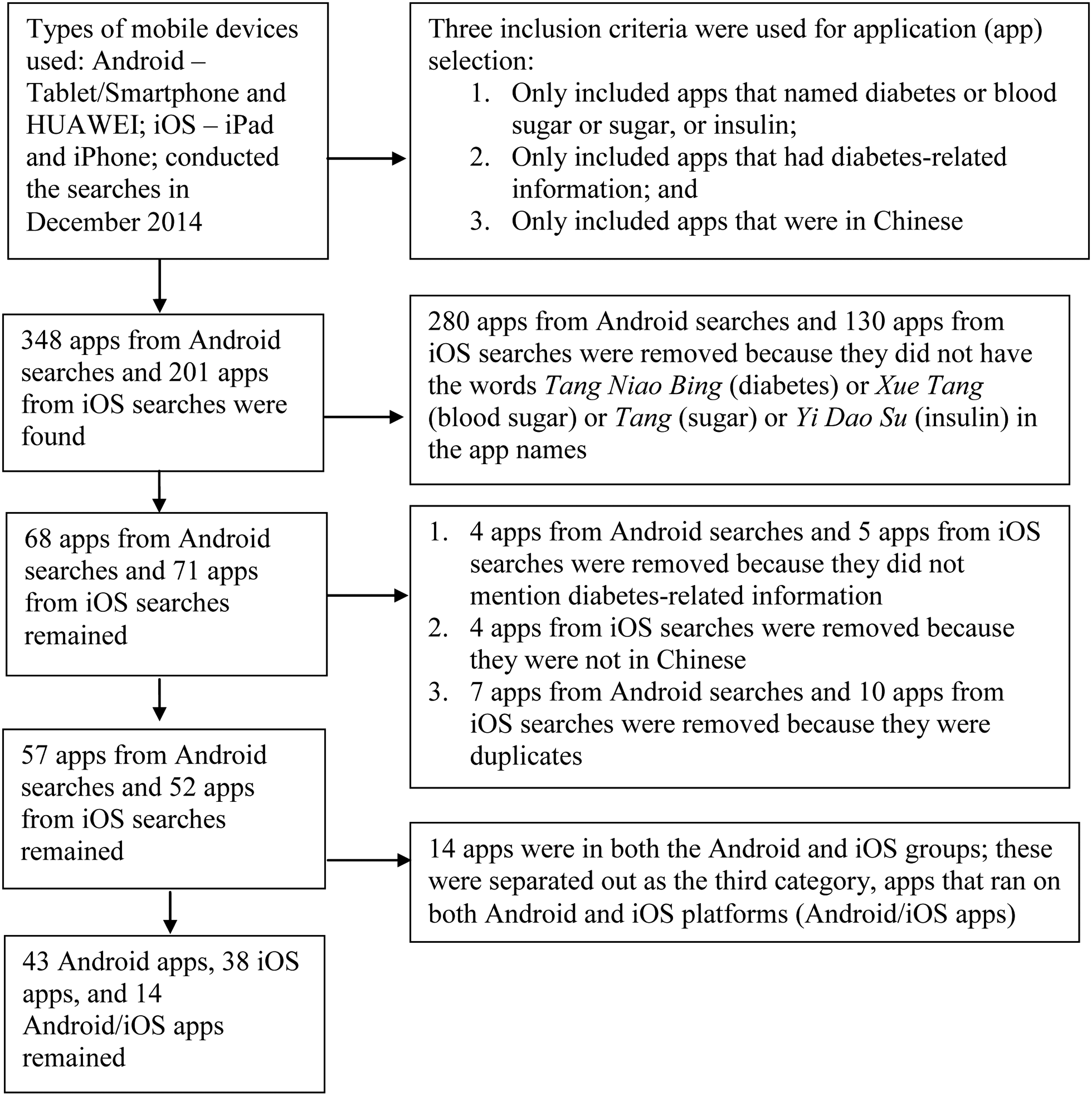
Application (app) selection process.
To analyze the types of health information provided in the apps, we adapted the health information wants (HIW) framework, 23 –25 which defines seven types of health information that patients desire in medical encounters: information about diagnosis; treatment; laboratory tests; self-care; complementary and alternative medicine (CAM); psychosocial aspects; and healthcare providers (Table 1). Each app was independently coded by at least two authors. The authors' agreement rates for the iOS and the Android apps were 97% and 98%, respectively. Apps that ran on both Android and iOS platforms were coded by three authors, with an agreement rate of 0.942 (Krippendorff's alpha). Differences were resolved through all authors' discussion.
Seven Types of Health Information
CAM, complementary and alternative medicine.
Results
The final sample numbered 95 apps: 43 for Android, 38 for iOS, and 14 that ran on both Android and iOS. All Android apps were free. Five of the iOS apps required a fee that ranged from $0.99 to $1.99 for downloading. All apps were released during 2011–2014, with 2014 seeing the highest number for both Android and iOS. The features and types of health information provided by the apps are summarized in Table 2.
Year When Each Application (App) Was Released, Features, and Types of Health Information Provided by Chinese Diabetes Apps
Data are n (%).
BMI, body mass index; CAM, complementary and alternative medicine.
Seven (7%) of the apps had none of the 15 features, 44 (46%) had 1–5, 39 (41%) had 6–10, and only 5 (5%) had more than 10 (Table 3).
Number of Features Provided in Each Chinese Diabetic Application
Six (6%) of the apps provided none of the seven types of health information defined by the HIW framework, 49 (52%) provided one to three types of information, and 40 (42%) provided four to six. No app provided all seven types (Table 4).
Numbers of Types of Health Information Provided in Each Chinese Diabetes Application
Discussion
General patient education was the most common feature among the apps, followed by monitoring of blood glucose, diet/food/nutrition, insulin, and exercise/physical exercise. These are also the most common features in U.S. diabetes apps, 12,26 supporting the generalizability of our findings. However, few apps included more than 12 of the 15 self-management features, and seven of the apps had none, suggesting that few of the apps could provide a comprehensive set of tools for diabetes self-management. 13,21,27
Psychosocial support, disease-related alerts/reminders, and information about BP, cholesterol, and body mass index were featured in only a small percentage of the apps, suggesting that there is much room for improvement in the development of Chinese diabetes mobile apps. Evidence suggests that information about laboratory tests, CAM, healthcare providers, and psychosocial support are all important to patients. 23 –25 Information about psychosocial support, for example, affects patients' well-being, 12,26,28 and psychosocial interventions can improve patients' diabetes self-management. 1,3,8,29 Not providing information about the psychosocial aspects of diabetes self-management is a missed opportunity that should be addressed. The majority of the apps also did not provide information about healthcare providers or facilities, so those apps could not facilitate decisions about sources of treatment. In addition, CAM has been recommended as a supplement to standard treatments in chronic disease prevention and health promotion, 30 but CAM information was least likely to be provided in the apps.
Shared decision-making is at the core of self-management and patient-centered care. It requires that patients be actively involved in their own care and decision-making and that healthcare providers provide services based on patients' personalized needs and preferences.
31
–34
Because the majority of the selected Chinese apps did not provide many of the features and types of information essential for diabetes self-management, we recommend the following for future mobile app development, diabetes research, and practice: 1. Diabetes apps should integrate more features that facilitate diabetes self-management. 2. M-health apps should provide a diverse range of types of health information, especially about laboratory tests, CAM, and healthcare providers. 3. Healthcare providers should examine the features and types of health information provided in apps so that they can recommend appropriate apps to patients.
A major limitation of this study is that we adapted the U.S. national standards for diabetes self-management to develop our list of features, and we used the U.S.-originated HIW framework to develop a list of the types of health information that patients might want. Although these algorithms formed a solid, justifiable foundation for our analyses, they do reflect a U.S. context and might not accurately reflect the environment and challenges that Chinese diabetic patients face. Some evidence suggests that there are differences in diabetic care and self-management practice between China and the United States. 5,35 Future research should examine the cultural aspects of diabetes self-management.
Footnotes
Acknowledgments
Editorial support with manuscript development was provided by the Cain Center for Nursing Research and the Center for Transdisciplinary Collaborative Research in Self-Management Science (grant P30, NR015335) at the University of Texas at Austin School of Nursing.
Disclosure Statement
No competing financial interests exist.