




Abstract
Background:
During clinical case diagnoses, especially in low-resourced areas, the use of vocabularies within Unified Medical Language System (UMLS) can strengthen discussions between health professionals and, in certain cases, eliminate the need, enabling faster treatment.
Introduction:
This article presents the benefits of using UMLS as a collaborative discussion tool and verifies its impact.
Materials and Methods:
The Sanar system has been improved by UMLS when using text retrieval to extract relevant medical concepts from cases investigated by the user and to provide contextualized searches of related articles. An experiment was conducted, focused on team engagement and discussion of a Zika virus case using Sanar, both with and without UMLS contextualization.
Results:
The use of the tool was measured, and it was determined that the discussion in the group with UMLS support was more complete based on better information and inclusion of more variables. Clinicians involved responded to a questionnaire evaluating the relevance of functions.
Discussion:
From the questionnaire showed that most of the group supported UMLS as important in complex diagnostics; the use of knowledge extraction before discussion is relevant to align knowledge of participants with more variables, such as the Zika virus, and to minimize the need for interaction in widely discussed cases.
Conclusions:
Based on the results obtained with the questionnaire, the use of UMLS provides acceleration in the diagnostic process that precedes interaction with other health professionals through clinical discussion tools. For future work, a mobile version will support offline navigation for locations with limited Internet access.
Introduction
Health information systems contribute to information exchange by providing service in a faster, more efficient, and more cost-effective manner. 1 –3 In complex situations that require greater agility for diagnosis and treatment, collaboration 4 –6 has been an option to encourage exchange of experiences to increase positive results. 7
Although collaborative tools, especially those that require real-time interaction, have a positive effect on discussion and resolution of clinical cases, there are still locations where Internet access is limited, 8 –10 thereby compromising intensive use of these technologies.
In the case of rare or region-specific diseases, such as the Zika virus, 11,12 it may be difficult to find users available for interaction at the time of greatest need. In situations such as this, the lack of interaction may have a negative impact on treatment, resulting in undesirable patient care. 13 –16
The use of alternative methods to ensure preliminary search and palliative care is necessary, although they may be checked or reinforced by subsequent interaction with other professionals. 17
Effective information extraction from biomedical research is an important area of information technology for the promotion of proactive health, both predictive and preventive. 18 –20 In this case, a base of knowledge has been built and access depends on the availability of information and knowledge of the professional.
Potential use is extensive. The information base available was built by extracting knowledge from an extensive clinical terminology library, so that the user need only to enter keywords for the search. 21
Whether through extraction of information from previous research, interaction with other professionals using cooperation, or both, the objective is to obtain maximum benefit for the patient.
This article shows that prior research can enrich discussion, promoting more positive results in collaborative interaction. This initiative triggers greater involvement of participants in discussion due to synergy arising from prior reading and greater alignment of knowledge. An open discussion tool that allows registration by users from any location is particularly relevant when considering different backgrounds and levels of experience. Another important aspect is the potential for faster analysis of the case since reading publications derived from proven knowledge can help in analysis and bring the team closer to the final diagnosis.
What is expected from this analysis is to determine the impact of the use of Unified Medical Language System (UMLS) 22 in supporting diagnosis of clinical cases.
Work is focused on evolution of the Sanar collaborative clinical platform. 23 Sanar is the culmination of analysis of computational tools focused on clinical cases. It was designed for global support of knowledge among health professionals. In this article, we present the methods integrated in Sanar that take advantage of standardized vocabularies inside UMLS for improving diagnosis.
Materials and Methods
Using Sanar through
Sanar allows a user to create a case that has diagnostic challenges. To enhance the initial case description and discussion, the Sanar platform has been extended to include the use of standardized vocabularies for describing cases.
Because of vocabularies available in UMLS, cases are semiautomatically coded using keywords obtained from case titles. For a better understanding, Figure 1 depicts the flow for concept extraction and search submission of a case and receipt of information from standard concepts and potential related publications.
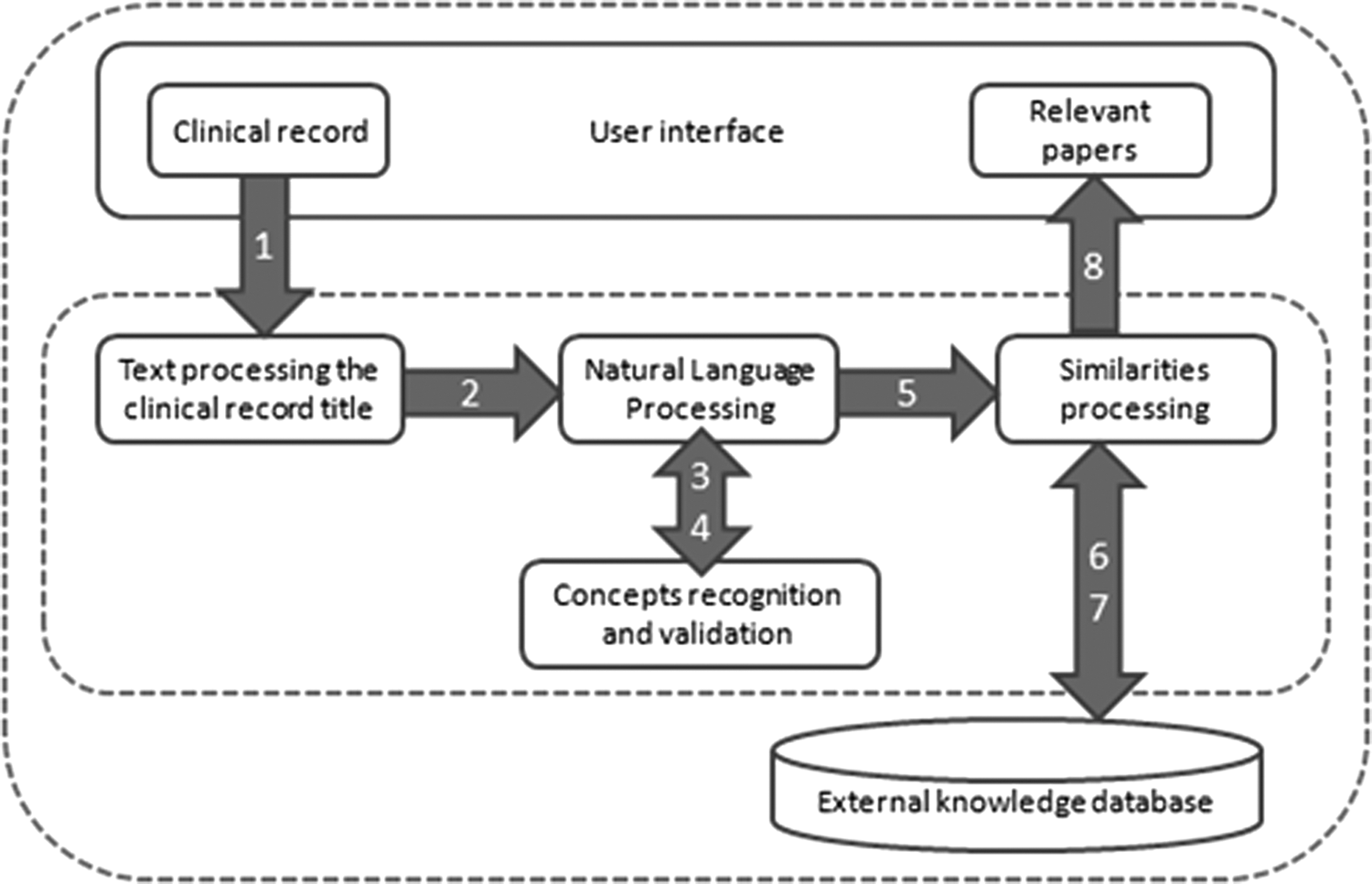
Architecture proposed for recovery of publications to support the discussion of clinical cases.
After publication of the case, the natural language of the title is analyzed using MetaMap. The MetaMap tool is capable of recognizing various concepts present in the free-text that comprises a case title. After obtaining information about a known concept unique identifier from a title, a concept-based search is developed to detect similarities with the knowledge base drawn from published medical cases. The related cases obtained are delivered to the user interface for query and application in the manner he/she considers relevant.
Registration of a case involves two steps, with the first being focused on key textual information and the second focused on inclusion of images to complement the case and facilitate discussion (Fig. 2).

Example of the workflow proposed to support the discussion of clinical cases.
In this work, the focus is on integration (marked in red in Fig. 3) that allows the user to enter text and generate search results with similar words using MetaMap accessible through links to publications. In addition to the automatic search, the user can also add or remove terms from the query. In the example, the following results can be viewed related to the term Syndrome.
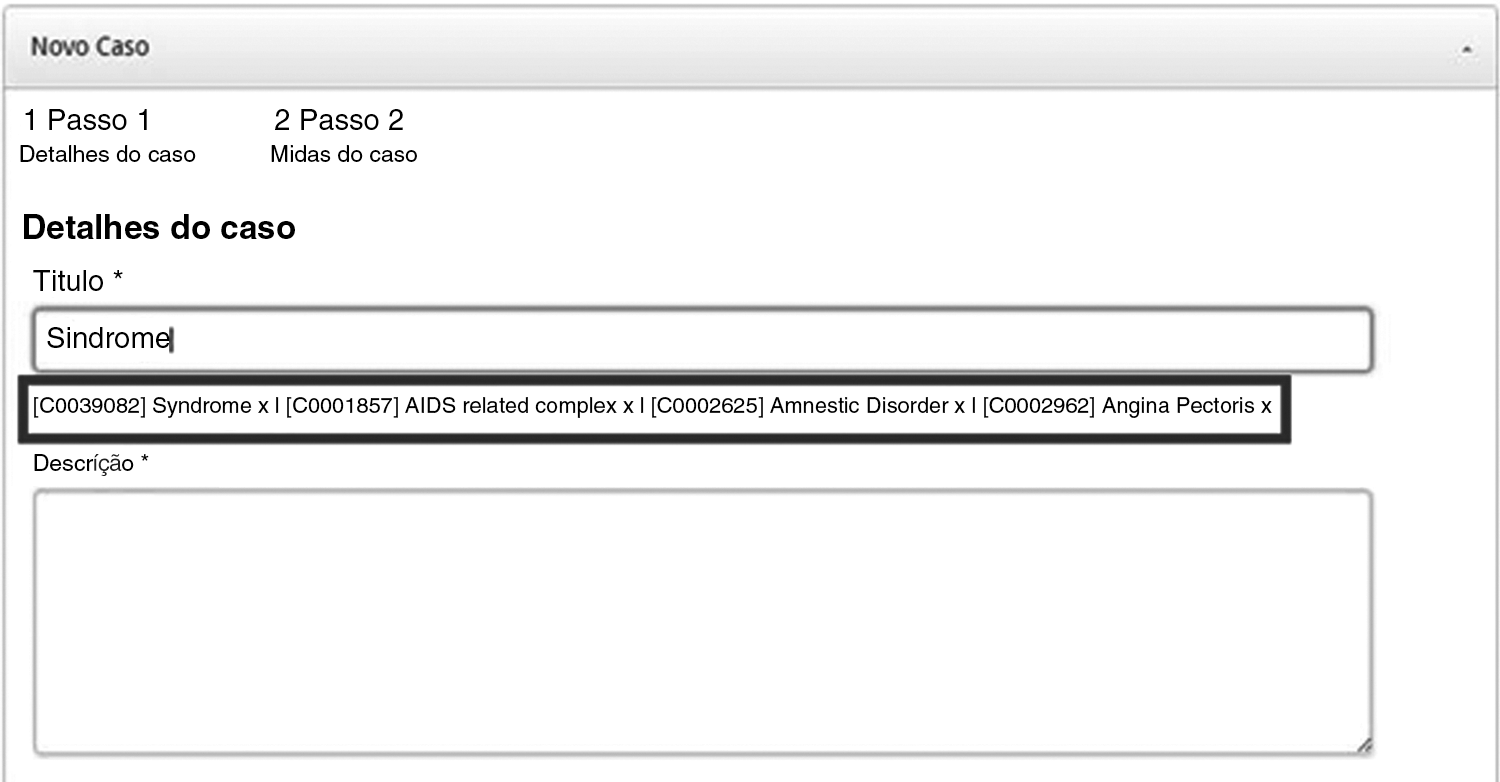
Sanar new case interface, including the proposed feature.
Following the same format as the previous figure, an indication in red was inserted to show the implementation area of the viewing screen and the case discussion using the Sanar tool. Just as it is possible for the author to view articles related to the specific case being published, other users can proceed in the same way. All those who interact with the case can obtain all knowledge within reach, as can be observed in Figure 4.
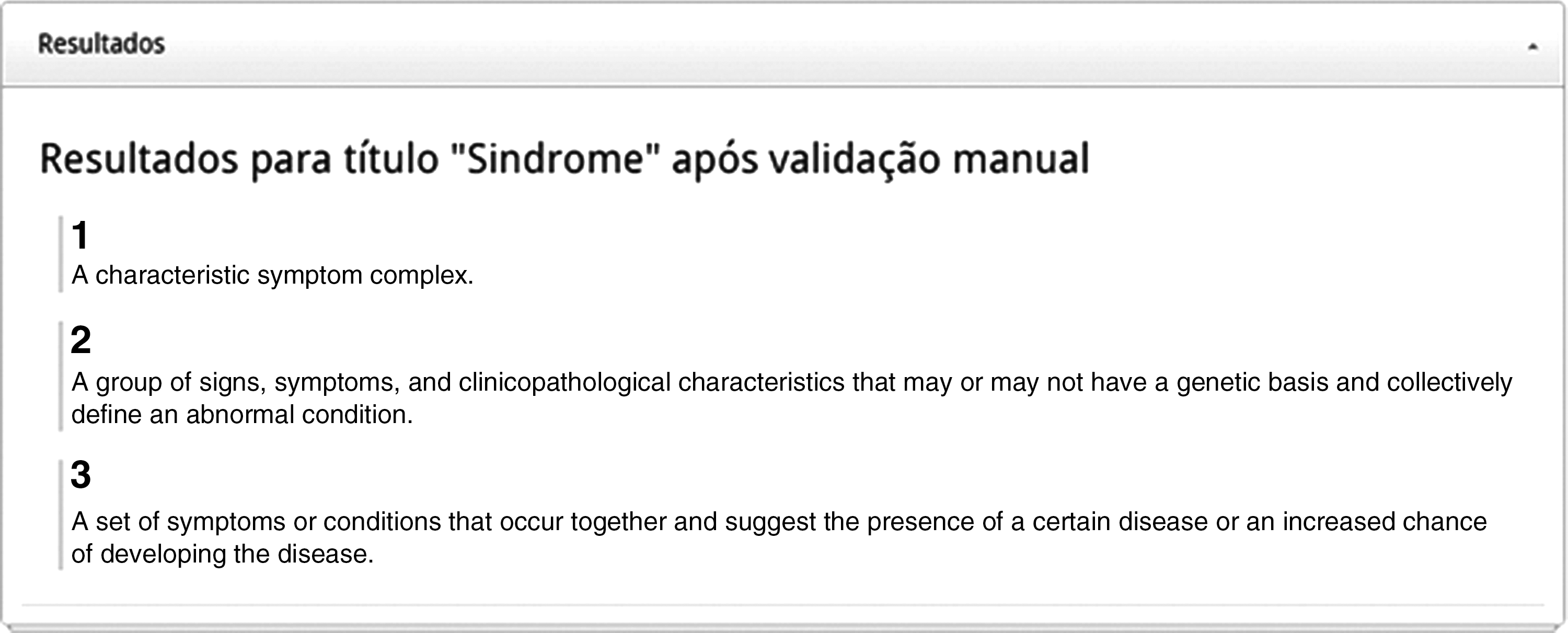
Sanar manual validation results interface.
In addition to the features that support discussion, the Sanar platform has also been extended by recording other indicators that measure the amount of interaction of the participants, the direction of reasoning around the expected diagnosis, any conflict during the interaction, and the estimated time to achieve the final result. The construction of a validation model through indicators was based on concepts related to awareness 24 –26 and context, 27 –29 as detailed below.
User Participation
This feature is present in collaborative environments. The action of users accessing textual information or action on an artifact can occur without intervention of the environment and with no special hardware requirements. Written text, for example, is a way of obtaining information from an environment. This is important to verify the performance level of an individual in building an artifact (in the case of this article, the diagnosis).
In the integration experiment, user participation level is measured by the length of time he/she interacts or until interrupted by another person, as in a shift system. The shift begins when a person starts interacting alone. The most appropriate way to measure interaction is the number of messages. Counting the number of words is also an option to obtain the degree of interest. Therefore:
These indicators reference individual actions. Group discussion is the sum of all individual participations. If the goal is to obtain the amount of participation from each participant, it is possible to calculate an average.
In integration of the Sanar tool, the amount of participation is reflected directly through comments on each case. Influence of a user in case A would not necessarily mean greater participation in case B.
Objects Manipulation
The input from a user within the application is a good indicator of interest in the discussion. This input also can establish what users are doing and how they are doing it. This approach is the most appropriate way to calculate the manipulation of objects:
In this work, object handling is determined through the use of images and through consultation of articles resulting from the use of UMLS.
Experiment Stages
Group members need time to become familiar with the interaction environment. In this experiment, this time is not counted. The group is forwarded directly to the doctor if the display relates to the Zika virus to proceed with comments based on the analysis performed. Participants can manipulate images or articles related to the case, obtained from the query using UMLS. The last step is the evaluation of the comments from the moderator, performed to define the final diagnosis.
Discussions
Regarding discussions, an analysis will be conducted to study the interaction time in relation to the number of people involved. In a situation where the moderator believes that the discussion cannot result in a possible diagnosis, he/she may intervene, suggesting the reasoning to be directed toward another path. The experiment's aim is to encourage discussion naturally without intervention. The discussion works similar to a forum; however, there are a number of mechanisms available to evaluate interaction among employees in a more accurate way.
Experiment Analysis
In the case of the experiment described in this article, there is a time limit for reply. It is noteworthy that are no time limits in a real-life situation, as the tool used for integration is based on asynchronous interactions.
From the moment the event is published, interaction can be started. The discussion will finish when the moderator is satisfied with the outcome. Either way, this action does not prevent another user from sending their opinion later, after days, weeks, or months.
The collaboration analysis occurs through the participation of each user. This process is facilitated through tools that capture the opinion of each individual and transform it into relevant information.
Results
For evaluating benefits from integrating standard vocabularies present in UMLS into Sanar collaborative cases, an experiment was performed. Participants did not, at first, know that the choice of a case related to the Zika virus was due to relevance at the time or the potential for extensive discussion due to its similarity to other diseases.
The same case was given to two groups: the first group used the previous version of the tool without UMLS integration and the second group used the new version with UMLS-annotated concepts and contextualized search. The main purpose of these experiments was to analyze the use of information extraction as a prior step to collaborative discussions of clinical cases. Additionally, it has been evaluated whether contextualization provided by information extraction was influenced positively by accelerating the collaborative process.
Empirical Validation
To prove the effectiveness of the proposed integration between Sanar and UMLS in promoting more productive discussions, studies were conducted.
Use of Sanar
The first study was carried out to validate that: 1. User participation, interaction variation, and above all, object handling are relevant to prove the contribution of users to medical knowledge. 2. The proposed interaction influences higher quality and the opportunity to seek answers to cases without the need for interaction.
An invitation for participation was delivered to various health professionals with knowledge in general practice from institutions located in Brazil. For the first interaction, four people were selected. Although the ideal would be to repeat the experiment with various homogeneous groups, the main goal at this point was to ensure minimal use of the proposed integration.
Materials for the interaction are participants' computers that are geographically dispersed, Internet access, and a web browser. Other than health-related knowledge, this activity does not require specific competencies.
Regarding the procedure, participants can access the entire application, including the help section. This allows more familiarity with the environment, providing relevant information for later analysis. The user will then have access to a clinical case specifically related to the Zika virus. This is a case already examined and diagnosed. This will be used to evaluate the quality of the discussion. During the course of the study, the user may speak as often as he/she considers necessary.
A case related to the Zika virus with images of symptoms and some related articles that were brought from the title insert “rash, joint pain, and conjunctivitis in a 25-year old man patient” was used. Data were extracted from conversations between the participants of the experiment. Volunteers actively participated in the experiment. The variation in the age of users (between 25 and 38 years) broadened the results.
The conversation consisted of a total of 18 messages during the day of the experiment. The time was well spent, since the inputs were properly distributed, as detailed below (Fig. 5).

Average access to the clinical case discussion tool.
Opinions were asked and discussed naturally. Fluidity of the results was detected, although technology as prior knowledge can generate a higher result in user participation quality.
One of the main observations in the experiment was the behavior of the respondents. Even if the researchers' arguments had been completed, reviews were delivered to support the suggested diagnosis. Other responses were characterized as complements or replies to concordant or discordant opinions.
User feedback questionnaire
At the conclusion of the process, feedback was collected from the second group regarding their experience using the integrated tool with UMLS to discuss consultations. An online questionnaire was used to capture participant's feedback regarding the use of the proposed integration and verify the quality of interaction.
An online questionnaire was sent to the participants with a period of about a week in which to respond. The goal was to treat all participants as part of a global group.
Materials and activities were the same as used in the previous experiment. The main difference was that the online questionnaire followed a statement model that could be scaled from 1 (strongly disagree) to 5 (strongly agree) (Table 1).
Questionnaire Results
According to the responses of users, the proposed initiative is useful and relevant. The tool still requires improvement in ease of use to provide a more intuitive interface.
Experiment Conclusions
The results obtained in the Sanar handling experiment, although it was performed by a small group of users, showed ease of use and interest in statistics of “Individual participation rate” and “Handling quantity.” Not only the descriptions but also the images were accessed by at least 80% of the interactions (4 out of 5). Attention to detail and proactivity in the search for knowledge are common characteristics of the health professional profile.
Another aspect was the interest of participants in commenting on responses to the questionnaire, although there was no field for that. This finding had not been anticipated in the experiment, but due to its relevance, the information sent was inserted.
The combination and subsequent analysis of the two parts of the experiment enabled both objective and subjective views, key to obtaining more positive conclusions.
Discussion
As stated in the previous section, the use of UMLS-based annotation and search accelerated the diagnostic process that preceded the interaction with other health professionals through clinical case discussion tools.
The results open the possibility of avoiding interactions for less complex cases, in addition to preparing individuals for collaboration. The inherent knowledge of the user combined with manual disambiguation provides an important step toward better search results.
The Zika virus is a disease whose symptoms are quite common, making it difficult to detect. The objective of the experiment to promote discussion that led to the diagnosis was successfully achieved.
Regarding the quantity of participation, the interaction of the younger professionals with the tool was more intensive. While this could be due to greater familiarity with technology, in informal feedback, the justification offered by some users outside of the lower age group was the lack of time available to access the application more frequently.
An observation that may be acted upon in the future is integration with Electronic Medical Record solutions. Taking proper care of data protection, sharing diagnostically similar case information may be a better approach for health professionals, who have greater day-to-day interaction with this class of software.
In future developments of the Sanar platform, we want to exploit the annotation of title cases and use International Classification of Diseases code for final diagnosis to recommend reviews of previously solved cases with similar symptoms. A mobile application is being developed to accelerate discussion by taking advantage of its chat-like nature.
Footnotes
Acknowledgments
We want to thank our colleagues from Fundação Oswaldo Cruz in Brazil, who assisted our research with their expertise and comments.
Disclosure Statement
No competing financial interests exist.