




Abstract
Background:
Appropriate and effective use of technology within practice is a key competency outlined in Australian dietetics training standards. An e-health skills component (lecture and workshop) was introduced to undergraduate students enrolled in an Australian nutrition and dietetics program.
Methods:
The lecture orientated students to key e-health terms and concepts relating to telehealth and m-health technologies, while the workshop provided an opportunity to apply knowledge. The workshop consisted of four stations with activities relating to (1) orientation to telehealth equipment; (2) comparison of dietetic consultation components completed in person versus remotely via video call; (3) quality assessment of mobile apps; and (4) exploration of advantages and disadvantages, and the ethical, security, and privacy issues relating to use of e-health technologies in dietetic practice. Student experience of the training was evaluated via questionnaire.
Results:
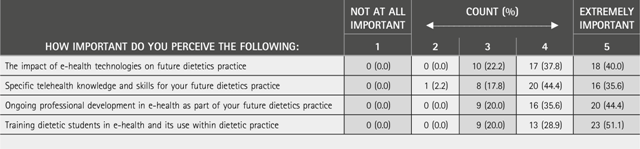
Forty-five students (62.2% aged ≤19–24 years, 86.7% female) completed the survey. Following the workshop, the level of understanding relating to each key e-health concept improved significantly (p < 0.001). The aspects relating to the impact and need for initial training and ongoing professional education to support the use of e-health technologies within dietetic practice were rated a high level of importance by most students (78–80%). The majority of students (93.3% to 97.8%) reported a positive experience at each of the four workshop stations, with “informative” the most common word selected to rate each station (37.8% to 44.4% of students across the four stations).
Conclusion:
The introduction of an e-health skills component resulted in an improved understanding of concepts for using these technologies. These findings provide preliminary support for integration of further e-health training within the dietetics program.
Introduction
The emergence of e-health, or the use of information and communication technologies to support healthcare, has important implications in training student dietitians. E-health is a broad term given to health services or information delivered or enhanced through the use of information and communication technologies, such as the Internet. 1 The definition of e-health continues to evolve and covers a variety of topics, including the remote delivery of health services (e.g., telemedicine, telehealth), through to use of specific technologies to assess and monitor health status and behaviors, and the experiences and applications of e-health by key stakeholders, such as patients and clinicians. 2,3 More recently m-health, which incorporates use of mobile phones, smartphones, and other mobile and wireless technologies, has emerged and can be considered under the umbrella of e-health, in addition to a distinct discipline. 4
The use of telehealth, in particular video consultations, and m-health technologies is recognized as the key element of current and future dietetic practice. 5,6 Demonstrating proficiency in the appropriate and effective use of technology within practice is a key competency outlined in the dietetics training standards of the United Kingdom, 7 Australia, 8 and Canada. 9 In addition to using technology for information management (e.g., sourcing, storing), these standards also dictate the need for education on the use of e-health technologies within practice in areas such as patient education and counseling, 7 or more generally throughout professional practice. 8,9 To ensure effective and appropriate use of e-health in practice, including the unique technical and administrative requirements and clinical considerations, training on the use of these technologies for the delivery of virtual nutrition care is essential. We report on the introduction and student experience of an e-health skills session within an Australian undergraduate dietetics program.
Materials and Methods
The e-health skills component (lecture and workshop) was delivered to third-year students within the Bachelor of Nutrition and Dietetics at the University of Newcastle. A lecture orientated students to e-health concepts and telehealth and m-health technologies. The workshop consisted of four stations with activities completed in small groups followed by a whole class discussion.
Station 1 involved familiarization with equipment (e.g., tablet; computers) and telehealth apps to undertake a video call and use and discuss features such as screen sharing.
Station 2 required students to view three video vignettes of key components of an in-person dietetic consultation: (1) collection of anthropometric data; (2) dietary assessment with portion size aids; and (3) nutrition education using props. Students discussed perceived challenges arising from performing these components during a video consultation and suggest suitable alternatives to allow for completion remotely.
Station 3 exposed students to the Mobile Application Rating Scale (MARS) tool 10 and the quality assessment of three popular nutrition-related apps relevant to the Australian context: (1) Australian Calorie Counter—EasyDietDiary (Xyris Software (Australia) Pty Ltd), (2) FoodSwitch (Bupa Australia Health Pty Ltd), and (3) Calorie Counter & Diet Tracker by MyFitnessPal (MyFitnessPal.com).
The final station built on the previous stations' activities through discussion of advantages and disadvantages of these technologies, including suitability for various settings, and ethical and privacy and security issues presented by virtual nutrition care.
Immediately following the workshop, students were invited to complete a short questionnaire to evaluate the content and impact on their understanding of e-health concepts. Similar to Reinits et al., 11 students were asked to select one word that best described their experience of each station from a predefined list of three pairs, each comprising one “positive” and one “negative” word. Information on age and gender was also collected, in addition to perceived competence across Internet skills using the Internet Skills Scale. 12,13 Completion of the survey was voluntary and anonymous. The project was approved by the University of Newcastle Human Research Ethics Committee (Approval Number QA122).
Statistical Analyses
A mean score was calculated for each of the five subscales of the Internet Skills Scale. 12,13 Responses to the six questions relating to the level of understanding of the key concepts before and after the workshop were converted to a numerical value and change scores calculated (change score = after score–before score). A paired t-test was used to determine if a difference in understanding, present after the workshop, was significant (p < 0.05). All analyses were completed using IBM SPSS Statistics V24.
Results
Sixty-seven students attended the workshop, with 56 attempting the evaluation questionnaire at the conclusion of the workshop and 45 completing all questions. Table 1 summarizes the characteristics of the students and the understanding of e-health skills concepts before and after the workshop. Students self-reported a high level of Internet skills relating to operational, information navigation, social, and mobile tasks (mean scores 4.41 to 4.67), while creative tasks were scored lower (3.77). On average, student understanding of key e-health concepts significantly improved following the workshop.
Student Characteristics and the Understanding of e-Health Concepts Before and After the Workshop (n = 45)
Internet Skills Scale: 23-items in total. Each item was scored on a 5-point Likert scale (1 = “Not at all true of me”; 2 = “Not very true of me”; 3 = “Neither true nor untrue of me”; 4 = “Mostly true of me”; 5 = “Very true of me”) and included a sixth option of “I do not understand what you mean by that,” which was scored as “0” as per van Deursen et al. 12 as it was assumed that participants who did not understand the activity would therefore lack the skill.
Level of understanding was rated on a 5-point scale: 1 = “poor”; 2 = “fair”; 3 = “good”; 4 = “very good”; 5 = “excellent.”
n = 44.
paired t-test; all changes p < 0.001.
SD, standard deviation.
The majority of students placed a high level of importance on e-health in future practice and the need for student training in preparation for practice with 77.8% to 80.0% rating these questions as either a “4” or “5”(out of 5) (Table 2). In general, students used positive words to rate their experience at each of the four stations, with “informative” the most common word selected (37.8% to 44.4% of students) (Table 3).
Student Perceptions of the Importance of e-Health Skills Training (n = 45)
Student Word Rating for Each Station (n = 45)
For the questions relating to experience of each station, responses of “relevant,” “informative,” and “interesting” were condensed into “positive”; while responses of “irrelevant,” “uninformative,” and “boring” were considered “negative.”
Discussion
The e-health skills workshop resulted in an improvement in student dietitians' understanding of key concepts relating to the use of technologies for telehealth and m-health within dietetic practice. Students placed high importance on the impact and need for specific skills and ongoing support relating to the use of e-health in their future practice, and in training dietetics students in the use of these technologies.
While a high level of competence in skills relating to the Internet was reported by this group, students predominantly found the station content to be “informative” with 37.8% to 44.4% students selecting this word to describe their experience across each of the four workshop stations, followed by the term “relevant” (24.4% to 37.8% of students over the four stations). Rienits et al. also found in their training of medical students that these sessions imparted new information. 11 Findings from the current study further highlight that use of e-health within practice is a unique skill set and that not only requires targeted training but also exposure to generic tools, such as the MARS, 10 which enable individuals to assess the quality of apps across various health behaviors, including nutrition.
A limitation of the current evaluation is that not all students who attended the workshop or started the questionnaire completed all questions, and therefore, it may be that the results tend to reflect those who were more engaged with the workshop content. In addition, these findings relate to the experiences of a single cohort of third-year dietetic students and to determine the reproducibility of these results, this session needs to be repeated across multiple cohorts.
The introduction of an e-health skills component was positively received by third-year dietetic students and resulted in an improvement in the understanding of concepts and requirements for using telehealth and m-health technologies. These findings provide preliminary support for integration of further e-health training within dietetics programs.
Footnotes
Acknowledgments
The authors thank Dr. Shamus P. Smith, the University of Newcastle, Australia, for loan of the tablet computers used in this project. C.E.C. is supported by the National Health and Medical Research Council Senior Research Fellowship (APP1108095).
Disclosure Statement
No competing financial interests exist.