




Abstract
Introduction:
Hearing loss (HL) affects people worldwide, many of whom are children. Especially in developing countries, epidemiological data on the prevalence of HL are insufficient to implement effective health promotion programs. In this preliminary study with young adults, we describe and validate a tablet-based hearing screening test developed for interactive remote hearing screening and compare the performance of an audiometry screening tablet application with conventional audiometry. In addition, the sensitivity, specificity, and predictive values of the tablet-based method and the concordance between the two methods were analyzed.
Methods:
Thirty volunteers participated in a double-blind study assessing two auditory threshold screening methods: tablet-based hearing screening and sweep audiometry. For both methods, a correct response to a minimum of two tones out of three emitted at 20 dBHL for the frequencies of 1, 2, and 4 kHz and 30 dBHL for 0.5 kHz in both ears, was considered a negative screening result (normal hearing), whereas hearing impairment was considered a positive screening result.
Results:
According to both methods, 26 participants had normal hearing and four had HL. The Kappa coefficient indicated perfect concordance between methods. The tablet-based hearing screening method had a sensitivity of 100% (confidence interval [CI]: 30.5–100.0), a specificity of 100% (CI: 87.1–100.0), a positive predictive value of 100% (CI: 30.5–100.0), and a negative predictive value of 100% (CI: 87.1–100.0).
Conclusions:
The tablet-based hearing screening test was shown to be a reliable and an accurate method for hearing screening that can be used effectively in places with Internet access and where local audiologists are not available.
Introduction
In the past few years, advances in teleaudiology have increased the use of technological resources for remote screening, assessment, intervention, and health education of hearing disorders. 1 Different telehealth service delivery models are available, including synchronous (real-time), asynchronous (store and forward), and hybrid models. 2 In situations where specialist healthcare personnel are limited or unavailable, teleaudiology may ensure that services and healthcare resources are optimized. 3,4 Even in developed countries, this approach could offer solutions to deliver health services in places with limited resources. 2
A systematic review about the use of telehealth in speech, language, and hearing sciences 1 concluded that telehealth procedures have advantages over the respective face-to-face modalities regarding access and quality of care. However, these studies also provided evidence of the need for additional research. 1,2
Disabling hearing loss (HL) refers to HL greater than 40 dB in the better hearing ear in adults (15 years or older) and greater than 30 dB in the better hearing ear in children (0–14 years). 5 In 2012, the World Health Organization (WHO) estimated that 360 million people worldwide have disabling HL (∼5% of the world's population), 32 million of whom are children (9%). Moreover, the prevalence of HL in low-income regions is nearly double that of high-income regions. 5
It should be noted that epidemiological data on the prevalence of HL in developing countries are scarce and insufficient to plan and implement effective intervention, prevention, and health promotion programs. 6 Moreover, 80% of school-age children have at least one episode of temporary HL during the school year, which may lead to oral and/or written language difficulties. 7
Audiometry is the gold standard of audiology diagnosis. However, this method is not suitable for large-scale population-based epidemiological studies or assessments, because it demands specific equipment and trained personnel, and participants have to go to a health facility. 8,9
The development of long-distance and/or automated audiometers may improve access to screening audiometry in areas without human or physical resources or primary care settings. Such a device may eventually enable a teacher or health professional to perform screening audiometry, resulting in earlier detection of hearing problems. 10 –16
Web-based hearing tests resembling a clinical pure-tone audiogram offer several potential benefits, 9,10,17 –19 and the development and validation of teleaudiology protocols are essential for using online hearing tests in health programs. 19 –22
With the success of tablet computers, it is evident that new technologies could be used for hearing assessment. Accordingly, touch interface computing associated with games has been shown to be a promising alternative for pediatric evaluation. 16
In this study, we describe a tablet-based hearing screening test (asynchronous method) and compare the performance of a hearing screening application (app) with conventional face-to-face audiometry. In addition, the sensitivity, specificity, and predictive values of the tablet-based method and the concordance between the two methods were analyzed.
Materials and Methods
The study was approved by the Research Ethics Committee (088/14), and all subjects provided informed consent before participation. Thirty adult volunteers (24 women; mean age: 22.3 years, age range: 18–34 years.) participated in the study. The participants’ ears were examined with an otoscope at the time of testing and were free of wax or abnormalities. Two auditory threshold screening methods (tablet-based hearing screening and sweep audiometry) were assessed in a double-blind manner (two different audiologists performed each method).
Tablet-Based Hearing Screening System Description: Design and Usage Specifications
The tablet-based hearing screening system consists of an Apple® iPad® (Apple, Inc., Cupertino, CA) that is connected to a TDH-39 headphone via a P10 to P2 adaptor cable plug.
We developed an interactive game app that tests for pure tone screening by using a yes/no two-alternative forced choice interaction. Visual presentation of stimuli (music instruments) was combined with sounds (calibrated warble tones) or silence. The app was developed by using an Adobe Flash CC platform on a Dell Notebook with an Intel Core i7, 16 GB of RAM, and 1 TB hard disk running Windows 8. The acoustic stimuli (warble tones of 0.5 kHz at 30 dBHL and 1, 2, and 4 kHz at 20 dBHL; 2.5 s in duration) were developed by using Wavtones according to the following parameters: carrier waves at 500 Hz and 1, 2, and 4 kHz; ±3% frequency deviation from the nominal frequency (485–515; 970–1030; 1940–2060; and 3880–4120); and 5 Hz modulation signal rate with a ±10% tolerance for the nominal value.
The system was calibrated so that acoustic stimuli were presented at the maximum iPad™ audio output intensity. Calibration met ISO-8253-1-1989, ISO-389-1-1998, IEC-60318-1-1998, and IEC-30318-3-1998 standards and was performed by using the following equipment: class 1 sound level meter Type 2250 with 1/3 octave filters (Brüel & Kjær, Nærum, Denmark), headphone coupler, and an artificial ear (model 4152; Brüel & Kjær) coupled to a one-inch microphone (model 4144; Brüel & Kjær). When the stimuli produced by the tablet had to be adjusted, the app was manipulated by using the Audacity® software until the stimulus reached the desired frequencies and intensities.
To ensure system stability, four iPad tablets were calibrated with two different headphones. No changes in the frequency and intensity of stimuli produced outside the limits allowed by ANSI S3.6 23 were observed after calibration. The hearing screening app includes an algorithm that randomly produces warble tones (at frequencies and intensities described earlier) or no sound, testing each ear separately. Before the test, participants were informed that the stimulus was accompanied by the figure of a musical instrument. The expected answers followed the standard parameters of the test, that is, give a motor response when listening to the sound presented: Participants should respond to the stimulus by touching the figure of the musical instrument that appeared on the tablet screen and then dragging and moving the figure to a specific icon depending on each condition (presence or absence of sound stimulus). On perceiving the sound stimulus (warble tone), participants should drag the musical instrument to the picture of a music band. When no sound stimulus was generated, the instrument should be dragged to the picture of a musical instrument repair shop. As positive reinforcement for responding correctly to the sound stimulus, an animation of an animal playing the musical instrument accompanied by background music was reproduced. Similarly, when no sound stimulus was generated and the musical instrument was dragged to the repair shop, an animation of the instrument being repaired appeared on screen (Fig. 1).
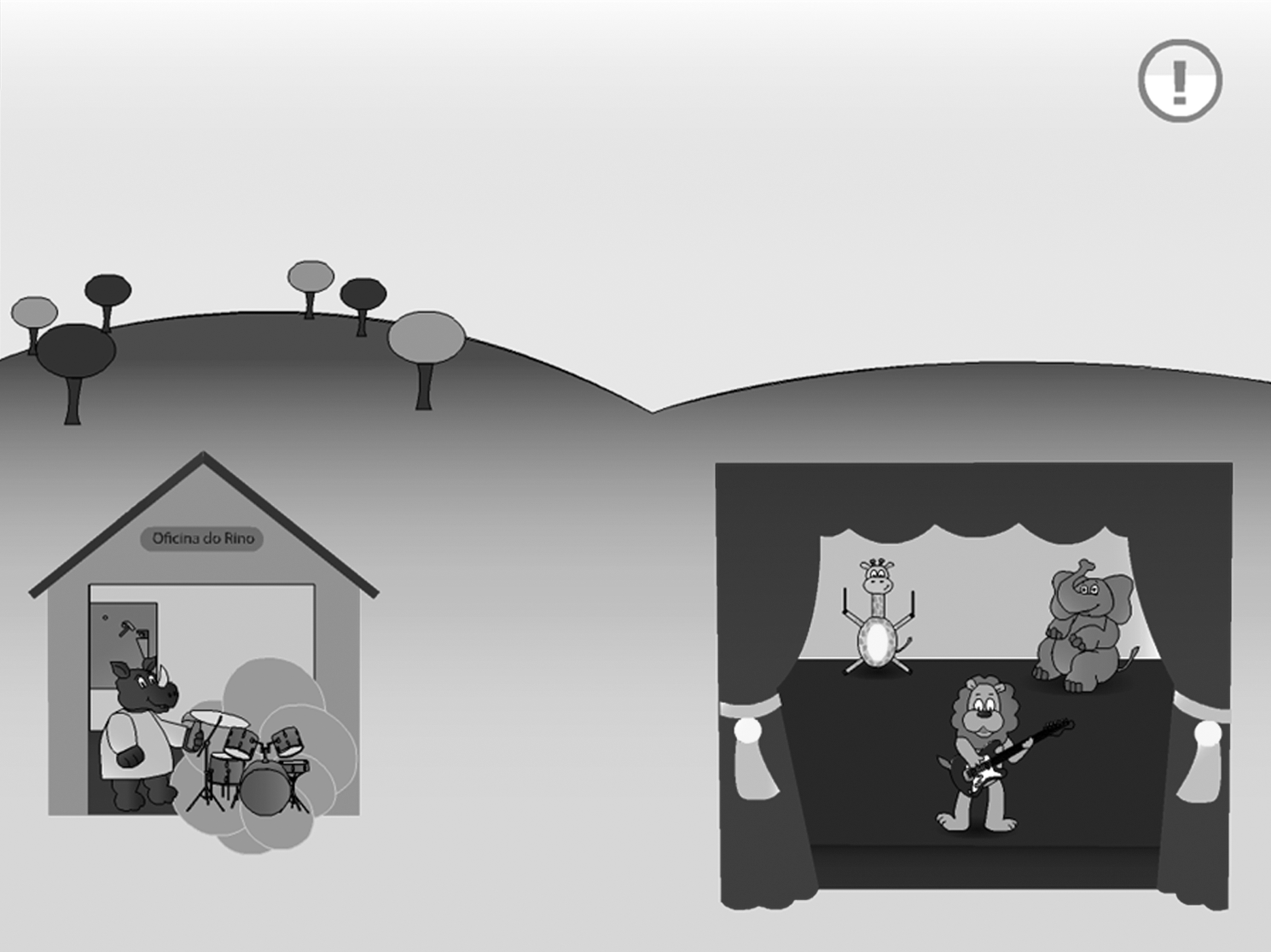
Tablet gameplay screenshot.
In total, 36 randomly selected audible and nonaudible stimuli were presented. Stimuli (both audible and nonaudible) were presented within a maximum interval of 4.5 s. Tablet-based testing was preceded by a familiarization phase consisting of three trials, two with sound stimuli and one with no sound stimulus. During the familiarization phase, participants were taught to play the game to familiarize themselves with the touch screen controls.
The Apple iPad app requires 100 MB minimum free hard disk space and IOS 8.7 compatibility and has remote access connectivity to a central database via the Internet, enabling remote data management, including participant registration, analysis of screening results, and management of the necessary referrals.
All tests were stored on the tablet, and results were later transmitted to the central database via Wi-Fi, without the need for Internet connectivity at the site where screenings were conducted.
Tablet-based testing was conducted in a nonacoustically treated room. Environmental noise levels were monitored during testing by using a decibel meter, and all tests exceeding 50 dB(A) were excluded.
Sweep Audiometry Screening
Sweep audiometric air conduction screening was performed at an intensity of 20 dBHL for frequencies of 1, 2, and 4 kHz and at 30 dBHL for 0.5 kHz. The hearing screening test started in the right ear. Sweep audiometry was conducted in an acoustic booth (ANSI S3.1-1991 standards) 24 by using a GSI 61 audiometer (ANSI S3.1-1996 standards) 25 and TDH50P headphones. Both tests were performed on the same day consecutively, first the tablet and then the sweep audiometry.
Screening Analysis Criteria
For both tablet-based hearing screening and sweep audiometry screening, a correct response a minimum of two tones out of three emitted at 20 dBHL for the frequencies of 1, 2, and 4 kHz and 30 dBHL for 0.5 kHz in both ears, was considered a negative screening result (i.e., normal hearing). 26 Hearing impairment was considered a positive screening result. 26
Statistical Analysis
The agreement between tablet-based screening and conventional audiometry results was measured by using the Kappa coefficient. To evaluate the diagnostic accuracy of tablet-based hearing screening, the following measures were calculated: sensitivity, specificity, positive predictive value, and negative predictive value.
Results
Twenty-six participants had normal hearing, and four participants had HL. This result was observed when using both the tablet-based and conventional audiometry screening methods (Table 1).
Concordance Between Results of Tablet-Based Hearing Screening System and Sweep Audiometry Screening
The Kappa coefficient indicated perfect concordance (kappa = 1) between tablet-based and sweep audiometry.
The diagnostic capacity of the tablet-based hearing screening method is shown in Table 2.
Diagnostic Values to the Tablet-Based Hearing Screening System
CI, confidence interval.
Discussion
We developed a tablet-based hearing screening test whose main capability is to interactively screen hearing by using an iPad game app. In this study, we tested this approach, which enables the discrimination of individuals at a higher risk for HL, because screening results are reported as “pass” or “fail.” In addition, screening results are available at the end of trials and can be uploaded wirelessly to a central database, enabling the management of the screening program. Thus, the screening test can be administered in different situations and in areas of difficult access with no physical or human resources available, enabling audiologists in remote locations to manage the results and referrals within a hearing health program.
Being an automatic application based on an interactive and self-explanatory game, the hearing screening test can be administered by health and education professionals without the need for an onsite audiologist at evaluations. 10 –15 To minimize possible interferences, the professional who performs the screening test should receive training to familiarize with the system components and with the procedure. Training could be given onsite or via distance learning systems. Future studies should evaluate the efficiency of training and of screening by nonaudiologist professionals.
The system is designed to be used in a nonsoundproof booth, but screening should be conducted in a quiet room.
The system was developed and calibrated for iPad tablets, and its great advantage is that it can be used in school settings where an audiometer or soundproof booths are not available. This technology is also interesting for hearing testing in settings with limited resources or space. 4
The use of this system in the school setting is promising, but noise levels in the school environment should be monitored. A recent study 19 showed that the use of teleaudiometry in schools (in the absence of a soundproof booth) requires a quiet place for testing and that noise levels in the test room be maintained to the minimum acceptable levels. The development of research in the school environment could contribute toward determining the effectiveness of this system in hearing screening programs in schools.
Even though the system was developed for children, here we tested its initial diagnostic capability in adults. Thus, the system must be tested in children to determine whether its diagnostic capacity is high among the pediatric population too. In fact, the system is currently being tested with children and results will be soon available.
The iPad volume control should be kept at the maximum level so that the intensity of the stimulus is in accordance with the screening specifications. Moreover, a TDH-39 headphone is required to maintain the proposed specifications. The system was tested in four iPads, and no variations in acoustic characteristics were detected. Thus, we believe that the system is stable for use in similar iPads with the same specifications. To confirm the applicability of the system using other brands of tablets and other operational systems, similar studies should be conducted while focusing on adapting the calibration parameters. 27
The sensitivity and specificity results indicate that the tablet-based system is valid and reliable and had perfect agreement with conventional audiometry. Similar results were obtained in other studies with adults, which evaluated similar instruments using a PC-based system and synchronous procedures. 9,22
As previously mentioned, our results need to be confirmed in the pediatric population. A Canadian research group developed a pediatric tablet-based play audiometer and showed that the portable tablet audiometer is an efficient tool for hearing assessment in children. 28 Another study in a pediatric population showed strong sensitivity (93.3%), specificity (94.5%), and negative predictive value (98.1%) for a tablet app compared with warble-tone audiometry. The authors concluded that the tablet audiometer was a valid and sensitive instrument for screening and assessment of hearing thresholds in children. 16 With the development of tablet computers such as Apple's iPad, it has become evident that touch interface computing enables even the youngest of users to interact intuitively with complex systems, which explains why portable systems have been widely embraced in healthcare and education. 29 –32
The system was developed and calibrated to be used with supra-aural TDH 39 earphones. The use of other earphones, including the tablet's earphone, may reduce costs, but their diagnostic value and the interference of environmental noise must be evaluated.
A recent study 29 reinforced the need of using professional earphones in tablet-based tests conducted outside a soundproof booth and managing low-frequency noise due to the large differences in hearing thresholds measured both inside and outside the booth.
Noise-cancelling earphones are also a good alternative for evaluations in noisy environments. However, because these earphones are not usually standard equipment for audiometry, they must be technically and biologically calibrated. In 2013, Chong and McPherson used noise-canceling headphones connected to an audiometer for hearing screening in the school environment, but a correction factor was required for biological calibration of the audiometer. 33 However, a correction factor cannot be applied when using the tablet-based system, because the stimuli are always presented at a single intensity for each frequency evaluated, which makes the use of noise-cancelling earphones more difficult. Other noise-cancellation systems could be investigated for use in these conditions.
It should be noted that a tablet-based hearing screening test is not a substitute for conventional audiometry for the diagnosis of HL, but it can be used to screen for hearing impairment risk in longitudinal, large-scale, population-based studies 27 and in locations where human and physical resources are scarce. 2
Conclusions
The tablet-based hearing screening test is a reliable and feasible method for hearing screening that can be used effectively and easily in places with Internet access and where local audiologists are not available. Nevertheless, this is a pilot investigation with a small sample size, and further studies are warranted. Finally, teleaudiometry can be advantageous in remote areas where specialized professionals and specific equipment are not available, potentially reducing the costs of hearing screening programs.
Footnotes
Acknowledgment
This study was supported by FAPESP (Fundação de Amparo à pesquisa do Estado de São Paulo) (No. 2013/22013-7).
Disclosure Statement
No competing financial interests exist.