




Abstract

I write in regard to introduction of medical applications (apps) in telemedicine and e-health. Today, we are part of the wonderful development of mobile applications. The first national body to face the problem of regulation was the Food and Drug Administration (FDA) in the United States; the problem was so broad that the FDA defined the topic as “The regulation of the infinite: the challenge of the FDA” by Baldani in her book. 1
The letter highlights: • the identification and the opportunities of medical apps for use in telemedicine and e-health; • the reasons hampering acceptance of these apps (the lack of patient's desire);
and • the rising solutions to improve the acceptance of medical apps for use in telemedicine and e-health based on a community-engaged approach (CEA).
Introduction of Medical Apps in Telemedicine and e-Health
Mobile apps for devices such as smartphones and tablets are already in the thousands. The period of fantasy has passed and we see rapid experimentation for medical and scientific purposes in hospitals, research laboratories, and in daily medical practice. There are apps to help quit smoking, whereas others store and archive medical records and make them available to the owner always and everywhere ensuring mobility, and yet others are more specialized for research purposes, and others for motion monitoring. Probably the apps for instant messaging tools will be a useful vehicle for teleconsulting in digital radiology and digital pathology. 2
The proliferation of medical and scientific apps is a simple consequence of the opportunities offered by new technologies in terms of automation of procedures, interaction with the user patient, and trials of new routes and medical approaches. New technologies, however, also pose some problems, which require thought and reflection. We must reflect on the user data privacy as well as consistency, safety, and regulation. 3 The first aspect to consider is the identification of the medical app, which is strictly related to national regulation and guarantees for a high standard of security and quality.
Even if the discussion about regulation and certification 3 is complex and far from the objective of this communication, it is useful to show (Fig. 1) the road map for the initial identification of a medical app on the basis of the medical intended use as a medical device (as for every other medical device in the European Certification process of medical devices).
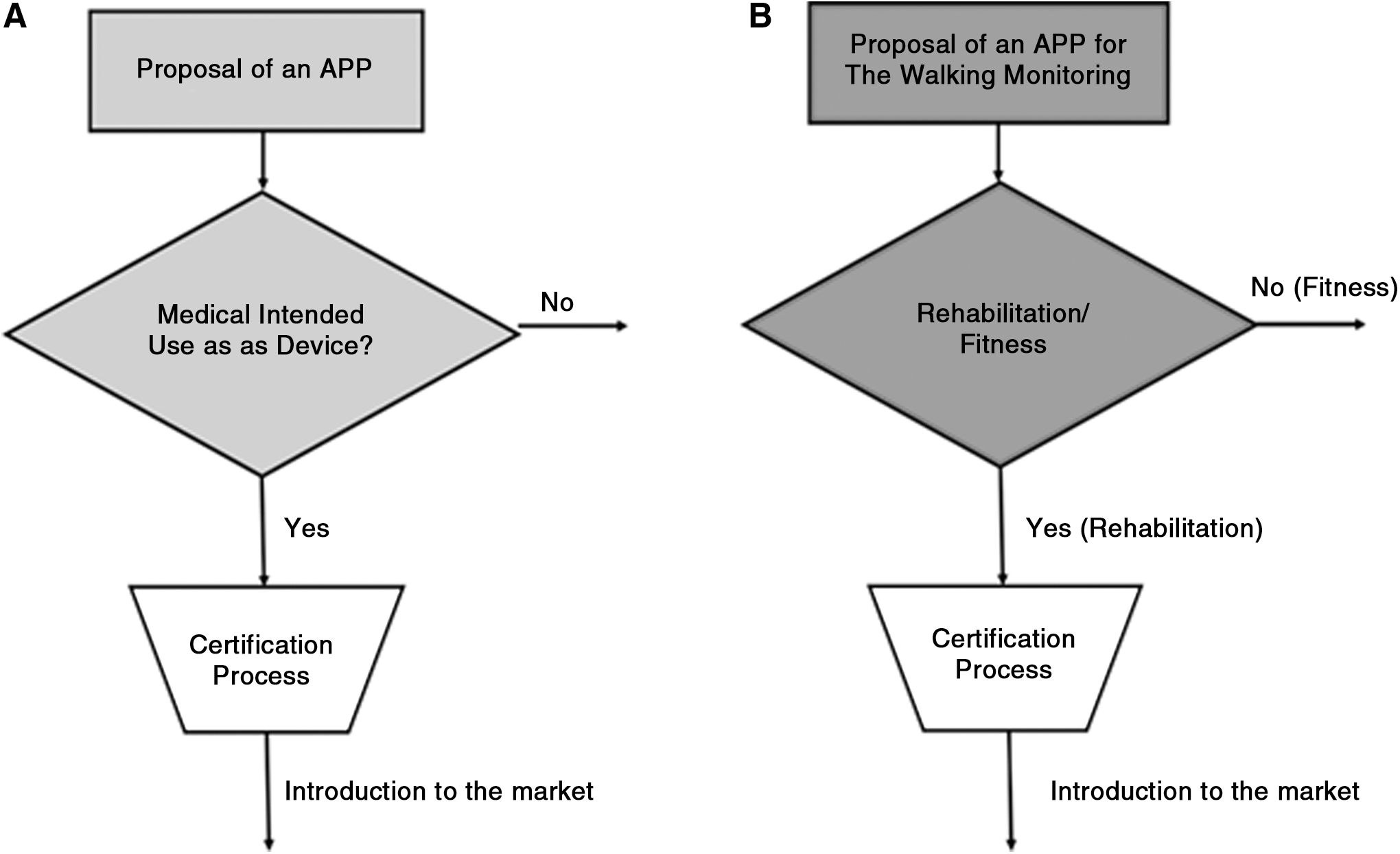
The core aspect of the identification of an app.
Figure 1A elucidates the initial discrimination process for a proposal of an app. Figure 1B elucidates an example of the initial discrimination relevant to a proposal of an app for the motion monitoring on the basis of the intended use. If the app is intended for fitness, it would not be considered a medical app, and will then not follow the European Certification process as a medical device. The apps used in telemedicine and e-health are those passing a discrimination process as shown in Figure 1 or similar depending on the national regulation.
Problems and Opportunities in Telemedicine and e-Health
One of the problems, which is hampering the diffusion of medical apps, is the acceptance by the public. We are in fact promoting the diffusion of a multitude of apps, which sometimes, after an initial use, are abandoned.
The reason is the lack in the APPs of the “desiderata” of the citizens, who in many cases consider them as gadgets with limited use.
Today, there are powerful platforms that allow the expert in informatics an easy and rapid way to design an app. The environment based on ResearchKit and Carekit, for example (
The design of an app has thus become very easy and now the core element is the careful attention to requirements. The expert in informatics without the correct involvement of the community is not able to match the “desiderata” of the citizens. The only chance we have to improve the acceptance of an app is the introduction of a methodology that involves the community.
The CEA in the Design of an App in Telemedicine and e-Health
The new rising idea, which can be useful to improve the acceptance of a telemedicine and e-health app, is the introduction of the CEA.
With the CEA, the elements of a community are involved and are not passive but active in the detection of the requirements in the design of an APP.
In the application of teleoncology where the telemedicine and e-health apps 4 could be useful, for example, in breast cancer detection, psychological monitoring, and functional activity monitoring, 5 –7 the CEA could be particularly useful. 8
The general awareness presented here is that the CEA should be arranged in three directions comprising three groups who are the true actors in the process of e-Care: (a) Subjects not involved in the process of e-Care. That is, the Public (PU). (b) Subjects involved (IN) in the process of e-Care. (c) Experts (EX), that is, the e-health actors in the process of e-Care.
In the case of breast cancer, for example, the three groups could be: (a) PU. (b) Women with the age for screening or with the relevant pathology. (c) Experts in breast cancer, radiologist, histologist, and others.
In the case of stroke, for example, the three groups could be: (a) PU. (b) Subjects after stroke or with the relevant high risk. (c) Experts in neurology, neurorehabilitation, and others.
Figure 2 elucidates the process for design of medical telemedicine and e-health apps using the CEA with the implementation of the idea.
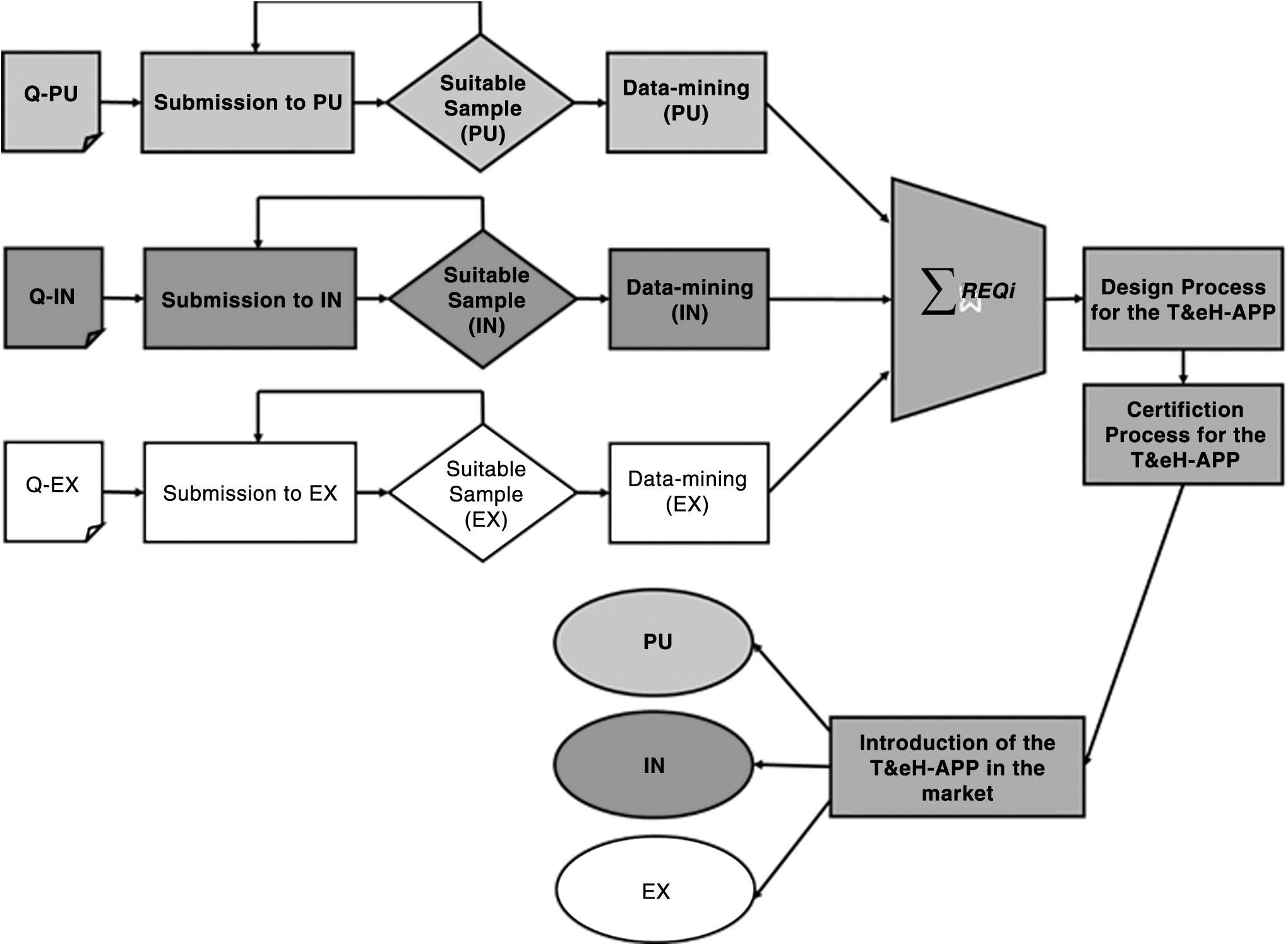
The proposed methodology based on the community-engaged approach.
The three different investigation forms, that is, questionnaires (Q-PU, Q-IN, and Q-EX), should be proposed to the three different groups (PU, IN, and EX carefully chosen in accordance with statistical, anthropological, sociological, and economic considerations) in order both to investigate the desiderata and collect the requirements. After datamining performed for each group, the requirements (REQi) are collected. Only after these actions is the expert in informatics capable of proceeding with the last part of the process of the development of telemedicine and e-health apps.
Work in Progress
The next work is the use of the CEA to design the three questionnaires in the field of breast cancer to develop the identikit of telemedicine and e-health apps for oncology in breast cancer for screening and surveillance. The study will be conducted in a specific scientific collaboration in Italy.
Footnotes
Disclosure Statement
No competing financial interests exist.