




Abstract
Background:
Telehealth is a form of assistance support and continuing education for professionals who work in Primary Healthcare.
Introduction:
The implementation of the Brazilian Telehealth Program has extended the need for evaluation of its results to improve its use and benefits. Thus, it is necessary to systematize the theory, principals, and guidelines that guide the program organization, its activities, and resources. The objective of this study is to propose a theoretical model of functioning and organization for telehealth centers of the Brazilian Telehealth Program.
Materials and Methods:
A study that combined bibliographic, documental research and empiric data to systematize information, which are the basis functioning of the program, and verify the availability of telehealth centers in Brazil.
Results:
The results were the construction of a theoretical model that demonstrated the evaluability of the object and the definition of methodological paths to continue the evaluation research that respond with fragilities and potentialities.
Discussion:
In Brazil, there is public funding for telehealth activities offered by telehealth centers linked to the Ministry of Health. Its operation is guided by support for training and assistance activities, enabling qualification and strengthening of professionals to improve patient care and increase access. The transformation of reality is possible and favored by the articulation of teaching and service. More research is needed to evaluate these services offered. Theoretical guidance through modeling is fundamental to qualify the evaluation.
Conclusion:
The theoretical model is an important tool to qualify and optimize the evaluative research process.
Introduction
Primary Healthcare (PHC) is the user's main doorway in the Brazilian Unified Health System (SUS). It is expected that it will take responsibility for the users it serves, will solve between 85% and 90% of the health demand, and will be a leader of healthcare networks, performing qualified referrals to other levels of care. 1,2
The work process of professionals in PHC is complex and requires a differentiated way of healthcare, especially in relation to the object of care and the way of organizing service and actions: the focus is the individual in his or her family context and in the physical and social environment, where healthcare is guided by the principle of health surveillance, combining actions of promotion, prevention, and cure, developed by a multidisciplinary team of professionals who have the sanitary responsibility on a defined territory. 3
In this context, the Ministry of Health identified the need to qualify these professionals to raise the solvability of PHC with continuing education initiatives, such as multiprofessional residences in family health, and introductory courses, on attendance and distance specializations, among others. To support professionals, particularly those who work far from the main training centers, and to promote Continuing Education, the Ministry of Health created the Brazilian Telehealth Project in 2007, which in 2011 was established as the Brazilian Telehealth Networks Program. 4
Telehealth is the use of information and communication technology on health for education actions and distance support, expanding access, qualifying care, and improving the solvability in the health system. 5
Nine telehealth centers were set in Brazil as a pilot project of this program, which have been developing activities since 2007. Currently, these pilot centers are consolidated and offering services recommended by the Ministry of Health: Teleconsulting, Tele-education, Telediagnostics, and Formative Second Opinion.
Telehealth evaluations in Brazil have already demonstrated that its use extends the possibilities of patients' access to health services by means of health professionals' support. 6,7 However, the use of models to represent reality and guide evaluative processes points to still different scenarios of access to telehealth services in Brazil and their uses, as well as incipience of norms to regulate their use and fragile initiatives by the Federal Government to guide telehealth actions and the articulation of its application in the teaching and service areas. 8,9
Brazilian Telehealth Networks is a young program and its actions have supported the construction of improvements in the health system; therefore, further studies are needed to evaluate the fragilities and potentialities of the actions that have been developed. 8 –12 In this scenario, the supply and use of telehealth services have grown, also increasing the need to evaluate its results to improve the use and benefits of all the actors involved, 5,9,10 strengthening its structure and organization to allow the expansion of the program, whose range and reach benefit the whole country.
Despite the proposition of monitoring and evaluation indicators of telehealth centers, 8,9,13 theoretical and evaluative models specifically proposed for the orientation of evaluative researches of center of Telehealth Program Brazil Networks that can be replicated at the national level have not been found in the literature.
Therefore, the objective of this article is to propose a theoretical model for functioning and organization of telehealth centers of the Brazilian Telehealth Networks Program, from which it is possible to propose evaluative studies in the light of the program theory, principles, and guidelines on which they were created, which may result in useful information for the program, helping in the reorganization of planning activities and resources, adapting them so the proposal objects may be achieved. 14
Materials and Methods
Study strategy
An availability study was carried out, whose objective is to realize a complete description of a program, which is graphically represented in a theoretical model, so, later, it will define an evaluation plan and establish an agreement among the interested ones.
15
The study was developed between January and September 2016. To achieve the objectives of an availability study, the elements of Thurston and Ramaliu
16
methodology were used to provide an understanding of the literature review systematization on the object for later design of the theoretical model of a telehealth center: (1) Identification of goals, objectives, and activities of a telehealth center; (2) Identification of available documents on the Brazilian Telehealth Networks Program and their telehealth centers; (3) Identification of the available resources, the aimed activities of the program, expected impacts, and presumed casual connections; (4) Understanding of the manner in which telehealth centers work; (5) Development of an evaluation theoretical model; (6) Identification of evaluation users and other involved principals; (7) Acquisition of an agreement regarding procedure of an evaluation.
The expected output of an Availability Study is an exhaustive description of the program that should support the definition of an evaluation plan and the establishment of an agreement among the interested ones 15 through a description of the mission and vision of the program, as well as its objectives, activities, methodology, and expected results involving and compromising those interested in the use of the study. 14,16
From the exhaustive description of the program, it follows the modeling, which is considered the most challenging stage of an evaluation study since it intends to graphically represent the theory of a program by identifying whether there is congruence between what the documents guide and what is observed in the effective development of the program. 15,17
In this process, the possibilities of evaluation of the program that are agreed among the participants are identified to qualify and make their practices more assertive.
Data collection
The techniques used to collect data according to the elements described above were a bibliographic review, interviews with key informants, visits to official Web sites, and documentary analysis, from 2007 to 2015. 18 The interviews included professionals working in the Brazilian Telehealth Networks Program since the beginning of their activities, intentionally selected by the authors.
Data collection was carried out from the documental analysis of the publications (Fig. 1).

Publications included in the documental analysis. Source: Elaborated by the authors.
The analysis of the information found in the documents and articles selected by the bibliographic review was based on the principles of exhaustiveness, homogeneity, and adequacy.
The findings and products elaborated in this study were appreciated by professionals involved in the program for feedback and suggestions.
Ethics aspects
This study was approved by the Research Ethics Committee of the Federal University of Santa Catarina, according to Opinion no. 1.466.605. All the ethical precepts were respected for the construction of a study involving human beings and free consent and consent of all those interested and involved were obtained.
Results
The collected data on telehealth centers allowed the understanding of the theoretical bases of the Brazilian Telehealth Networks Program, as well as the context of their creation and insertion in SUS. Hence, it was possible to respond to each of the seven elements of Thurston and Ramaliu. 16 The results for each element are summarized in Table 1.
Results from the Bibliographic Review on a Telehealth Center per Elements of Thurston and Ramaliu's Methodology a
Source: Elaborated by the authors.
PHC, Primary Healthcare; SAS, Health Assistance Secretariat; SUS, Unified Health System of Brazil.
Proposition of a theoretical model for evaluation of telehealth centers
From the development of the evaluation study, it was possible to graphically develop a theoretical model for telehealth centers (Fig. 2).
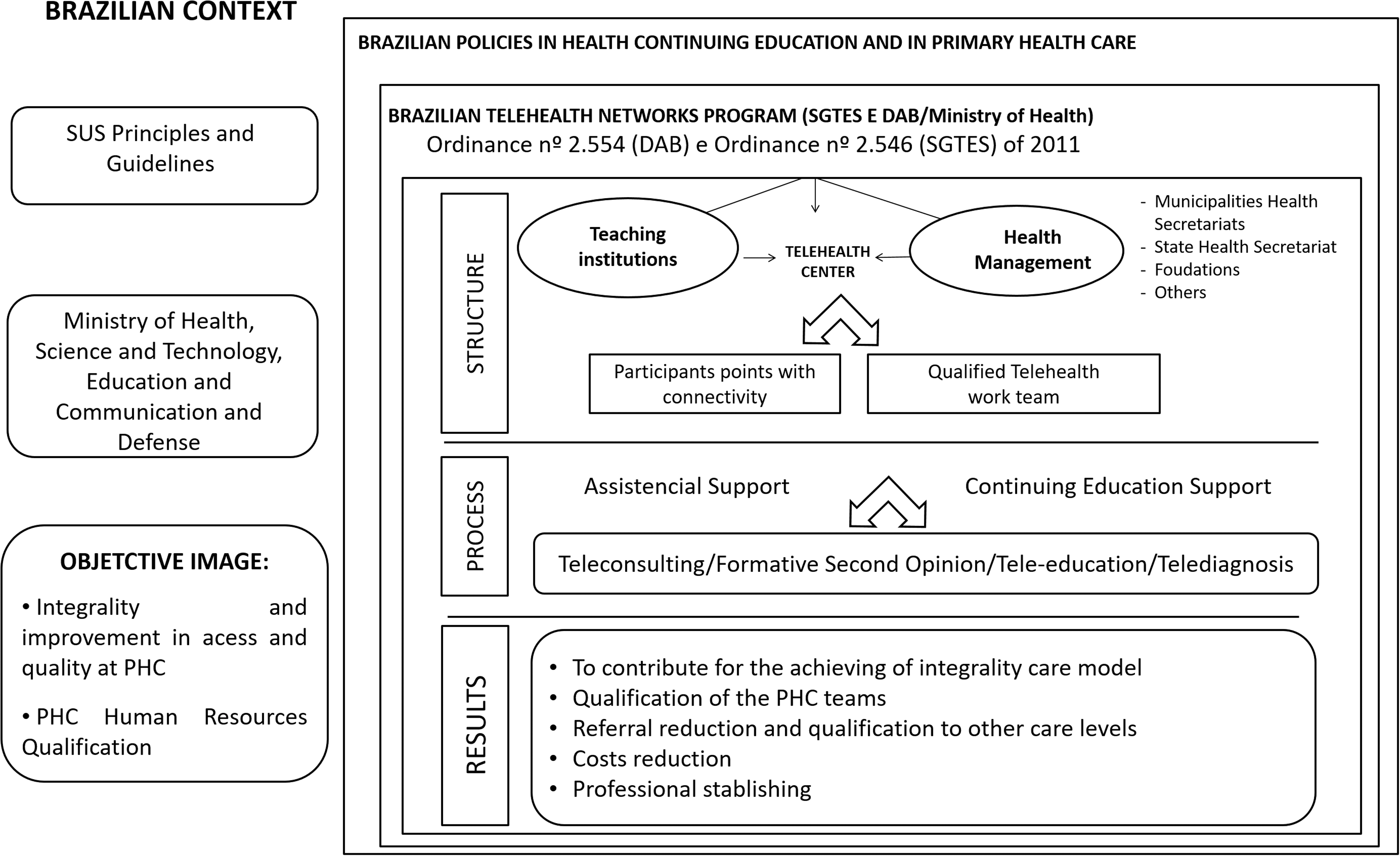
Theoretical model for telehealth centers of the Brazilian Telehealth Networks Program. Source: Elaborated by the authors. DAB, Primary Health Care Department; PHC, Primary Health Care; SGTES, Secretariat of Work and Education Management in Health; SUS, Unified Health System of Brazil.
This theoretical model attempts to express objectively the national context of telehealth centers, their main epistemological bases (Continuing Education in Health and Primary Health Care), the local context (management and structure), as well as the services offering process (for assistance support and continuing education support), and the expected results (as described in each element of analysis), according to Donabedian's proposal. 23
A telehealth center is inserted in the national context of SUS by means of Brazilian Telehealth Networks Program. Its conception is intersectoral, permeating the Ministries of Health, Education, Science and Technology, and Communication and Defense.
Its objective image is to promote the integrality and improvement of access and quality in PHC, through distance support that promotes qualification and security for the performance of human resources.
The main epistemological bases of the program are the Primary Healthcare and Continuing Education in Health, following the directives that guide them. 3,24
The telehealth centers are officially linked to the Ministry of Health through the Secretariat of Work and Education Management in Health (SGTES) 20 and the Health Assistance Secretariat (SAS), through the Department of Primary Health Care (DAB), 21 which guides the manner in which the structure, the processes of offering telehealth services, and the expected results of a telehealth center in local contexts should be.
Regarding the structure of a telehealth center, it is foreseen that Teaching Institutions and Health Managing Organizations will be jointly or individually responsible for coordination, physical structure, and financial management. Several organizational designs are possible, with variations in the interaction between the Teaching Institutions with the health managers that can be of municipal, regional, or state scope, or even with foundations and public health sectors, where the approval of a work plan by the Bipartite Interagency Commission is required.
A telehealth center is formed by the participating telehealth points (primary health teams and professionals) that must have connectivity and equipment available for the access of the services offered, and by qualified teams of professionals hired to meet the demands of the participants by means of the offered telehealth services.
With this structure available, the telehealth centers seek to offer assistance and support for the continuing education of health work teams through the types of planned services based on scientific evidence. This offer must be made from the survey of the epidemiological demands and actual work processes of the participating health teams and professionals, with the purpose of transforming and qualifying such work practices, always based on the principles and guidelines of SUS, guided by Primary Health Care and Continuing Health Education.
The searched results aim at the qualification and strengthening of PHC to respond to the needs of the users it serves.
Discussion
Currently, there are over 40 centers implanted in 23 Brazilian states and others in the implantation phase. In Brazil, telehealth plays an important role in strengthening and expanding PHC as the network coordinator by supporting ministerial strategies to strengthen the proposed care model for SUS and qualifying the care provided to users. 4
The two ordinances ruling the telehealth centers (one from the SGTES and another from the DAB) are coherent with each other regarding the objectives and functioning of the telehealth centers, differing only in the ways of financing and transferring resources from these two sectors. The telehealth centers financing may include a single source or both, depending on the type of local coordination and the project submitted to the Ministry of Health for approval of the services offered.
The expansion of this program coverage assumes that the telehealth centers are articulated with the service network of SUS, organizing and structuring the services in response to the needs demanded by the professionals and managers, which compound the healthcare networks in the area under influence of the telehealth center, with a strong alignment with PHC management, creating opportunities for reality orientation and its transformation by continuing education.
The support offered strengthens and qualifies the professionals and avoids the need to remove patients to other health services, which contributes to the qualified and resolute care and optimization of public resources use in health. 10 –12,25 The services allow professionals in different locations to access support for the various doubts that arise in the daily work. 4
The monitoring of the participation in the services offered by the telehealth centers allows identifying the growth in their use over the years. Although the program is deployed and under growth, it is still little used in comparison with the offer capacity and support by telehealth services. 10,25 The existing official documents guide the practice of telehealth, but do not guarantee the incorporation of services by management and the access and use by professionals of different health teams.
Assessing fulfillment of the objectives proposed in daily life (expansion of PHC solvability and offer of support to healthcare, and continuing education of the teams) is still necessary.
Modeling is an essential element in an assessment study to give more precision and safety to those involved in decision making by certain methodological paths. By proposing a theoretical model for the telehealth center, it was possible to identify the object as subject to evaluation and provided the participants with a deeper understanding of the program and clarification about the theory that supports it. 17
The construction of this theoretical model allowed the identification of several spotlights and possibilities of evaluative studies such as the evaluation of the structure of the centers, evaluation of the interaction between the managing organizations of the centers, evaluation of the connectivity of the telehealth points, and evaluation of the implementation of each service according to proposed objectives, among others. Each telehealth center may analyze and prioritize the aspects that are most necessary to evaluate.
However, in this process, two lines of evaluative studies were highlighted, which presented themselves as fundamental issues in the work process of a telehealth center, namely, care support and support for continuing health education. Each of these lines, although complementary to each other, presents a development complexity that requires specific attention of the researchers.
Although these proposed lines of research represent the two main objectives of a telehealth center, no study presenting models for evaluating the fulfillment of these objectives and considering specific indicators for this purpose were found.
To deepen this study, we propose the construction of two logical models and evaluation matrices, one for each identified line of research (care support and support for continuing health education), defining indicators, criteria, and evaluation parameters that are replicable to other telehealth centers.
Conclusion
Through this availability study, we see the validity of theoretical model construction, which contributes in identifying more appropriate and useful methodological paths to evaluate health programs, as the Brazilian Telehealth Networks Program.
Another contribution of this study was the formative nature of the process, which allowed clarifying the participants about possible contexts for the insertion of telehealth centers of the Brazilian Telehealth Networks Program and its modes of operation, allowing to resignify the work processes within the program and guide the planning and execution of actions.
Footnotes
Acknowledgment
The authors would like to acknowledge the National Council of Scientific and Technologic Development (CNPq) for funding this research (MCTI/CNPq/MS—SCTIE—Decit No. 08/2013—Research in continuing education for SUS and evaluation on health labor force).
Disclosure Statement
No competing financial interests exist.