




Abstract
Importance:
With an increasing number of patients requiring translator services, many providers are turning to mobile applications (apps) for assistance. However, there have been no published reviews of medical translator apps.
Objective:
To identify and evaluate medical translator mobile apps using an adapted APPLICATIONS scoring system.
Design:
A list of apps was identified from the Apple iTunes and Google Play stores, using the search term, “medical translator.” Apps not found on two different searches, not in an English-based platform, not used for translation, or not functional after purchase, were excluded. The remaining apps were evaluated using an adapted APPLICATIONS scoring system, which included both objective and subjective criteria. App comprehensiveness was a weighted score defined by the number of non-English languages included in each app relative to the proportion of non-English speakers in the United States.
Setting:
The Apple iTunes and Google Play stores.
Participants:
Medical translator apps identified using the search term “medical translator.”
Main Outcomes and Measures:
Compilation of medical translator apps for provider usage.
Results:
A total of 524 apps were initially found. After applying the exclusion criteria, 20 (8.2%) apps from the Google Play store and 26 (9.2%) apps from the Apple iTunes store remained for evaluation. The highest scoring apps, Canopy Medical Translator, Universal Doctor Speaker, and Vocre Translate, scored 13.5 out of 18.7 possible points.
Conclusions and Relevance:
A large proportion of apps initially found did not function as medical translator apps. Using the APPLICATIONS scoring system, we have identified and evaluated medical translator apps for providers who care for non-English speaking patients.
Introduction
According to the U.S. Census Bureau of 2015, more than 60 million individuals, about 19% of Americans, reported speaking a language other than English at home and more than 25 million said they speak English “less than very well.” 1,2 The top five non-English languages spoken at home were Spanish, French, Chinese, Tagalog, and Vietnamese, encompassing 72% of non-English speakers. In the healthcare sector, translator services are essential for providing accurate and culturally competent care. In 2006, a national survey of hospitals found that 80% of the hospitals reported encountering limited English proficiency (LEP) patients frequently, defined as monthly, weekly, or daily. 3 As this population of LEP patients increases, with some hospitals experiencing almost a 100% increase in their LEP population between 1990 and 2000, the incorporation of translator services has increased over time. 3–4 Legislation has been passed at the federal, state, and city levels requiring provision of such services. For example, Title VI of the Civil Rights Act of 1964, which bans discrimination based on national origin, requires that language translator services be offered to all LEP patients in institutions accepting federal aid and funding. 5 In addition, the Joint Commission passed a statute in 2006 requiring all hospitals to collect patient primary language at time of registration. 6
Even though such mandates exist, underuse of translator services is common. Sandler et al. surveyed ∼300 clinicians regarding their use of translator services and found that clinicians are twice as likely to use interpreters at time of admission and at discharge, than during daily rounds or while addressing patient questions. 7 When clinicians were asked about why they underutilized translator services, lack of time, lack of knowledge, and lack of timely access to interpreters were cited as the most common reasons. Furthermore, in private practice, insurance companies rarely reimburse physicians for using translator services, and calls can cost between $1.50 and 3.00 per minute. 3,8
Current options for translator services include face-to-face interpreters, phone-based translator services, and translator apps available on mobile devices. In settings where face-to-face interpreters or phone-based translator services are not available, translator apps may provide reasonable ad hoc alternatives given easy access to cell phones and mobile applications. Although independent online user reviews and reviews on the Apple iTunes and Google Play stores exist, there are no known peer-reviewed publications or organizations available to guide providers on the usefulness of mobile translation apps. 9 In this study, we aim to identify and evaluate medical translator apps available on the Apple iTunes and Google Play stores using an adapted APPLICATIONS scoring system to aid providers in using such apps during clinical encounters.
Methods
This study did not require approval by the Institutional Review Board as the research did not pose any risks to humans. We searched the Apple iTunes and the Google Play stores using the term “medical translator” on February 12, 2016 and May 4, 2016 and included all of the unique apps found on both dates. This term was used to increase the realism of the app sample as users without preexisting knowledge would be more likely to use a single term when searching. Apps that were no longer available for purchase or did not have translating capabilities were excluded. Apps in a non-English platform or nonfunctional after purchase were also excluded. The remaining apps were purchased and categorized as medical dictionaries, preset medical phrase translators, or general language translators.
Characteristic information about the remaining apps was collected. This included the developer or seller, version, price, number of languages, and download date. The APPLICATIONS scoring system is an acronym for components (characteristics and features) of apps that can be identified and scored to help determine the utility of the app. The components of the APPLICATIONS scoring system were developed based on existing literature and have been modified in other studies. 10 –15 We further adapted the APPLICATIONS scoring system as shown in Table 1. The special features component was expanded to include specific app features, particularly audio, English microphone, non-English microphone, English keyboard for direct translation, non-English keyboard for direct translation, scribe, dial-out to phone interpreters, links to resources, and feedback to app makers as shown in Table 2. We also included a component to account for subspecialty-specific translation, where the app was given one point if terms were divided by medical subspecialty within the app.
APPLICATIONS Scoring System Modified for Medical Translator Apps
See Table 3 for exact % of U.S. LEP Population values.
See Table 2 for a list of the special features included.
LEP, limited English proficiency.
Special Features
The app comprehensiveness score was dependent on the prevalence of non-English languages within the United States. The languages that comprised 90% of non-English speakers were extracted from the 2015 U.S. Census data, which report the number of people who spoke languages other than English at home. 1 The proportion of speakers of each of these languages was determined by dividing the number of individuals speaking that language at home by the total number of non-English speakers (60.3 million). Table 3 shows each of the included languages and their computed proportions. If an app included more than one of these languages, the proportions were added and multiplied by a total score of 3 to result in an app comprehensiveness score. Since we used the top 90% of languages spoken by the U.S. population, the maximum app comprehensiveness score that could be achieved is 2.7. Thus, when calculating the score to the nearest ½ percent, the score was rounded down to be as conservative as possible.
Percentage of the U.S. Limited English Proficiency Population Who Reported Speaking the Included Languages at Home a
Ref. 1.
Navigation ease and subjective presentation were evaluated on a Likert scale with 1 = poor, 2 = below average, 3 = average, 4 = above average, and 5 = excellent. An average rating of <3 received no points, and an average rating of three or greater received one point. Each of the authors independently scored each app to account for any interobserver differences. Their scores were averaged.
Results
A total of 281 apps resulted from the Apple iTunes store search, and 243 apps resulted from the Google Play store search. After applying our exclusion criteria, 20 Apple iTunes apps (8.2%) and 26 Google Play apps (9.2%) remained (Fig. 1). Of these apps, 20 were categorized as preset medical phrase translators, 10 as medical dictionaries, and 6 as general language translators in Table 4. One app, VAS Translator, did not fall into any of the three categories. This app has the unique purpose of allowing a user to use a scroll bar over a visual analog scale to rate his/her pain in several languages.
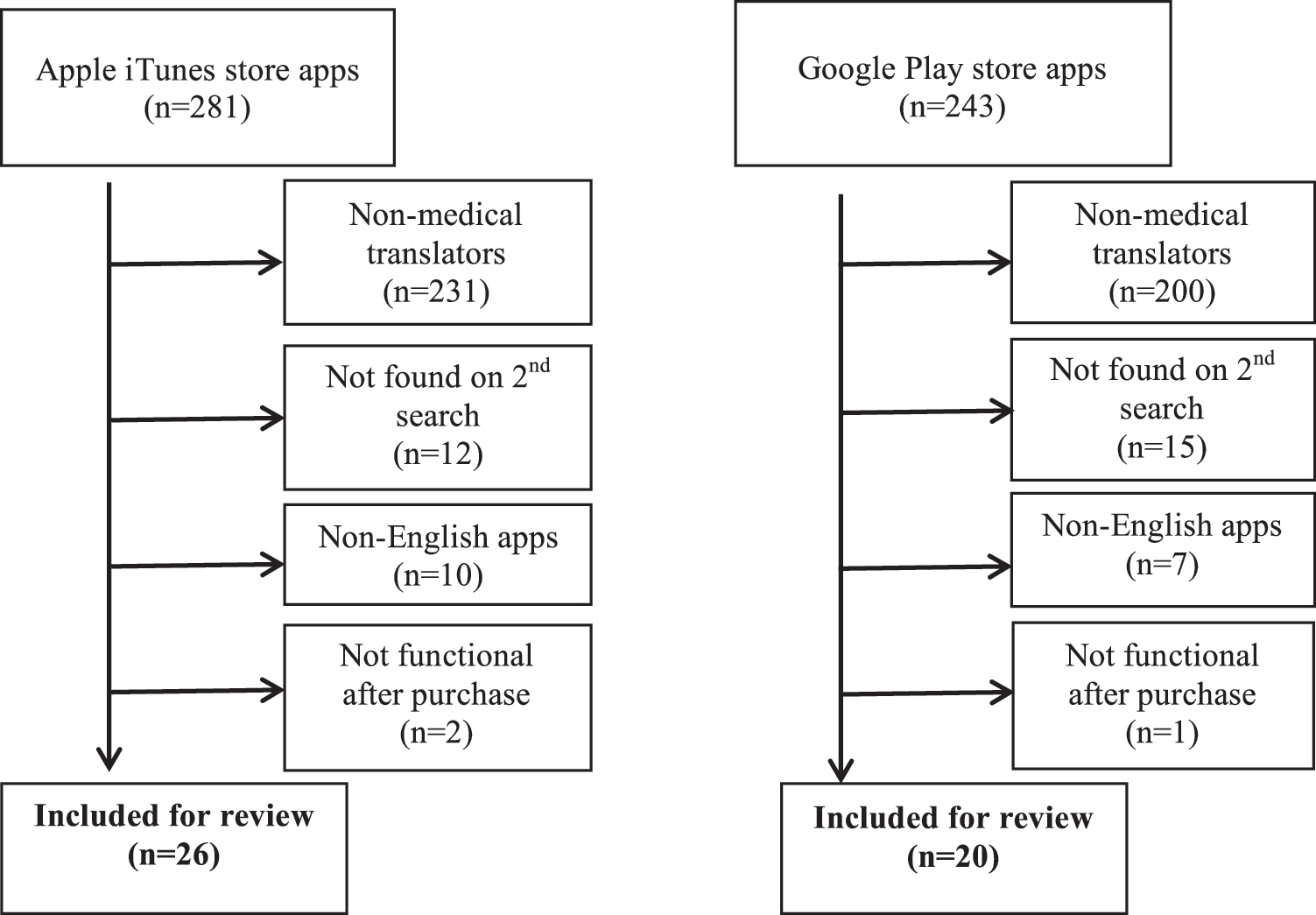
Flowchart of medical translator apps identified.
Translator Apps Divided by Category
Available on both Apple iTunes and Google Play stores.
Preset medical phrase translator apps required the user to search for or find a question or statement to facilitate a conversation. Using these types of apps would allow a provider to choose fully conjugated sentences, which can be played or read back to the patient in the chosen translated language. Within this group of apps, Canopy was unique in allowing the user to call out to an outside interpreter. iSign was notable for incorporating sign language. All of the apps found that were available for download on both iOS and Google platforms happened to be preset medical phrase translators.
Medical dictionary apps required the user to search for a medical term in one language and receive a translation in another language. These apps were more likely to have keyboards and search features to help providers find and define specific terms in a given language. For example, in EasyChinese Medical Dictionary, the user has the option of starting in either English or Chinese. Then a term is inserted into the search field, resulting in the translation and definition of the term.
General language translator apps required the user to enter a term, statement, or question in one language and receive a translation in another language. These had voice and keyboard features and encompassed a larger number of languages than the other app categories (ranging from 31 to 92 languages). These apps were less likely to have professional involvement or use literature references. With the exception of one app, Med Translate, the apps within this category were all found in the Google Play store only.
Characteristic app information and the calculated APPLICATIONS scores are shown in Table 5. To account for interobserver differences, the APPLICATIONS scoring system was validated by having each author individually rate the objective and subjective criteria of each app. The objective reporting error rate was 32 of 644 (5.0%), meaning that the authors independently assigned the same score to a given objective component of an app 95% of the time.
Characteristics and APPLICATIONS Scores for Medical Translator Apps
Found in the Apple iTunes store.
Found in the Google Play store.
The scores ranged from a minimum of 5 to 13.5 out of a possible total of 18.7 points, with an average score of 9.5 and a median score of 10. There were 29 apps that scored ≤10. These apps were found to have overall lower App Comprehensive, Price, Connectivity, and Special Feature scores. The rest of the apps (n = 17) scored ≥10.5 and conversely earned higher Comprehensive, Price, Connectivity, and Special Feature Scores. Universal Doctor Speaker, a preset medical phrase translator app, scored 13.5 on both platforms. Canopy Medical Translator, another preset medical phrase translator app, scored 13.5 as an Apple iTunes app and 11.5 as a Google Play app. The app required Internet connectivity as a Google Play app but not as an Apple iTunes app and did not have references of professional involvement as a Google Play app. Of note, the Google Play versions of Universal Doctor Speaker and Canopy Medical Translator were both older than the Apple iTunes versions of the apps, respectively. Vocre Translate, a general language translator app, available on Google Play, also scored 13.5.
As Spanish encompasses 62% of the non-English speakers at home (Table 3), the 35 out of 46 apps (76%) that included Spanish automatically earned a minimum App Comprehensiveness score of 2 out of a possible 2.7. The remaining 11 apps earned Comprehensiveness scores of 0–0.5 as they did not include the Spanish language.
Discussion
The bewildering diversity of apps makes it challenging for providers to determine which apps are safe, effective, and of high quality and value. This “app overload” has led to a call for critical app review by the scientific and medical community. 9,16,17 Our study takes on the challenge to identify and evaluate the myriad of medical translator apps currently on the market. Since tens of millions of Americans speak another language at home, providers must be able to appropriately interact with such patients as mandated by law. 5
Similar to other studies demonstrating “app overload,” 10 –15 our initial search returned over 500 medical translator apps; yet only 46 (17.4%) were actual medical translators. To analyze how healthcare providers can use the apps in the workplace, we divided the apps into categories based on functionality: preset medical phrase translator apps, medical dictionary apps, and general language translator apps. Each category of apps may be useful for a different set of providers. For example, a Spanish-speaking patient who speaks very little English would need very little translation when interacting with a fluent Spanish-speaking provider. Perhaps, the physician and the patient learned Spanish in different countries, and certain words are not the same. In such a situation, the provider would benefit from using a medical dictionary app, where he/she can find one particular English word to be translated into multiple Spanish versions of the word. Next, if the provider is not as proficient in Spanish but can function at a conversational level he/she may wish to use a preset medical phrase translator app to learn phrases and questions within his/her specialty and use them in conversations with patients. Of course, not all physicians speak the Spanish language and perhaps using a general language translator app with microphone capability would greatly aid such physicians in communicating with non-English speaking patients. In this way, medical translator apps offer added options to face-to-face interpreters or phone-based translator services.
To answer the concerns of effectiveness, quality, and value of the apps found, we used an adapted APPLICATIONS scoring system to score the apps. While there is no gold standard for rating apps and multiple scoring systems do exist in the literature, this scoring system has been used in prior studies to evaluate many types of apps, including pregnancy wheel or due date calculator apps, menstrual cycle apps, contraception apps, apps in the field of gynecologic oncology, and apps in the field of reproductive endocrinology and infertility. 11 –15 The highest scoring apps were Canopy Medical Translator, Universal Doctor Speaker, and Vocre Translate. Canopy Medical Translator and Universal Doctor Speaker are both highly accessible to providers who wish to use preset medical phrase translator apps since both apps are available on the Apple iTunes and Google Play stores, and both apps are free. In contrast, Vocre Translate is only on the Google Play store and is priced, but has functionality as a general language translator app.
The results of our study must be interpreted in the context of the study limitations. Given the breadth and dynamic nature of apps, we may not have captured every medical translator app in our search. In addition, the study would have benefitted from a systematic method of generating multiple search terms to encompass a large number of applications. However, using one specific search, we generated over 500 apps. Thus, including additional search terms were beyond the scope of this study. Our search was inclusive of the most popular app stores used by consumers; however, other app stores exist globally. In performing this study, we were surprised that one particular app, Google Translate, did not result in our searches. It is possible that this app is not indexed as a “medical translator” by Google and, hence, was missed. 18 Searching a more general term such as “translator” would have yielded many more apps and would have potentially yielded missed apps. However, our primary aim was to focus on identifying and evaluating medical translators. This further supports the difficulties that providers may have in finding and choosing useful apps. Although we were able to rate the apps using both objective and subjective measures, we are not able to verify the accuracy of the translations within the apps due to the plethora of languages included and the variety of translations available within each language.
To compensate for this study weakness, we noted whether or not professional involvement and/or literature references were used in each app. Finally, due to the rapid daily advancements of technology, the availability, content, and characteristics of the apps may have changed between the initiation of the study and dissemination of our findings. 19 We performed our search over two different time periods to attempt to account for the high turnaround and fluidity of the app stores. We also provided app version information to allow for independent assessment of changes in subsequent versions.
Conclusions
Overall, our goal was to identify and evaluate the litany of medical translators available on the market as they would be most helpful to providers when interpreters are not readily available. From our study, we have identified apps that are economical, comprehensive in capturing a large population of LEP patients, and easy to use. We encourage each provider to select apps based on his/her individualized needs, the app's professional credibility, and the needs of the patient population. We hope our research can encourage future studies in determining the usefulness and ease of integration of these apps in the workplace.
Footnotes
Disclosure Statement
No competing financial interests exist.