




Abstract

Dear Editors:
The perspectives, highlighted in the Mars and Scott article “Being Spontaneous: The Future of Telehealth Implementation?” published in September 2017, are forward thinking, innovative, realistic, and in alignment with our experience on the ground in Botswana. 1 We would like to share our experience using WhatsApp for dermatology care in Botswana, and explain how this application can be easily adapted and integrated into clinical practice in resource-limited settings to improve patient outcomes.
Telemedicine is approaching an exciting new frontier due the scale up of high-speed cellular networks and exponential increase in the use of mobile devices globally. In the recent past, low and middle income countries (LMIC) were effectively cut off from the informatics innovations of the developed world due to the high cost of electronic devices, inadequate mobile connectivity, and limited literacy with electronic devices. Within only the last few years in Botswana, possession of a smartphone and/or tablet with mobile Internet connectivity has become almost ubiquitous across all age and income brackets of the population. This has created an incredible opportunity for the use of new telemedicine methods that are critically needed to improve communication, patient referral, and outcomes within this resource poor healthcare system.
Dermatology is an exceedingly scarce skill in Botswana. For years, there has been no dermatology specialist working in the public sector and currently, one author (V.W.) practices full time as the only dermatologist for the government healthcare system. With a 40% rural population, a large portion of patients live in isolated rural villages with access to only a health post or sparsely staffed regional hospital. 2 Time, distance, and sheer patient volume make it impossible for every patient with a skin condition to be seen in person by a dermatologist; thus, a reliable mechanism for teleconsultation is a vital need in this healthcare system. 3
Various informatics projects aimed at implementation of a sustainable telemedicine platform have been piloted in Botswana. 4 –13 Despite engagement with the Ministry of Health, the University of Botswana, cellular providers, and other key stakeholders, local issues, including high cost, unreliable bandwidth, need to use designated mobile devices, use of unfamiliar telemedicine apps, or time commitments required of healthcare professionals has prevented these projects from becoming widely adopted in the long term.
One author (V.W.) came upon a solution for a simple, sustainable, cost effective and user friendly telemedicine resource in Botswana with WhatsApp. Although this seems like an unlikely healthcare tool, it has now become an indispensable part of the dermatology service. WhatsApp is a free mobile instant messaging application, which allows secure exchange of text, photos, audio, video and document files using mobile data or Wi-Fi. More than 1 billion people in over 180 countries worldwide are currently using WhatsApp, and it is the predominant form of electronic communication used in Botswana. 14
The idea for using WhatsApp for telemedicine developed spontaneously from a common problem in our clinic. V.W. receives numerous phone calls from providers in outlying clinics wanting to schedule patients in dermatology clinic. When callers were unable to give any information about their patient's skin condition, V.W. started asking for a clinical photo to be sent via WhatsApp messaging. This allowed the patient's condition to be accurately evaluated and triaged into clinic based on severity and urgency. WhatsApp soon became an invaluable tool for streamlining clinic flow and prioritizing the needs of critically ill patients.
Via word of mouth, the dermatology WhatsApp number spread to clinical sites across Botswana. Messages were soon coming in from clinicians needing assistance with diagnosis and management of skin conditions. Although diagnoses may not always be reliably rendered from photos, most often a good differential diagnosis can be generated to allow initiation of a work up plan. Many patients need to eventually be examined in person; however, WhatsApp teleconsultation allows greater optimization of these clinic visits. Recommendations can be made for necessary tests to be completed before the visit, and a therapeutic trial may be initiated to ease symptoms while awaiting an appointment.
Before the use of WhatsApp, we trialed other electronic platforms which required use of a computer, Internet connection, user logins and specific training on the use of an associated application. 4 –9,11 –13 Designated clinical time, which might only be available every few weeks, would have to be set aside for evaluation of cases. Often, photos were poor or historical information incomplete, causing further delays in patient care while consultants awaited receipt of necessary information. Overall, in-country providers found these systems inefficient and too burdensome to integrate efficiently into the resource limited healthcare system.
WhatsApp is theoretically a “store-and-forward” form of telemedicine; however, because mobile phones have become an integral part of work, these cases can be viewed immediately, making turnaround time quicker than any other form of telemedicine we have experienced in LMICs. Within seconds, a significant amount of data can be gathered on a patient, allowing immediate diagnostic and treatment recommendations to be made or a conversation to be started to gain more insight.
Over the past year and a half of using WhatsApp for teledermatology consultations, several new uses for the platform have organically evolved. Through reviewing cases with referring physicians, a variety of key dermatology skills can be easily and effectively taught. Feedback is provided on how to perform skin exams, describe skin lesions, take appropriate histories, take adequate photos, and most importantly, triage skin conditions. When there is only one dermatologist in a public health system, it is essential that all referring providers know how to recognize life threatening skin conditions and appropriately notify the dermatology service for urgent evaluation. WhatsApp allows referring physicians to get immediate feedback including educational material on their own patients.
After a physician reaches out for a consultation, there are often follow up questions that arise, and a dialogue is open for educational opportunities. Focused information can be sent to the provider on dermatologic conditions, particularly when their initial assessment of a case requires significant redirection. For example, one case included a photo of a girl with scaly eczematous patches in a flexural distribution with the message, “Hello Doc, I have a 15 year old female who I think has psoriasis, could you assist with treatment.” It was clear that the photo did not depict plaques of psoriasis, but lesions more consistent with eczema. The provider was subsequently sent pictures of classic eczema and psoriasis lesions with descriptions to help teach the salient features of each condition so they would be better able to make the correct diagnosis in the future (Fig. 1). Providers have been very open and appreciative of these learning opportunities related to their patients.
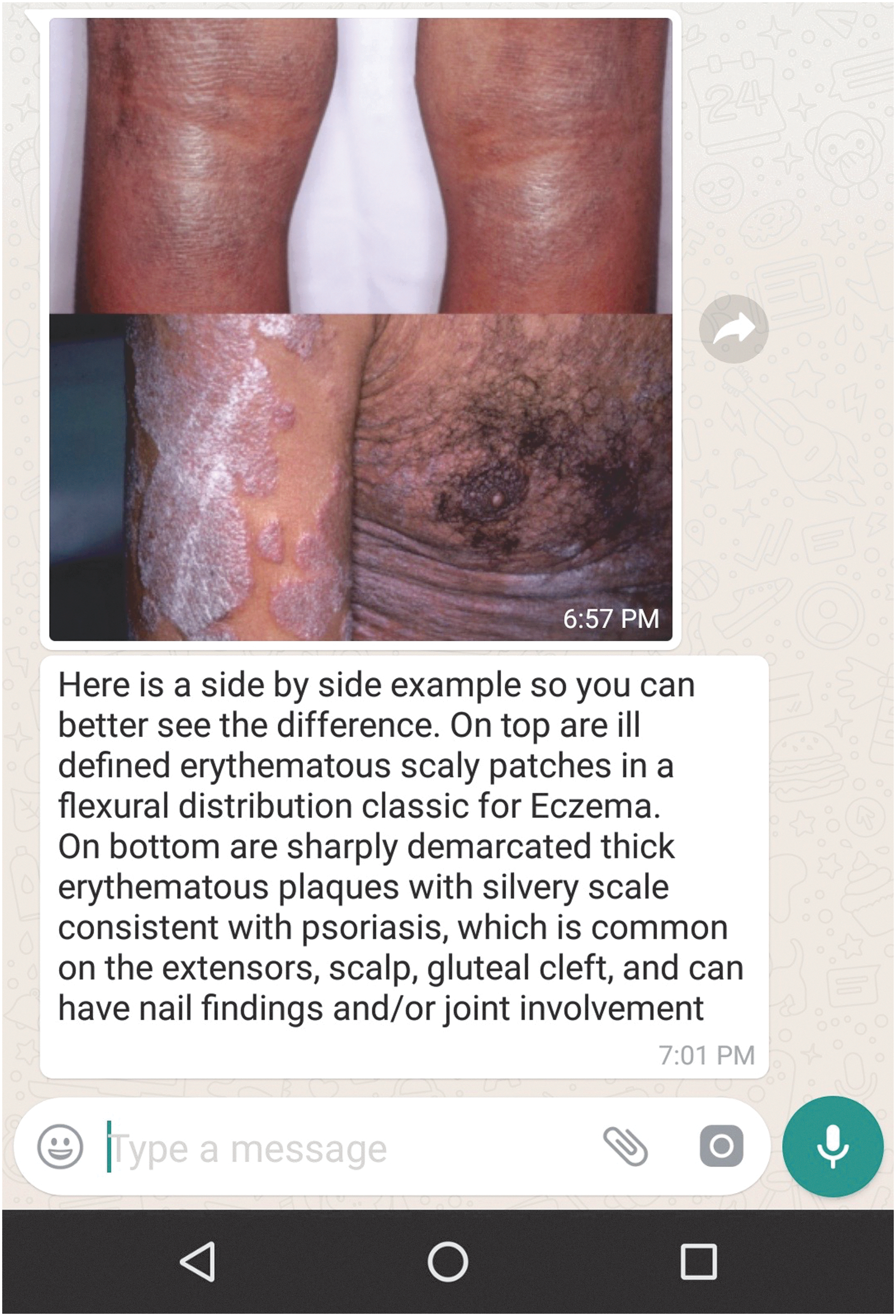
WhatsApp consultation assisting with both patient care and education of referring provider.
When in person, rather than WhatsApp referrals are made to dermatology clinic, the consultation note, which includes educational information, almost never makes it back to the referring provider because patients are typically seen by different rotating physicians in local clinics. This lack of continuity becomes a major problem when trying to build local capacity in dermatology skills. It has been our experience that clinicians who send repeated consults over WhatsApp have improved dermatologic skills in terms of providing better pictures, better lesion descriptions, better histories, and more complete differential diagnoses. However, clinicians who repeatedly refer patients through traditional means do not appear to gain any proficiency in basic dermatology skills.
A large number of dermatology patients in Botswana live greater than 5–8 hours away from our clinics. It is not possible to see them with the frequency necessary for good clinical care; however, for select patients, WhatsApp messaging can be utilized to improve dermatology care. WhatsApp allows patients to reach out directly when they have questions about complicated care instructions, share photos of their skin to determine if they need urgent evaluation, or determine if their management plan needs to be adjusted (Fig. 2). If acute care is needed, word for word instructions can be shown to a physician at their local clinic who can directly provide care with a reduced chance of error. Across patients and local clinicians in Botswana, English is comprehended significantly better in writing than in verbal conversations; therefore, WhatsApp has provided a key mechanism to bypass communication barriers that previously hindered patient compliance and follow up care.

WhatsApp utilized for direct patient care.
WhatsApp also provides a system to bypass other unique communication barriers. When trying to reach people by phone, you will often get no answer or an “out of service” notification indicating the person is out of mobile airtime minutes. If you send a text message (SMS) when a person has no phone minutes loaded, it will not be received even when they load more airtime. Many patients cannot afford to buy mobile airtime regularly so you may have to wait weeks until you can reach them by phone or SMS. Voicemail is incredibly uncommon. E-mail is used by a small portion of the population and is not regularly monitored. WhatsApp is a reliable form of communication integrated into the culture that can circumvent verbal language barriers, allow messages to be transmitted without use of paid airtime, and will allow you to leave written messages for people that will be viewed when their phone gets Wi-Fi connectivity.
Perhaps one of the most important ways WhatsApp has been adopted is for care coordination. Lack of communication between physicians across specialties is one of the biggest challenges of practicing medicine in Botswana. WhatsApp has the capability of creating “group chats” where multiple providers can be linked to build multidisciplinary care teams. For example, otolaryngology, ophthalmology, oromaxilofacial surgery, general surgery, plastic surgery and oncology can be linked with the dermatology team to coordinate care for patients with complex head and neck tumors. High quality WhatsApp photos give surgeons the ability to assess operability remotely then directly schedule patients for surgery or advise referral to a different surgical specialty if needed (Fig. 3). This has decreased wait times and improved outcomes for many of our patients who would have previously had to navigate appointments between numerous surgical referral centers across the country. With only cryptic chart notes to inform the next provider, patients were often sent home without being provided any care.

WhatsApp can optimize patient triage and coordination of care.
Despite the significant benefits that WhatsApp brings, there are clearly some challenges with regulating such a new technology that need to be addressed. In a recent review, Mars and Scott detailed perceived advantages and disadvantages of using WhatsApp for telemedicine, and many aligned with our experiences. 15 Recent updates to the application in 2016 have addressed security concerns by creating end to end encryption for Android, iOS and Windows devices. 16 WhatsApp's messaging encryption has proven to be so secure that British, Indian and Brazilian governments are attempting to ban use of WhatsApp to prevent the potential for unmonitored communication by terrorist groups. 17 –19 Future expansion of WhatsApp's use for telemedicine will be hindered if these types of regulations are widely adopted.
Particular concerns in Botswana are the inability to ensure privacy of patient photos, which are being sent to the provider. There are no standardized procedures for photo consenting in Botswana, as in many other LMICs, so it is impossible to know if patients are being properly consented. How to protect patient data and control over who can access it once sent over a mobile network are also issues that need to be addressed. Another drawback is the inability to save data centrally or integrate WhatsApp consultations into a patient's medical record.
Overall, the advantages of using WhatsApp for dermatologic care vastly outweigh the disadvantages in this current healthcare setting. WhatsApp provides the bare essentials of an eHealth platform while integrating seamlessly into the daily clinic routine without added effort, training for consulting physicians, or additional cost of equipment or Internet access. This makes it an incredible tool for sustainable telehealth in Botswana. The various ways WhatsApp can be adapted for patient care consultation, provider and patient education, patient triage, and care coordination, make it a powerfully versatile tool for clinicians in a resource limited setting. Using WhatsApp for telehealth harnesses one of the key features needed to create sustainable healthcare advances in developing countries–adapting a tool that is already used and accepted by locals.
Looking ahead, more studies are needed to formally evaluate the usage of WhatsApp in different healthcare settings to determine guidelines for best practices to avoid improper usage.
Footnotes
Disclosure Statement
No competing financial interests exist.