




Abstract
Background:
The effectiveness of any remote healthcare monitoring system depends on how much accurate, patient-friendly, versatile, and cost-effective measurement it is delivering. There has always been a huge demand for such a long-term noninvasive remote blood pressure (BP) measurement system, which could be used worldwide in the remote healthcare industry. Thus, noninvasive continuous BP measurement and remote monitoring have become an emerging area in the remote healthcare industry.
Introduction:
Photoplethysmography-based (PPG) BP measurement is a continuous, unobtrusive, patient-friendly, and cost-effective solution. However, BP measurements through PPG sensors are not much reliable and accurate due to some major limitations like pressure disturbance, motion artifacts, and variations in human skin tone.
Materials and Methods:
A novel reflective PPG sensor has been developed to eliminate the abovementioned pressure disturbance and motion artifacts during the BP measurement. Considering the variations of the human skin tone across demography, a novel algorithm has been developed to make the BP measurement accurate and reliable. The training dataset captured 186 subjects' data and the trial dataset captured another new 102 subjects' data.
Results and Discussion:
The overall accuracy achieved by using the proposed method is nearly 98%. Thus, demonstrating the efficacy of the proposed method.
Conclusions:
The developed BP monitoring system is quite accurate, reliable, cost-effective, handy, and user friendly. It is also expected that this system would be quite useful to monitor the BP of infants, elderly people, patients having wounds, burn injury, or in the intensive care unit environment.
Introduction
The telehealth network is speedily growing across all demography and it promises to grow more rapidly in the coming decades due to the huge demand of e-Health services worldwide. 1 In spite of its number of benefits and advantages, the success of any remote healthcare monitoring system mostly depends on the accuracy and reliability of the physiological parameter measurement mechanism. 2 Nowadays, the importance of continuous and accurate remote blood pressure (BP) measurement is acknowledged in the monitoring and treatment of cardiovascular ailment, such as stroke or heart failure. 3 In the previous study, 4 authors have thoroughly reviewed the advantages and limitations of various long-term noninvasive BP measurement techniques. It has been found from that study that photoplethysmography (PPG)-based BP measurement technique is cost effective, versatile, patient friendly, and easily integratable with the remote healthcare system. However, PPG-based BP measurement is not much accurate due to some limitations, such as lack of the proper measurement sites on the body, pressure disturbances, motion artifacts, variation of human skin structures, etc. 5
Traditional PPG sensors are transmissive type (i.e., the body part is kept between the light source and photodetector). So, the measurement sites are limited only to peripheral organs of the body like the fingertip or earlobe. 6 In this study, reflective type PPG sensor has been introduced where the light source and the photodetector are kept on the same side of the body. Now the sensor placement is not restricted to any particular measurement site on the body. Using this sensor, good PPG signal can be obtained easily where the capillary density is high beneath the skin. 7
The other two major limitations, pressure disturbance and motion artifact, are also inherited in the reflective PPG sensor. 8 Pressure disturbance occurs due to the arterial geometric deformation from the force exerted by the sensor probe on the skin. An ergonomic sensor design with Velcro straps has been introduced so that the sensor could be mounted very lightly on the body. It offers benefits in two ways. First, the issue of pressure disturbance could be avoided during the BP measurement. Second, it is more of a patient-friendly approach as it does not restrict day-to-day activities of the patient.
Motion artifact occurs due to the movements of the human body (during the measurement phase) and it distorts the PPG signal. Although there are some filtering algorithms available, it is quite difficult to restore the original PPG signal from the distorted one. 9 Moreover, all these algorithms are working with offline data. Integrating these algorithms with the online remote BP measurement system is extremely complicated because these algorithms use a number of sophisticated mathematical tools, which possess very slow execution speed. 10 In the previous researches by the authors, it is observed that red light, as a source of a PPG sensor with an inclined incidence, exhibits a good signal-to-noise ratio (SNR) and it is least vulnerable to the motion artifact. 11 This technique has also been introduced in the developed PPG sensor to remove the impact of motion artifact and to achieve the better SNR.
In the previous research work by the authors, a bio-optical model of the human skin has been developed which illustrates various optical phenomenon inside the different skin layers. 11 Various optical phenomena, such as absorption, scattering, refraction, etc., have been considered in this model to find out the attenuation of the incident light. It has been shown in the previous works that blood is not the only absorbent of the incident light. Melanin, the pigment, which controls the skin tone of any human, is another major absorbent of the incident light. The volume of melanin in any particular area of skin depends on many factors, such as gender, age, demography, lifestyle, and much more. So, the light absorbed by melanin need to be considered while finding out the correlation between the BP and the PPG signal. A skin tone meter is quite useful to find the proper skin tones. 12 Using such concepts, a novel algorithm has been developed to find out the correlation between the measured PPG Signal and BP for all the different types of skin tone. Hence, with the help of the skin tone meter and the abovementioned algorithm, the issue of human skin structure variation could be eliminated during the BP measurement using the reflective type PPG sensor.
The primary objective of this study is to develop a reflective type PPG sensor, which will measure the BP accurately across all demography. Also, the whole BP measurement system should be patient friendly, cost effective, handy, and reliable. In this study, a complete noninvasive continuous BP measurement system for remote healthcare monitoring has been designed, developed, and tested.
The article is organized as follows. The algorithm to correlate the BP and PPG signal is described below. A brief description of the developed sensing system and the noninvasive continuous remote BP monitoring method with the detailed procedures are also explained. Experimental results are displayed to certify the efficiency and accuracy of the developed method and sensing system.
The correlation between BP and PPG signal
PPG is a method of detecting the changes in blood volume in peripheral arteries by using the light absorption property of the blood. The blood volume in the peripheral artery changes during each heart stroke. This change can be measured using a light source and a photodetector. The output of the photodetector is called the PPG signal and this signal carries many valuable biomedical information, such as pulse rate (PR), BP, oxygen saturation of blood, respiratory rate, etc. The graphical representation of the inverted PPG signal is shown in Figure 1.

Graphical interpretation of a sample PPG signal. PPG, photoplethysmography.
As shown in Figure 1, one maxima with corresponding minima indicate one complete heart cycle. So, the number of maxima in a timeframe represents the number of heartbeats in that particular time. Based on this algorithm, the program calculates the number of maxima for 60 s and displays as the PR (bits per minute). On the other hand, the amplitude of the maxima in a timeframe represents the Systolic Blood Pressure (SBP) at that particular time. Alternatively, the amplitude of the minima in a timeframe represents the Diastolic Blood Pressure (DBP) at that particular time. Based on this algorithm, the program calculates the average of maxima(s) and minima(s) for a predefined interval and displays the corresponding SBP and DBP (mmHg).
The authors have taken a data-driven programming approach for correlating the SBP with PPG maxima and DBP with PPG minima. PPG data from 186 volunteers have been collected and analyzed in the training phase to find out the desired correlation. Each subject has been categorized based on their skin tone. The skin tone of each subject was determined using the abovementioned skin tone meter. In this skin tone meter scale, the number 1 indicates the fairer skin tone and the number 6 indicates the darker skin tone. All the volunteers are categorized into four groups (2–5) based on their skin tone as no subject with skin tone 1 and 6 was found during the training measurement. The distribution of male (M) and female (F) volunteer for each type of skin tone is presented in Table 1.
Distribution of Volunteers for Different Skin Tones at Training Phase
A least squares algorithm is used to determine the linear correlation between SBP with PPG maxima and DBP with PPG minima. 13 The benchmark BP was measured using the automatic BP monitor (Omron HEM-7121). The graphical representations of the correlations from the training data set for SBP and DBP are shown in Figures 2A and B respectively.
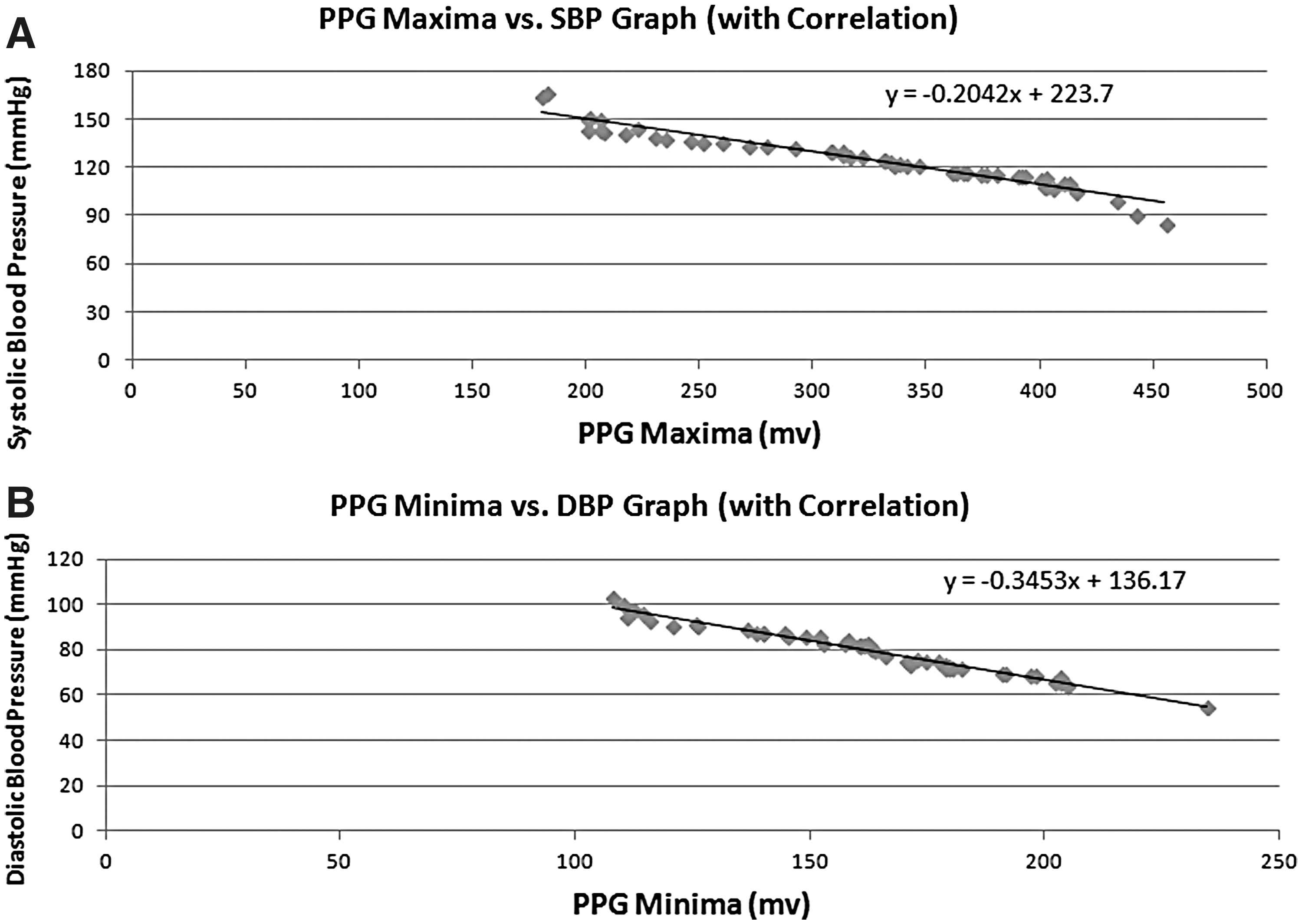
Similarly, four different set of mathematical relations has been developed for the skin type 2–5 to find out the corresponding SBP and DBP. The coefficients of these four equations are shown in Table 2.
Equation Coefficients for Different Skin Tones
DBP, diastolic blood pressure; SBP, systolic blood pressure.
Materials and Methods of the Sensing System
In the previous research work by the authors, a simplified block diagram of the proposed hardware model has been presented. 4 As per that model, a remote noninvasive continuous BP monitoring system has been developed. The whole system can be divided into three parts. Those are (1) PPG sensor; (2) signal conditioning circuitry and microcontroller; and (3) PC/PDA-based data logging and Graphical User Interface (GUI) for the continuous monitoring system. A brief description of each part is described below.
The PPG sensor
A reflective type PPG sensor has been developed to sense the changes in blood volume across the capillary of the epidermis layer of skin. An innovative ergonomic design and Velcro straps have been used to develop the sensor. Velcro straps are required to mount the sensor on body lightly to avoid the pressure disturbance during the BP measurement. The ergonomic design helps the patients to continue their day-to-day activities without any restriction during the BP measurement. A high glow red LED (Model No: TLDR5800) is used as the transmitter and a visual light sensing phototransistor (Model no: TEPT4400) is used as the receiver. 14,15 The LED is mounted at 650 angle to ensure that the incident light is projecting on the skin at 650 angle only. A 5 mm thick black acrylic sheet is used as the sensor base. The gap between the LED and the phototransistor is kept around 3–3.5 mm to get the optimum SNR. 16 Also, it creates an optical insulation so that no direct optical energy could be transmitted from the LED to the phototransistor and also ensures that the light is coming through the skin only. Rest of the acrylic sheet covers the measurement site so that no ambient light affects the measurement. The actual photograph of the sensor is shown in Figure 3.
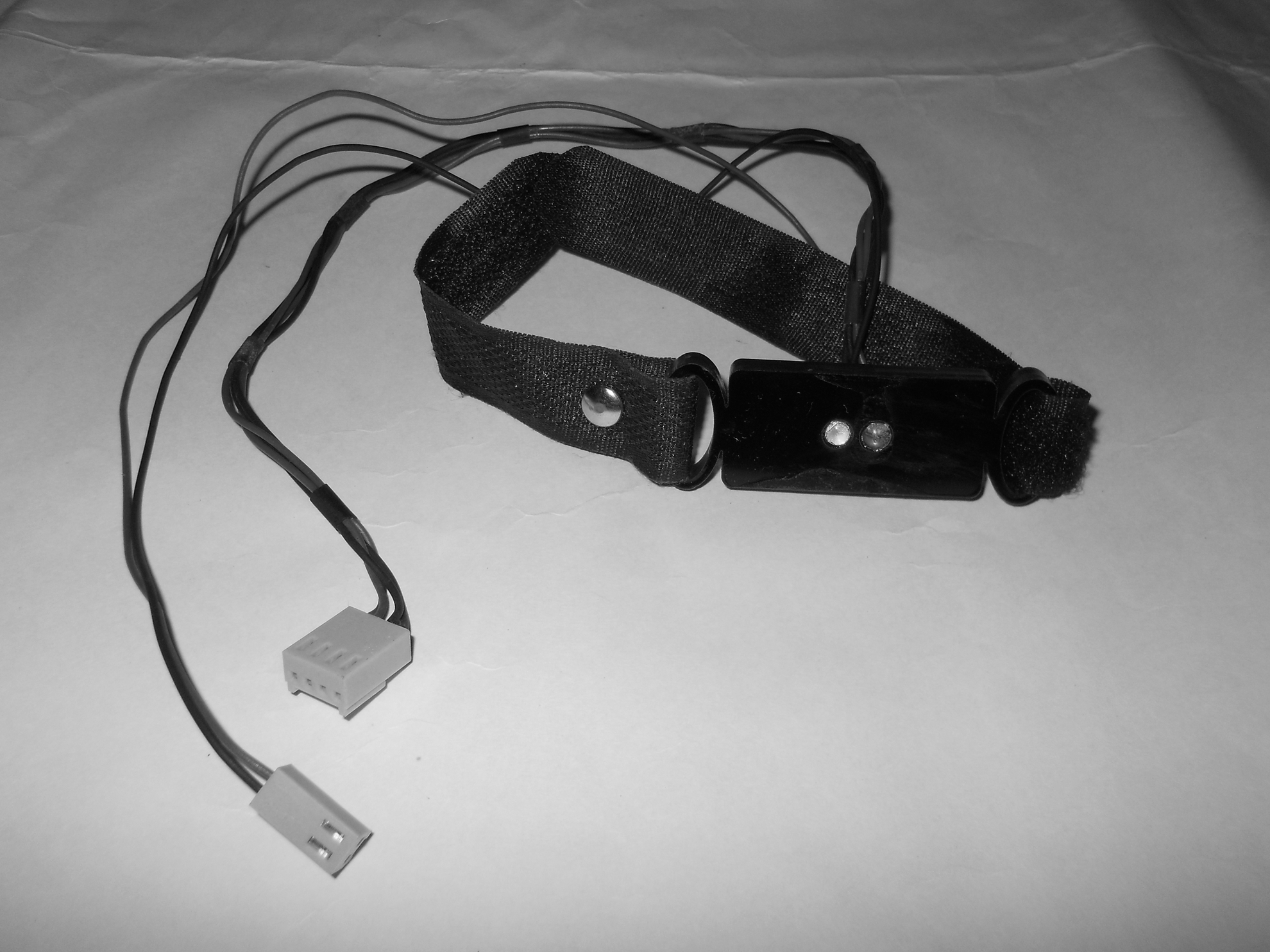
Actual photograph of the developed sensor.
Signal conditioning circuitry and microcontroller
The signal conditioning circuit along with the microcontroller plays a major role in the developed BP measurement system. It works as a driver circuit of the sensor as well. The current to the LED is kept constant for all measurements so that the illumination will be constant. The output of the phototransistor is fed through the filtering and amplifying circuit. The circuit converts the photocurrent into equivalent voltage. A combination of high-pass filter and low-pass filter is used in this circuit. The filters eliminate the DC value and pass the AC value only. The amplifier boosted the amplitude of the signal as the signal generated by the photodiode is very feeble and not suitable for any operation.
Now, the output of the signal conditioning circuit is fed through the Microcontroller. In this study, Arduino Nano V3, which is based on ATmega328 microcontroller, is used to process and transfer data to a PC or PDA using the Universal Serial Bus (USB) interface. The microcontroller has a built-in 10-bit analog-to-digital converter (ADC). 17 It converts the analog data into digital and transfers data to the PC or PDA through a USB cable. The actual photograph of the signal conditioning circuitry along with the microcontroller mounted on the Stripboard is shown in Figure 4.

Actual photograph of the signal conditioning circuitry, including the microcontroller.
PC/PDA-based data logging and GUI for continuous monitoring system
Once data are received at the PC or PDA from the microcontroller, a program stored the data into a comma-separated value (CSV) file with the date and time stamp. Then, the program has spawned an online time versus amplitude graph from the RAW data and displayed it through a customized GUI. The program executes the developed algorithm to find out the values of PR, SBP, and DBP. Also, it stores the values of PR, SBP, and DBP with date and time in a CSV file throughout the measurement. As the program works on the real-time data, the developed system is suitable for continues remote BP monitoring. The whole program, including the GUI, has been developed using the “Processing” language (V3.3). 18 The actual photograph of the whole setup is shown in Figure 5, which is captured during a sample BP measurement.
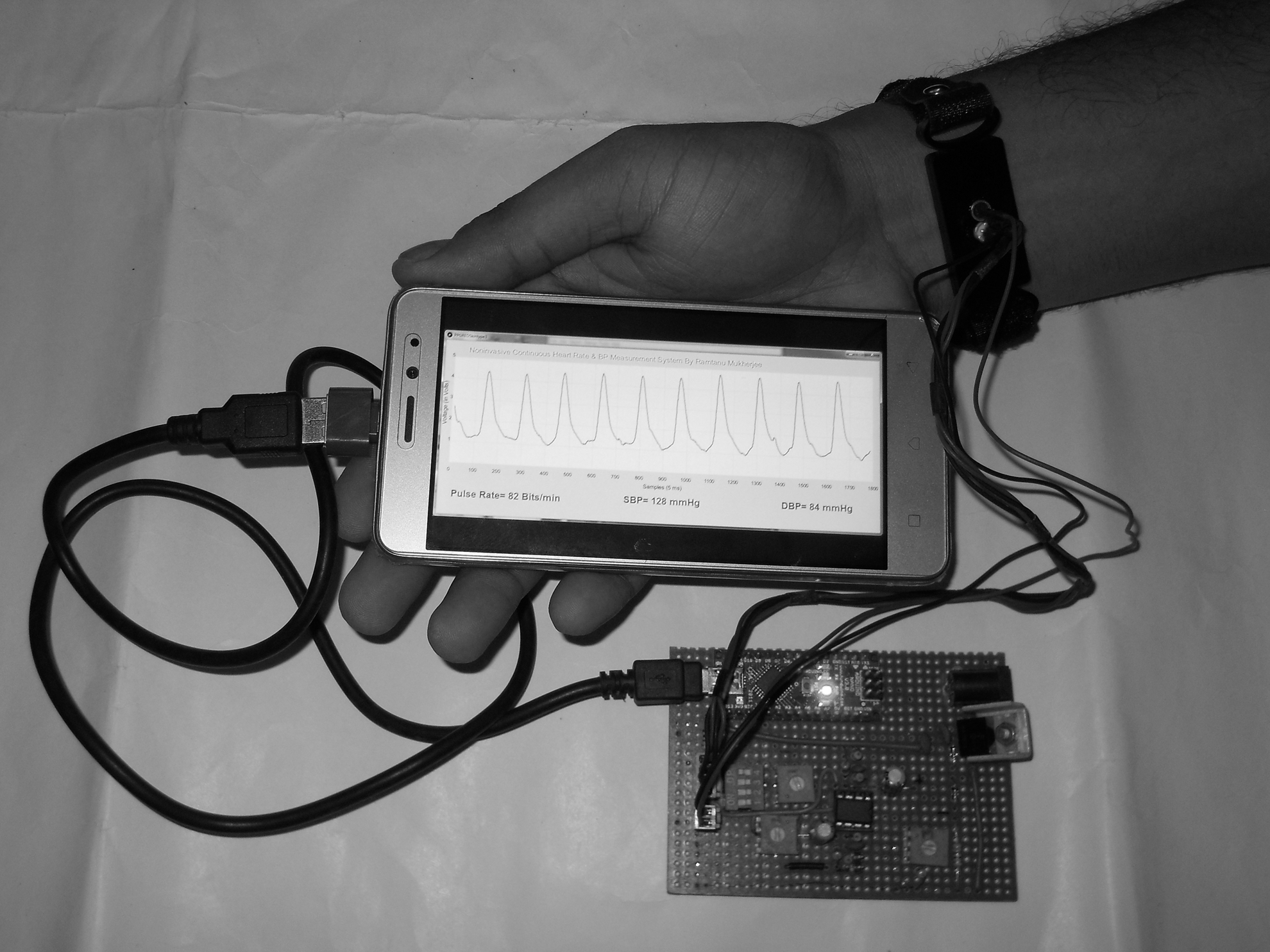
Actual photograph of the developed system.
Methodology
The whole trial is conducted on a total of 102 new volunteers. The age span of the volunteers was 10–92 years. There were 54 female and 48 male volunteers and none of them has any severe heart disease in history. All the volunteers were directed to sit calmly for 10 min before the measurement as well as during the measurement. The skin tone of each subject is measured using the skin tone meter and noted. Then the sensor has been mounted on-body and started the program. The program was recording and displaying the SBP and DBP of the subject. After recording these data, benchmark BP was measured using the automatic BP monitor (Omron HEM-7121).
Results and Discussion
A considerably high-quality signal is obtained from the prototype sensing system. Hence, the detection of maxima and minima are quite accurate and the overall performance of the whole system is excellent. During the experiment, the major observation is that the developed PPG sensor is least vulnerable from the motion artifacts. The least distortion is observed in the PPG signal due to any body movements or physical activities by the volunteers during the measurement.
Table 3 presents the measurement details for 102 volunteers measured using the developed sensing system and compared with benchmark BP measurement device. The percent of error is calculated for SBP and DBP with respect to the corresponding benchmark SBP and DBP. Then, Root Mean Square of Errors (RMSE) of SBP and DBP and Standard Deviation of Errors (STDEVE) of SBP and DBP is calculated from the earlier derived% of errors. Those are shown in Table 4.
The Blood Pressure Measurement Datasheet of the 102 Volunteers
The RMSE and STDEVE for the Measured SBP & DBP
RMSE, root mean square of errors; STDEVE, standard deviation of errors.
The value of RMSE clearly indicates that the overall accuracy is almost 98% for SBP and 97.5% for DBP, that is, a maximum of 4 mmHg difference between the BP measured by the benchmark system and the developed system. This is within the acceptable range of BP measurement. There is no difference between the BP measured by the benchmark system and the developed system, which is the best case.
Conclusions
The developed remote noninvasive continuous BP monitoring system is quite accurate, reliable, handy, cost effective, and user friendly. The accuracy of the BP measurement is achieved in a standard situation is 98%. Additionally, it is observed that the accuracy of the BP measurement with motion artifact is 96% and it is a very good achievement in this field. However, it is to be noted that such accuracy is achieved by taking into consideration the respective skin tones. Subjects have been bracketed into one of six skin tones pool for the purpose of training data. Therefore, an ideal PPG-based BP measurement system should be able to integrate an automated skin tone meter or equivalent system. This system is integrated with the remote healthcare system. The recorded data can be transmitted to any other location for further analysis and can be stored for the medical history of the patients. The system can be very useful to monitor the BP of infants, elderly people, and patients having the wound or burn injury. The sensor used the visible light as the source. Hence, it complies with all the occupational safety and health standards. The device can be operated for a long time through a small battery as the power rating is quite low. Finally, a novel noninvasive continuous BP measurement system for remote healthcare monitoring has been invented.
Footnotes
Disclosure Statement
The authors declare that there is no conflict of interest.